What if the numbers in your business records could do more than track money coming in and going out? For UAE businesses, disciplined accounting turns everyday transactions into a clearer view of performance, cash flow, and obligations. Yet the terminology can feel technical, and bookkeeping, accounting, and financial reporting are often treated as though they mean the same thing.
That confusion can make incomplete records harder to interpret and important decisions more difficult to support. This guide explains the purpose and basic components of accounting, clarifies how it differs from bookkeeping and financial reporting, and shows how transaction records are organized into useful financial statements.
You’ll also see how reliable accounting information can support business planning and help UAE businesses prepare for tax compliance requirements, including VAT and Corporate Tax. The sections below trace the process from recording transactions to reviewing financial results, with practical points to help you understand what your records reveal and where errors can arise.
Key Takeaways
- Understand how accounting differs from bookkeeping and how each contributes to a clearer view of business finances.
- Follow the accounting cycle to see how source documents become organized records and financial reports.
- Learn what the income statement, balance sheet, and cash flow statement each reveal, and why profit is not the same as available cash.
- See how reliable records can support UAE VAT and Corporate Tax processes while helping inform budgets and business plans.
What Is Accounting, and Why Does It Matter to a Business?
Accounting identifies, records, organizes, and communicates a business’s financial activity. It turns transactions into information that helps owners understand cash movement, assess performance, plan ahead, and prepare for responsibilities such as tax reporting. A broader accounting overview also shows how the discipline spans different fields and purposes.
Accounting transforms financial activity into organized information that can inform decisions and support compliance processes, but records alone don’t guarantee compliance. For a UAE business, dependable records can help answer practical questions: Are sales covering operating costs? Which customers still owe money? Are upcoming payments likely to put pressure on cash? Clear records also make it easier to assemble relevant information for VAT and Corporate Tax processes. Their usefulness depends on accurate, complete records and appropriate review.
How Is Accounting Different from Bookkeeping?
Bookkeeping records transactions; accounting interprets and reports them. If a business makes a sale and receives payment, bookkeeping captures the transaction’s date, invoice, amount, and receipt. Accounting then classifies the sale as revenue, considers its effect on cash, and places it in context with other income and costs to help explain performance.
Bookkeeping is part of the wider accounting process, not a competing function. For reliable reports, records should be complete, categorized consistently, and supported by documents such as invoices, receipts, and bank statements. Accounting can then use that foundation to review trends and explain the figures.
Who Uses Accounting Information?
Owners and managers use reports to monitor results, manage spending, and plan operations. Lenders may review financial information when assessing a financing request, while investors use it to evaluate performance and prospects. Relevant authorities may rely on records and reports for regulatory or tax responsibilities. Each user has a different purpose, but all need information that is organized, consistent, and dependable.
For SMEs and freelancers, professional bookkeeping and accounting services can help maintain clearer records and improve financial visibility, supporting more informed decisions as the business develops.
How Does the Accounting Cycle Turn Transactions into Financial Records?
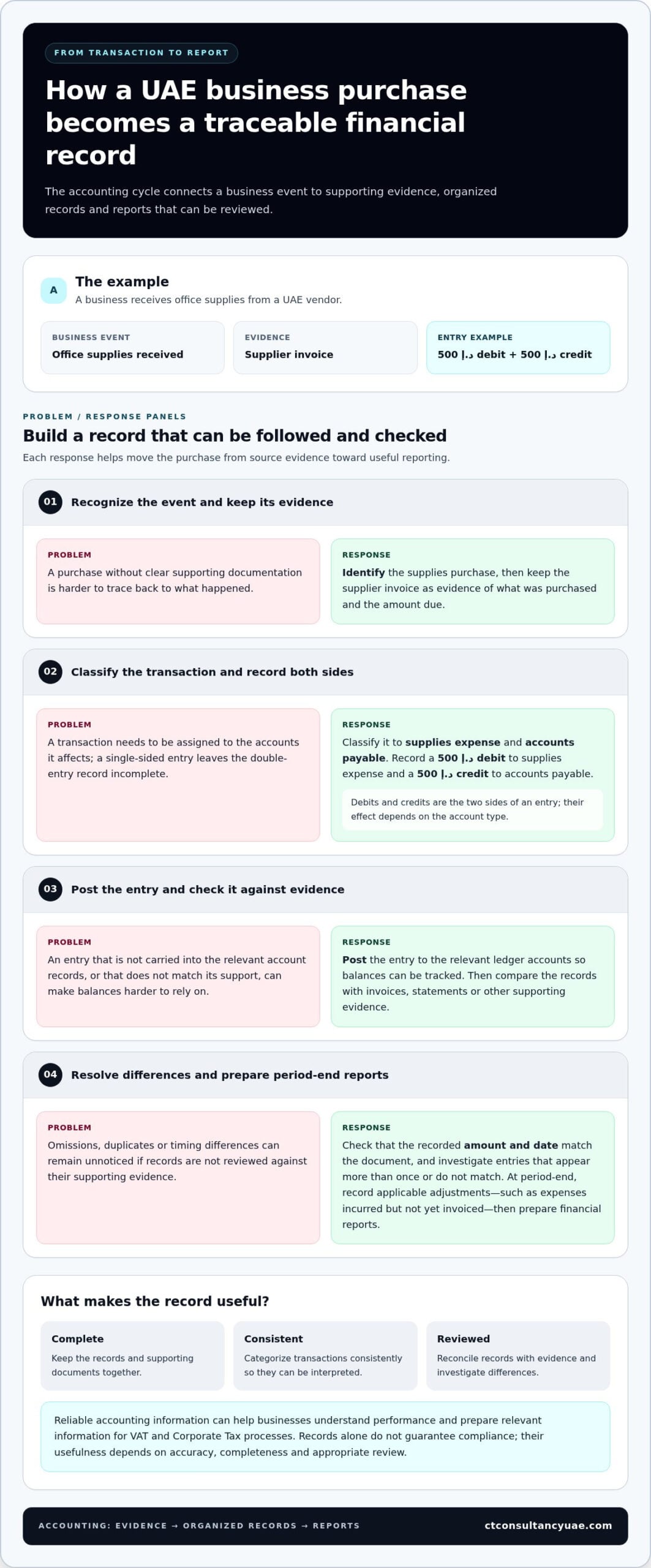
The accounting cycle takes a business event from its supporting evidence to reports that can be reviewed and used. A clear workflow also makes it easier to trace an entry back to its source. Oracle NetSuite outlines the eight steps of the accounting cycle; the sequence below presents the core process through one UAE business purchase.
What Are the Main Steps in the Accounting Cycle?
- Identify the transaction: A business receives office supplies from a UAE vendor.
- Gather the source document: Keep the supplier invoice as evidence of what was purchased and the amount due.
- Classify the transaction: Determine which accounts are affected, such as supplies expense and accounts payable.
- Record the entry: Under double-entry accounting, enter a debit of د.إ 500 to supplies expense and a credit of د.إ 500 to accounts payable. Debits and credits are the two sides of an entry; their effect depends on the account type.
- Post to the ledger: Transfer the entry into the relevant account records so balances can be tracked.
- Review and reconcile: Compare records with invoices, statements, or other supporting evidence to identify omissions, duplicates, or timing differences.
- Adjust and report: At period-end, record applicable adjustments, such as expenses incurred but not yet invoiced, then prepare financial reports.
A source document connects each recorded transaction to evidence, creating a traceable record for review. When reconciling, check that the recorded amount and date match the supporting document, and investigate entries that appear more than once or do not match. Adjustments help reflect activity in the correct period, but they do not replace appropriate review of the business’s records. To simplify these recurring tasks, many growing enterprises rely on cloud-based solutions like MyAccount.my to centralize transaction tracking and ledger maintenance.
Cash-Basis and Accrual Accounting: What Is the Difference?
Under cash-basis accounting, income and expenses are generally recorded when money is received or paid. Under accrual accounting, they are recorded when the income is earned or expense incurred, even if payment occurs later. The method used can affect when transactions appear in reports. Applicable requirements and business circumstances determine which approach is appropriate; neither method is universally right for every business.
Whichever approach is used, apply it consistently and keep supporting records that show when income was earned, expenses were incurred, and payments were made. Bookkeeping and accounting services can support businesses seeking clearer, more reliable financial records.
Financial statements offer complementary views of a business: its results over time, its financial position at a particular date, and the movement of cash. Read together, they help owners look beyond a single figure and ask more useful management questions.
| Statement |
What it shows |
Practical management question |
| Income statement |
Revenue, expenses, and profit or loss over a period. |
Are sales covering costs, and how are margins changing? |
| Balance sheet |
Assets, liabilities, and equity at a specific date. |
What does the business own and owe right now? |
| Cash flow statement |
Cash received and paid across operating, investing, and financing activities over a period. |
Where is cash coming from, and what is using it? |
A balance sheet is a snapshot of financial position at one date; the income statement and cash flow statement describe activity over a period. Use the statements together and compare results across periods. A change in profit, for example, may need further investigation if cash is falling or customer balances are rising. No single figure tells the whole story without timing and business context.
What Is the Difference Between Profit and Cash Flow?
Illustrative example: Assume an accrual-basis business invoices a customer د.إ 10,000 for completed work, but has received only د.إ 4,000 by period-end. Subject to the business’s accounting treatment, the income statement may include the full revenue, while cash received from that sale is د.إ 4,000 and the remaining amount is still due. Profit and available cash are related, but they aren’t interchangeable.
How Can Owners Read the Main Statements Together?
Compare profit with cash movement to understand whether reported earnings are translating into funds available to operate. Then review assets and liabilities to see the wider position, including amounts owed by customers and amounts payable to suppliers. Consider changes across periods and investigate unusual movements before deciding what action to take. For instance, growing customer balances alongside stronger reported sales can prompt a closer look at collection timing and cash forecasts.
CTC Tax & Accounting provides bookkeeping and accounting services to help businesses maintain records and gain clearer financial visibility.
How Does Accounting Support UAE Businesses Beyond Record-Keeping?
Organized accounting records can support VAT and Corporate Tax processes by making transactions and supporting documents easier to review. UAE VAT records must generally be kept for at least five years, while Corporate Tax records must be retained for at least seven years after the end of the relevant tax period. Recordkeeping is only one part of meeting obligations, so businesses should also consider the rules that apply to their activities and circumstances.
Consistent reports are useful between filing periods, too. They can show whether costs are rising, when cash may be tight, and how actual results compare with a budget. For more process detail, see this guide to UAE bookkeeping guidance.
When Should a Business Review Its Accounting Process?
Delayed reconciliations, uncertainty about the cash position, and records that vary across systems or periods are practical prompts to review how information is collected and checked. They aren’t, by themselves, proof of a compliance breach. A process review can help identify where documents are missed, responsibilities are unclear, or reporting arrives too late to be useful. A simple starting point is to map how invoices, receipts, and bank activity move from the point of receipt into the accounting records, then note where checks or approvals are needed.
How Can Accounting Information Inform Business Planning?
Historical income, costs, and cash movements give owners a grounded starting point for budgets and forecasts. Comparing actual results with assumptions can help identify seasonal cash needs, reconsider spending, or assess the timing of planned investment. Broader choices about allocating resources can also benefit from a strategic financial management perspective.
The right reporting process depends on the business’s size, activity, and decision-making needs. Start by identifying which figures take the most effort to assemble or are hardest to interpret, then address the underlying recordkeeping or reporting gaps. CTC Tax & Accounting provides bookkeeping, accounting, tax compliance, and CFO advisory services to help businesses improve financial visibility and support planning.
Build a Clearer Financial View for Your UAE Business
Reliable accounting gives business owners more than a record of past transactions. It creates a structured view of performance, financial position, and cash movement, helping you ask better questions about costs, liquidity, and future plans. When source records are organized and reviewed consistently, financial statements become more useful for both day-to-day decisions and UAE tax processes.
The right approach depends on your business activity, reporting needs, and internal capacity. CTC Tax & Accounting provides accounting services alongside bookkeeping, tax compliance, and CFO advisory. This joined-up perspective can help connect well-maintained records with clearer reporting and more informed planning.
Take a practical next step: identify where your records or reports need greater clarity, then contact CTC Tax & Accounting about accounting support suited to your business. With a reliable financial foundation, you can make decisions with a clearer view of your numbers.
Frequently Asked Questions
What is accounting in simple terms?
Accounting is the process of identifying, recording, organizing, and communicating an organization’s financial activity. It turns transactions, such as customer sales and supplier payments, into information about performance, financial position, and cash movement. Bookkeeping supports transaction recording, while accounting also involves reviewing and interpreting the resulting information. This helps owners and managers make decisions and prepare for relevant reporting responsibilities.
What is the difference between accounting and bookkeeping?
Bookkeeping focuses on recording and organizing financial transactions, while accounting uses those records to review activity, prepare reports, and explain what the figures indicate. For example, bookkeeping records a sale and its payment status; accounting considers how that sale affects revenue, customer balances, and reported performance. The functions are connected: accurate bookkeeping provides the foundation, and accounting adds analysis and context.
What are the main types of accounting?
Common types include financial, management, tax, and cost accounting. Financial accounting prepares reports for internal and external readers, while management accounting helps inform operational decisions. Tax accounting organizes financial information for tax-related purposes, and cost accounting examines the costs of products, services, or activities. A business may use more than one area, depending on its operations, reporting requirements, and management needs.
What are the three main financial statements?
The three main financial statements are the income statement, balance sheet, and cash flow statement. The income statement reports revenue and expenses over a period; the balance sheet shows assets, liabilities, and equity at a particular date; and the cash flow statement tracks cash received and paid over a period. Considered together, they provide complementary views of results, financial position, and cash movement.
Why is accounting important for a small business?
Accounting gives a small business an organized view of transactions, performance, financial position, and cash movement. Reviewing reliable information can help owners monitor costs, understand available cash, and prepare budgets or forecasts. Organized records can also support relevant reporting responsibilities, including those connected with UAE VAT and Corporate Tax. The process should reflect the business’s activities, applicable requirements, and practical reporting needs.