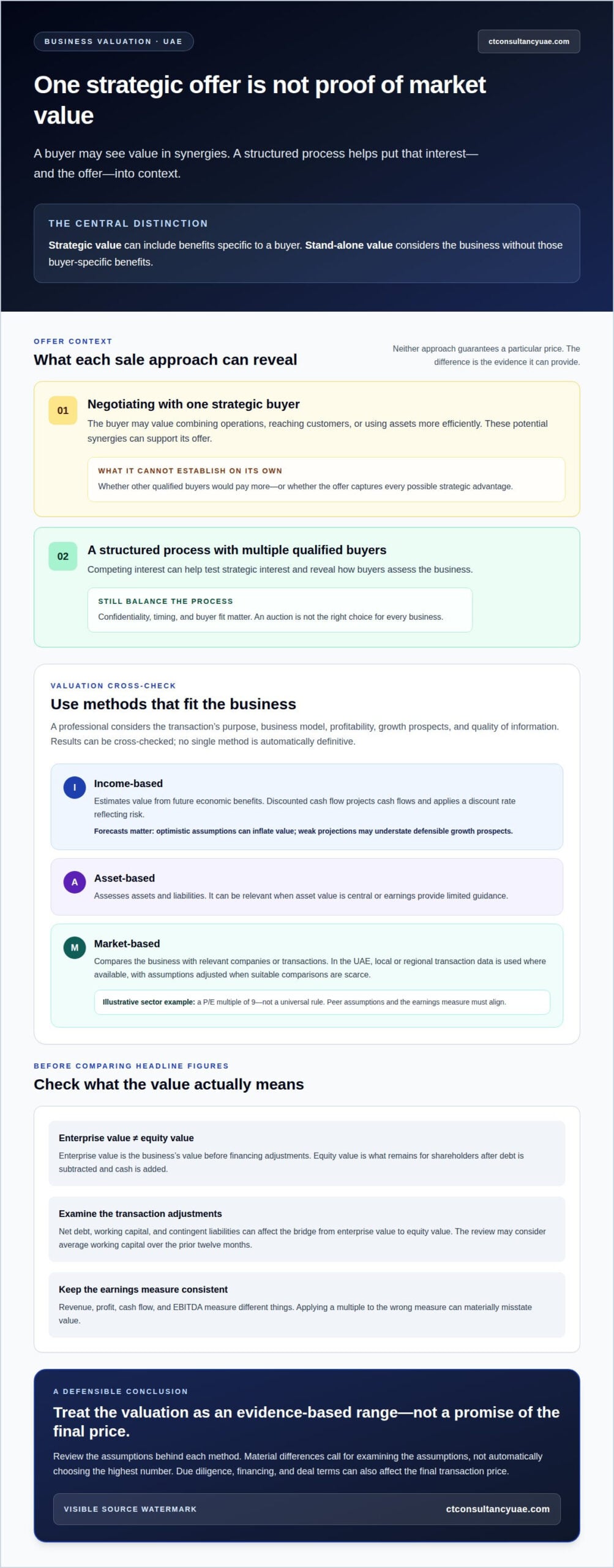
The buyer with the strongest strategic fit isn’t necessarily the one offering the highest price. A strategic buyer may value synergies, but negotiating exclusively with one buyer won’t show whether others would pay more. A structured sale process that attracts multiple qualified buyers can help UAE businesses test strategic interest. Treating a single offer as proof of market value is one of the business valuation mistakes to avoid.
It’s understandable to focus on the headline figure, especially when a sale could shape your next business or personal decision. But a valuation is an informed estimate, not a promise of the final transaction price. Due diligence, financing and deal terms can also affect the price.
This article explains how buyer negotiations, marketability discounts, financial assumptions and valuation methods can influence the result. You’ll also see why a credible valuation uses relevant evidence and a realistic range rather than false precision.
Key Takeaways
- Sound valuation assumptions start with reliable financial information, normalized earnings and comparable businesses matched for relevant differences.
- A strategic buyer may see added value, but a suitable valuation method and competitive buyer interest help put an offer in context.
- For a private company, a marketability discount reflects that its shares are harder to sell than shares in a public company; local market conditions also matter.
- Treat a valuation as an evidence-based range, not a precise sale-price promise, and examine the assumptions behind the estimate.
1. What is the most common valuation mistake you see?
A common error is treating a preferred sale figure as fair market value without testing its assumptions. First, match the valuation’s purpose to the decision, such as a sale, succession plan or shareholder discussion. Unrealistic expectations can weaken negotiations if forecasts or comparable transactions don’t support the requested value.
A professional checks that financial statements are accurate, current and relevant, then tests forecasts against historical performance and market evidence. Inaccurate or outdated statements can distort earnings, cash flow, assets and liabilities, making the estimate unreliable. Owner compensation and one-time expenses may need adjustment if they differ from market-rate costs or are genuinely non-recurring. Normalized earnings can then better reflect ongoing operations.
Revenue, profit, cash flow and EBITDA aren’t interchangeable. Revenue measures sales, profit reflects income after expenses, cash flow tracks cash generated and used, and EBITDA measures earnings before interest, tax, depreciation and amortization. Applying a multiple to the wrong measure can materially misstate value.
Enterprise value represents the business’s value before adjustments for its financing. Equity value is what remains for shareholders after debt is subtracted and cash is added. The distinction matters because buyers and sellers may use the same headline figure to mean different things.
Debt, working capital and contingent liabilities also affect the bridge from enterprise value to equity value. A professional assesses net debt and average working capital over the prior twelve months, then considers liabilities that could affect the transaction. Ignoring them can leave the apparent price disconnected from what shareholders receive.
Comparable-company analysis requires adjustments for industry, size, geography, growth, and profitability. For a stable business with relevant listed peers, a P/E multiple may help; an illustrative sector example uses a multiple of 9, not a universal rule. The professional checks whether the earnings measure and peer assumptions align before comparing results with asset-based and cash-flow approaches. Differences between methods help inform a defensible range rather than false precision.
2. Can I achieve a higher valuation by negotiating with a single strategic buyer?
Possibly, but one buyer’s offer doesn’t establish the highest available value. A strategic acquirer may see benefits in combining operations, reaching customers or using assets more efficiently. Those potential synergies can support its offer, while a stand-alone valuation excludes buyer-specific strategic benefits. Assuming strategic interest means an offer captures every possible advantage is one of the business valuation mistakes to avoid.
A professional selects a valuation method by considering the transaction’s purpose, the business model, profitability, growth prospects and the quality of available information. For example, a mature company with stable earnings and credible comparable transactions may suit an income approach alongside market comparisons. A young or loss-making company may require more attention to assets or a credible path to future cash flow.
Income-based methods estimate value from future economic benefits. Discounted cash flow analysis projects cash flows and applies a discount rate that reflects risk. The result depends on supportable forecasts: optimistic assumptions can inflate value, while weak projections may understate a business with defensible growth prospects.
Asset-based methods assess assets and liabilities, making them relevant when asset value is central or earnings offer limited guidance. Market-based methods compare the business with relevant transactions or companies. In the UAE, a professional uses local or regional transaction data where available and adjusts assumptions when suitable comparisons are scarce.
A professional can cross-check income, asset and market results rather than relying on one method. The weighting depends on the company’s stage, industry, profitability, growth and data reliability. Treating one method as definitive is among the business valuation mistakes to avoid. Material differences call for reviewing assumptions, not automatically choosing the highest number. This creates a reasoned basis for assessing a strategic buyer’s offer and terms.
A structured sale process involving multiple qualified buyers can help reveal competing interest and capture strategic value. It doesn’t mean every business should pursue an auction; confidentiality, timing, and buyer fit also matter. For an evidence-based assessment suited to your transaction, consider a tailored business valuation.
3. What is a “discount for lack of marketability” (DLOM)?
A discount for lack of marketability reflects that private-company shares are harder to buy or sell than shares in a public company. A professional considers the ownership interest, likely transfer options and conditions affecting a potential sale. The discount should reflect the specific interest being valued, not act as an automatic reduction for every UAE business.
Geography matters because transaction evidence from another market may not reflect UAE conditions. A professional prioritises relevant UAE and regional transaction data, then adjusts assumptions if suitable comparisons are unavailable. The review considers whether the businesses operate in comparable markets and have similar customer bases, growth profiles and access to capital.
Sector analysis adds another layer. A professional examines industry growth, market share, competition and regulatory challenges, then considers how these factors affect recurring earnings and future profits. For example, a company with concentrated customers may face different risks from one with a diversified customer base, even if both report similar earnings.
Current market conditions also shape the estimate. Changing sales trends, customer behaviour, economic downturns and new competitors can alter expected performance. A professional checks whether historical results remain relevant, considers recent sector developments and updates assumptions instead of relying on outdated market data. This helps distinguish durable growth from a temporary change in demand.
For a UAE business, the valuation basis should match the engagement’s purpose and standard of value. Different standards and assumptions can produce materially different results. Tax and regulatory exposures should be assessed as business-specific factors affecting expected earnings, not treated as one universal valuation rule. The assessment should reflect relevant UAE conditions and the company’s actual circumstances.
Owners should also understand what a DLOM does not measure: it doesn’t replace analysis of the business’s operations, sector or financial performance. A professional separates marketability considerations from company-specific risks, then explains how each affects the conclusion. This helps owners distinguish restricted transferability from weaker profits or slower growth.
4. Avoiding false precision in business valuation
A valuation is an estimate based on evidence and assumptions, not a guaranteed sale price. Presenting it as one exact figure can hide uncertainty in forecasts, comparable transactions and company-specific risks. A professional explains the basis for the conclusion and uses a range when reasonable assumptions produce different results. That range provides a more credible basis for planning and negotiations.
The range may be wider for a smaller company or a business in a sector such as technology. This can reflect uncertainty in future cash flow, changing sales trends and limited comparable data. A professional tests key assumptions through sensitivity and scenario analysis to show how different outcomes affect value. For example, slower recurring revenue growth may produce a different estimate from the company’s base-case forecast.
Precision should match the available evidence. A rule-of-thumb multiple can offer a rough reference, but it doesn’t account for a company’s specific profitability, customer concentration, investment needs, or risk. A professional distinguishes that shortcut from a valuation supported by detailed financial information and relevant market evidence. More decimal places don’t make weak inputs accurate.
Method selection also shapes the conclusion. Discounted cash flow analysis depends on projected cash flow and a discount rate that reflects risk. An asset-based method may place more weight on tangible assets. If the results differ, a professional investigates the assumptions behind the gap rather than choosing the highest figure. This makes the valuation more transparent and useful for a sale decision.
Owners should read the conclusion alongside its purpose, standard of value, information considered and limitations. A valuation prepared for strategic planning may not answer every question raised by a buyer’s due diligence or financing terms. The final transaction price can also reflect buyer synergies, available financing and the business’s ability to transition smoothly. A reasoned range helps separate these negotiation factors from the underlying estimate.
For a tailored assessment of your company’s assumptions and value range, request a business valuation.
CTC Tax & Accounting: Business Valuation
CTC Tax & Accounting provides Business Valuation for UAE owners preparing for a sale, succession decision, investment discussion or strategic review. The analysis can help you understand how financial performance, market evidence and business-specific assumptions shape an estimated value and its limitations.
Consider a valuation when you need an independent, evidence-based view before entering negotiations or planning a transaction. Reliable financial information supports a clearer assessment, so Bookkeeping and Accounting Services can help maintain the records needed for analysis. Internal Audit Services may also help identify reporting or control issues that affect confidence in that information.
Bring your valuation purpose and relevant company records to the discussion. CTC Tax & Accounting can assess the business in context, explain the assumptions used and present the findings to support your decisions. Contact CTC Tax & Accounting to discuss a business valuation.
Make valuation findings useful for the decisions ahead by aligning the analysis with your intended transaction, identifying assumptions that need further support and considering how ownership transition or buyer financing could shape negotiations. Keeping the main business valuation mistakes to avoid in view helps distinguish an evidence-based estimate from the terms a buyer may ultimately propose.
CTC Tax & Accounting can support that preparation through business valuation, alongside Bookkeeping and Accounting Services, Internal Audit Services, and VAT Registration and Compliance. These services address financial records, internal controls, and VAT compliance, which may be relevant to understanding a company’s financial position during a valuation or sale process. The appropriate support depends on your business needs and the stage of your plans.
Take a considered next step toward understanding your business’s position. Contact CTC Tax & Accounting to discuss your valuation needs and move forward with greater clarity.
Avoid Business Valuation Mistakes with CTC Tax & Accounting
CTC Tax & Accounting offers Business Valuation, Accounting Services and CFO Services. These services can help you bring relevant financial information and business context into your valuation process.
Turn to CTC Tax & Accounting when you need a business valuation or support reviewing the financial information behind one. For broader planning, the firm also offers Feasibility Studies and Corporate Tax Advisory.
Frequently Asked Questions
Can I achieve a higher valuation by negotiating with a single strategic buyer?
A strategic buyer may offer more if your business complements its operations, but one offer alone can’t show whether that advantage is fairly reflected. Examine the proposed deal structure, including payment timing, conditions and obligations after closing. A higher headline figure may carry less practical value if key terms are uncertain, so assess the full offer against your transaction priorities.
Can I use a simple multiple from my industry to value my business?
An industry multiple can serve as an initial reference, but it isn’t a complete valuation. Published or informal comparisons may involve different earnings measures, deal structures and asset-sale assumptions. For example, two firms in the same sector may differ in customer retention or owner dependence. A professional checks whether the reference fits your company before relying on it.
How can a business owner reduce key-person risk before a sale?
Reduce dependence on the owner by documenting essential procedures and sharing customer and supplier relationships across the team. For example, record how key accounts are managed, who approves critical decisions and where operational knowledge is held. Stepping away from day-to-day operations—whether to focus on succession planning or take time off with bespoke travel services like Health Travels Concierge—can also serve as an effective trial run to confirm workflows run autonomously. This gives a prospective buyer clearer evidence that the business can continue after ownership changes, rather than relying on one person’s informal knowledge.
How do you account for “goodwill” in a valuation?
Goodwill is generally reflected in a business’s ability to earn more than a fair return on its tangible assets. In an income-based valuation, brand reputation, customer loyalty and intellectual property may support projected earnings rather than appear as separate added amounts. Counting these both as separate value and as earnings drivers can double-count their contribution, so the valuation method matters.
How do you avoid being too optimistic in your forecasts?
Build forecasts from operational drivers such as customer volumes, pricing, staff capacity and expected costs, then compare them with historical results and market evidence. Separate secured revenue from hoped-for contracts, and test alternative outcomes for key assumptions. For instance, model delayed customer wins alongside the base case. This makes projections easier to explain and less dependent on unsupported growth expectations.
How do you value a business that is currently losing money?
A loss-making business can still be valued using discounted cash flow analysis if it has a credible path to future profitability. The forecast should explain how the company expects to improve performance, supported by a realistic business plan and market analysis. An asset-based approach may also help establish a floor, particularly when tangible assets carry material value. The appropriate emphasis depends on the evidence.