
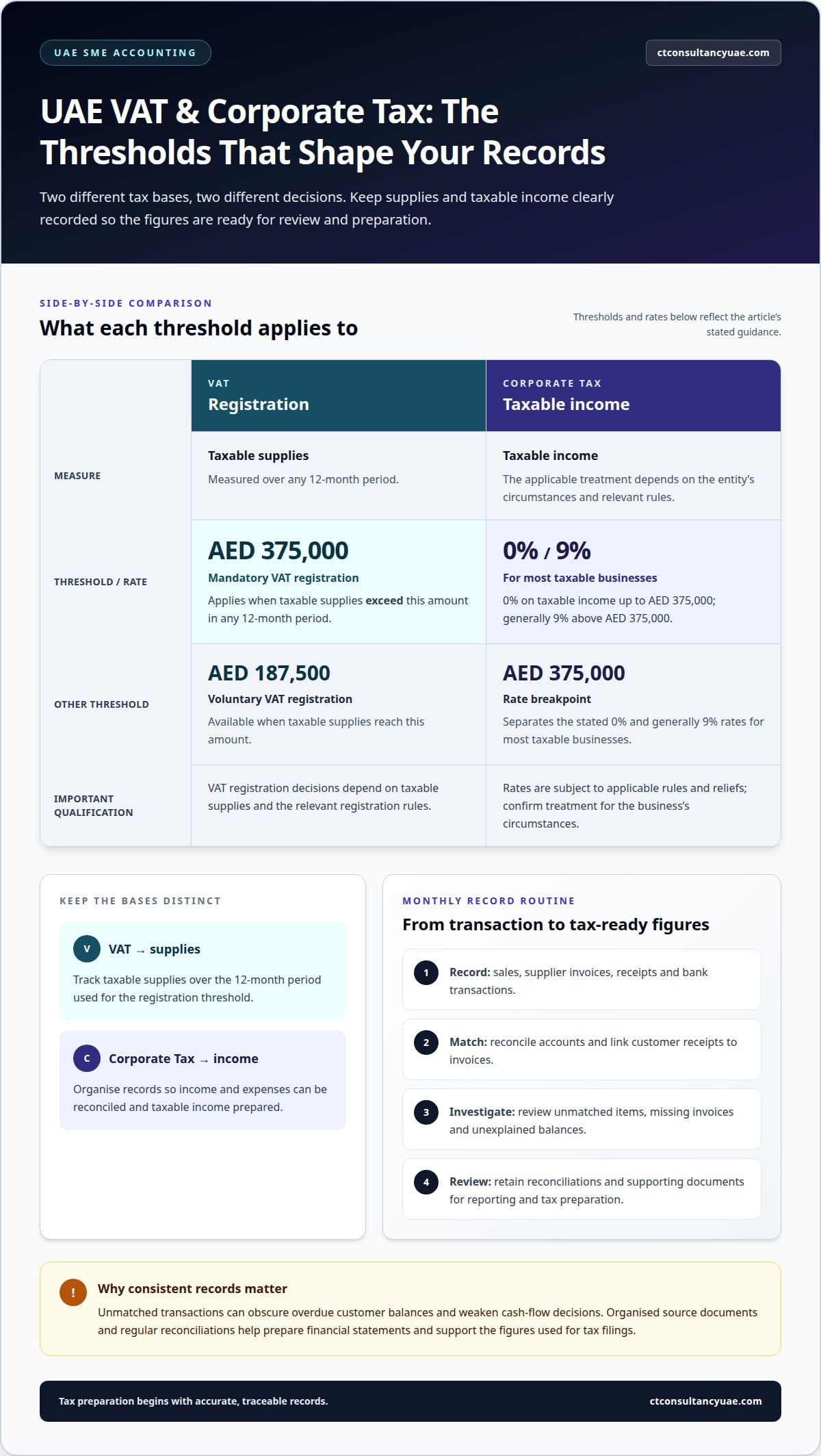
Reliable accounting gives a growing SME across the UAE more than a record of past transactions: it supports tax preparation and informed decisions throughout the year. Professional SME accounting services in Dubai and the wider UAE can combine outsourced bookkeeping, compliance support and monthly financial reporting. According to the Federal Tax Authority, mandatory VAT registration applies when taxable supplies exceed AED 375,000 in any 12-month period; for most taxable businesses, taxable income above AED 375,000 is generally subject to a 9% Corporate Tax rate, subject to applicable rules and reliefs.
Keeping records current and reviewing them monthly can help you spot cash-flow pressures, track performance and prepare for tax filings with greater clarity. The right support depends on your business activity, transaction volume, reporting needs and tax obligations. This guide explains what comprehensive SME accounting services can cover, how monthly reports support day-to-day decisions, and which UAE compliance considerations matter when arranging accounting support with CTC Tax & Accounting.
For a Dubai SME, accounting support connects transaction records with tax preparation and management decisions. The Federal Tax Authority sets the UAE’s mandatory VAT registration threshold at AED 375,000 in taxable supplies over any 12-month period. Voluntary VAT registration is available when taxable supplies reach AED 187,500, according to the Federal Tax Authority. These thresholds make reliable bookkeeping useful well before a business approaches a filing decision.
Corporate Tax also makes accurate records important. According to the Federal Tax Authority, for most taxable businesses in the UAE, taxable income up to AED 375,000 is subject to a 0% Corporate Tax rate, subject to the applicable rules and reliefs. For most taxable businesses, taxable income above AED 375,000 is generally subject to a 9% Corporate Tax rate, subject to the applicable rules and reliefs, according to the Federal Tax Authority. Accounting and bookkeeping support helps organise the underlying figures for preparation.
A practical monthly workflow starts by recording sales, supplier invoices, receipts and bank transactions, then reconciling accounts and reviewing outstanding items. For example, matching a customer receipt to its invoice helps keep the ledger and receivables current. SMEs can use cloud accounting software; examples include Xero, QuickBooks Online and Zoho Books. The platform should suit the company’s transaction process and reporting needs.
Monthly bookkeeping can be tailored to transaction volume, record quality and reporting requirements. A small consultancy may need routine transaction coding and bank reconciliations, while a trading business may also need inventory entries and closer review of supplier balances. Monthly management accounts can bring together a profit and loss statement, balance sheet, cash position and notes on material changes, giving owners a regular basis for decisions.
Businesses operating in ADGM, DIFC or another Free Zone should organise records around their entity structure, licence conditions and reporting obligations. The appropriate accounting firm can help identify which records and preparation steps apply to the business, rather than assuming every Free Zone follows the same process. Chartered accountants may also provide advisory input when management needs clearer interpretation of results, reconciliations or reporting adjustments.
Outsourcing can give SMEs consistent financial processes without building every accounting function in-house. The right scope depends on transaction volume, reporting needs and the records your business maintains.
For startups and established businesses, outsourced support can cover transaction recording, reconciliations, monthly statements and management reporting. A small business can assign routine bookkeeping while retaining approval of payments and access to its records. Cash-flow forecasting can use expected customer receipts, supplier payments and payroll commitments to highlight upcoming shortfalls. Part-time CFO support can interpret those forecasts and help management assess spending decisions.
Onboarding works best when the business provides its chart of accounts, prior statements, invoices, bank records and relevant VAT registration details. A clear handover also identifies reporting responsibilities, approval steps and the accounting period. These steps help the accounting team understand the business structure and prepare consistent records.
UAE businesses must maintain accounting records, regardless of size, nature, transactions or industry. SMEs should keep source documents organised so income and expenses can be reconciled and financial statements prepared. For Corporate Tax filing, records should support the taxable income calculation and the figures included in the return. The applicable treatment depends on the entity’s circumstances and relevant regulations.
A practical process assigns responsibility for collecting invoices, recording transactions and reviewing balances before each filing. Management should also retain reconciliations and supporting documents that explain adjustments. This creates a traceable basis for tax preparation without assuming every business has identical requirements.
Poor records can leave transactions unmatched, obscure overdue customer balances and weaken cash-flow decisions. In Dubai, VAT non-compliance can result in fines, legal penalties, operational disruption and reputational harm. Late or inaccurate filings can also create additional work when businesses must reconstruct records or correct reporting errors.
To reduce these risks, assign an owner to each monthly task, reconcile bank activity, and review filing dates against the company’s obligations. A structured review can identify missing invoices or unexplained balances before they affect statements. Businesses seeking tailored accounting support can use that process to clarify records, reporting responsibilities and compliance priorities.
A monthly reporting cycle turns recorded transactions into information owners can use. Reviewing results regularly helps SMEs identify changes in revenue, expenses, cash position and payroll.
Accurate financial reporting starts with records that can be traced to source documents. Each month, match bank transactions to invoices, receipts and payment records, then investigate unmatched items. An unreconciled supplier payment, for example, can distort expense totals and the cash position. A consistent process also makes records easier to use when preparing Corporate Tax figures or responding to an audit request.
Include payroll in this cycle. Record salary costs, payment dates and supporting documents alongside other transactions, then reconcile payroll entries with bank activity. Across the UAE, payroll reporting can support compliance with labour requirements. A monthly review helps management identify unusual changes, such as a payroll total that differs from the previous month, before finalising reports.
Monthly statements help explain business performance and the position of its resources. A UAE mainland LLC’s financial statements should include a balance sheet, profit and loss account, statement of changes in equity and cash flow statement. Read them together: the profit and loss account shows operating results, while the cash flow statement tracks the movement of funds.
Compare each month’s figures with the previous period and explain material movements, such as higher supplier costs or slower customer receipts. This turns financial statements into a management tool, rather than a record viewed only at year-end. CFO services can add interpretation, helping leaders connect monthly results with cash-flow forecasts, investment choices and operating priorities.
A practical month-end close follows clear steps: reconcile accounts, review payroll and supplier balances, investigate exceptions, then issue statements with concise explanations. This gives owners a sound basis for decisions and helps keep records aligned with Corporate Tax preparation. Retaining the supporting documents behind each adjustment also makes later review more straightforward.
For an SME, accounting services in Dubai should align with its reporting needs, entity type and filing responsibilities. The right partner explains the scope clearly and sets out how records, reviews and communication will be managed.
When comparing SME accounting services in Dubai, look at what the work includes, such as bookkeeping, VAT registration and compliance, Corporate Tax support or internal review. Ask how transactions are recorded, reconciliations handled and monthly reports prepared. A consultancy with few invoices may need a different scope from a trading company managing frequent supplier payments.
Before engaging an outsourced accountant, map the handover: identify the accounting period, provide prior statements and assign responsibility for approvals. Clarify how missing documents and reporting exceptions will be communicated. These steps help establish a workable relationship and make filing responsibilities easier to track.
Dubai firms serving SMEs can be assessed by their focus on recurring bookkeeping, compliance coordination and management reporting. Look for practical experience with the relevant structure, whether mainland or Free Zone, and a clear explanation of how work is tailored to transaction volume and reporting requirements. The goal is a service scope that fits the company’s operations.
Some businesses also need CFO advice to interpret results or plan cash flow. A growing startup, for example, might need monthly accounts and financial guidance, while a mature company may prioritise internal controls and filing preparation. SME accounting services in Dubai can be tailored to these different priorities rather than delivered as a standard package.
Use an initial discussion to define deliverables, document access, review responsibilities and the reporting schedule. A written scope helps clarify which records the business must supply and which tasks the provider will handle. To explore accounting support for your SME, consider an arrangement aligned with your reporting and compliance requirements.
CTC Tax & Accounting provides Bookkeeping and Accounting Services for SMEs that need organised records and consistent financial reporting. Turn to the team when transaction processing, reconciliations or monthly management accounts are taking time away from core operations. A defined accounting process helps owners maintain usable records and understand the figures behind business decisions.
Where compliance needs extend beyond bookkeeping, CTC Tax & Accounting also provides VAT Registration and Compliance and Corporate Tax Advisory. Internal Audit Services can support businesses reviewing their internal controls and accounting processes. The right combination depends on your records, reporting needs and compliance priorities, not a one-size-fits-all package.
Contact CTC Tax & Accounting to discuss the accounting support that fits your SME’s requirements.
Start by defining what your finance function needs to deliver, then align the work with your reporting calendar. For SMEs considering SME accounting services in Dubai, this means clarifying who maintains records, who reviews key balances and how financial information supports management decisions. A well-defined scope can make future handovers more orderly as the business changes.
CTC Tax & Accounting offers Bookkeeping and Accounting Services, Internal Audit Services, and VAT Registration and Compliance. These services support businesses that need organised financial records, a review of internal processes or help with VAT compliance. The right starting point depends on the task requiring attention and the current state of your records.
To discuss your SME’s accounting requirements and possible next steps, contact CTC Tax & Accounting. A clear conversation can help you determine which priorities to address first and move forward with greater confidence.
Yes, CTC Tax & Accounting’s Accounting Services include backlog clean-up. Start by gathering available bank statements, sales invoices, supplier bills and prior reports, then organise them by accounting period. Reconciliations can reveal missing documents or transactions recorded twice. After reviewing and adjusting the records, the business can use a clearer ledger for ongoing reporting and tax preparation.
Free Zone status does not automatically exempt a company from Corporate Tax. A UAE Free Zone juridical person generally must register for Corporate Tax, while a Qualifying Free Zone Person may qualify for a 0% rate on Qualifying Income if it meets the required conditions. A company should distinguish qualifying income from other income and maintain records that support its tax treatment.
According to the Federal Tax Authority, mandatory VAT registration applies at AED 375,000 in taxable supplies over any 12-month period. Voluntary registration is available when taxable supplies reach AED 187,500, according to the Federal Tax Authority. Review supplies across the relevant period and keep transaction records organised, so you can assess whether your business has reached a registration threshold and prepare the necessary supporting information.
Bookkeeping gives business owners a structured record of what the company earns, spends and is owed. Separating supplier invoices from payment confirmations, for example, helps identify an unpaid bill without counting it twice. Reviewing receivables also shows which customer balances may need follow-up. These records support decisions about purchasing, spending and working capital, while giving management a clearer basis for discussing results.
VAT affects how a business records taxable sales and purchases, issues invoices and prepares its VAT return. Retain sales invoices and purchase documents so reported figures can be traced to the underlying transactions. VAT can also affect cash-flow planning because collected amounts and recoverable input VAT influence the funds moving through the business. Consistent records make those movements easier to track.
SMEs commonly need bookkeeping, reconciliations and financial reporting, with tax support shaped by their activities and obligations. A company making taxable supplies may also need VAT Registration and Compliance; a business reviewing its controls may benefit from Internal Audit Services. Corporate Tax Advisory can help address tax-related questions. The right scope depends on transaction patterns, entity structure and the decisions management needs to make.