
Banks in the UAE typically review a balance sheet, income statement, cash flow statement and supporting schedules, alongside three to five years of historical financial information, depending on how long the business has operated. To understand what banks look for in financial statements, focus on whether the figures show dependable earnings, manageable debt and enough cash flow to meet financing commitments.
A profitable income statement may seem decisive, but lenders also examine liquidity, accounting policies, financial risks and whether figures reconcile with tax returns and bank statements. This article explains which statements and forecasts banks may expect, how they assess key line items and ratios, and what the figures reveal about business health and repayment capacity.
UAE lenders assess reported performance alongside the quality and consistency of the underlying records. They look at how each reporting period, line item and accounting policy affects the company’s ability to repay.
A compilation presents information supplied by a company, a review provides limited assurance, and an audit tests whether significant inaccuracies exist. The report type indicates how much scrutiny lenders can place on the figures. An audit provides the highest level of assurance, while a review may examine accounting practices, recording procedures, internal controls and fraud risks. UAE banks may require or prefer audited statements.
A balance sheet shows a company’s assets, liabilities and equity at a specific reporting date. Lenders compare these figures to assess leverage, liquidity and the assets available to support repayment. They may compare current assets with current liabilities, examine debt relative to equity, and assess whether inventory is saleable and properly valued. Unsecured loans to associates may carry little weight because recovery could be difficult after default. Rising liabilities alongside declining equity can also signal increased financial pressure.
Revenue trends, profit margins and earnings stability indicate whether business activity generates dependable returns. Banks compare income statements across reporting periods, looking for sustained sales, cost control and profit generation rather than relying on one strong period. They assess whether revenue growth is supported by consistent margins and repeatable earnings, and whether unusual gains or rising costs distort the results. Companies with fluctuating earnings should explain the underlying commercial changes.
Banks assess accuracy by tracing reported amounts to accounting records and checking that policies are applied consistently across periods. They consider the engagement report, accounting methods, internal controls and whether material figures reconcile across schedules. Red flags include unexplained discrepancies, overdue tax obligations, deteriorating margins and weak asset support. Material inconsistencies, uncollectible related-party balances and apparently overdue obligations can undermine confidence in repayment capacity.
UAE funding applications commonly include historical financial statements and forward-looking projections. Companies generally provide three to five years of historical financial information, depending on how long they have operated, and applicants are expected to provide forecast financial statements for the next five years.
Prepare income statements, balance sheets, cash flow statements and supporting schedules. Financial reporting should follow IFRS or acceptable local accounting standards. Figures should also align with the business’s tax returns and bank statements. Differences in revenue, expenses, loan balances or cash movements can prompt questions, so reconciliations help connect reported figures to the underlying records.
What debt ratios and leverage limits do banks typically require? Lenders assess measures such as debt-to-equity and debt-to-assets, then apply their own preferred ranges. No single threshold applies across every UAE application; a ratio’s meaning depends on the company’s assets, earnings, sector, and repayment capacity.
What balance sheet assets and liabilities concern banks most? Lenders examine whether assets can support repayment and whether liabilities create pressure on cash flow. Cash, receivables, and inventory matter because their quality and timing affect liquidity; overdue payables and unsecured loans to related parties can raise concerns. Banks may assign minimal value to unsecured related-party loans if they could be difficult to collect following default.
Fair-value estimates can help explain what an asset may be worth, while its recorded balance shows how it appears in financial reporting. Lenders consider the basis and assumptions behind an estimate rather than treating estimated value as available cash. They also review how debt, trade payables and equity combine to shape leverage and the company’s ability to meet obligations.
For a UAE financing application, present the statements as a coherent account of the business’s assets, liabilities, and funding needs. Explain material differences between reporting records, tax returns, and bank activity so lenders can assess the figures clearly. Consistent records support this process; accounting services can help maintain financial reporting that is easier to follow.
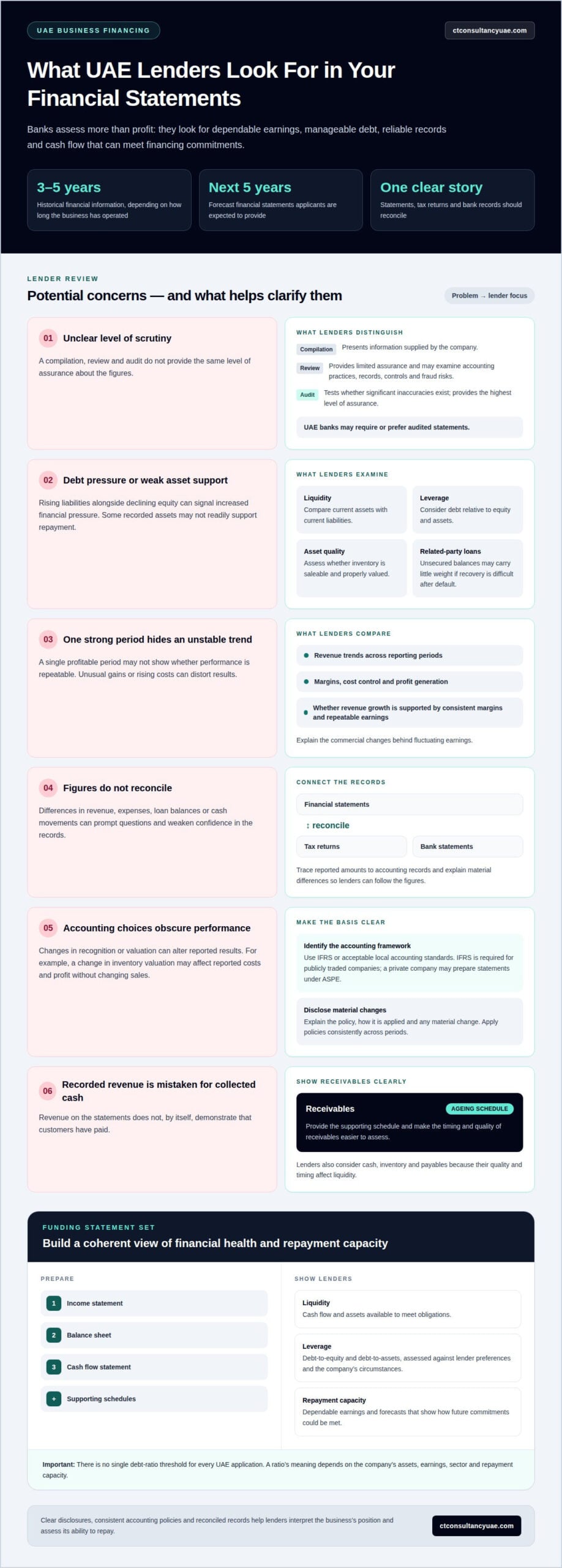
Notes explain how accounting choices shape reported revenue, income, assets and earnings. Lenders can assess whether changes in recognition or valuation affect comparisons between reporting periods. For example, a change in inventory valuation may alter reported costs and profit without changing sales. Clear disclosures identify the policy, how it is applied and any material change, helping lenders interpret figures consistently rather than treating every movement as improved performance.
For UAE bank financing, financial statements should follow IFRS or acceptable local accounting standards. Consistent application helps lenders compare companies and distinguish operating changes from accounting changes. IFRS is required for publicly traded companies, while a private company may prepare statements under Accounting Standards for Private Enterprises (ASPE). These frameworks are not interchangeable labels: identify the applicable basis and apply accounting policies consistently across the statements being assessed.
Receivables require attention because recorded revenue does not itself demonstrate collection. Lenders assess the ageing schedule, payment history, and whether balances relate to ordinary trading or unusual transactions. Business debtors aged 30 or 60 days generally receive greater value in assessment, while balances more than 90 days old may be viewed unfavourably. Aged or disputed receivables can weaken the expected conversion of income into cash and affect how much working capital appears available.
Accounts payable provide a complementary view of short-term pressure. Banks may view payables more than 30 days old, or outside agreed trading terms, unfavourably because they can indicate delayed settlements or strained liquidity. Notes should explain material overdue balances, disputes, and unusual payment arrangements. Lenders and investors may also investigate ongoing lawsuits or class action settlements during due diligence. Explain how these matters affect revenue, earnings, or liabilities, and keep the explanation aligned with the accounting records, so disclosed risks and reported figures tell a coherent story.
In the UAE, financial statements help banks assess whether a business can service credit and maintain liquidity. The income statement shows profitability, while the cash flow statement tracks whether earnings convert into cash available for repayments.
Banks typically want 12 to 24 months of projected cash flows to assess future profits and financing commitments. Projections should demonstrate capacity to pay interest and principal, and should reflect the proposed facility’s effect on cash movements. A profitable period alone cannot establish whether funds will arrive in time to meet scheduled payments.
How do banks assess financial statements for small businesses versus individuals? For a small business, lenders evaluate company earnings, assets, liabilities, and operating cash flow. For an individual application, they focus on personal income, existing obligations, and repayment capacity rather than company trading results.
In UAE business financing, banks often focus more on cash flow than accounting profit. A loss does not automatically disqualify a borrower, but the business should explain its cause and show a credible path to profitability. Lenders may assess liquidity, profitability, leverage and efficiency together, since a weakness in one area can affect the overall credit picture.
What profitability ratios do banks look for in financial statements? Common measures include net profit margin, calculated as net profit divided by revenue, and interest coverage, calculated as earnings before interest and tax divided by interest expense. Banks may also review the current ratio, current assets divided by current liabilities, and inventory turnover, cost of goods sold divided by average inventory. Lenders can set their own preferred ratio ranges.
Use forecasts to connect the funding request with its expected effect on cash flow, earnings, and working capital. For a clearer view of how the business’s assets and earnings support its financial position, explore business valuation support.
CTC Tax & Accounting helps businesses prepare and maintain financial records through Bookkeeping and Accounting Services. This support is useful when incomplete records, inconsistent reporting or unclear account balances make it difficult to present a coherent funding application.
Well-organized accounts help lenders follow revenue, expenses, assets and liabilities across reporting periods. Internal Audit Services can help examine financial processes and controls, while VAT Registration and Compliance and Corporate Tax Advisory address related tax matters that may affect reported obligations. The right support depends on the records and compliance needs involved.
Preparing for funding means more than producing statements: the underlying accounting must also be clear and supportable. Contact CTC Tax & Accounting to discuss your bookkeeping and accounting needs.
Preparing for finance is an opportunity to strengthen how your business understands and presents its financial position. Knowing what banks look for in financial statements can help you identify recordkeeping gaps before they complicate a funding discussion. Review how transactions are recorded, how obligations are tracked and whether management can clearly explain the figures.
CTC Tax & Accounting supports this work through Bookkeeping and Accounting Services, Internal Audit Services, and VAT Registration and Compliance. These services help businesses organize accounting records, review financial processes and address relevant VAT compliance needs as they prepare for lender scrutiny.
Bring your financing goals and accounting priorities into a focused discussion, then determine which support best fits your business. Contact CTC Tax & Accounting today to discuss your next step toward a more considered funding application.
Financial statements turn recorded transactions into information for planning and management decisions. Compare actual results with budgets to see whether rising sales are improving margins or whether costs are absorbing the gains. For example, a business considering a new product can use projected revenue and expenses to assess whether the proposal supports its objectives. Regular reviews help owners identify patterns and adjust plans before seeking additional capital.
Banks commonly review the balance sheet, income statement, cash flow statement and supporting schedules. They assess whether the records clearly show the business’s position, operating performance and cash movements. Reconciliation schedules for material balances, such as borrowing or large receivables, can clarify changes. Interim statements can also show developments since year-end.
Banks may assess the current ratio, quick ratio and working capital to understand near-term payment capacity. The current ratio compares current assets with current liabilities; working capital is what remains after current liabilities are deducted from current assets. A business with substantial inventory may appear liquid under the current ratio but have less immediately available cash. Lenders therefore consider asset quality and how quickly receivables can be collected.
Banks compare expected cash inflows with operating costs, existing obligations and proposed loan repayments. A useful forecast distinguishes recurring customer receipts from one-off income and shows when major outflows are expected. If revenue is seasonal, the forecast should show how the business will manage quieter periods while meeting scheduled interest and principal payments. Lenders use this analysis to assess repayment capacity, not just the profit reported for a period.
For UAE business loans, lenders commonly expect historical statements, supporting schedules and forecasts, with the required period shaped by the company’s operating history. Statements should use IFRS or acceptable local accounting standards and align with tax returns and bank records. Banks may require or prefer audited statements. Explaining material variances and significant transactions can make a funding file easier to assess.