
Financial crime can harm a business even when its owners have no intention of facilitating it. Protecting my business from financial crime starts with understanding how criminals may exploit businesses for money laundering, then assessing risks in proportion to the nature and scale of the business and its transactions. Where money laundering risk is higher, enhanced due diligence is appropriate.
It is reasonable to focus on legitimate transactions and secure operations. But the consequences can extend beyond a suspicious payment: weak controls may expose customer information, undermine trust, and create operational and compliance challenges.
This article explains what financial crime can look like for a UAE business and how practical safeguards can reduce exposure. You’ll learn how compliance policies, customer and beneficial-owner due diligence, staff training, and oversight of outsourced suppliers fit together, as well as how AI fraud models can support monitoring. The aim is a clear, proportionate approach to understanding your risks and responding with confidence.
Financial crime involves using business activity, money, or transactions to commit or conceal wrongdoing. Money laundering is one example: a business may be exploited to move funds linked to criminal activity, even without its owners’ knowledge. Fraud is another risk, such as a false invoice diverting a legitimate payment. For a UAE business owner, protecting my business from financial crime starts with understanding how routine processes could be misused.
What financial crimes commonly target businesses in the UAE? Money laundering and fraud are relevant risks, including transactions that disguise the origin of funds or use false payment instructions. Exposure depends on the business model: a company handling third-party payments faces different transaction risks from one selling directly to customers.
A financial crime risk assessment should reflect the nature and scale of the business and how it handles transactions. Map customer types, services, payment routes, and third-party relationships. Then identify where funds might pass through the business without a clear commercial purpose. For example, compare an unusual payment route with the customer’s stated activity and normal transaction pattern. This gives protecting my business from financial crime a practical starting point.
Make the assessment strategic, not a generic checklist. Rank risks by likelihood and potential impact, then assign controls to the highest-risk processes. A small firm with few payment channels may focus on onboarding and invoice approval; a business with complex payment flows may scrutinise counterparties and transaction patterns more closely. Review the assessment when services, customers, or payment methods change.
Enhanced due diligence is appropriate when a customer or transaction presents a higher money laundering risk. Examine the customer’s business purpose, ownership structure, and expected activity, then compare these details with actual transactions. If a customer claiming to provide local consulting receives unexplained payments from unrelated parties, investigate the discrepancy and document the review. Clear records help staff apply scrutiny consistently.
Effective compliance turns financial crime policy into repeatable actions. Senior management should understand the business’s risks and take part in its response. Keep procedures current, appropriate to the business, accessible, and understood by staff. For example, an onboarding procedure should explain who verifies identity, where records are stored, and how staff escalate concerns.
Customer due diligence, often called KYC, starts with identifying the customer and verifying their identity. Where applicable, identify and verify the beneficial owner too. Record the expected purpose of the relationship, then compare activity with that profile. If a company’s ownership details differ from its customer records, review the discrepancy before relying on those details.
Which UAE businesses must register with goAML or appoint a compliance officer? These obligations depend on whether the business falls within a regulated or reporting category; they do not apply identically to every UAE company. Assess the business’s activities against its applicable AML requirements and supervisory remit before deciding which registration and compliance arrangements apply.
Internal controls can make employee fraud and embezzlement harder to conceal. Separate payment preparation from approval, restrict access to banking credentials, and reconcile statements against invoices and accounting entries. For example, a staff member who creates a supplier record should not be the sole approver of payments to that supplier. An internal audit can test whether these controls work in practice.
How should a UAE business report suspected financial crime, and to which authorities? Document the concern and escalate it promptly to the designated compliance officer or responsible senior manager. Where the business has a reporting obligation, use the applicable UAE reporting channel, including goAML where required, and follow the relevant supervisory process.
Keep an audit trail of customer checks, approvals, escalations, and decisions. Staff need practical training to recognise risks and apply procedures consistently; one useful format is a case-based session using realistic payment or identity scenarios. A structured AML compliance review can help identify gaps between written procedures and everyday controls.
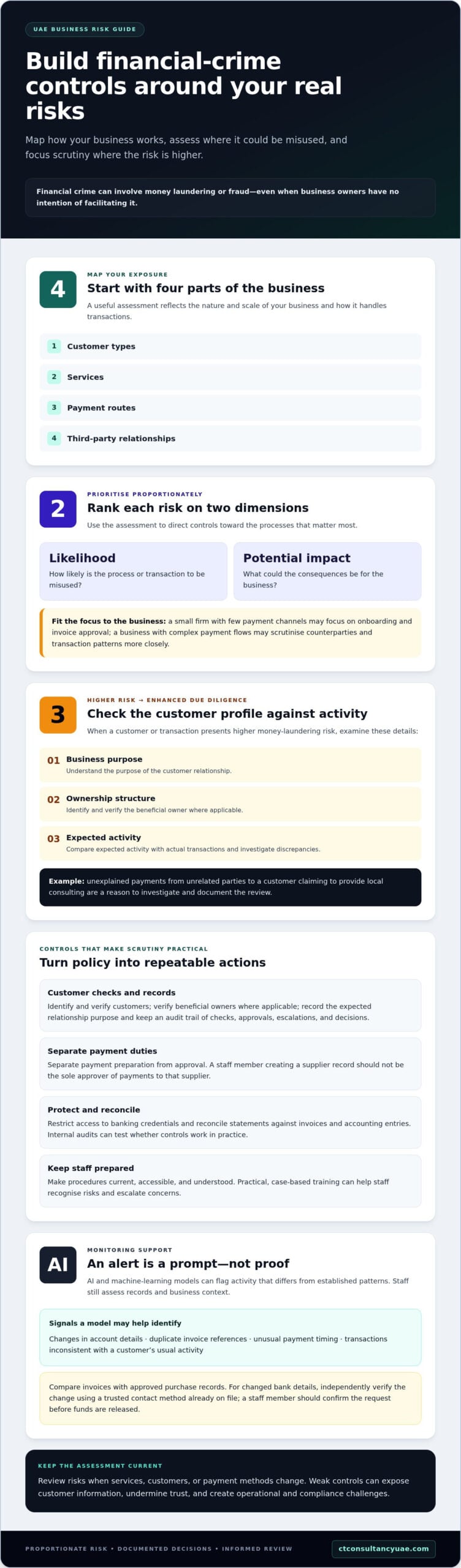
AI and machine learning models can examine transaction patterns and flag activity that differs from established behaviour. A model might highlight a supplier payment whose amount, timing, or destination account differs from previous invoices. Treat the alert as a prompt for investigation, not proof of fraud; staff must assess the underlying records and business context.
For useful results, define what the model should detect before using it. Identify relevant signals, such as changes in account details, duplicate invoice references, unusual payment timing, or transactions inconsistent with a customer’s usual activity. Use reliable, appropriately governed data, and document why an alert was raised and how it was resolved. Poorly maintained supplier records can weaken even sophisticated analysis.
How can a business detect and prevent invoice fraud, payment diversion, and business email compromise? Compare invoices with approved purchase records, flag changed bank details, and independently verify payment changes using a trusted contact method already on file. AI can prioritise unusual patterns, while a staff member confirms the request before releasing funds.
Machine learning can support detection by finding relationships across records that manual reviews may miss. For example, a model could flag several supplier accounts sharing the same bank details, or payments that repeatedly fall outside a vendor’s usual pattern. Review alerts against contracts, purchase approvals, correspondence, and payment history before deciding whether activity is suspicious.
Keep the process auditable. Assign someone to review alerts, record the evidence considered, and track false positives so the model can be refined. Test whether changes in business activity affect its performance: a new supplier mix, sales channel, or payment process can alter normal patterns. Human oversight also helps prevent legitimate transactions from being blocked solely because they look unusual.
AI does not replace compliance responsibilities or sound internal controls. Align data access, model oversight, and escalation procedures with the business’s regulatory obligations. A clear review process connects automated signals to accountable decisions, helping staff respond consistently while preserving records that explain each decision.
A financial crime incident can disrupt cash flow before its full effects become clear. A diverted supplier payment may leave invoices unpaid, interrupt deliveries, and consume staff time during recovery. Even if funds are recovered, management must investigate the transaction, preserve records, and restore normal payment processes.
Trust can also suffer. A customer whose identity or payment information is misused may question the business’s controls, while suppliers may delay work until payment procedures are clarified. Repeated incidents can distract leadership from operations and growth. Assess not only direct losses, but also the time, relationships, and business activity affected.
What are the penalties for AML, sanctions, fraud, and reporting violations in the UAE? Consequences depend on the conduct and applicable legal framework; they can include financial penalties or prosecution. The impact also depends on the business’s role, the circumstances, and how it responded to warning signs.
What does financial crime insurance cover for businesses in the UAE, and how much does it cost? Coverage depends on the policy wording and may address specified losses from events such as employee dishonesty or fraudulent payment instructions. Cost depends on factors such as the insured activities, selected cover, exclusions, and risk controls; compare the policy terms with the business’s actual exposures.
After an incident, create a clear record of the discovery, affected transactions, approvals, and actions taken. Then identify the control failure: perhaps one employee could create a supplier and release payment, or a bank-detail change lacked independent verification. Assign responsibility for each corrective action and test whether the revised process works.
Financial crime can also affect how stakeholders view business stability and value. If an incident raises questions about reliable records or internal controls, a business valuation can help assess the company’s financial position. Consider this step when ownership, financing, or a strategic decision requires a clearer view of potential exposure.
CTC Tax & Accounting supports businesses that need clearer financial records and stronger internal oversight. Its Bookkeeping and Accounting Services organise transaction records, making it easier to review payments, trace entries, and identify inconsistencies. When you need to assess whether financial controls work as intended, Internal Audit Services can examine processes and highlight areas requiring attention.
For UAE businesses managing tax obligations alongside financial crime controls, VAT Registration and Compliance and Corporate Tax Advisory provide support with tax matters. These services complement sound recordkeeping but do not replace AML procedures or required reporting obligations. Consider professional accounting or audit support when transaction records are difficult to reconcile, payment approvals lack clear documentation, or management needs a structured review of financial processes.
Contact CTC Tax & Accounting to discuss the accounting or audit support your business needs.
Protecting my business from financial crime is not a one-off project; it is an ongoing governance priority that should evolve as operations, customers, and payment practices change. Set a regular time to review who owns each control, whether records support management decisions, and how identified weaknesses are addressed. This makes risk management an operating discipline, not just a response to an incident.
When financial records need greater structure, CTC Tax & Accounting provides Bookkeeping and Accounting Services. Its Internal Audit Services can assess how controls function, while VAT Registration and Compliance supports businesses managing related tax processes. Choose support that addresses the specific gap, whether that means reliable transaction records, clearer oversight, or organised compliance work.
Discuss the accounting or audit support relevant to your business with CTC Tax & Accounting. A considered next step can help you build stronger processes with clarity and confidence.
Financial crime uses deception or business activity to obtain, move, or conceal funds unlawfully. Examples include a fabricated supplier invoice, an employee diverting a company payment, or transactions used to disguise proceeds from criminal activity. These events can involve internal or external actors and may exploit routine processes such as purchasing, payroll, or customer payments. Reviewing how each process is initiated and approved can reveal weak points.
Requirements depend on the business’s activities and whether it falls within a regulated or reporting category. Businesses subject to AML rules need suitable policies, controls, and staff understanding to prevent misuse of their services. Relevant procedures may include customer identification, beneficial-owner checks, transaction monitoring, recordkeeping, and escalation of concerns. Registration and reporting processes, including goAML, apply according to the business’s obligations, not automatically to every UAE company.
Identify the customer, verify their identity, and identify and verify the beneficial owner where applicable. For a corporate customer, review its ownership information and establish which individual ultimately owns or controls it. Compare the stated business purpose with the products or services requested, then retain a clear record of documents reviewed and decisions made. If ownership details conflict across records, resolve the discrepancy before relying on them.
Screen relevant names against the UAE and United Nations Security Council sanctions lists, and retain the date, search details, and outcome. Check identifying information alongside names, since similar names can produce false matches. Review a possible match carefully before proceeding, escalate it through the business’s compliance process, and document the decision. CTC Tax & Accounting’s Anti-Money Laundering service includes client name screening against UNSC and UAE sanctions lists.