
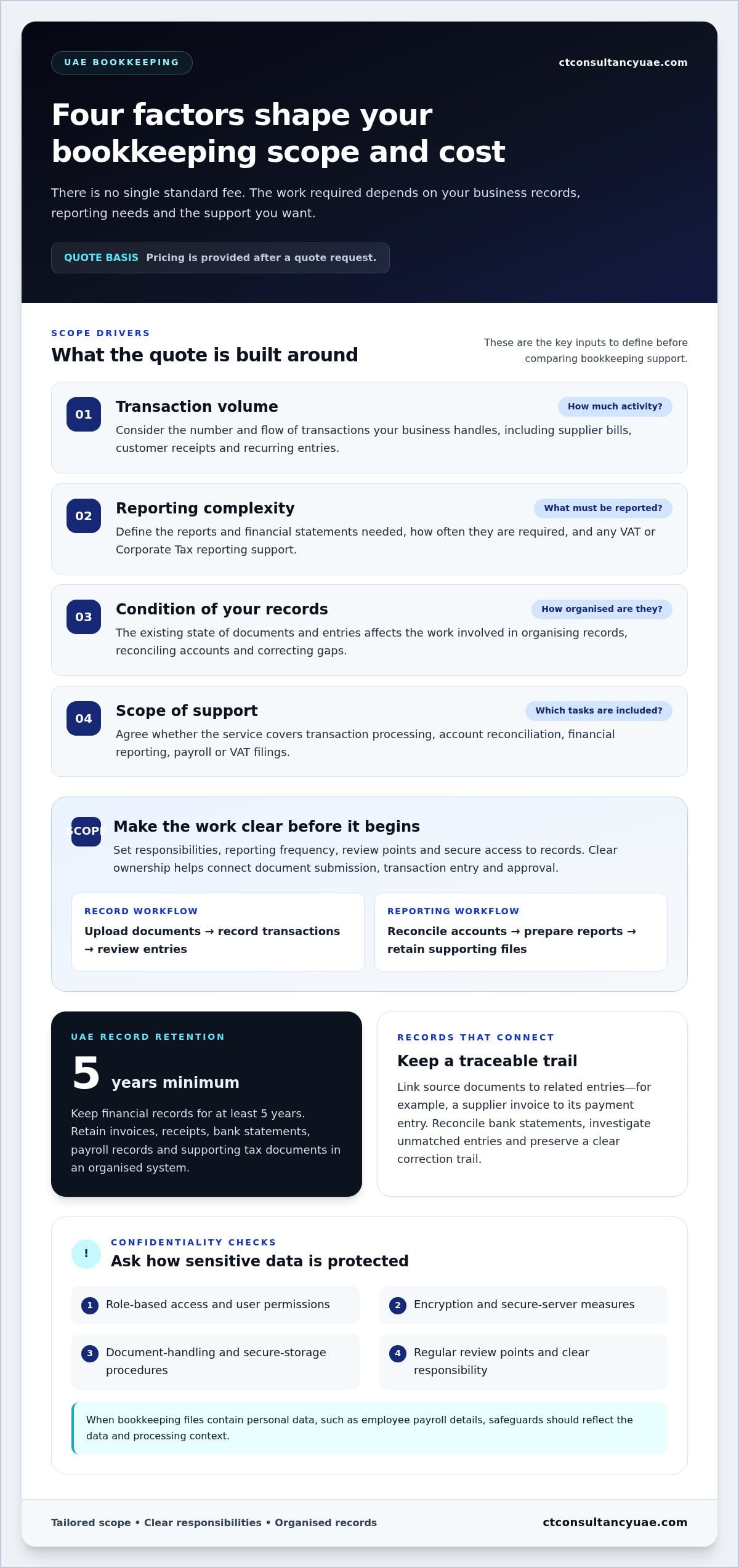
Bookkeeping costs in the UAE depend on the work your business needs, rather than a single standard fee. For secure and confidential bookkeeping in the UAE, the price depends on transaction volume, reporting complexity, the condition of your records and the scope of support, and is provided after a quote request. UAE businesses should keep financial records for at least 5 years, so reliable, well-organised recordkeeping matters beyond routine monthly reporting.
It’s reasonable to want clear costs while protecting sensitive financial information and keeping records ready for tax and reporting obligations. This guide explains how outsourced bookkeeping works, what affects its scope, and how to assess confidentiality and record retention.
You’ll also find practical guidance for startups, SMEs and Free Zone businesses on how bookkeeping supports VAT and Corporate Tax compliance, and when professional accounting support can make financial processes easier to manage.
In the UAE, accurate bookkeeping supports VAT compliance, Corporate Tax filing and informed financial decisions. Outsourcing can bring transaction records, financial statements and reporting together in a defined accounting workflow.
Financial accounting records, classifies and organises business transactions, then presents them in structured reports. An outsourced team can maintain ledgers, reconcile accounts and prepare IFRS-aligned financial statements. When assessing accounting firms, look at their UAE compliance knowledge, reporting accuracy, and VAT and Corporate Tax experience. Agree on responsibilities, reporting frequency and secure access to records before work begins.
Accounts payable tracks supplier invoices, approval status and payment due dates. Accounts receivable records customer invoices, receipts and overdue balances. Matching a supplier invoice to its approval and applying a customer payment to the correct invoice, for example, helps keep account balances current. Define who reviews exceptions and how supporting documents are retained so each transaction can be traced through the records.
Accounting and bookkeeping services can combine transaction processing with financial reporting, with payroll or VAT filings included where needed. The right scope depends on transaction volume, reporting complexity and the company’s internal capacity. UAE businesses should maintain proper records and structured reporting, including financial statements. IFRS-aligned records support audit preparation.
VAT-registered businesses should track VAT on sales and purchases, retain proper records and file returns on time. UAE VAT returns may be filed quarterly or monthly. VAT was formed in 2018, and Corporate Tax was introduced in 2023. These requirements make consistent bookkeeping useful for connecting source documents to tax reporting. Accounting services can support a business’s financial workflow.
For secure and confidential bookkeeping in the UAE, set role-based access, clear document-handling procedures and regular review points. Ask how encryption and secure servers protect financial data. These controls matter whether the business has an internal accounting team or outsources its bookkeeping, helping govern sensitive information throughout routine accounting work.
UAE businesses should keep financial records for at least 5 years. Retain invoices, receipts, bank statements, payroll records and supporting tax documents in an organised system. For example, link each supplier invoice to its payment entry so the transaction can be traced later.
Compare bookkeeping providers by asking how they restrict access, protect stored files and maintain accurate records. Ask about encryption and secure-server measures, user permissions and document-handling procedures. Assess these controls alongside the provider’s approach to compliance, reporting and record retention.
UAE bookkeeping and accounting requirements include proper records, financial statements and structured reporting. The UAE record-retention rule covered here is at least 5 years; records should also support accurate VAT and Corporate Tax reporting. The requirements do not reduce to one confidentiality rule, so consider the type of data and the business’s reporting obligations.
The UAE Personal Data Protection Law is relevant when bookkeeping files contain personal data, such as employee payroll details. Its application depends on the data and processing context. Anyone handling those files should use appropriate safeguards, restrict access to authorised users and follow secure storage procedures.
Effective record management starts with a consistent process. Assign responsibility for uploading documents, approving corrections and reviewing account entries. Use accounting software to organise records by transaction type and reporting period, and retain source documents alongside the related entries. For example, a VAT registration or payroll change should be reflected in the relevant accounting records and supporting files.
Accuracy also depends on regular reconciliation. Compare bank statements with recorded transactions, investigate unmatched entries and preserve a clear correction trail. These steps help businesses prepare reliable financial reports and support tax compliance. For tailored bookkeeping and accounting support, consider how your current process handles record access, accuracy and retention.
Startups, SMEs and Free Zone entities need bookkeeping processes that fit their transaction volume and reporting needs. A founder managing a few monthly invoices may need a different workflow from a growing company handling supplier bills, customer receipts and payroll. Start by listing recurring transactions, internal approvals and the reports needed for management decisions.
Free-zone status does not remove the UAE-wide baseline: businesses should retain financial records for at least 5 years. The applicable accounting and reporting obligations depend on the entity’s circumstances and relevant framework, while data safeguards should reflect the personal information being handled. Map those requirements before selecting bookkeeping services or setting staff access.
For a small business, bookkeeping support can include transaction categorisation, account reconciliation and periodic reporting. For example, a startup can provide bank statements and sales invoices, then review reconciliations and management reports with its finance lead. Clear responsibilities help prevent gaps between document submission, transaction entry and approval.
Bookkeeping costs for small businesses depend on transaction volume, record condition, reporting complexity and the scope of support. The price depends on the case and is given after a quote request. These factors also help determine whether outsourcing or hiring an internal employee better fits the workload.
Before engaging firms in Dubai, outline the records they will handle, reporting frequency and review process. Ask how the workflow supports audit preparation, who approves adjustments and how sensitive files are protected. A defined process makes it easier to compare service scope without relying on a headline fee alone.
As the business expands, revisit the arrangement when new branches, employees or revenue channels change transaction patterns. Advisory services can help management interpret reports and plan financial oversight, while bookkeeping staff maintain the underlying records. For a Free Zone company, align that review with its reporting framework and operating structure.
For a startup, bookkeeping should capture the business model from the first transactions. Separate business spending from owner expenses, classify sales by revenue stream and record financing separately from income. These steps give founders clearer cash-flow insights before hiring, purchasing or expansion decisions.
An established SME often needs more analytical reporting than transaction entry alone. Add project codes, departments or branch identifiers when they help explain performance. For example, a service company can compare revenue and supplier costs by project, then use the results to set budgets or assess consulting work.
Free Zone entities should build bookkeeping around their actual activities, entity structure and reporting needs. Free Zone status alone does not dictate one accounting workflow for every company. Map revenue streams, operating costs and ownership transactions, then align the chart of accounts with reporting and filing requirements.
Use a monthly close routine that assigns responsibility for collecting documents, reviewing unusual entries and preparing management reports. A founder might approve major expenses while a finance lead reviews reconciliations and outstanding customer balances. Documenting these roles creates a useful review trail without making every routine entry a management decision.
As activity expands, reassess whether the existing process can handle additional currencies, locations, employees or transaction types. A growing business may need more detailed cost allocation, while a lean startup may prioritise a straightforward income and expense view. Choose bookkeeping support based on workload and reporting complexity, not the company label alone.
For a practical assessment, prepare a sample month of invoices, receipts and bank transactions. Use it to clarify expected reports, review responsibilities, access controls and how unusual transactions will be handled. A professional’s credentials may inform your assessment, but the workflow should also demonstrate accurate records and useful reporting. Plan a bookkeeping workflow around your business structure and growth priorities.
CTC Tax & Accounting supports businesses that need consistent bookkeeping, organised financial reporting or clearer oversight of accounting processes. Its Bookkeeping and Accounting Services are a practical next step when internal capacity is limited or records need more structured management.
Businesses preparing VAT filings can also use VAT Registration and Compliance support, while Corporate Tax Advisory can help address tax-related accounting considerations. Internal Audit Services may suit management seeking a review of financial controls and recordkeeping procedures.
The appropriate support depends on your current records, reporting requirements and internal responsibilities. To discuss bookkeeping needs or explore the available accounting services, contact CTC Tax & Accounting.
Reliable records are more than an administrative requirement: they give owners a clearer basis for decisions about cash flow, hiring and growth. Treat secure and confidential bookkeeping in the UAE as an operating discipline. Define who can access financial data, who reviews entries and how reports inform management decisions.
When internal processes need structure, CTC Tax & Accounting offers Bookkeeping and Accounting Services, Internal Audit Services, and VAT Registration and Compliance. These services support businesses seeking consistent records, a review of financial controls or help with VAT compliance. Start by identifying the pressure point in your current process, then match support to that need.
Before discussing your requirements, prepare a concise picture of your transaction workflow, reporting priorities and record-access responsibilities. This gives the conversation a practical starting point without assuming every business needs the same arrangement.
Contact CTC Tax & Accounting to discuss bookkeeping support for your business. A clear process can help you move forward with greater confidence.
CTC Tax & Accounting provides Bookkeeping and Accounting Services for businesses seeking support with financial recordkeeping. If you need help maintaining your books or accounting support as your business develops, these services are a natural next step.
You can also turn to CTC Tax & Accounting for related support, including Internal Audit Services, VAT Registration and Compliance, Corporate Tax Advisory and CFO Advisory Services. The firm also offers business valuation, feasibility studies, company liquidation, ESR compliance, UBO filing and AML compliance.
Bookkeeping fees depend on transaction volume, record condition, reporting complexity and scope. A small operation with orderly sales and expense records has a different workload from a business needing reconciliations, backlog cleanup and management reporting. Compare proposals by deliverables and review responsibilities, not just transaction processing, so the scope fits your records and reporting needs.
If your business is VAT-registered, its bookkeeping should capture VAT on sales and purchases and support return preparation. For example, organise invoices and expense records so taxable and non-taxable transactions can be reviewed separately.
Choose a bookkeeper whose scope fits your records, reporting needs and confidentiality expectations, rather than relying on a “top” label alone. Review which reports are produced, how corrections are handled and how access to financial files is controlled. CTC Tax & Accounting provides Bookkeeping and Accounting Services for businesses seeking help with transaction records and financial reporting.
Poorly maintained bookkeeping can contribute to VAT penalties, inaccurate financial reports and audit complications. Missing or misclassified entries can also obscure the business’s actual cash position, making it harder to plan supplier payments or assess customer balances. If records have fallen behind, gather bank statements, invoices and receipts, then reconcile transactions and identify gaps before preparing management or tax reports.
Assess trustworthiness through relevant UAE compliance knowledge, accurate reporting and clear processes for handling financial data. Ask what the accounting scope covers, who reviews entries and how the work supports your reporting obligations. CTC Tax & Accounting offers Bookkeeping and Accounting Services, Internal Audit Services and VAT Registration and Compliance to address recordkeeping, control review and VAT support needs.
UAE businesses should retain financial records for at least 5 years. Store supporting documents so each ledger entry can be traced to its source, such as matching a bank transaction with its invoice and payment evidence. Limit access to authorised users and use encryption and secure-server measures to protect confidential information. A consistent naming and filing process also makes records easier to retrieve for reviews.