
Tax efficiency in the UAE depends on disciplined compliance, not simply reducing the tax bill. For businesses, avoiding tax compliance headaches in the UAE starts with reconciling tax return figures to the accounts and keeping supporting records; records related to Corporate Tax filing must be retained for a minimum of 8 years. According to the Federal Tax Authority, the standard Corporate Tax rate is 9% on taxable income exceeding AED 375,000.
For foreign founders and business owners, record-keeping duties and tax rules can be difficult to manage alongside day-to-day operations. This guide explains which documents to organise, how UAE Corporate Tax rules apply, and how lawful planning can support tax efficiency without compromising compliance. You’ll also learn when a transaction’s structure or financial records call for closer review, so you can make decisions with a clearer understanding of your obligations.
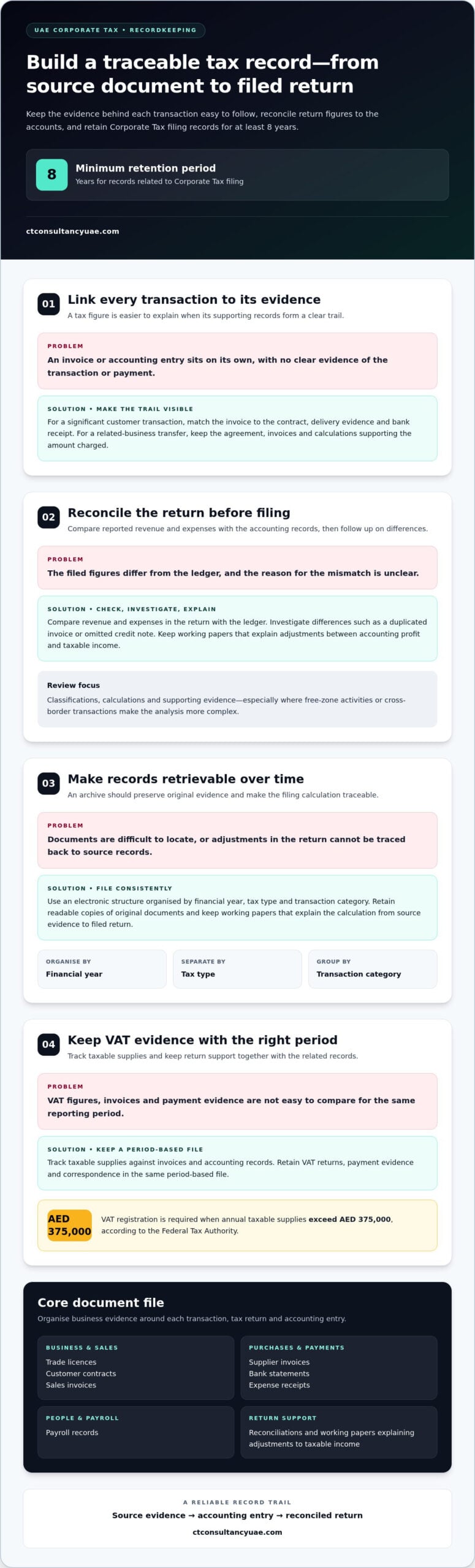
Foreign owners should organise business evidence around each transaction, tax return and accounting entry. A practical file includes trade licences, customer contracts, sales invoices, supplier invoices, bank statements, payroll records and expense receipts. These documents help explain revenue, deductible costs and the calculation of tax liability under applicable UAE laws and regulations.
For significant transactions, keep records that show the commercial purpose and payment trail. For example, match a customer invoice to its contract, delivery evidence and bank receipt. For a transfer between related businesses, retain the agreement, invoices and calculations supporting the amount charged. Clear links between records make it easier to explain figures in an FTA inquiry.
Before filing, reconcile the tax return against the accounts and gather supporting documents ahead of the deadline. Compare reported revenue and expenses with the ledger, then investigate differences such as a duplicated invoice or omitted credit note. A tax professional can review classifications, calculations and supporting evidence, particularly when free-zone activities or cross-border transactions make the analysis more complex.
UAE businesses must maintain records related to Corporate Tax filing for a minimum of 8 years. Use a consistent electronic filing structure by financial year, tax type and transaction category, while retaining readable copies of original documents. Keep working papers that explain adjustments between accounting profit and taxable income, so the calculation can be traced from source evidence to the filed return.
VAT records also require careful organisation. According to the Federal Tax Authority, businesses must register for VAT when annual taxable supplies exceed AED 375,000. Track taxable supplies against invoices and accounting records, and retain VAT returns, payment evidence and correspondence in the same period-based file. Foreign owners should seek professional advice when ownership, residency, free-zone status or cross-border income affects how their records support a filing position.
The UAE introduced Corporate Tax in 2023, with rates based on taxable income and taxpayer status. According to the Federal Tax Authority, the standard corporate tax rate is 9% on taxable income exceeding AED 375,000. Qualifying free-zone businesses may receive a 0% corporate tax rate on qualifying income if they meet the prescribed conditions, according to the Federal Tax Authority. Small Business Relief may exempt an eligible business from paying tax when claimed.
A separate 15% rate applies to multinational enterprise groups with global turnover above AED 3.15 billion, subject to certain conditions. This means a company should distinguish accounting profit from taxable income, then assess its eligibility for relief before estimating its liability. A qualifying free zone does not, by itself, make all income eligible for the 0% rate.
Corporate Tax registration applies to UAE companies regardless of revenue or profit. A company established after 1 March 2024 must register within 3 months of its licence issuance; missing the registration deadline carries a AED 10,000 penalty. Returns are due within 9 months of the relevant financial year-end, so record the year-end and filing deadline together.
VAT returns follow the assigned filing cycle, monthly or quarterly, and monthly returns are due by the 28th of the month. Settle the VAT due by the applicable return deadline; administrative or procedural tax compliance failures may attract fixed or recurring penalties from AED 1,000 to AED 20,000, depending on the violation.
Coordinate VAT and Corporate Tax reviews using the same sales ledger, while preserving each tax’s distinct classifications. For example, reconcile reported sales and invoice dates, then investigate differences before filing either return. This helps explain how transaction treatment affects taxable income and VAT reporting, including sales across a border. A structured tax compliance review can help identify mismatches and clarify filing obligations.
Seek tax advice before signing a major acquisition, restructuring, related-party agreement or cross-border contract. Early analysis helps compare the proposed transaction’s accounting treatment with its commercial purpose. It can also identify the contracts, valuations and supporting records to prepare before signing. Assessing the implications in advance may help avoid costly changes later.
Transfer pricing and treaty shopping can affect how income is allocated across borders. The parties, functions, assets and commercial rationale help explain a transaction’s structure and pricing. Treaty shopping and corporate inversions may be used to reduce cross-border tax liabilities, but must comply with applicable international tax laws. Keep agreements and accounting records consistent with actual activities and payments. This is a practical step toward avoiding tax compliance headaches in the UAE.
The OECD’s Base Erosion and Profit Shifting project aims to reduce income shifted to low-tax jurisdictions and ensure profits are taxed where the activities generating them take place. A proposed relocation of intellectual property or management functions should therefore be assessed against the business’s actual operations. A structure without economic substance may attract scrutiny, particularly when its tax outcome appears disconnected from its activities.
A UAE business may form a tax group, subject to conditions, to set off taxable losses against taxable profits of other group companies. Before transferring activities between entities, assess eligibility, ownership structure and the effect on each company’s accounting records. Model the group outcome using actual forecasts rather than assuming every loss qualifies or can be used immediately.
For a planned free-zone restructuring, separate qualifying income from other revenue and assess whether prescribed conditions remain satisfied. Qualifying free-zone businesses may receive a 0% rate on qualifying income under Federal Tax Authority rules. Document the commercial rationale, transaction steps, expected cash flows and accounting entries before implementation. This disciplined preparation supports avoiding tax compliance headaches in the UAE while helping decision-makers compare tax efficiency with operational substance and compliance exposure.
Start by matching each business activity to its actual income, contracts and operating structure. Separate revenue streams in the accounts, then identify the applicable UAE regulations before allocating costs or claiming relief. Support each decision with a documented commercial purpose, not just a desired tax outcome. This approach helps businesses focus on avoiding tax compliance headaches in the UAE while making operating decisions.
Natural persons, including freelance licence holders, are subject to UAE Corporate Tax if their annual turnover exceeds AED 1,000,000. Track business turnover separately from personal funds, and retain invoices and contracts that show which activity generated income. Individuals should review how their licence and business activity affect their filing position. Clear classification can prevent business income from being confused with personal funds.
Eligible businesses may claim Small Business Relief, which may exempt a business from paying tax when claimed. Assess eligibility using the relevant tax period and business records, then document the decision alongside the return. Relief does not remove the need to maintain proper accounts or meet filing deadlines. Keep records supporting reported income and expenses.
To structure operations efficiently, compare where functions are performed, where staff and assets are used, and which entity earns each income stream. For example, a free-zone business should distinguish qualifying income from other revenue and keep evidence supporting its status. Businesses can also apply available reliefs, deductions and tax losses under applicable rules rather than relying on informal arrangements.
Use a repeatable review process: reconcile accounting figures, assess relief eligibility, document the commercial rationale, and calendar filing and payment deadlines. The Federal Tax Authority identifies SMEs as particularly affected by regulatory complexity or unclear guidance. Consistent procedures can make avoiding tax compliance headaches uae part of routine planning. Request a UAE tax compliance review to assess how your business structure, records and relief claims fit together.
CTC Tax & Accounting supports businesses with reliable accounts and coordinated tax compliance. Its Bookkeeping and Accounting Services help organise financial records, while Internal Audit Services review internal controls and identify process gaps. For businesses managing both tax regimes, VAT Registration and Compliance and Corporate Tax Advisory support registration, reporting and tax decisions.
Consider this support when transactions are difficult to reconcile, filing responsibilities overlap or a business structure changes. Clear accounting records help trace figures from source documents to tax returns and identify issues to address before filing. Contact CTC Tax & Accounting to discuss your bookkeeping or UAE tax compliance needs.
A business’s compliance framework should evolve alongside its operations. New revenue streams, ownership changes or expansion into additional markets can affect how financial information is produced and reviewed. Making tax governance part of routine decision-making helps leaders identify responsibilities early, assign clear ownership and keep financial processes aligned with commercial plans. This is a practical foundation for avoiding tax compliance headaches in the UAE as the business develops.
CTC Tax & Accounting offers Bookkeeping and Accounting Services, Internal Audit Services, and VAT Registration and Compliance to support these operational needs. Whether you’re formalising internal controls or improving how transaction records flow into reporting, take the next step with a focused discussion about your business priorities.
Contact CTC Tax & Accounting to explore support suited to your requirements. With clear processes and informed decisions, your business can move forward with greater confidence.
Businesses can pursue tax efficiency by applying available reliefs and deductions while supporting each claim with its commercial basis. Before recognising a tax loss or allowance, for example, compare eligibility with the relevant rules and ensure the accounting treatment matches the underlying transaction. A clear record of the decision helps distinguish legitimate planning from unsupported adjustments and gives management a consistent approach across reporting periods.
The answer depends on whether you mean federal taxes or all tax-like charges. Three major federal business taxes are Corporate Tax, VAT and Excise Tax. They apply to different tax bases: business taxable income, taxable supplies and specified products, respectively. The United Arab Emirates also has municipal property charges, distinct from those federal taxes, so businesses should identify the relevant regime before assessing their obligations.
Yes, free-zone companies fall within the UAE Corporate Tax framework, but qualifying businesses may receive a 0% rate on qualifying income if they meet prescribed conditions, according to the Federal Tax Authority. The benefit is not an automatic exemption for every activity or income stream. A company should distinguish qualifying income from other income and assess its status against the applicable conditions.
Corporate Tax registration applies to UAE companies regardless of revenue or profit. VAT registration is mandatory when annual taxable supplies exceed AED 375,000, according to the Federal Tax Authority. These are separate registration tests: a business may have a Corporate Tax registration obligation without reaching the VAT threshold. Keep the two assessments distinct, and base VAT monitoring on taxable supplies rather than accounting profit.
If a filing question, accounting discrepancy or relief assessment is holding up a decision, define the issue and gather the relevant records first. CTC Tax & Accounting offers Corporate Tax Advisory and Bookkeeping and Accounting Services to support tax and financial processes. Internal Audit Services can also address internal control concerns. A focused review can clarify the work required and set practical next steps.
Retain documents that establish ownership, authority and the commercial substance of your UAE operations. Useful evidence includes incorporation and licence documents, ownership records, lease agreements, board decisions, bank correspondence and contracts explaining how the business earns income. Organise these alongside tax filings and payment confirmations so each record is linked to the entity, activity and reporting position it supports.