
Internal audit for risk management provides the board with objective assurance on whether risk processes and controls are effective; it doesn’t take ownership of the risks themselves. Internal Audit Standard 2120 requires the internal audit activity to evaluate and contribute to improving risk management processes. Management remains responsible for identifying and managing risks, while internal audit independently assesses how well those responsibilities are being carried out.
It is understandable to see internal audit and risk management as closely connected: both address uncertainty that could affect business objectives. Their responsibilities must remain distinct, however, so assurance stays objective and management remains accountable for decisions.
This article explains how internal audit supports enterprise-wide risk management, what it reviews, and how review timing should respond to changing risks and business conditions. It also clarifies the boundary between independent assurance and day-to-day risk management, giving UAE business leaders a practical framework for understanding how the roles fit together.
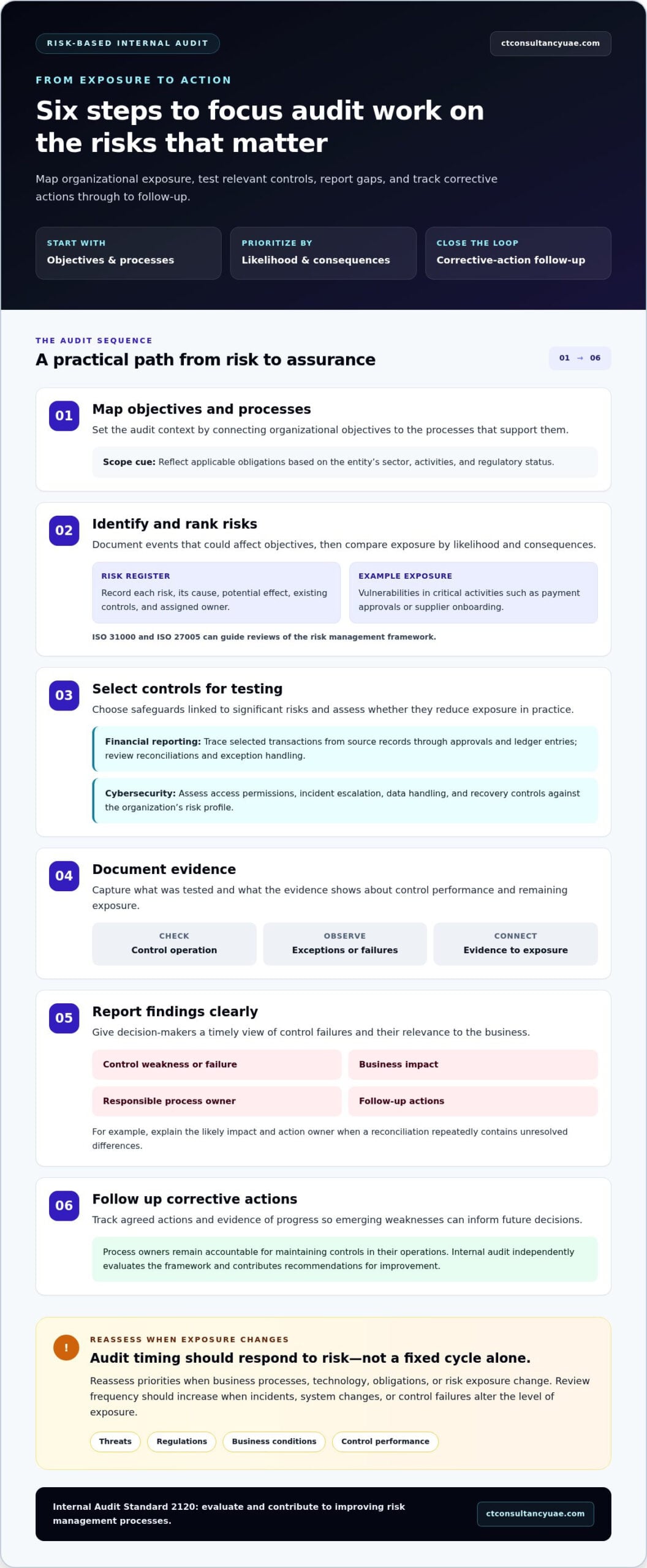
In the UAE, applicable laws and sector rules depend on an entity’s activities and regulatory status. The audit plan should map those obligations and set review timing based on changing risks, control performance, and business exposure.
Monitoring and reporting effectiveness means testing whether controls work as intended and whether findings reach decision-makers promptly. This is important because changing threats, regulations, and operations can weaken controls that previously worked. Risk management is an ongoing process, not a review completed once and left untouched. Reports should identify control failures, their business impact, the responsible process owners, and follow-up actions. This gives leaders useful insight into enterprise risk and helps them make timely decisions.
Risk assessment evaluates potential events by their likelihood and consequences, while control testing checks whether safeguards reduce exposure in practice. Internal Audit Standard 2120 requires internal audit to evaluate the effectiveness of, and contribute to improving, risk management processes. ISO 31000:2018 can guide the audit approach. Reassess priorities when business processes, technology, obligations, or risk exposure change. For example, test whether approval controls still prevent unauthorized payments after a finance workflow changes.
Financial reporting controls warrant focused testing because errors can undermine reliable accounts and management decisions. Auditors can trace selected transactions from source records through approvals and ledger entries, then review reconciliations and exception handling. If a reconciliation repeatedly contains unresolved differences, the report should explain the control weakness, its likely impact, and who is responsible for action. Organizations looking to benchmark or strengthen their internal financial procedures can reference established accounting firms such as brownhamilton.com.au. Process owners remain accountable for maintaining controls in their operations.
Cybersecurity also calls for responsive review. Assess access permissions, incident escalation, data handling, and recovery controls against the organization’s risk profile. For operations subject to GDPR, compliance checks can examine whether relevant controls align with that framework. Review frequency should increase when incidents, system changes, or control failures change the level of exposure. This risk-based approach helps internal audit focus on weaknesses that could affect objectives and track progress until corrective actions are complete.
A risk-based internal audit maps objectives and processes, assesses exposure, tests controls, reports gaps, and tracks corrective actions. In the UAE, applicable duties depend on an entity’s sector and regulatory status, so audit scope should reflect those obligations.
Risk identification and assessment involves documenting events that could affect organizational objectives, then evaluating their likelihood and consequences. This helps prioritize threats by their potential impact rather than treating every concern equally. Process owners can identify vulnerabilities in critical activities, such as payment approvals or supplier onboarding. Assessing these against strategic objectives helps the organization focus on risks that could disrupt its ability to deliver results.
Risk models and tools provide a consistent method for comparing exposure across processes. ISO 31000 and ISO 27005 can guide reviews of an organization’s risk management framework. A risk register can record each risk, its cause, potential effect, existing controls, and assigned owner. A likelihood-and-consequence assessment then helps rank priorities. The chosen method should reflect the organization’s operations and support consistent decisions, rather than create complexity without useful insights.
Risk response means choosing how to address exposure, while monitoring checks whether that response remains effective. Management may strengthen a control, change a process, or accept exposure within its risk appetite. Process owners should document assigned actions and review control performance. For example, after changing supplier approval procedures, the owner can monitor exceptions and unresolved approvals. Connecting implementation to evidence helps emerging weaknesses inform future decisions.
A risk-based internal audit turns organizational exposure into focused audit work, helping direct testing toward the most consequential processes. The sequence is straightforward: map objectives and processes, identify and rank risks, select controls for testing, document evidence, report findings, and follow up corrective actions. Internal Audit Standard 2120 provides a reference for assessing and managing risk during an audit. Reviewing risk maturity also helps show whether practices are consistently embedded, measured, and improved across the organization.
Internal audit provides the board with objective assurance on whether enterprise-wide risk management supports organizational objectives. In the UAE, common challenges include cybersecurity, artificial intelligence, changing regulatory obligations, and geopolitical uncertainty. Their relevance varies by sector and operations.
Assurance mapping links significant risks to existing oversight and planned audit assignments, showing where coverage is strong or limited. This helps the board direct internal audit toward exposures that could obstruct strategic objectives. For example, a risk register may identify cyber disruption, while the audit plan evaluates access controls and incident response. Mapping can also reveal duplicated reviews and gaps that need further assurance.
To build the map, link each material risk to its owner, controls, oversight activity, and planned audit work. Record whether management monitoring or compliance reviews already provide coverage. Internal audit can then prioritize independent testing where evidence is limited and avoid unnecessary overlap. The result is a clearer picture of how assurance supports the organization’s objectives.
Risk assurance is independent evaluation of how well governance, controls, and risk processes operate; oversight challenges management’s approach. Under the IIA Global Three Lines Model, published in 2020, internal audit provides independent assurance without operational responsibilities. Management owns and manages risks, while risk management and compliance provide oversight and challenge. This separation protects audit objectivity and clarifies responsibilities when findings require action.
The IIA’s 2025 Global Standards emphasize assurance on risk management, governance, and control processes. ISO 37000:2021 recommends that governing authorities obtain assurance. Internal audit can evaluate whether reports give the board relevant insight, then monitor agreed actions. It may advise management, but should not make risk decisions or operate controls it later audits.
Quality assurance reviews assess whether internal audit follows its charter, applies consistent methods, and supports its conclusions with evidence. A review can examine audit planning, evidence files, reporting, and follow-up on findings. For example, checking whether a reported control weakness is linked to documented evidence helps assess audit quality. Direct reporting to the board, external validation, and adherence to established frameworks can help maintain credibility.
Risk management is responsible for identifying, assessing, and addressing threats; internal audit independently evaluates how well that work is performed. This distinction matters because effective governance requires both active risk ownership and credible assurance that internal controls support objectives.
Management establishes and operates the risk management framework on the board’s behalf. Risk professionals and process owners identify exposures, choose responses, and maintain controls in daily operations. For example, a finance manager may set approval limits to reduce unauthorized payments. Internal audit does not set those limits or manage the payment process. It evaluates whether controls are appropriately designed and working as intended.
The IIA Global Three Lines Model, published in 2020, clarifies this division. Management owns and manages risks through operations, while risk management and compliance provide oversight and challenge. Internal audit provides independent assurance without operational responsibilities. This structure helps leaders distinguish control ownership from objective evaluation, which is essential when regulatory obligations or business priorities change.
The roles can overlap in practice: nearly one-third of chief audit executives have direct responsibility for enterprise risk management at their organizations. If internal audit helps management develop or improve the framework, its plan should define how and when responsibility transfers to management. Internal auditors may advise, facilitate discussions, and challenge assumptions, but management must retain responsibility for risk decisions. Auditors cannot provide objective assurance over areas they manage themselves.
For UAE organizations, a practical test is whether governance records clearly assign responsibilities. Identify who owns each risk, operates its controls, oversees performance, and independently evaluates the evidence. If one role combines management and audit duties, safeguards such as direct reporting to the board can help preserve objectivity. Clear separation supports better decisions and makes accountability visible.
Where independent review is needed, engage Internal Audit Services to evaluate risk processes and controls.
CTC Tax & Accounting supports UAE businesses with financial information and independent reviews of risk processes. Its Internal Audit Services can assess controls and identify opportunities to strengthen governance, while its Bookkeeping and Accounting Services help maintain organized financial records. These services can be useful when reporting needs closer review, processes have changed, or management wants a clearer view of control performance.
For related compliance needs, the firm also provides VAT Registration and Compliance and Corporate Tax Advisory. These services can support businesses reviewing tax processes alongside broader financial controls, while management retains responsibility for its own risk decisions.
Contact CTC Tax & Accounting to discuss your internal audit or accounting needs.
The next step is to connect risk oversight with the decisions your business needs to make. Consider whether current records, control responsibilities, and audit priorities give management a useful basis for those decisions. A structured internal audit for risk management can clarify where independent review would add value while leaving risk ownership with management.
CTC Tax & Accounting provides Internal Audit Services, Bookkeeping and Accounting Services, and VAT Registration and Compliance. These services support businesses seeking a closer review of controls, more organized financial information, or help with VAT compliance. The right focus depends on the issue your organization needs to address.
For a discussion of your business’s accounting or internal audit needs, contact CTC Tax & Accounting. A considered next step can help your team strengthen oversight with clarity and purpose.
CTC Tax & Accounting provides Internal Audit Services to help businesses examine how risk management works in their operations. If you are considering an internal audit or want to review risk-related processes, discuss your needs with the firm.
CTC Tax & Accounting also provides Bookkeeping and Accounting Services, CFO Advisory Services, and compliance support for VAT, Corporate Tax, ESR, UBO, and AML. These services can help when your needs extend beyond internal audit to related accounting, advisory, or compliance support.
An internal audit for risk management gives the board an independent view of whether risk governance supports the organization’s objectives. It can examine how management escalates significant exposures, evaluates evidence, and follows through on corrective actions. For example, if supplier disruptions affect delivery commitments, auditors can assess whether management’s response is documented and appropriately overseen without choosing or managing that response themselves.
Internal audit considers how risks could affect objectives, then assesses their likelihood, consequences, and existing safeguards. The organization’s risk appetite helps distinguish exposures management accepts from those requiring further attention. For example, a supplier dependency may warrant greater attention if disruption threatens a critical operation and alternatives are limited. Auditors can compare management’s assessment with process evidence and explain why a risk merits audit attention.
An internal audit for risk management evaluates control design and tests whether controls operate consistently in practice. Auditors may inspect approval records, trace transactions, observe procedures, or compare exceptions with escalation requirements. If approvals are missing from selected transactions, they assess the cause and potential impact, then consider whether management’s corrective action addresses the underlying weakness rather than only the sample reviewed.
Risk management identifies and addresses uncertainty affecting business objectives; compliance focuses on meeting applicable obligations; internal audit independently evaluates relevant processes and controls. For example, compliance may monitor whether required records are maintained, while management owns the process and its risks. Internal audit can assess whether those responsibilities are clear and effective. The IIA Global Three Lines Model, published in 2020, describes these distinct roles.
Reports should explain the issue, the affected objective or process, the supporting evidence, and the practical implications of the control weakness. Each recommendation should name an accountable management owner and explain how corrective action will be tracked. For instance, a report on delayed approvals can distinguish isolated exceptions from a broader process weakness. Clear status reporting lets the board monitor unresolved findings and see where management action remains outstanding.
Common challenges include cybersecurity, artificial intelligence, changing regulatory obligations, and geopolitical uncertainty. Their relevance depends on the sector and the organization’s operations.