
Can professional help for messy books turn unmatched bank transactions, missing invoices and uncertain balances into accounts you can rely on, without bringing day-to-day business to a halt? Yes. A structured cleanup reviews the backlog in stages, identifies the records needed to support transactions and gives you a more dependable basis for financial oversight.
It’s understandable to worry that correcting old entries may take time or uncover errors. But leaving discrepancies unresolved can make management reports harder to trust and tax records more difficult to organise. The aim isn’t simply to tidy a ledger. It’s to establish accurate, usable accounts and a practical process for keeping them that way.
This guide explains how professional bookkeeping cleanup works for UAE businesses, which bank statements, invoices and other supporting documents to prepare, and how transactions are reviewed and reconciled. You’ll also learn how tailored bookkeeping and accounting support can help SMEs and freelancers move from a one-off cleanup to a repeatable cycle of monthly recordkeeping and financial review.
Messy books aren’t defined by one untidy spreadsheet. Common signs include unreconciled bank or credit-card accounts, missing invoices and receipts, duplicate entries, unexplained ledger balances, or transactions categorised inconsistently. A bookkeeping backlog may simply mean records haven’t been entered or checked. It does not, by itself, establish fraud or a complex dispute. Those concerns require evidence and appropriate investigation, not assumptions based on disorganisation alone.
Bookkeeping cleanup is the process of correcting and reconciling historical financial records so they provide a consistent, supportable view of business activity. Since Bookkeeping involves systematically recording financial transactions, gaps in that record can affect the reports built from it. Professional help for messy books brings structure to the review, while tailored accounting services can support reliable records for ongoing oversight.
Look for bank differences that remain unresolved, reconciliations that are repeatedly overdue, and ledger balances no one can readily explain. Repeated spreadsheet workarounds can obscure which figures are current. Missing invoices make it harder to substantiate a payment or explain how a purchase was categorised. If reports need manual adjustments each time they’re prepared, review how those figures were compiled and whether the underlying records support them.
Incomplete or inconsistent entries can make cash-flow monitoring less dependable. The recorded balance may not reflect transactions still awaiting entry or reconciliation, which can complicate decisions about spending, collections and upcoming commitments. Unreliable records can also make comparisons between reporting periods less meaningful.
For UAE businesses, tax and reporting implications depend on the entity, its activities and applicable requirements. Organised records can support preparation for VAT or Corporate Tax obligations, but cleanup alone doesn’t establish that a particular filing is complete or compliant. Start by identifying the affected accounts and periods, then gather the evidence needed to review them.
A structured cleanup starts by defining the affected periods, accounts and intended deliverables. The bookkeeper reviews available records, reconciles accounts, investigates exceptions and makes supported corrections before preparing updated reports. This sequence helps distinguish errors in transactions already recorded from transactions that were never entered. For example, a missed bank fee needs to be recorded, while a duplicate payment entry needs to be corrected.
Reconciliation compares transactions recorded in the books with evidence from bank, payment or other relevant accounts to identify and resolve differences. Professional help for messy books should leave a traceable explanation of material adjustments, not simply replace unexplained balances with new figures.
Organise documents into practical groups: bank and payment account statements; sales invoices and receipts; purchase invoices and expense receipts; payroll records, if applicable; and prior ledgers, reports or reconciliation schedules. The Importance of Accurate Records guidance from the IRS explains general recordkeeping benefits, but it isn’t a statement of UAE requirements. The records needed for a particular cleanup depend on the business, its transaction history and the agreed scope.
For each unmatched item, the reviewer traces the recorded amount and date to available source evidence, such as a statement, invoice or receipt. A supported correction is recorded with a clear explanation, and the related working papers are retained. If evidence is missing, the gap should be identified rather than treated as proof of a particular transaction. Different exceptions may require different follow-up or accounting treatment.
The final record should make clear which periods and accounts were reviewed, what adjustments were made and which questions remain unresolved. Organised bookkeeping and accounting support can carry verified records into dependable reporting and ongoing financial oversight.
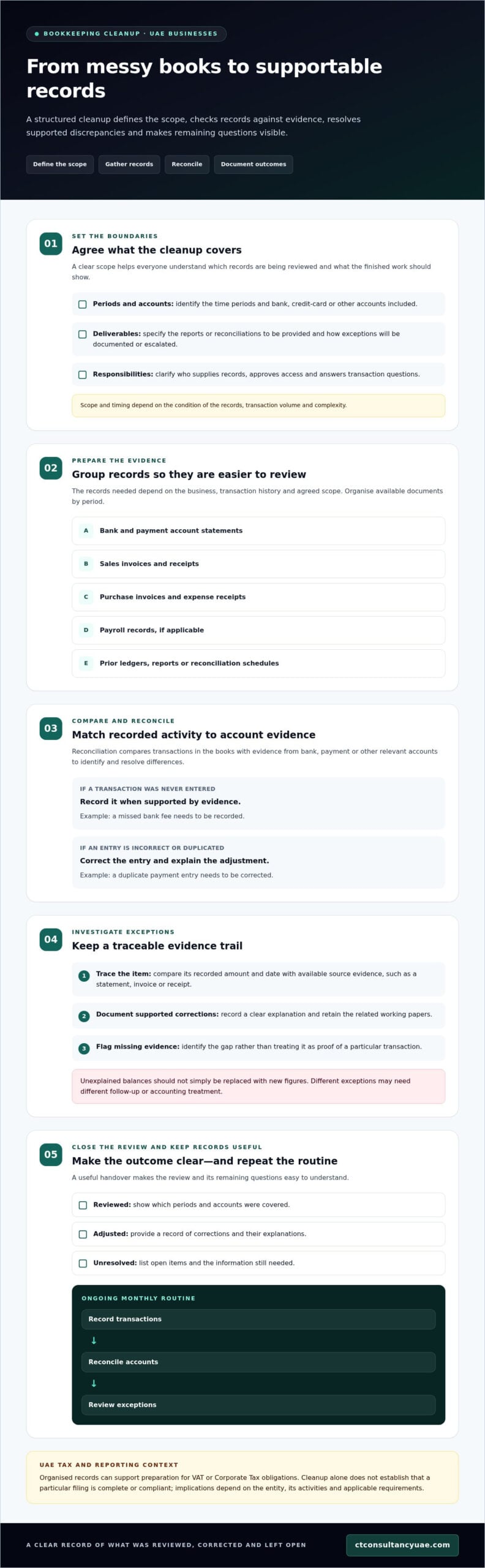
Before work begins, agree on what the cleanup covers and how its outcome will be assessed. Professional help for messy books is easier to manage when everyone understands the affected periods, accounts, available records and reporting needs. A defined scope also separates historical corrections from transactions that still need to be entered, reducing ambiguity as questions arise.
Set out which periods and accounts are included, what reports or reconciliations will be delivered, and how exceptions will be documented and escalated. Clarify who will supply records, approve access and answer transaction questions. Scope and timing depend on the condition of the records, transaction volume and complexity, so don’t assume every cleanup follows the same schedule.
Useful handover outputs may include reconciled accounts, a record of adjustments and a list of unresolved items with the information still needed. Organise statements, invoices and prior reports by period, then appoint one knowledgeable contact who can respond to questions or direct them to the right colleague. This keeps decisions traceable and helps prevent delays caused by conflicting explanations.
Consider relevant VAT and Corporate Tax records when defining the work, since accurate underlying accounts can support compliance processes and preparation. The specific implications depend on the business’s circumstances and applicable UAE requirements. Bookkeeping cleanup alone doesn’t determine a filing position or guarantee a compliance outcome. CTC’s VAT and Corporate Tax services can help businesses manage tax compliance alongside organised accounts.
For SMEs and freelancers, bookkeeping and accounting services provide a route from a one-off review to ongoing transaction recording and ledger maintenance. A cleanup establishes a reliable starting point; recurring support helps maintain it. Define the records, reporting needs and ongoing tasks that should be included in your bookkeeping support.
A historical cleanup restores a more dependable starting point, but it cannot keep future records current on its own. A practical monthly cycle is straightforward: capture transactions as they occur, reconcile bank and payment accounts, review exceptions, and retain supporting records. Regular attention makes it easier to spot a missing entry or unexplained difference before it becomes part of a larger backlog.
With routine recording and reconciliations in place, business owners can review current information rather than rely on figures assembled long after the fact. Periodic review can surface changes in cash position, outstanding customer balances or spending patterns in time to inform decisions. Organised records also make it easier to provide a clear trail of transactions when supporting information is needed for a review or audit.
A one-time cleanup addresses historical records within an agreed scope; it doesn’t replace ongoing bookkeeping. The right level of support depends on transaction activity, internal capacity and reporting needs. Consistency matters more than applying an identical process to every company.
CTC Tax & Accounting provides personalised bookkeeping and accounting support for UAE SMEs and freelancers, including recurring bookkeeping retainers for transaction recording and ledger maintenance. This support can establish a regular process after cleanup, with the scope shaped around the business’s requirements. Learn how bookkeeping and accounting services can support ongoing financial oversight.
Professional help for messy books can begin a more controlled accounting routine, not merely correct past entries. If your business is ready to plan that transition, discuss a tailored bookkeeping cleanup and ongoing accounting support.
Clean, current accounts give you a stronger basis for deciding what to prioritise, when to commit resources and which questions need closer attention. Make financial oversight fit the way your business operates, so maintaining reliable records becomes part of its routine rather than another backlog. Professional help for messy books can support that transition with an approach tailored to your records and ongoing support needs.
CTC Tax & Accounting provides personalised bookkeeping and accounting support to businesses in the UAE. The focus is on helping you create a practical plan for keeping financial information organised and useful as your business evolves.
Ready to take the next step? Discuss tailored bookkeeping support and plan a structured approach to stronger financial oversight. With a clear process in place, you can give greater attention to decisions and growth, supported by accounts you can use with confidence.
Yes. A bookkeeper can review records covering several months or years, but the scope depends on the periods involved, record availability and transaction complexity. A business with complete statements and orderly invoices may require a different review from one with multiple accounts and gaps in its files. Agreeing on the starting and ending periods helps clarify the work and its expected outputs.
Gather bank and payment account statements, sales and purchase invoices, receipts, payroll records where applicable, and prior ledgers or financial reports. If available, include earlier VAT or Corporate Tax working papers related to the periods under review. Requirements vary by business and transaction history, so begin with what you have and organise it by account and period rather than delaying over one missing file.
Professionals compare ledger entries with account statements and supporting documents, then trace differences to their likely source. For example, a payment recorded twice may be treated differently from a bank charge that was never entered. Corrections should be explained in the working records. Items without enough evidence should remain identified as unresolved rather than being assigned an unsupported explanation.
No. Incomplete records don’t automatically prevent a review, though they can limit what can be substantiated. A professional can assess available statements, invoices, receipts and other business records to determine which transactions can be supported and where gaps remain. Professional help for messy books can clarify what evidence is still needed; it can’t guarantee that missing documentation can be recovered or every balance conclusively established.
It depends on your transaction volume, internal capacity and how frequently you need current financial information. A one-off cleanup addresses historical records within its agreed scope, while recurring bookkeeping involves recording new activity and maintaining ledgers over time. A business with reliable in-house processes may need a different arrangement from one that prefers regular external support, so align the approach with your operating needs.