
What if the main challenge in an FTA audit isn’t a single tax calculation, but tracing each figure back to consistent records? For UAE businesses, uncertainty about what the Federal Tax Authority may review can make invoices, VAT returns and accounting balances difficult to reconcile. Understanding the vat audit process in uae helps replace that uncertainty with a clear plan: an audit is a documented verification of tax compliance, not the same exercise as a financial audit.
This guide explains how a VAT audit typically progresses, which records may be requested, and how to organise and respond to information requests. You’ll also learn how to reconcile reported figures with accounting records and source documents. When internal processes need strengthening, structured bookkeeping, VAT compliance and internal audit support can help build a more organised foundation for audit readiness.
The vat audit process in uae is a Federal Tax Authority (FTA) review of a business’s VAT compliance, records and relevant transactions. It may involve checking whether VAT returns are supported by underlying documents and whether the treatment of sales, purchases and imports is consistent. For general context on how VAT operates, see Understanding Value-Added Tax.
An FTA VAT audit tests whether VAT has been accounted for and reported correctly. A financial-statement audit assesses whether financial statements present a fair picture under the applicable reporting framework. An internal audit, by contrast, assesses an organisation’s controls, processes and risks. These reviews may examine overlapping records, but they have different purposes. An audit communication is a formal request or notice, not, by itself, proof that the business has failed to comply.
The FTA conducts the review and communicates the matters under examination. The business should coordinate responses through an authorised representative, with relevant finance, accounting or tax personnel helping to locate records and explain transactions. The scope depends on the issues under review. A request may focus on particular periods, transactions or VAT treatments rather than every aspect of the business.
Records may include VAT returns, tax invoices, credit notes, general ledgers and supporting transaction documents. The FTA may compare reported sales and output VAT with sales records, and assess input tax claims against purchase invoices and evidence supporting the transaction. Where relevant, import or export documentation can help substantiate how a supply was treated.
For example, if a return reports input VAT that differs from the purchase ledger, the invoices and transaction records can help explain the variance. Check that the transaction is recorded in the correct period, trace the amount from the invoice to the ledger and return, and document any difference. Clear bookkeeping and reconciliations make these links easier to follow, while a well-defined scope helps the business prepare a relevant, orderly response.
The vat audit process in uae commonly moves through communication, scope-setting, records requests, review, findings and follow-up. These are practical stages, not a guaranteed sequence or fixed timetable. The FTA’s approach and the information requested depend on the matters under examination. The IMF Guide to VAT Audit Methodology also illustrates how audit work can involve reviewing records and testing transactions against the applicable tax treatment.
Read each formal communication carefully. Identify the periods or transactions covered, the documents requested, the submission method and any stated deadline. Assign a coordinator and keep a request log that records what was asked for, who is responsible for providing it, and when it was submitted. Retain copies of every response and supporting file.
During the review, the FTA may compare returns with ledgers and source documents, then request clarification or additional evidence where figures or VAT treatment need explanation. Respond to each point directly. For each question, identify the relevant period and transaction, state the explanation, and link it to the supporting records instead of sending an unstructured collection of files.
Questions raised during the review or preliminary observations should not automatically be treated as a final assessment or decision. Check the communication’s status and basis, compare calculations with the underlying transactions, and provide relevant explanations or evidence through the stated process. If a formal outcome is issued, verify the current official procedures and applicable deadlines for responding, reconsideration or appeal. Requirements can change, so rely on current FTA guidance.
In summary, an FTA audit typically progresses from communication and scope definition through evidence review to findings and follow-up, with the sequence shaped by the case. A request log and orderly reconciliations can make each step easier to manage. Businesses seeking to strengthen their VAT compliance processes can explore VAT and tax compliance support.
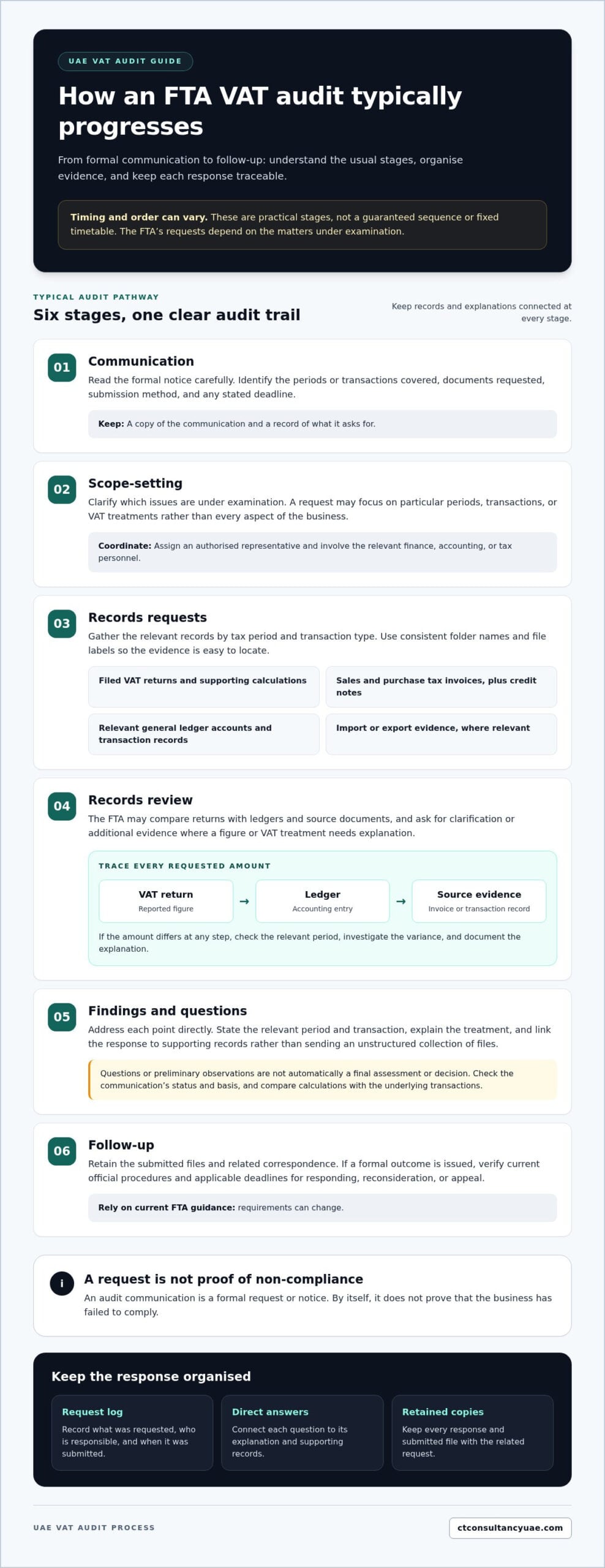
Preparation is more manageable when each figure in a VAT return can be traced to its supporting records. Before responding, reconcile the figures requested against your accounting records and source documents, investigate variances, and assemble a clear file for the relevant tax periods. A simple check is to follow each requested amount from the VAT return to the ledger, then to the invoice or other transaction evidence.
Organise documents by tax period and transaction type, using consistent folder names and file labels. The aim is a clear audit trail from the original evidence through the accounting entry to the VAT return. Include:
For example, a purchase included in an input tax claim should be traceable from its invoice to the ledger and then to the relevant return. If the amount differs at any step, note the reason and keep the calculation or other evidence that explains it. Store submitted files with the related FTA request and response so the full record is easy to retrieve.
Assign one internal owner to coordinate requests, track stated deadlines and maintain the current version of each document. Before submission, check that records are complete, legible and labelled so the reviewer can identify the period and transaction without guesswork. Retain a copy of every response and attachment.
If a figure does not match, explain the difference factually and include the supporting calculation or evidence. For instance, distinguish a timing difference from a correction, and show how the amount was reconciled. Don’t adjust records simply to force a match. Preserve the original audit trail and document any correction through the appropriate process.
These practices support a more orderly vat audit process in uae and build on sound VAT administration. For background on registration and ongoing obligations, use current official guidance. CTC Tax & Accounting also provides VAT registration and compliance support to help businesses strengthen the processes behind their records.
Once the FTA communicates its findings or another formal outcome, review the document alongside the supporting calculations and the transactions examined. Check which periods and VAT treatments are addressed, how any adjustment was derived, and whether the conclusion reflects the records provided. Separate requests for clarification or preliminary observations from a formal assessment or decision, and follow the instructions and deadlines stated in the communication.
Don’t assume a particular penalty or outcome. Applicable rules and procedures depend on the circumstances and may change, so verify current requirements through official FTA guidance before deciding how to respond or address an error.
Convert each substantiated observation into a documented action. Record the issue, its cause, the correction or process change, the person responsible and how completion will be checked. If a mismatch arose because a ledger wasn’t reconciled to a return, for example, introduce a periodic reconciliation and assign clear review responsibility. Consistent record retention and version control can also make future checks more orderly. Accounting and bookkeeping support can help maintain reliable ledgers and supporting records.
Structured support may be useful when findings involve complex transactions, several reporting periods or differences that are difficult to trace. CTC Tax & Accounting provides VAT compliance support to help organise records, review reconciliations and clarify technical VAT treatment in context. The appropriate work depends on the business’s records and the matters raised; no audit result should be assumed. Explore VAT and tax compliance services for support with your records and compliance processes.
Handled systematically, the vat audit process in uae can also highlight practical improvements to documentation and review controls, helping the business strengthen its ongoing compliance processes.
A clear understanding of the vat audit process in uae helps your business respond with greater structure: follow the FTA’s communications, keep records traceable to VAT returns, and review findings carefully before deciding on corrective action. Well-maintained reconciliations and documented controls can also support stronger compliance beyond the audit itself.
For SMEs and freelancers managing UAE regulatory requirements, organised accounting and tailored VAT compliance support can make complex records and processes easier to manage. Founded in 2015, CTC Tax & Accounting supports businesses through VAT compliance, bookkeeping, accounting and internal audit services.
Explore tailored UAE tax compliance support to take a considered next step towards more orderly records and confident compliance. Consistent preparation and support can help your business approach future requirements with greater clarity.
There isn’t one publicly established trigger that applies to every UAE VAT audit. The FTA selects audits and defines their scope through its compliance and verification activities, with the matters reviewed depending on the case. The vat audit process in uae may involve checking particular returns, transactions or reporting periods. A review request alone shouldn’t be taken as proof of a specific risk profile or an established breach.
The duration varies according to the audit’s scope, the volume and organisation of the records, and how promptly the business can provide complete responses. A focused review supported by well-indexed documents may involve less follow-up than a broader review with unresolved discrepancies, but no standard duration should be assumed. Check the FTA’s formal communications for stated requirements, and verify current official guidance before relying on timing rules.
Documents depend on the FTA’s request and the transactions under review. Common records include filed VAT returns, tax invoices, credit notes, accounting ledgers and supporting transaction evidence. The FTA may also request import or export documents where these substantiate the VAT treatment. Organise records by tax period and transaction type, and reconcile return figures to the ledger and source documents so each amount can be traced clearly.
No. A VAT audit notice or information request initiates or relates to a review; it does not, by itself, establish that your business has failed to comply. Read the communication carefully to understand its scope, requested records and stated requirements. Coordinate a complete, factual response, retain copies of submitted documents, and distinguish preliminary questions from any formal findings or decision communicated later.
Review the FTA’s formal communication, the transactions concerned and any supporting calculations before deciding on next steps. The appropriate response may depend on whether the communication is a query, finding or formal decision, as well as the applicable procedure. Document any corrective action and preserve the supporting evidence. Verify current official rules and deadlines for correcting an error or challenging an outcome rather than assuming a particular result.