What if your financial reports could do more than explain what has already happened? For many UAE businesses, accounts provide a clear record of past performance but leave owners with questions about cash flow, hiring, investment, and growth. That’s where CFO advisory can help turn financial information into a practical decision-making tool, rather than another layer of reporting.
Routine accounting remains essential, but strategic finance support connects the numbers to the choices ahead. Tailored CFO advisory from CTC Tax & Accounting can strengthen budgeting, cash-flow planning, and financial control while giving business leaders access to senior-level guidance without a full-time finance hire.
In this article, you’ll learn what CFO advisory can deliver, when it may be valuable, and how to shape an engagement around your business priorities. We’ll also look at how advisory can complement bookkeeping and accounting, creating clearer financial visibility and a more considered basis for decisions.
Key Takeaways
- Recognize when growth, cash-flow pressure, or investment plans call for stronger forward-looking financial insight.
- See how #cfoadvisory extends beyond accounting by connecting financial information with forecasts, planning, and strategic recommendations.
- Use a focused self-assessment to identify the decisions where clearer cash visibility or forecasting would make the greatest difference.
- Learn how CTC Tax & Accounting can connect financial information to priorities, analysis, and practical planning.
When Does CFO Advisory Become Valuable for a UAE Business?
Bookkeeping and accounting show what has happened. The next challenge is using that information to decide what to do. As a UAE business grows, cash-flow uncertainty, a potential investment, or more complex planning can make it harder to judge whether a decision is sustainable. Strategic finance support can help address these questions without adding a full-time CFO role.
CFO advisory turns financial information into practical guidance for planning, managing cash, and making business decisions. It draws on the wider responsibilities associated with a Chief Financial Officer (CFO), while tailoring the support to a company’s priorities. CTC Tax & Accounting provides CFO advisory services focused on budgeting, cash-flow management, and strategic financial guidance.
What business challenges can CFO advisory address?
Cash-flow uncertainty can make it difficult to decide when to hire, build inventory, or commit to a project. Unclear margins may leave an owner unsure which products or services contribute most to costs. A budget that isn’t linked to current plans can also obscure whether expansion is affordable. CFO advisory helps interpret these signals and connect them to operational choices, so decisions draw on more than a backward-looking report.
Is CFO advisory only for large businesses?
No. Executive-level finance support can be tailored to a business’s size, stage, and decision-making needs; it doesn’t automatically require a full-time hire. A growing SME might need to strengthen its cash-flow forecast before taking on staff, while another business may need structured budgeting to evaluate an investment. With #cfoadvisory, the focus is on matching guidance to the decisions the business needs to make, not adopting a one-size-fits-all finance structure.
What Does CFO Advisory Include Beyond Accounting and Bookkeeping?
Accounting and bookkeeping establish a reliable record of transactions and financial performance. CFO advisory uses that information to look ahead, assess options, and guide planning. Its scope can include budgets, cash-flow forecasts, financial analysis, and strategic recommendations, connecting financial oversight with business priorities.
Accounting: Records and organizes financial activity to support accurate reporting.
CFO advisory: Interprets financial information to develop forecasts, evaluate scenarios, and inform plans.
Executive decision-makers: Set priorities and make business decisions, using financial insight alongside operational considerations.
How does a CFO advisor support financial decisions?
Management accounts can show how actual performance compares with plans. A CFO advisor can use that information to prepare forecasts, examine possible choices, and provide practical recommendations. For example, before hiring, a business can assess the expected cost against its projected cash flow and budget capacity. Financial modelling helps make assumptions visible and compare scenarios, but it can’t guarantee an outcome. Explore CFO advisory services to see how tailored support can connect analysis with decisions.
How does CFO advisory complement accounting?
Advisory relies on dependable underlying records, but the work is distinct. Accounting organizes and reports financial activity; CFO advisory applies those records to forward-looking questions, such as whether a planned expense fits the budget or how cash needs may change. #cfoadvisory can add a decision-making layer to established finance processes rather than replace them. CTC Tax & Accounting provides accounting services alongside advisory, helping businesses connect financial records with planning and strategic guidance.
How Can You Decide Whether CFO Advisory Fits Your Business?
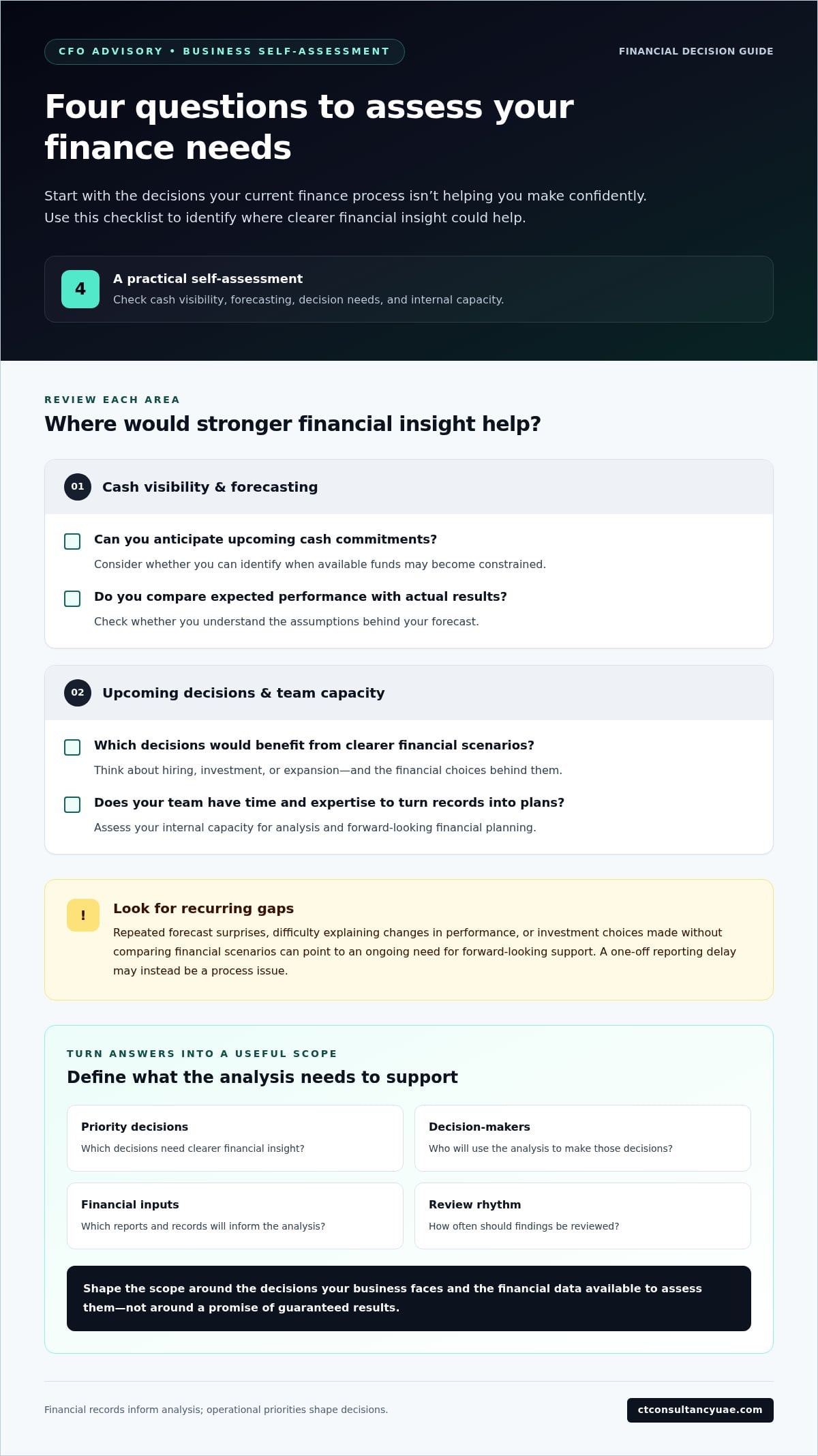
Start with the decisions your current finance process isn’t helping you make confidently. Consider these four questions:
- Cash visibility: Can you anticipate upcoming cash commitments and identify when available funds may become constrained?
- Forecasting: Do you compare expected performance with actual results and understand the assumptions behind your forecast?
- Decision needs: Which upcoming decisions, such as hiring, investment, or expansion, would benefit from clearer financial scenarios?
- Internal capacity: Does your team have the time and expertise to turn financial records into analysis and forward-looking plans?
Use your answers to define a practical objective, such as improving cash-flow visibility for a planned investment or clarifying the financial assumptions behind a hiring decision. Specify the analysis and reporting inputs you need, and the decisions they should inform, rather than expecting guaranteed business results. A useful advisory scope is shaped by the decisions a business faces and the financial data available to assess them.
Which signs suggest your finance function needs more strategic input?
Recurring forecast surprises, difficulty explaining changes in performance, or investment choices made without comparing financial scenarios can point to an ongoing need for forward-looking support. A one-off reporting delay may be a process issue. If the same gap repeatedly affects planning and decisions, broader strategic input may be useful.
What should a tailored advisory scope clarify?
Define the priority decisions, who will make them, which reports and records will inform the analysis, and how often findings will be reviewed. CTC Tax & Accounting tailors strategic financial guidance to business needs, helping align the scope with budgeting, cash-flow management, and planning priorities. Explore CTC’s CFO advisory services to discuss a tailored scope.
How Can CTC Tax & Accounting Turn CFO Advisory into a Practical Next Step?
A practical advisory process connects the financial information a business already has with the decisions it needs to make. CTC Tax & Accounting uses current financial records to clarify priorities, assess relevant figures, and shape planning around budgeting, cash-flow management, and strategic financial guidance. This creates a structured path from financial oversight to business planning, with the scope shaped around the company’s needs.
What should a first advisory discussion establish?
Prepare a concise picture of your business priorities, the reports currently available, and the near-term decisions that need financial insight. These might include managing cash around planned expenditure or assessing the assumptions behind a growth plan. Discussing those needs helps shape a focused advisory scope instead of a one-size-fits-all proposal. For broader context, read this UAE financial management guide.
How can advisory connect with wider business planning?
Financial analysis can inform related work when a business is assessing an opportunity, considering its value, or testing whether a proposed activity is feasible. The relevant analysis depends on the question: a valuation and a feasibility study serve different planning needs, but both can draw on an understanding of the company’s financial position. Where wider strategic support is useful, explore business advisory services.
With #cfoadvisory, the objective is to align financial analysis with the decisions and priorities that matter to your business. Explore CTC’s CFO advisory services to take the next step toward tailored financial planning and guidance.
Make Your Financial Insight Work for What Comes Next
Strong financial records explain performance, while strategic finance support connects that picture to future choices. CFO advisory can help UAE businesses improve cash-flow visibility, build more useful budgets, and assess decisions with clearer financial context. Its value comes from shaping support around important decisions, not adding reporting without a clear purpose.
CTC Tax & Accounting provides CFO advisory that includes budgeting, cash-flow management, and strategic financial guidance. With #cfoadvisory, business leaders can access tailored finance support that complements accounting processes and helps translate financial information into considered planning, without automatically requiring a full-time CFO.
Identify the upcoming decisions where better analysis would help, then explore how tailored advisory can support them. Explore tailored CFO advisory support to discuss your financial planning priorities.
Frequently Asked Questions
What is CFO advisory?
CFO advisory is strategic financial guidance that helps a business use its financial information to plan and make decisions. It can connect current performance with forecasts, budgets, cash-flow needs, and business priorities. Rather than focusing only on recording past transactions, #cfoadvisory helps leaders assess financial options, understand assumptions, and make more informed choices about growth, investment, and resource allocation.
How is CFO advisory different from accounting?
Accounting records, organizes, and reports financial activity, while CFO advisory applies financial information to forward-looking planning and strategic decisions. Accurate accounts provide the foundation for useful analysis, but they don’t by themselves show whether a planned expense fits the budget or how a decision could affect cash flow. The two functions complement one another, but serve distinct purposes.
Does a small business need CFO advisory?
A small business may benefit from CFO advisory when its leaders need stronger financial insight but don’t require a full-time CFO. Support can be tailored to the company’s stage and priorities, such as improving budget visibility or assessing the financial assumptions behind a growth plan. The key consideration is whether strategic guidance would help address real decisions, not the size of the business alone.
What services are usually included in CFO advisory?
CFO advisory commonly includes budgeting, cash-flow management, financial analysis, forecasting, and strategic financial guidance. The precise scope depends on the business’s priorities and the decisions it needs to support. At CTC Tax & Accounting, advisory work includes budgeting, cash-flow management, and strategic financial guidance, helping businesses connect financial oversight with planning while complementing their accounting processes.
When should a business consider CFO advisory?
Consider CFO advisory when cash-flow uncertainty, recurring forecast surprises, unclear performance drivers, or an upcoming investment makes decisions harder to assess. It may also help when financial reports describe past results but don’t answer practical questions about what to do next. Start by identifying one or two decisions where better analysis could clarify options and planning priorities.