A board doesn’t approve a CFO title; it approves the financial capability needed to protect and advance business priorities. If you’re asking how to convince my board we need a CFO, start by identifying the gap between the financial support you have and the decisions your business needs to make. Directors may see the role as added overhead, especially if current reports explain what has happened but don’t show what action to take. That concern is reasonable. Your proposal needs to connect the gap to specific business priorities.
This article shows how to build a board-ready case around practical needs such as cash-flow visibility, growth planning, and stronger decision support. You’ll learn how to link CFO-level leadership to defined outcomes, compare full-time, part-time, and outsourced support, and agree on responsibilities and review measures before work begins. The goal is a tailored proposal that gives directors a clear basis for deciding what level of financial leadership the business needs now.
Key Takeaways
- Frame the request around a defined business problem, such as unreliable forecasts, reactive cash decisions, or limited financial visibility.
- To explain how to convince my board we need a CFO, use existing reports and decision examples to show where stronger financial leadership could help.
- Compare full-time, part-time, and outsourced support by availability, scope, decision complexity, and your internal finance capacity.
- Present a focused recommendation and seek approval for a defined scope or evaluation period with clear measures for review.
How to Convince Your Board You Need a CFO: Start With the Business Problem
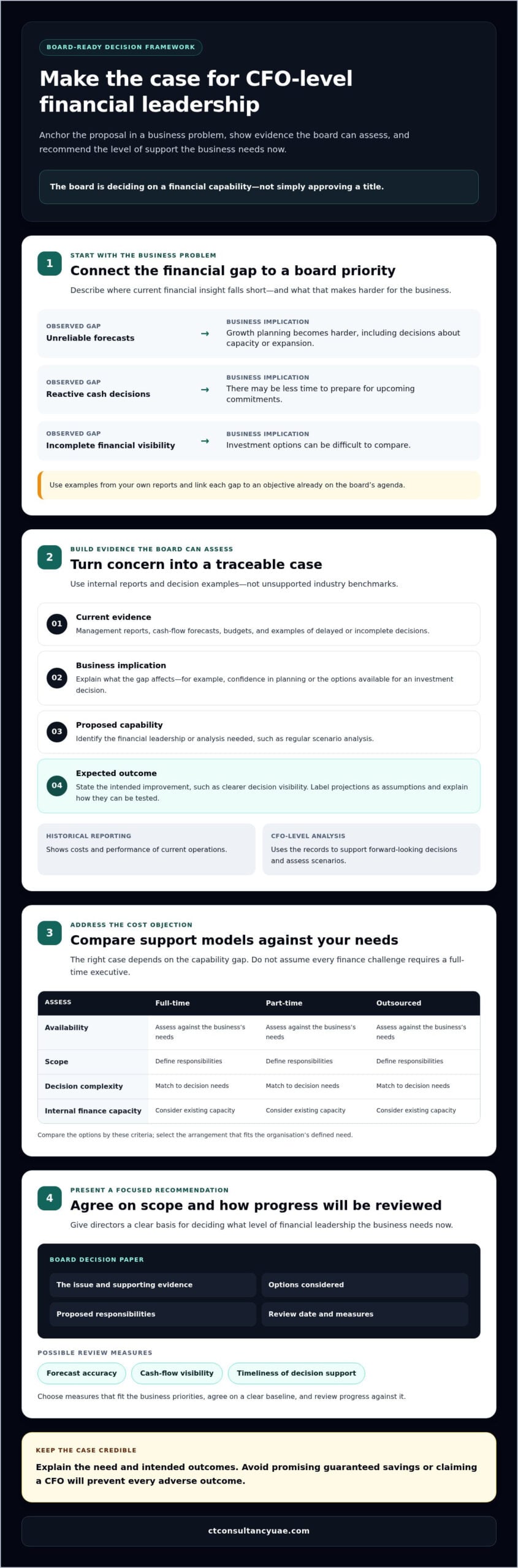
Build the proposal around a decision the business needs to make, not the seniority of the person you want to hire. To answer how to convince my board we need a CFO, identify where current financial insight falls short and explain how that affects the board’s priorities. For example, unreliable forecasts can make growth planning harder, reactive cash decisions can limit preparation for upcoming commitments, and incomplete financial visibility can make investment options difficult to compare.
CFO-level leadership turns financial information into forward-looking analysis that supports better business decisions. The Chief Financial Officer (CFO) role spans financial oversight and strategic input, but the right case depends on what your organisation needs. The board should assess a specific capability gap, not assume that every finance challenge requires a full-time executive.
Distinguish bookkeeping from CFO-level financial leadership
Accurate bookkeeping and accounting records are the foundation for reliable reporting and compliance. CFO-level work uses those records to guide decisions. Historical reports, for instance, can show the costs and performance of current operations. Scenario analysis can help directors assess a proposed investment by setting out its cash requirements, the assumptions behind it, and how it could affect other priorities. The records remain essential, but the analysis helps the board decide what to do with them.
Translate finance gaps into board priorities
Connect each gap to an objective already on the board’s agenda. If growth is a priority, explain how uncertain forecasts affect decisions about capacity or expansion. If cash resilience matters, show how late visibility can reduce time to prepare for upcoming commitments. If oversight is the concern, identify where directors lack timely, decision-ready analysis. Use examples from your own reports rather than unsupported industry benchmarks. Then consider whether tailored CFO advisory services could address the gap alongside other support, rather than assuming a permanent hire is necessary.
Build a CFO Business Case With Evidence the Board Can Assess
Turn concerns about financial visibility into evidence directors can examine. Gather current management reports, cash-flow forecasts, budgets, and examples of decisions delayed or made with incomplete information. Set a concise baseline: where forecasts differ from actual results, how often cash assumptions change, or which investment decisions lack scenario analysis. Choose measures that relate directly to the business problem, and use current internal data rather than unsupported industry benchmarks.
Describe the cost of delay in operational terms. For example, explain how an outdated cash forecast could narrow the options available for an investment decision. Avoid claiming that a CFO would guarantee savings or prevent every adverse outcome. A perspective on strategic investment in finance leadership can also help frame why increasing complexity may call for more forward-looking financial input.
Use a repeatable evidence-to-outcome sequence
For each priority, set out four links: current evidence, business implication, proposed capability, and expected outcome. If forecasts don’t reflect changing assumptions, for example, the business implication may be reduced confidence in planning. The proposed capability might be regular scenario analysis, with clearer decision visibility as the intended outcome. Label projections as assumptions, state what they depend on, and explain how the board can test them at review.
Prepare a concise board decision paper
Keep the paper focused on the issue, evidence, options, proposed responsibilities, and review date. Specify measures directors can use to assess progress, such as forecast accuracy, cash-flow visibility, or the timeliness of decision support, where these fit your priorities. For further context on financial management for SMEs, explore relevant guidance before finalising the paper. A tailored CFO advisory approach may help align the proposed scope with the business’s needs.
Connect the CFO proposal to named business objectives, then agree on a small set of measures the board can review against a clear baseline.
Address the Cost Objection: Compare Full-Time, Part-Time, and Outsourced CFO Support
A board may reasonably conclude that a full-time CFO is premature if executive finance work is only needed at key planning points, or if ongoing responsibilities haven’t been defined. Address the concern by comparing the available options against the business’s actual requirements, not title or perceived prestige. Consider how often senior input is needed, the complexity of upcoming decisions, the scope of the work, and the capacity of the existing finance team.
- Full-time: May suit a sustained executive workload, with continuing strategic finance requirements and regular involvement in business decisions.
- Part-time: Can provide scheduled senior input when the need recurs but doesn’t require a full-time appointment.
- Outsourced: May fit when the business needs defined CFO-level support, such as budgeting or cash-flow management, while maintaining its existing finance capacity.
Assess the full commitment within your budget, including the scope and availability expected from each model. Don’t assume one option is automatically less costly or more suitable. Clarify what is included, who owns each responsibility, and how the board will evaluate the arrangement.
When a full-time CFO may be appropriate
A full-time role may be appropriate when strategic finance work is continuous, senior leaders need frequent financial input, and complex decisions create a sustained executive workload. Before approving a hire, define the remit and expected outcomes. The board should be able to distinguish ongoing CFO responsibilities from work already covered by accounting staff or other advisers.
When flexible CFO support may fit better
Part-time or outsourced support can give a business access to executive-level financial expertise without appointing a full-time CFO. This may suit a clearly defined need that is limited in frequency or scope. If you’re deciding how to convince my board we need a CFO, present flexible support as an option to assess, not a foregone conclusion. Explore CFO advisory services to consider a tailored scope.
Present the CFO Proposal and Agree on a Measurable Next Step
Keep the board presentation focused on the decision. Cover five points in order: the business issue, the evidence behind it, the available support models, your recommendation, and the specific approval you’re requesting. If you’re considering how to convince my board we need a CFO, make the request bounded. Seek approval for a defined scope, initial engagement, or evaluation period rather than an open-ended commitment.
Agree with directors on how progress will be assessed. Measures might include forecast reliability, the timeliness of cash-flow information, or whether leadership receives analysis for strategic decisions. Assign an owner to each deliverable, and confirm who will report results to the board and when.
Prepare for the board’s likely questions
Be ready to explain what the existing accounting team handles, where CFO-level responsibilities begin, and which outcomes are reasonably within scope. Bring supporting reports and identify the assumptions behind any projections. State what the proposal excludes, too, so directors can distinguish the requested capability from work that remains with internal staff or other providers.
Turn approval into an accountable working arrangement
Before work begins, document the agreed deliverables, reporting cadence, access to financial data, responsibility boundaries, and a formal review point. For example, the board might review whether agreed forecasting outputs are being delivered and whether they support the decisions identified in the proposal. This gives directors a clear basis to continue, revise, or conclude the arrangement.
A structured proposal gives directors a practical way to approve financial leadership while retaining oversight. If CFO-level support is the option you recommend, explore CFO advisory services and support as you define a scope that fits your business.
Make the Next Board Decision Clear and Measurable
A persuasive CFO proposal starts with a business need, supports it with evidence, and matches it to an appropriate level of financial leadership. Rather than asking directors to approve a title on faith, show how the proposed scope connects to current priorities, define what progress will look like, and agree when it will be reviewed. This gives the board a structured way to assess whether the arrangement is providing useful decision support.
If you’re still considering how to convince my board we need a CFO, focus the next discussion on the capability your organisation requires, whether that means a full-time appointment or more flexible advisory support. CTC Tax & Accounting’s CFO advisory services include budgeting and cash-flow management, giving SMEs access to executive-level financial expertise without a full-time hire.
Explore tailored CFO advisory support to consider how a defined scope could support your business priorities. Bring a clear proposal and review measures to help the board make an accountable decision.
Frequently Asked Questions
How do I prove to the board that our business needs a CFO?
Show the board a specific financial capability gap and explain how it affects business decisions. If you’re asking how to convince my board we need a CFO, use existing reports, forecasts, and examples to connect the gap to a priority such as cash resilience or growth planning. Recommend a suitable support model, define expected outcomes, and propose measures the board can review against a clear baseline.
When should a company hire its first CFO?
A company should consider its first CFO when financial decision-making requires sustained executive-level input that current resources can’t provide. Signals may include increasingly complex planning, forecasts that don’t support major decisions, or a recurring need for strategic financial analysis. These issues don’t automatically justify a full-time hire. Assess how continuous the work is, what outcomes are needed, and whether flexible support could address the gap.
Can a small business use a part-time or outsourced CFO?
Yes. A small business can consider part-time or outsourced CFO support when it needs senior financial input but doesn’t require a full-time appointment. The appropriate scope depends on the frequency of support, decision complexity, and internal finance capacity. CTC Tax & Accounting’s CFO advisory service includes budgeting and cash-flow management, giving SMEs access to executive-level financial expertise without hiring a full-time CFO.
What should a CFO proposal to the board include?
A CFO proposal should identify the business problem, provide supporting evidence, compare relevant options, and recommend a defined scope. It should also clarify responsibilities, expected outcomes, assumptions, and what falls outside the proposed remit. Ask the board to approve a specific next step, such as an initial engagement or evaluation period, and agree on measures, reporting ownership, and a formal review point.