
Over 68,600 UAE entities recently secured an automated waiver of the AED 10,000 late-registration penalty by accelerating their filings within the seven-month window. It’s understandable if the transition from general guidance to strict FTA enforcement feels like a high-stakes challenge for your firm. You aren’t alone in seeking clarity on how to reduce corporate tax liability legally while maintaining a flawless compliance record.
This briefing provides a sophisticated roadmap to optimize your fiscal position under the 2026 regulatory framework. We’ll explore the critical extension of Small Business Relief for revenues up to AED 3,000,000 and the specific 95% ownership requirements necessary to establish a consolidated Tax Group. By meticulously aligning your business structure with these statutory provisions, you’ll secure long-term stability and a significantly lower effective tax rate. Our analysis also clarifies the complex nuances of expense deductibility and interest caps, ensuring every dirham is accounted for with professional precision.
The UAE’s fiscal landscape is governed by a standard 9% corporate tax rate, which applies to taxable income exceeding AED 375,000. For income below this threshold, a 0% rate is maintained to support smaller enterprises. Understanding the mechanics of taxation in the United Arab Emirates requires a clear distinction between accounting profit and taxable income. While your financial statements reflect accounting profit, the Federal Tax Authority (FTA) requires specific adjustments for non-deductible items, such as certain entertainment costs, to arrive at the final taxable figure.
It’s vital to distinguish between legal tax optimization and illegal evasion. Strategic planning focuses on how to reduce corporate tax liability legally through statutory allowances and structural alignment. Conversely, evasion involves deliberate misrepresentation or concealment of income, which carries severe administrative penalties. Engaging professional tax consultancy services in dubai ensures your optimization strategies remain within the bounds of Decree-Law No. 47 of 2022. This precision is essential for maintaining a clean compliance record while maximizing your firm’s financial health.
Under Ministerial Decision No. 131 of 2026, the Small Business Relief (SBR) program has been extended to tax periods ending on or before 31 December 2029. Eligible businesses with gross revenue of AED 3,000,000 or less in the current and prior periods can elect to be treated as having no taxable income. This effectively secures a 0% tax rate without the need for complex transfer pricing documentation. However, you should recognize that entities claiming SBR cannot carry forward tax losses or net interest expenditure from that period to future years. This relief provides a significant lifeline for startups, though it requires a careful annual election on the tax return.
Reducing taxable profit hinges on the meticulous identification of deductible expenditure. Under the official UAE corporate tax framework, expenses incurred wholly and exclusively for business purposes are generally deductible. Core operational costs, including staff salaries, office rent, and utility fees, form the foundation of these claims. However, the Federal Tax Authority (FTA) requires contemporaneous documentation to substantiate every entry. Without precise records, even legitimate costs may be disallowed during a 2026 audit.
Optimizing your fiscal position also involves the strategic timing of capital expenditures. By aligning asset acquisitions with your tax periods, you can leverage depreciation schedules to offset taxable income effectively. This level of detail requires robust accounting services to ensure every dirham spent is categorized correctly. It’s a fundamental pillar for any executive investigating how to reduce corporate tax liability legally while maintaining high-end corporate governance standards.
Specific caps apply to mixed-purpose expenses that require careful classification. While internal staff events remain 100% deductible, Article 32 limits the deductibility of entertainment for customers, suppliers, or partners to 50%. This includes meals, hospitality, and accommodation costs. Additionally, the General Interest Deduction Limitation Rule (GIDLR) caps net interest expenditure at 30% of adjusted EBITDA, though a de minimis safe harbor of AED 12,000,000 provides relief for many enterprises.
To ensure a frictionless audit, apply the “wholly and exclusively” test using this checklist:
Maintaining these standards ensures your business remains audit-ready. If you require executive-level oversight to refine these processes, our CFO advisory services provide the strategic clarity needed for complex tax planning.
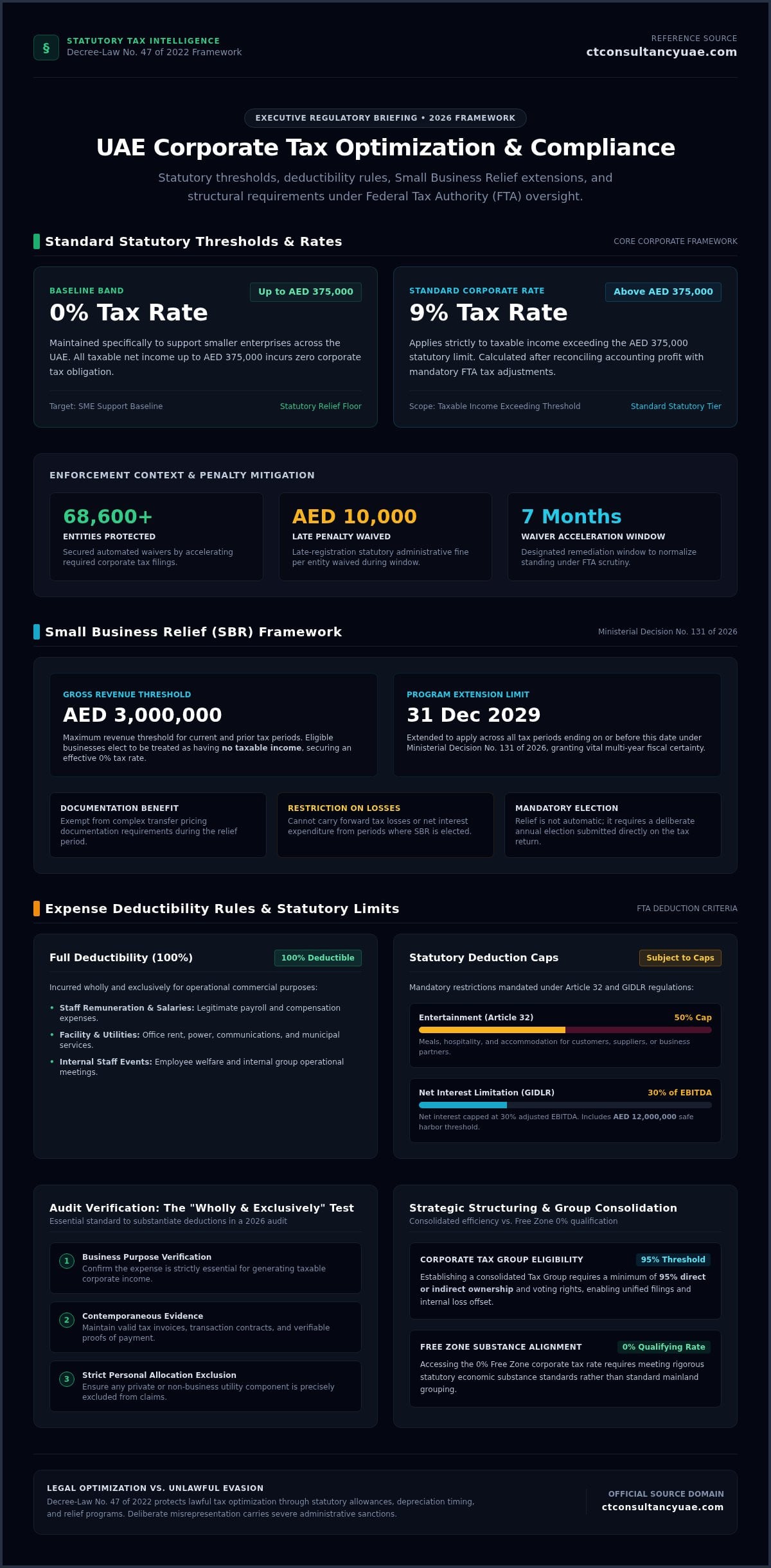
Choosing the optimal corporate structure is a pivotal decision for long-term fiscal efficiency. Mainland entities typically follow the standard official UAE corporate tax framework, whereas a Qualifying Free Zone Person (QFZP) may benefit from a 0% rate on “Qualifying Income.” This incentive isn’t an entitlement. It requires rigorous adherence to substance requirements, including physical presence and core income-generating activities. If an entity fails the de minimis test—where non-qualifying revenue exceeds 5% of total revenue or AED 5,000,000—it loses its 0% status for five years.
Strategic structural alignment requires high-level financial oversight to navigate these complexities. Our CFO advisory services provide the executive insights necessary to determine whether maintaining Free Zone status or transitioning to a Mainland structure offers the most robust path for your enterprise. This ensures your configuration is optimized for both growth and compliance.
For conglomerates, forming a Tax Group is a primary method for how to reduce corporate tax liability legally. A UAE resident parent company and its subsidiaries can file a single consolidated return if the parent holds at least 95% of the share capital and voting rights. This structure eliminates the administrative burden of internal transfer pricing for intra-group transactions and allows for the seamless offsetting of losses between profitable and loss-making sister companies.
When the 95% threshold isn’t met, entities sharing 75% common ownership can still transfer tax losses, provided the offset doesn’t exceed 75% of the recipient’s taxable income. It’s essential that all related party transactions adhere to the Arm’s Length principle. This ensures that pricing mirrors market conditions, protecting the group from FTA adjustments and penalties. To refine your structural strategy, consult our business advisory experts today.
Regular internal audits serve as a primary defense against fiscal leakage. These reviews identify overpayments and ensure that all eligible deductions are captured before the filing deadline. By scrutinizing ledger entries against FTA standards, businesses can rectify errors that would otherwise trigger administrative penalties. This proactive approach is a cornerstone of how to reduce corporate tax liability legally while maintaining an impeccable standing with the authorities. It transforms the audit process from a reactive necessity into a strategic tool for financial optimization.
There’s also a vital synergy between VAT and Corporate Tax strategies. Inconsistent reporting between these two regimes is a common red flag for regulatory scrutiny. Aligning your tax positions ensures that input VAT claims and corporate expense deductions are reconciled, providing a unified financial narrative. Utilizing expert business advisory services allows for this holistic oversight, ensuring that every transaction supports your broader fiscal goals without creating compliance gaps.
Relying on a DIY approach often results in missed statutory reliefs or the misapplication of the AED 3,000,000 Small Business Relief threshold. These oversights lead to costly FTA fines or lost opportunities for optimization. CTC Tax & Accounting removes this friction by providing specialized expertise tailored to the UAE’s specific regulatory environment. We ensure your business navigates the 2026 landscape with precision and confidence.
To maintain a tax-efficient enterprise, adopt these essential practices:
Take the next step toward fiscal security by booking a strategic consultation with our Corporate Tax Advisory team to develop your customized compliance roadmap.
Navigating the UAE’s evolving tax environment requires more than just awareness; it demands a proactive alignment with statutory reliefs and structural opportunities. You’ve seen how leveraging the Small Business Relief extension through 2029 and establishing robust Corporate Tax Groups can protect your margins. Meticulous documentation and a clear distinction between accounting profit and taxable income remain your strongest assets. Ultimately, the most effective way to understand how to reduce corporate tax liability legally is through a compliance-first approach that prioritizes long-term stability over short-term fixes.
At CTC Tax & Accounting, we provide decades of international financial expertise and specialized SME regulatory support to ensure your business thrives. Our team offers comprehensive end-to-end compliance solutions that remove the friction from complex filings. It’s time to transform your tax obligations into a strategic advantage for growth. Optimise your tax strategy today with a professional consultation from CTC Tax & Accounting. Your journey toward a frictionless and tax-efficient future starts with a single, strategic step.
Yes, you can legally achieve a 0% effective tax rate if your taxable income remains below the AED 375,000 threshold or if you qualify for Small Business Relief. Under Ministerial Decision No. 131 of 2026, eligible entities with revenue under AED 3,000,000 can elect for relief until 2029. Qualifying Free Zone Persons also enjoy a 0% rate on qualifying income, provided they maintain adequate substance and meet all regulatory conditions.
Certain expenditures are strictly disallowed by the Federal Tax Authority to maintain fiscal integrity. These include administrative penalties, corporate tax payments, and donations made to non-qualifying public benefit entities. Additionally, only 50% of expenses incurred for entertaining customers or suppliers are deductible. Understanding these exclusions is a vital component of how to reduce corporate tax liability legally, as it prevents the inflation of non-deductible costs that trigger unnecessary tax exposure.
Freelancers operating under a valid permit are taxable persons if their annual turnover exceeds AED 1,000,000. However, they can access Small Business Relief if their total gross revenue stays below AED 3,000,000 for the tax period. This election allows the freelancer to be treated as having no taxable income. It’s a strategic lifeline that simplifies compliance by removing the need to maintain complex transfer pricing local files until 2029.
Interest deductibility isn’t absolute and is governed by the General Interest Deduction Limitation Rule. While net interest is generally deductible, it’s capped at the higher of 30% of your adjusted EBITDA or the safe-harbor threshold of AED 12,000,000. Any excess interest disallowed in the current period can be carried forward for up to ten tax years. This ensures highly leveraged structures don’t erode the UAE’s tax base inappropriately.
Submitting an inaccurate tax return can lead to significant administrative penalties and heightened scrutiny during future Federal Tax Authority audits. If you discover an error, you should file a voluntary disclosure to rectify the position before the authority initiates an assessment. Incorrectly claiming deductions often stems from poor record-keeping or a misunderstanding of Article 33 exclusions. Professional oversight ensures your filings remain accurate, shielding your business from the friction of avoidable legal disputes.