
The implementation of the 9% UAE Corporate Tax on 1 June 2023 has fundamentally shifted the requirements of financial leadership, making the traditional back-office accountant a potential liability for ambitious firms. Many executives now find themselves burdened by complex compliance mandates while remaining blind to future cash flow volatility. It’s a common frustration to possess vast amounts of data yet lack the clarity needed to make informed investment decisions. This gap between recording the past and architecting the future often determines whether a company merely survives or truly scales.
Understanding the distinction between a strategic cfo vs traditional cfo is essential for navigating this high-stakes environment. By exploring this guide, you’ll learn how to pivot from reactive reporting to a proactive framework that optimizes capital allocation and ensures full regulatory adherence. We provide a comprehensive overview of how elite financial leadership removes operational friction, allowing you to focus on national expansion with absolute confidence in your fiscal foundation.
The role of the Chief Financial Officer has transitioned from a back-office administrative function to a pivotal seat at the boardroom table. Historically, the position functioned as a “Scorekeeper,” serving as the primary guardian of accuracy and fiduciary stewardship. This model prioritizes historical data and audit readiness to ensure that every entry aligns with standard reporting requirements. While this foundation remains critical, relying solely on a retrospective view isn’t sufficient for businesses facing rapid market fluctuations.
When comparing a strategic cfo vs traditional cfo, the most significant shift is the move from managing the balance sheet to driving the entire business value chain. A strategic leader acts as a growth architect, leveraging financial data to influence operational strategy and mitigate risks before they materialize. This evolution ensures that financial oversight isn’t just a hurdle to clear, but a catalyst for sustainable expansion.
Standard accounting services form the backbone of the traditional approach. This mandate centers on internal controls, risk mitigation, and ensuring historical accuracy for annual audits. While essential for basic compliance, this reactive framework lacks the predictive power needed to guide a company through complex expansion phases. It focuses on what happened yesterday rather than what’s possible tomorrow.
A strategic partner analyzes market trends and internal performance to forecast future outcomes with precision. By collaborating closely with CEOs, they refine business models for long-term scalability. To further strengthen your executive team’s capabilities, you can discover Poulton Consultancy for expert leadership and team-building guidance. This proactive planning transforms finance from a cost center into a powerful engine for value creation. It ensures that capital allocation aligns perfectly with national growth objectives, turning data into actionable intelligence for every department.
Distinguishing between a strategic cfo vs traditional cfo requires looking beyond professional titles and into daily operational mindsets. While the traditional model operates with a “What happened?” perspective to ensure books are balanced and audits are seamless, the strategic leader adopts a “What should we do next?” approach. This shift isn’t merely philosophical; it’s reflected in technology adoption. Traditional roles often rely on basic ledgers and manual tracking, whereas strategic leaders utilize advanced data analytics and ERP integration to turn raw numbers into predictive insights.
Communication styles also diverge significantly. A traditional executive focuses on reporting historical performance to the board, but a strategic advisor actively guides the board on capital allocation and long-term investment. Similarly, where one tracks cash flow to maintain liquidity, the other optimizes it to fuel expansion. This ensures that capital isn’t just sitting idle but is working toward organizational milestones.
Traditional financial roles prioritize staying within regulatory lines to avoid penalties. Conversely, strategic roles seek to expand the boundaries of what’s possible by identifying untapped efficiencies. Utilizing professional business advisory services helps bridge the gap between stagnant reporting and decisive action, ensuring every fiscal decision supports broader corporate goals and operational excellence.
The traditional mindset often defaults to saying “No” to protect existing assets from volatility. A strategic leader asks “How” to enable growth through structured opportunities. Strategic foresight transforms financial risk into a manageable variable for investment by quantifying potential outcomes against national growth targets. If you’re ready to evolve your financial framework, exploring specialized CFO services can provide the high-level oversight your business requires to thrive.
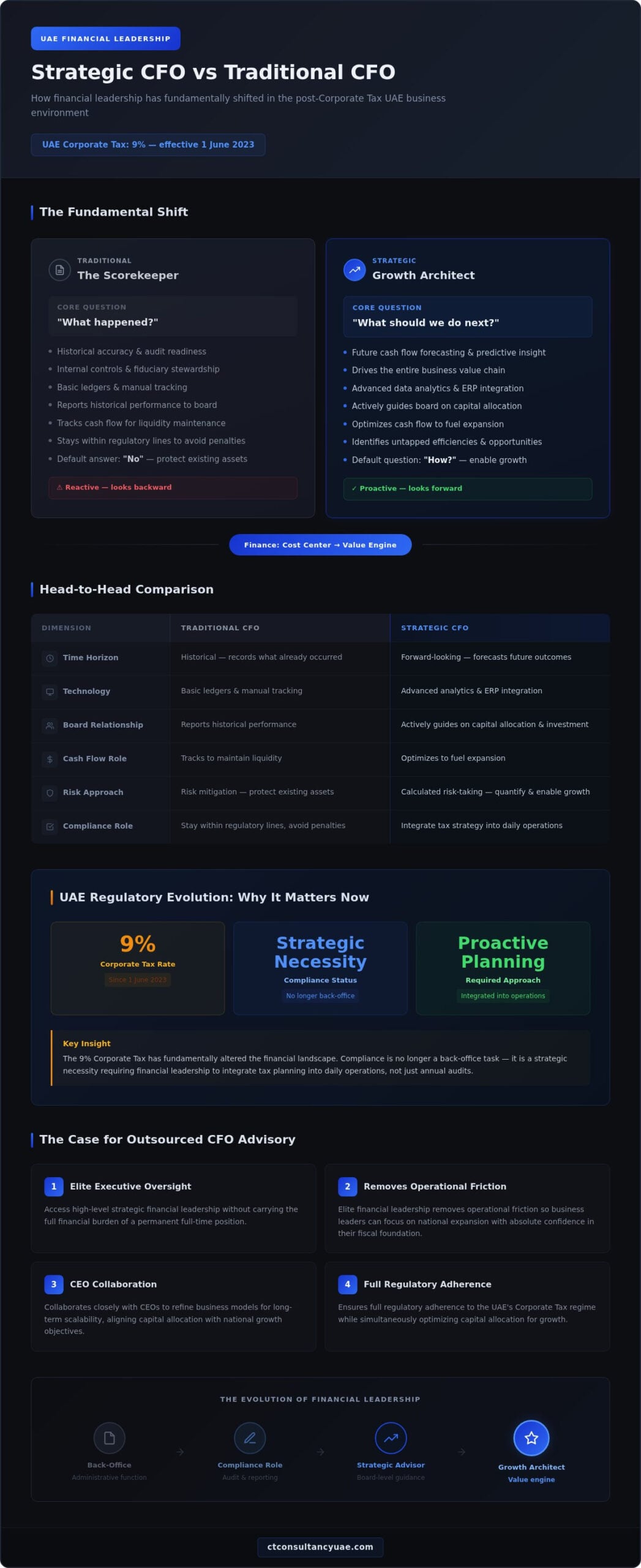
The implementation of Corporate Tax on 1 June 2023 has fundamentally altered the financial landscape. Compliance is no longer a back-office task; it’s a strategic necessity. When deciding between a strategic cfo vs traditional cfo, businesses must consider who is better equipped to handle the complexities of Economic Substance Regulations (ESR) and Anti-Money Laundering (AML) mandates. While traditional roles might track these requirements, a strategic partner integrates them into the growth plan to prevent operational friction.
SMEs often struggle to balance these heavy compliance burdens with their need for expansion. Professional VAT registration services uae have shifted from basic filing toward intricate tax planning that supports broader fiscal health. Executive oversight ensures that these legislative changes don’t disrupt daily workflows but instead provide a clearer path toward national success.
Modern firms are moving beyond simple record-keeping to utilize comprehensive tax services that prioritize liability optimization. Strategic positioning allows companies to navigate the 9% tax threshold effectively while ensuring every filing is precise. This approach minimizes risk and maximizes the capital available for reinvestment in the business.
An internal audit serves as a diagnostic engine for improvement rather than a simple checklist. It uncovers hidden risks and validates the integrity of financial reporting. Effective financial management for smes relies on these audits to maintain high standards and provide the data needed for confident decision-making. To ensure your business remains fully compliant while scaling, consider partnering with our experts for Corporate Tax Advisory to secure your financial future.
Securing high-level financial leadership is often perceived as a luxury reserved for multinational corporations. For many UAE enterprises, the substantial remuneration required for a full-time executive can be prohibitive, especially when navigating the early stages of national expansion. However, the choice between a strategic cfo vs traditional cfo doesn’t have to be a binary decision between high overhead and limited insight. Utilizing cfo advisory services offers a scalable alternative that aligns with modern business needs. This fractional model provides access to elite talent and an unbiased perspective without the financial burden of a permanent salary package. It’s an efficient way to inject sophisticated logic into your fiscal planning while keeping operational costs manageable.
Identifying the precise moment to pivot is crucial for maintaining organizational momentum. Common triggers include stagnant revenue growth, complex tax restructuring following the 2023 Corporate Tax rollout, or preparing for an accurate business valuation. Reliable outsourced bookkeeping services provide the clean data foundation necessary for these strategic insights. Transitioning early ensures that your internal controls are robust enough to support future scalability. It allows leadership to focus on core operations while the financial framework evolves in parallel.
Selection criteria should prioritize deep local regulatory knowledge and a proven track record of strategic impact within your specific industry. A partner should act as a friction-remover, simplifying the complexities of ESR and UBO filings while driving profitability. They must be able to translate technical data into actionable board-level advice. Discover how CFO Advisory Services from CTC Tax & Accounting can transform your financial department into a growth engine. By aligning with experts who understand the nuances of the regional market, you ensure long-term stability and meticulous planning. This partnership bridges the gap between basic compliance and elite financial performance.
The transition from historical record-keeping to proactive growth architecture is now a prerequisite for long-term stability. The choice between a strategic cfo vs traditional cfo determines whether your organization remains burdened by reactive compliance or moves forward with data-driven confidence. By integrating advanced foresight with meticulous regulatory adherence, you ensure that every fiscal decision aligns with your broader expansion goals. This shift empowers leadership to transform financial risks into calculated opportunities for national success.
We provide the precision and reliability needed to navigate the 2023 Corporate Tax mandates and complex VAT requirements. With decades of international experience, our team delivers customized strategic roadmaps that remove operational friction and optimize capital allocation. It’s time to secure a resilient future. Elevate your financial strategy with CTC Tax & Accounting. Your journey toward elite financial leadership starts with a partner dedicated to your sustainable growth.
The primary distinction between a strategic cfo vs traditional cfo lies in their temporal focus and organizational impact. While a traditional lead prioritizes historical reporting and fiduciary stewardship, a strategic partner utilizes that data to architect future growth. They move beyond mere scorekeeping to influence operational decisions, ensuring that every financial move aligns with the company’s long-term scalability and national market positioning.
Small businesses navigating the complex regulatory environment of the United Arab Emirates benefit significantly from executive-level oversight. A strategic lead helps SMEs transition from reactive bookkeeping to proactive planning, which is vital for managing cash flow volatility. This level of guidance ensures that your business doesn’t just meet minimum compliance standards but optimizes its capital allocation to facilitate sustainable expansion across the national market.
A strategic advisor provides comprehensive Corporate Tax Advisory that extends beyond the initial registration and filing process. By analyzing your financial structure, they identify opportunities to optimize tax liabilities within the 9% threshold implemented on 1 June 2023. This proactive approach ensures that your company remains fully compliant with Federal Tax Authority mandates while maintaining the liquidity necessary to fund ongoing operational requirements and strategic projects.
Costs vary based on the specific requirements of your organization and the scope of the engagement. CTC Tax & Accounting utilizes a flexible fee structure, including advisory fees for strategic planning and fixed project fees for specific compliance tasks. This fractional model allows businesses to access elite financial expertise without the overhead of a full-time executive salary, making high-level financial leadership accessible to growing enterprises.
Transitioning from a tactical accountant to a strategic leader is possible through a fundamental shift in professional focus. It requires moving beyond the strategic cfo vs traditional cfo divide by mastering data analytics and business advisory skills. While traditional accounting services provide the necessary foundation of accuracy, the strategic role demands a deeper understanding of how financial levers can be used to drive overall business value and national expansion.