
A bank balance overflowing with AED doesn’t necessarily mean your enterprise is thriving. Many executive decision-makers in the UAE find themselves trapped in a cycle of high revenue but stagnant growth, often feeling a profound sense of anxiety as they navigate the complexities of the Corporate Tax regime. You likely recognize that a healthy top line is meaningless if your cash flow visibility remains clouded or if regulatory compliance feels like a moving target. Understanding what makes a business financially healthy requires a shift from reactive bookkeeping to proactive, strategic oversight.
In this guide, we provide the precision and clarity you need to move from mere survival to long-term stability. You’ll discover the critical metrics and regulatory benchmarks that define success for companies operating within the Emirates. We’ll outline a clear framework for measuring performance, offer peace of mind regarding evolving tax requirements, and present a strategic roadmap for scaling your operations with confidence through 2026 and beyond.
Financial health isn’t a static snapshot of a bank account. It’s an objective measurement of an entity’s capacity to sustain operations and fund growth without external distress. While many entrepreneurs focus on sales volume, true stability rests on retained earnings and consistent liquidity. Understanding what makes a business financially healthy requires looking past the top line. Historical records provide context, but predictive data is essential for navigating future obligations. In the UAE, this health is increasingly defined by how well a company integrates regulatory compliance into its core strategy.
A profitable P&L statement can be deceptive. It often hides a looming liquidity crisis if the timing of cash inflows doesn’t align with immediate operational expenses. While profit is an accounting metric, cash flow is the actual fuel for daily survival. Business leaders must focus on understanding financial ratios to bridge this gap. Utilizing professional accounting services ensures that revenue isn’t just a number on paper but a tangible asset available for deployment. This distinction is vital in 2026 as credit markets tighten.
Warning signals often appear long before a total collapse. Increasing debt-to-equity ratios and shrinking margins suggest that the cost of doing business is outpacing value creation. Companies often fall into the trap of reactive accounting, only reviewing figures when a crisis hits. A healthy business prioritizes proactive management. It maintains visibility into future cash requirements. Without this foresight, even a high-revenue firm can find itself unable to meet its UAE Corporate Tax obligations or operational overheads. Identifying what makes a business financially healthy involves spotting these trends early to pivot toward stability.
A robust architecture is what makes a business financially healthy, resting upon four distinct pillars: liquidity, solvency, profitability, and operating efficiency. Liquidity measures your capacity to meet short-term obligations, typically via the Current Ratio, whereas solvency assesses long-term viability through disciplined debt management and asset coverage. Profitability evaluates the conversion of revenue into net margin, reflecting true earning power. Finally, operating efficiency determines how effectively the firm utilizes its assets to generate income, ensuring no resource remains underutilized.
Strategic leaders prioritize the Quick Ratio, a stringent test of immediate resilience that excludes less liquid assets like inventory. Maintaining adequate working capital ensures the daily engine of your enterprise has sufficient fuel for expansion. Stagnant capital often remains trapped in slow inventory turnover, a risk that becomes evident when developing financial projections for your business plan. These ratios offer a transparent view of operational health that goes deeper than a standard ledger.
To understand what makes a business financially healthy in the local context, you must benchmark your ratios against national industry standards. Performance gaps often reveal themselves when regional regulatory costs or specific logistics nuances aren’t factored into the equation. Leveraging strategic financial management for SMEs provides the logic needed to interpret these metrics accurately. If your internal data lacks clarity, seeking specialized CFO advisory services can help align your financial foundation with your long-term growth objectives.
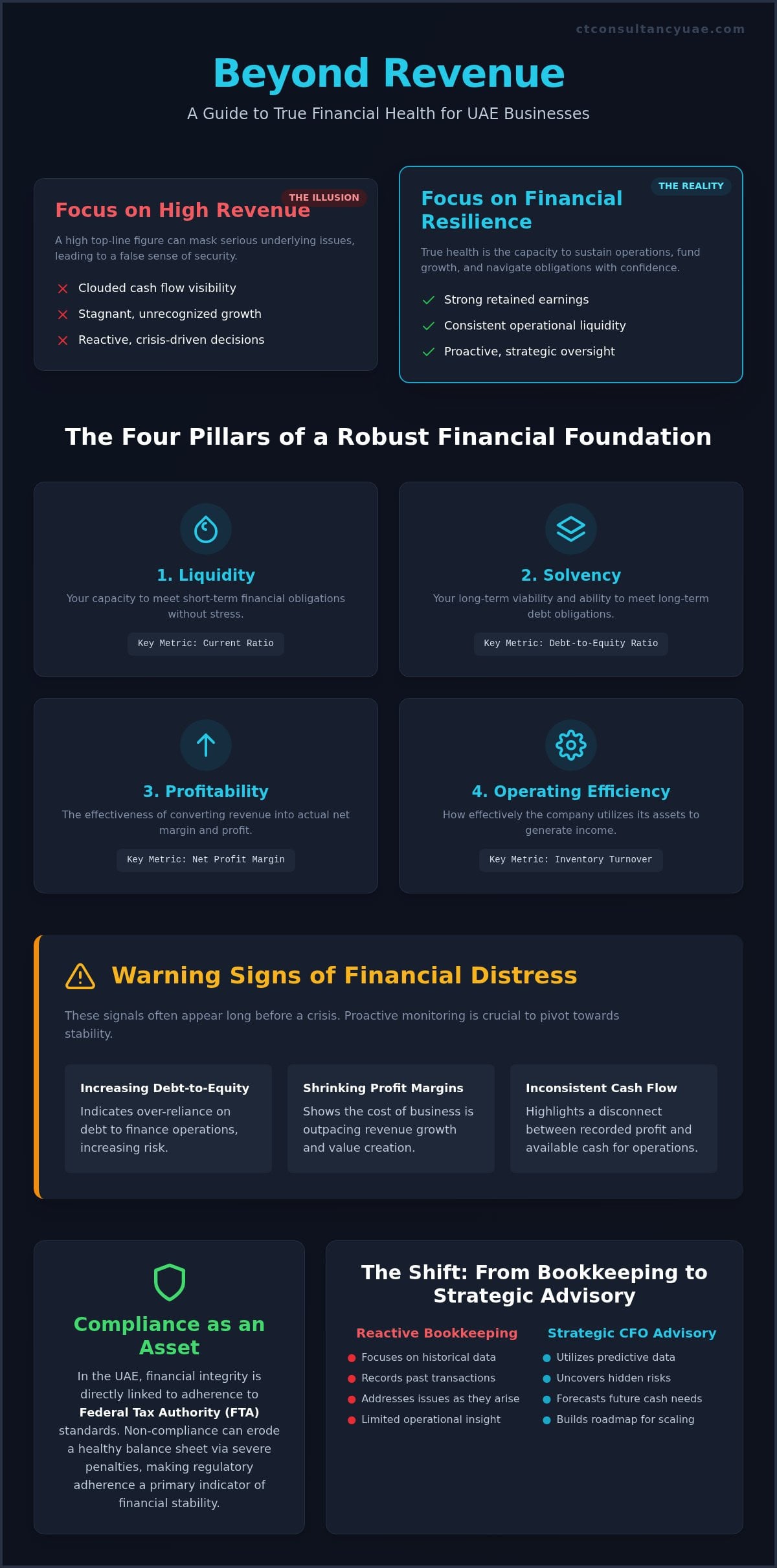
In the United Arab Emirates, financial health is inextricably linked to adherence to Federal Tax Authority (FTA) standards. An enterprise may boast impressive liquidity ratios, but a single non-compliance event can instantly erode a healthy balance sheet through severe administrative penalties. When you determine the financial health of your company, you must consider regulatory integrity as a primary asset. Understanding what makes a business financially healthy requires a lens that views tax obligations as strategic commitments rather than mere overhead. Maintaining a transparent audit trail serves as a prerequisite for securing bank financing or attracting venture capital, as creditors and investors view systematic compliance as a hallmark of professional reliability.
Ensuring accurate VAT registration and compliance is a defensive strategy against avoidable capital outflows. Financially stable businesses prioritize Corporate Tax readiness by calculating potential liabilities months in advance. This foresight prevents liquidity shocks during tax season and ensures that profit remains available for reinvestment rather than being diverted to settle retroactive tax assessments. It’s about protecting the bottom line from regulatory friction and maintaining a predictable cash flow cycle.
Adhering to robust Anti-Money Laundering (AML) and Economic Substance Regulations (ESR) signals professional maturity to international partners. These frameworks aren’t just bureaucratic hurdles; they are vital components of a business’s valuation. Integrating these standards is part of what makes a business financially healthy, as it protects your market reputation and long-term viability. Clean records accelerate scaling by removing the legal obstacles that often hinder cross-border expansion or high-value investor entry. To ensure your enterprise remains resilient against shifting mandates, it’s wise to engage professional tax services to safeguard your growth.
Transitioning from standard bookkeeping services to high-level financial strategy marks the critical evolution of a growing enterprise. While daily ledgers record the past, strategic management focuses on architecting the future. This involves conducting rigorous internal audits to identify hidden operational risks before they manifest as tangible financial losses. Similarly, feasibility studies ensure that new capital-intensive growth projects remain grounded in financial reality rather than optimistic speculation. Ultimately, understanding what makes a business financially healthy involves leveraging these sophisticated tools to maintain a competitive edge within the UAE’s increasingly sophisticated market landscape.
SMEs frequently require executive-level expertise in budgeting and forecasting but don’t always possess the overhead capacity for a permanent hire. Engaging CFO advisory services enables firms to access sophisticated strategic planning, including precise business valuation and professional exit strategies. This tailored guidance helps decision-makers navigate complex market shifts and shifting regulatory mandates with a level of precision that standard accounting cannot provide. It transforms financial data into a roadmap for sustainable scaling and long-term security, which is why many expatriate founders also explore All-Inclusive Digital Will Package to protect their UAE-based interests.
A standardized reporting structure is indispensable for monitoring the four pillars of your financial foundation in real-time. This dashboard should track liquidity, solvency, and operating efficiency metrics, providing a comprehensive view of what makes a business financially healthy on a month-over-month basis. Regular internal audits reinforce this reporting system, ensuring that financial processes remain under strict control and that data integrity is never compromised. By moving beyond the ledger, you ensure that every dirham is strategically deployed to support your broader corporate objectives.
Achieving true financial stability requires moving beyond the basic ledger to embrace a holistic view of your operations. We’ve explored how the four pillars of liquidity, solvency, profitability, and efficiency form the bedrock of any successful venture. In the evolving UAE landscape, meticulous adherence to Federal Tax Authority standards and AML protocols is no longer optional; it’s a fundamental indicator of your company’s integrity. Understanding what makes a business financially healthy involves integrating these regulatory requirements into a broader strategic framework that prioritizes foresight over reaction.
With decades of international financial experience and specialized UAE regulatory expertise, CTC Tax & Accounting provides tailored solutions for SMEs and freelancers looking to scale with precision. Whether you require internal audits or sophisticated forecasting, our team acts as a supportive partner in your growth. Secure your business’s future with professional CFO and Advisory services from CTC Tax & Accounting. By grounding your decisions in verifiable data and expert logic, you can navigate 2026 with confidence and clarity.
The primary indicators include shrinking net margins, an increasing reliance on short-term credit, and consistent delays in payments to vendors. These signals suggest that the operational engine is consuming more capital than it generates. Detecting these trends early is vital to understanding what makes a business financially healthy. If your current liabilities consistently outpace liquid assets, it’s a clear warning that your long-term stability is under immediate threat.
Corporate Tax directly impacts net profitability and the level of retained earnings available for reinvestment. Businesses must account for the 9% tax on taxable income exceeding د.إ375,000, which necessitates more rigorous cash flow forecasting. A resilient firm treats tax compliance as a strategic priority. This ensures that sufficient capital is reserved to meet these obligations without disrupting the company’s daily working capital or its ability to fund growth.
While benchmarks vary by industry, a debt-to-equity ratio between 1:1 and 2:1 is generally considered manageable for most SMEs across the Emirates. A lower ratio indicates high stability and less reliance on external creditors, which is a key component of what makes a business financially healthy. Ratios exceeding 2:1 may signal over-leveraging. This increases your vulnerability to market shifts or changes in regional lending conditions.
Yes, profitability on an income statement doesn’t guarantee health if the entity lacks sufficient liquidity. A company might report high earnings while struggling with a cash flow crisis due to long accounts receivable cycles or excessive inventory. Without liquid cash to meet immediate obligations like payroll or VAT payments, even a profitable firm faces insolvency risks. True health requires a balance between accounting profits and actual available cash.
Most resilient enterprises conduct internal audits at least quarterly to maintain rigorous control over their financial processes. These regular reviews identify operational inefficiencies and compliance gaps before they escalate into significant liabilities. For companies navigating complex UAE regulations like AML or ESR, more frequent checks may be necessary. Consistent auditing ensures that your reporting remains accurate and that your growth strategy stays grounded in verifiable performance data.