
Does a single administrative oversight justify a baseline penalty of AED 10,000 for your business? For many established enterprises and emerging startups, the transition from a historically tax-free environment to a sophisticated regulatory framework remains a source of significant operational anxiety. You likely recognize that uae corporate tax registration is no longer a peripheral task but a core requirement for commercial legitimacy in the Emirates. Navigating the distinctions between Mainland obligations and the specific “Qualifying Income” criteria for Free Zones requires more than just clerical effort; it demands strategic precision.
This definitive guide provides a professional roadmap to secure your Corporate Tax Registration Number while ensuring your documentation aligns with current Federal Tax Authority standards. We will analyze the mandatory 2026 deadlines, the evidentiary requirements for the EmaraTax portal, and the ongoing filing obligations necessary to protect your firm from avoidable financial liabilities. By establishing a rigorous compliance foundation today, you ensure the long-term stability and friction-free growth of your regional operations.
UAE Corporate Tax is a federal direct tax imposed on the net profit of businesses, representing a significant evolution in the nation’s fiscal policy. While the initial rollout commenced in June 2023, the 2026 era marks a matured compliance landscape where it’s vital to recognize that enforcement has become more stringent. This regulatory framework is jointly overseen by the Ministry of Finance, which handles legislative policy, and the Federal Tax Authority (FTA), which manages day-to-day administration. The Corporate Tax Registration Number (TRN) serves as the primary identifier for taxable persons, ensuring their activities are accurately recorded within the federal system.
The implementation of this regime aligns the Emirates with the UAE Taxation Overview provided by international standards, specifically the OECD BEPS Pillar 2 framework. By diversifying national revenue streams beyond hydrocarbon sectors, the government secures long-term economic resilience and stability. These measures enhance the UAE’s reputation as a high-tier global business hub that prioritizes financial transparency and international cooperation, ultimately attracting higher levels of foreign direct investment. This transition supports a sustainable fiscal future while maintaining a competitive environment for global commerce.
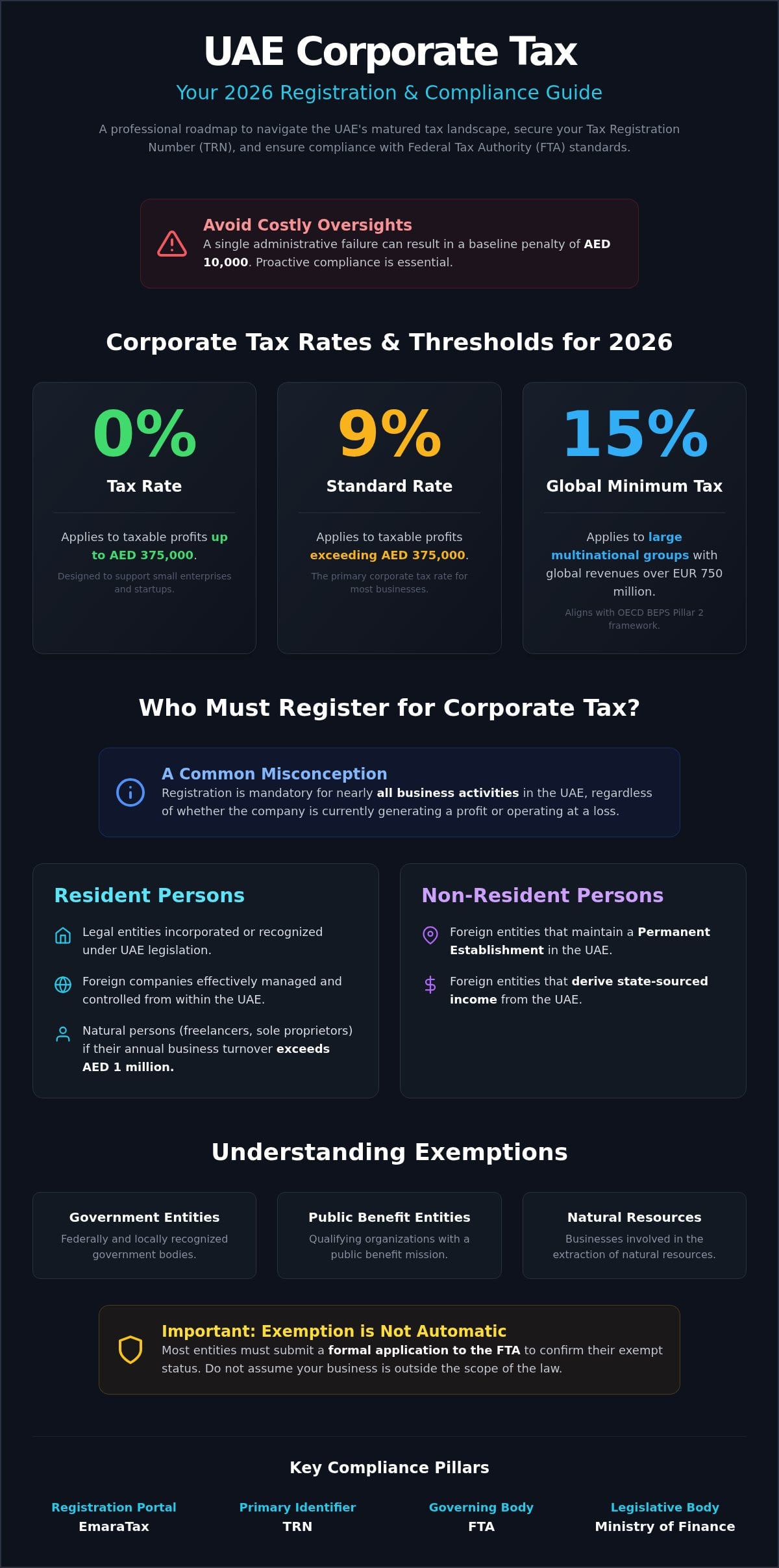
Under the current structure, a 0% rate applies to taxable profits up to AED 375,000 to support small enterprises and startups. Profits exceeding this threshold are subject to a standard rate of 9%. Large multinational groups with global revenues surpassing EUR 750 million may also be subject to a 15% domestic top-up tax in accordance with global minimum tax standards. Securing professional Corporate Tax Advisory ensures these thresholds are managed with precision. Efficient uae corporate tax registration remains the foundational step in navigating these fiscal tiers while maintaining full legal standing.
Identifying your specific taxable status is the essential precursor to a successful Federal Tax Authority Corporate Tax Registration. A common misconception remains that registration is only required for entities exceeding the profit threshold. In reality, the mandate applies to nearly all business activities within the Emirates, regardless of whether the company is currently generating a profit or operating at a loss. Utilizing specialized tax consultancy services can clarify these obligations for complex corporate structures, ensuring no statutory deadlines are missed.
Resident Persons include all legal entities incorporated or recognized under UAE legislation, along with foreign companies effectively managed and controlled from within the country. Natural persons, such as freelancers and sole proprietors, also fall under this category if their annual business turnover exceeds AED 1 million. Conversely, Non-Resident Persons are foreign entities that maintain a Permanent Establishment in the UAE or derive income from UAE sources. Determining where your business sits on this spectrum is a nuanced task that often requires the expertise found in our guide on Corporate Tax Consultants Dubai: Navigating the 2026 UAE Tax Landscape.
Certain organizations, such as government entities, qualifying public benefit entities, and businesses involved in the extraction of natural resources, may qualify for exemptions. It’s vital to understand that an exempt status is rarely automatic. Most entities must submit a formal application to the FTA to confirm their standing rather than simply assuming they’re outside the scope of the law. If you’re uncertain about your eligibility for specific reliefs, exploring our business advisory solutions can help verify your status before penalties accrue. This proactive approach ensures your uae corporate tax registration remains accurate and fully compliant with the matured 2026 regulatory standards.
The 2026 “Zero Bureaucracy” initiative has significantly streamlined digital government interactions, yet uae corporate tax registration remains a high-stakes administrative task that demands meticulous attention to detail. The Federal Tax Authority (FTA) typically requires 20 business days to review submissions, though this duration can fluctuate based on application volume. You can track your application status directly through the EmaraTax dashboard using your unique reference number. To secure your status, follow these five steps on the platform:
For a broader perspective on the national fiscal strategy, the UAE Government Corporate Tax Information portal provides updated regulatory context for all taxable persons.
To ensure a successful uae corporate tax registration, precision is paramount to avoid document rejection or unnecessary queries from the FTA. You must provide a valid Trade License, Commercial Registration certificates, and the Memorandum of Association (MOA). For authorized signatories, clear copies of Passports and Emirates IDs are mandatory. Additionally, provide ownership details for any individual holding more than 25% of the entity. All files must be uploaded in PDF format and remain under the 15MB size limit to ensure portal compatibility.
Compliance timelines are strictly enforced in this matured 2026 era, leaving little room for administrative error. Failure to complete your registration by the specified deadline results in a fixed administrative penalty of AED 10,000. Proactive filing is strongly advised to circumvent potential portal congestion during peak periods. If you require a friction-free experience, our Corporate Tax Advisory team can manage the end-to-end submission process on your behalf.
Securing your Corporate Tax TRN marks the beginning of a broader commitment to fiscal transparency. Once uae corporate tax registration is finalized, it acts as a catalyst for integrating more sophisticated accounting services into your daily operations. This isn’t merely about administrative box-ticking; it’s about aligning your Corporate Tax obligations with existing VAT and ESR compliance in the UAE. This registration is also a prerequisite for advanced CFO advisory services, which transform raw data into strategic growth insights.
Under Federal Law, businesses must maintain comprehensive financial records for a minimum of seven years. Systematic bookkeeping ensures you’re prepared for potential FTA audits, which have become more frequent in the 2026 matured tax era. For many organizations, the most efficient path involves Outsourced Bookkeeping Services in Dubai: The Strategic Guide. This approach provides the necessary rigor without the overhead of an internal department, ensuring every transaction is audit-ready.
Managing international tax treaties and transfer pricing requires expertise that goes beyond basic filing. A professional advisor ensures all deductible expenses are correctly identified, optimizing your tax liability while remaining within legal boundaries. This specialized oversight is critical for entities managing cross-border transactions or inter-company charges. By shifting your perspective, you can view compliance as a competitive advantage rather than an operational burden. Strategic planning allows your business to leverage regional incentives effectively, securing long-term stability.
A long-term partnership with CTC Tax & Accounting provides the professional oversight needed to mitigate risk. We serve as your primary friction-remover, ensuring your uae corporate tax registration leads to sustained financial health and seamless expansion within the Emirates.
The 2026 fiscal environment in the Emirates demands a transition from simple awareness to precise, strategic execution. It’s clear that successful compliance relies on a deep understanding of residency statuses and the meticulous preparation of evidentiary documentation for the EmaraTax portal. Proactive uae corporate tax registration isn’t just a legal hurdle; it’s the baseline for a transparent financial identity that facilitates long term stability and global credibility. By establishing these foundations early, you mitigate the risk of heavy administrative penalties while positioning your enterprise for friction-free growth.
CTC Tax & Accounting serves as your primary partner in this journey, combining decades of international financial expertise with specialized SME and freelancer compliance support. Our team provides comprehensive end-to-end regulatory management, ensuring your records meet every Federal Tax Authority standard while you focus on core business objectives. We reject one-size-fits-all approaches, opting instead for customized solutions that reflect the unique needs of your corporate structure.
Building a compliant foundation today ensures your enterprise remains resilient and ready for the opportunities of tomorrow.
Yes, uae corporate tax registration is mandatory for all legal entities and certain natural persons conducting business activities within the country. This requirement applies even if your enterprise currently operates at a loss or falls below the AED 375,000 profit threshold for the 9% tax rate. All taxable persons must obtain a Tax Registration Number (TRN) to ensure their financial activities are properly documented and recognized by the Federal Tax Authority.
A fixed administrative penalty of AED 10,000 is imposed on any taxable person who fails to submit their registration application within the timelines specified by the Federal Tax Authority. This penalty is strictly enforced to ensure national compliance and fiscal transparency. Beyond the immediate financial cost, late registration can lead to increased regulatory scrutiny and potential complications during subsequent tax periods, highlighting the importance of meeting all statutory deadlines.
The Federal Tax Authority generally requires approximately 20 business days to review and process a uae corporate tax registration application submitted through the EmaraTax portal. While the 2026 “Zero Bureaucracy” initiative has streamlined digital interactions, processing times can vary based on the complexity of your corporate structure and the accuracy of the provided documentation. Applicants can monitor their submission status in real time via their personalized dashboard using the reference number provided.
Every Free Zone company is legally required to register for corporate tax, even if they anticipate qualifying for the 0% rate on “Qualifying Income.” Registration is the foundational step that allows an entity to be recognized as a Qualifying Free Zone Person (QFZP). Failing to register prevents your business from accessing these tax incentives, resulting in the application of the standard 9% rate on all taxable profits exceeding the national threshold.
Foreign companies must provide their valid Trade License, Commercial Registration certificates, and the Memorandum of Association or equivalent foundational documents. Additionally, you must submit ownership details for any individual holding a stake exceeding 25% and the Passport or Emirates ID copies of the authorized signatory. For foreign entities managed and controlled from the UAE, proof of residency and management location is essential to confirm their status as a Resident Person for tax purposes.