
In the UAE’s current regulatory climate, reactive bookkeeping is no longer just a nuisance; it’s a significant liability that can trigger penalties starting at AED 10,000. You’ve likely felt the pressure of shifting VAT requirements and the recent implementation of Corporate Tax, wondering if your internal records would withstand a rigorous Federal Tax Authority audit. It’s exhausting to manage daily operations while simultaneously worrying whether your tax filings are accurate or if you’re inadvertently missing critical deadlines. This guide illustrates how professional monthly accounting services transform these complex regulatory hurdles into a frictionless framework for long-term stability. By securing an expert partner, you ensure total compliance. This precision allows you to drive strategic growth with unwavering clarity. We’ll examine how transitioning to a structured monthly model provides the audit-ready records and sophisticated management reports necessary to scale your enterprise with confidence in its legal standing.
Monthly accounting is defined as a systematic methodology for recording, classifying, and summarizing financial transactions within a specific fiscal period. Historically, numerous UAE enterprises viewed bookkeeping as a secondary administrative task. However, the maturation of the local regulatory environment has necessitated a transition from basic ledger maintenance to professional financial management. Maintaining records that adhere to recognized accounting standards, specifically IFRS, is now essential. It’s a requirement for national transparency. Consequently, forward-thinking businesses are abandoning the high-risk “catch-up” accounting model in favor of proactive monthly accounting services.
The implementation of a 9% Corporate Tax on taxable income exceeding AED 375,000 has fundamentally altered the documentation landscape. SMEs can’t afford to be lax with expense documentation if they intend to optimize their tax positions legally. Utilizing dedicated monthly accounting services ensures that every transaction is categorized correctly in real time. This creates a “clean” audit trail for the Federal Tax Authority. This systematic approach eliminates the panic of missing receipts and ensures that the business remains audit-ready at all times.
A structured monthly engagement serves as a primary friction-remover for growing firms. It provides continuous financial oversight, which is vital for preventing cash flow bottlenecks that often stifle expansion. Precision matters here. By identifying discrepancies early, you avoid the chaotic reconciliation crises that typically plague year-end closings. These services prioritize long-term stability through:
This disciplined cycle ensures that your financial records are a strategic asset rather than a compliance burden.
Effective financial management requires a disciplined, recurring cycle. It begins with the systematic recording of daily business transactions into primary ledgers. This foundational step ensures every dirham is accounted for from day one. This isn’t merely about compliance; it’s about establishing a reliable data source for all future business evaluations and strategic shifts. Without this daily diligence, the month-end process becomes a source of friction rather than a tool for growth.
Categorizing expenses must align strictly with UAE tax consultancy standards to ensure maximum deductibility. Under the UAE Corporate Tax Law, businesses must maintain IFRS-compliant records for at least seven years. Transitioning to cloud-based accounting software facilitates real-time digital record-keeping. This prevents the loss of vital documentation and ensures accessibility for executive teams. Our experts help clients implement these systems to streamline their professional bookkeeping services. Precise entry is the bedrock of strategic planning.
Monthly bank and credit card reconciliations serve as the first line of defense against financial errors or fraud. They ensure the integrity of the data used for high-stakes decisions. By maintaining rigorous accounts payable and receivable schedules, businesses can effectively manage working capital and avoid liquidity issues. The cycle culminates in the preparation of a trial balance. This document acts as the essential foundation for formal financial statements. It’s a critical component of monthly accounting services that prepares your firm for any external audit. It ensures that the debits and credits align perfectly before the final reporting phase begins. If you’re looking to fortify your financial framework, exploring specialized advisory can provide the necessary oversight for long-term stability.
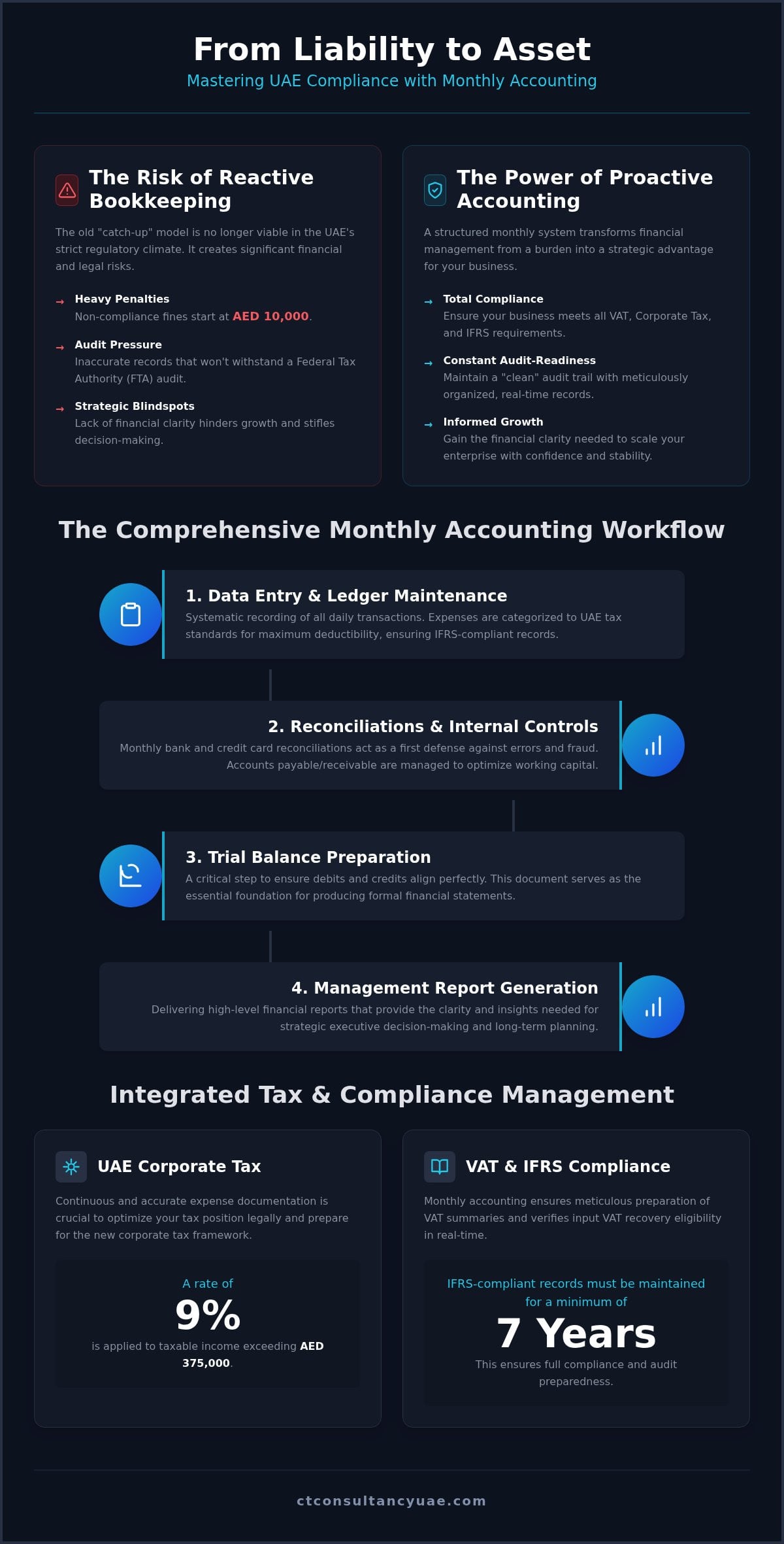
Compliance in the UAE is no longer a static year-end event but a continuous obligation that demands precision. Engaging monthly accounting services allows for the meticulous preparation of VAT summaries, ensuring that every transaction aligns perfectly with UAE Federal Tax Authority regulations. Beyond standard bookkeeping, professional oversight integrates Corporate Tax provisions directly into your monthly profit and loss statements. This proactive approach ensures that the 9% tax liability is anticipated and managed throughout the fiscal year, preventing liquidity surprises during the final filing period.
Conducting monthly reviews is the most effective way to prevent the common mistake of missing input tax recovery on eligible business expenses. This level of detail is a hallmark of seasoned UAE Corporate Tax Consultants who prioritize long-term fiscal health. By reconciling tax accounts every thirty days, businesses maintain a state of perpetual readiness for any FTA inquiry or formal audit request.
Modern compliance also extends to specialized filings such as Anti-Money Laundering (AML) and Economic Substance Regulations (ESR). Monthly accounting provides the high-quality data necessary to demonstrate genuine economic activity and substance within the jurisdiction. It also facilitates the maintenance of Ultimate Beneficial Ownership (UBO) records. This ensures that any changes in corporate structure are captured and reported promptly to the relevant authorities, maintaining your firm’s legal standing.
Adhering to national reporting standards requires a steady flow of verified financial information. Utilizing monthly data supports strategic ESR compliance by providing a clear link between local operations and financial results. This systematic documentation acts as a primary friction-remover during regulatory reviews. If you require specialized assistance in aligning your business with these complex requirements, consider our comprehensive tax services for customized support.
Management reports transform raw transactional data into a strategic roadmap for executive leadership. While preceding sections focused on the mechanics of compliance, the reporting phase is where financial clarity drives value creation. Profit and Loss (P&L) statements are indispensable for high-level decision-making. They reveal exactly where margins are being squeezed and where revenue is accelerating. Similarly, Balance Sheets provide a comprehensive snapshot of the firm’s economic health. This allows stakeholders to assess solvency and debt-to-equity ratios with professional precision. It’s about turning a back-office requirement into a primary growth engine.
Strategic monthly accounting services involve breaking down complex financial ratios into actionable business insights. Instead of viewing a collection of abstract numbers, leadership receives a structured briefing on liquidity and operational efficiency. This level of granular reporting facilitates outsourced CFO advisory. An expert partner provides the necessary context to navigate market volatility and ensure long-term stability. It’s a customized approach that rejects one-size-fits-all reporting in favor of individualized solutions.
Utilizing Cash Flow statements is essential for planning future investments or regional expansion. It prevents the common pitfall of being profitable on paper but cash-poor in reality. Comparing actual performance against monthly budgets allows for the immediate identification of variances. You can identify discrepancies before they become systemic issues. This historical data serves as a foundation for business advisory and feasibility studies. It ensures that any new venture is backed by empirical evidence. For growth-oriented SMEs, moving beyond data entry makes CFO advisory services the logical next step for scaling operations. This systematic approach positions your firm as a primary friction-remover in its industry.
Transitioning to a proactive financial model is no longer a matter of convenience; it’s a strategic necessity for any business operating within the UAE’s rigorous tax framework. By adopting professional monthly accounting services, you replace the anxiety of non-compliance with the confidence of audit-ready records. This precision matters. A systematic approach ensures that VAT and Corporate Tax obligations are met with accuracy, while sophisticated management reports empower you to make informed decisions for future expansion. CTC Tax & Accounting brings decades of international financial expertise to every engagement, offering customized solutions for SMEs and freelancers that include comprehensive AML and tax compliance support. Our team acts as a primary friction-remover, allowing you to focus on core operations while we maintain your legal integrity. Secure your business growth with professional monthly accounting from CTC Tax & Accounting. Your path to long-term stability starts with meticulous planning.
Bookkeeping focuses on the foundational recording of daily transactions, whereas monthly accounting services involve the sophisticated analysis and classification of that data to ensure regulatory alignment. While bookkeeping tracks income and expenses, accounting provides the high-level oversight needed for VAT compliance and Corporate Tax provisions. This systematic approach ensures that your primary ledgers are not just updated but are also strategically reviewed for financial health and long-term stability.
The cost of professional financial oversight varies based on the specific volume of transactions and the complexity of your business structure. While basic bookkeeping is generally more affordable, comprehensive packages that include tax compliance and strategic reporting require a higher investment. Most businesses find that outsourcing these functions is significantly more cost-effective than hiring a full-time in-house accountant, as it provides access to a broader range of specialized expertise without substantial overhead.
While the law doesn’t explicitly mandate a monthly schedule for every entity, the UAE Corporate Tax Law requires all businesses to maintain IFRS-compliant records for a minimum of seven years. Given that VAT returns are often due quarterly or monthly, a proactive monthly cycle is the most reliable method to ensure frictionless compliance. This disciplined approach prevents the accumulation of errors and ensures that your firm is always prepared for potential Federal Tax Authority inquiries.
Maintaining a structured accounting cycle is vital for a smooth Corporate Tax registration process with the Federal Tax Authority. Accurate monthly records provide the verified financial data required to determine your tax group eligibility or small business relief status. By integrating tax advisory into your monthly workflow, you ensure that your registration reflects your actual financial position, which is essential for avoiding penalties related to incorrect or late filings during the registration phase.
Monthly accounting services act as a primary friction-remover during the external audit process by providing a complete and reconciled trial balance. When your ledgers are maintained and reconciled every thirty days, the external auditor can verify your financial statements with greater efficiency and precision. This state of perpetual readiness significantly reduces the time and resources required for annual certification, ensuring that your business remains in good standing with national licensing authorities.