
In the current national investment climate, a target company’s reported profit is no longer the definitive metric of its value. You’ve likely realized that while the national market offers unparalleled growth, the implementation of the 9% Corporate Tax and the stringent Federal Decree-Law No. 10 of 2025 on Anti-Money Laundering has added layers of liability to every transaction. It’s natural to feel uncertain about the accuracy of financial statements or the threat of hidden tax debts that could emerge after the deal closes. This uncertainty can stall momentum and lead to overvaluation in a competitive market.
This guide empowers you to master financial due diligence in the UAE to mitigate these risks and maximize your investment value. We’ll provide a clear framework to assess the “Quality of Earnings” and identify potential deal-breakers before you commit capital. You’ll learn how to navigate the 2026 regulatory landscape, including new VAT compliance rules and mandatory climate reporting, ensuring your price negotiations are backed by precise financial intelligence and strategic reassurance.
The Essence of Financial Due Diligence involves a meticulous, deep-dive examination of a target entity’s fiscal integrity, extending far beyond the surface of standard balance sheets. Within the nation’s competitive investment environment, performing financial due diligence dubai serves as a critical mechanism for validating that a business’s reported performance aligns with its underlying operational reality. It’s a strategic risk-mitigation tool that validates the economic substance of a transaction by uncovering potential liabilities and verifying the sustainability of future cash flows. By scrutinizing the financial architecture of a target, investors can transition from speculative interest to informed commitment with absolute clarity.
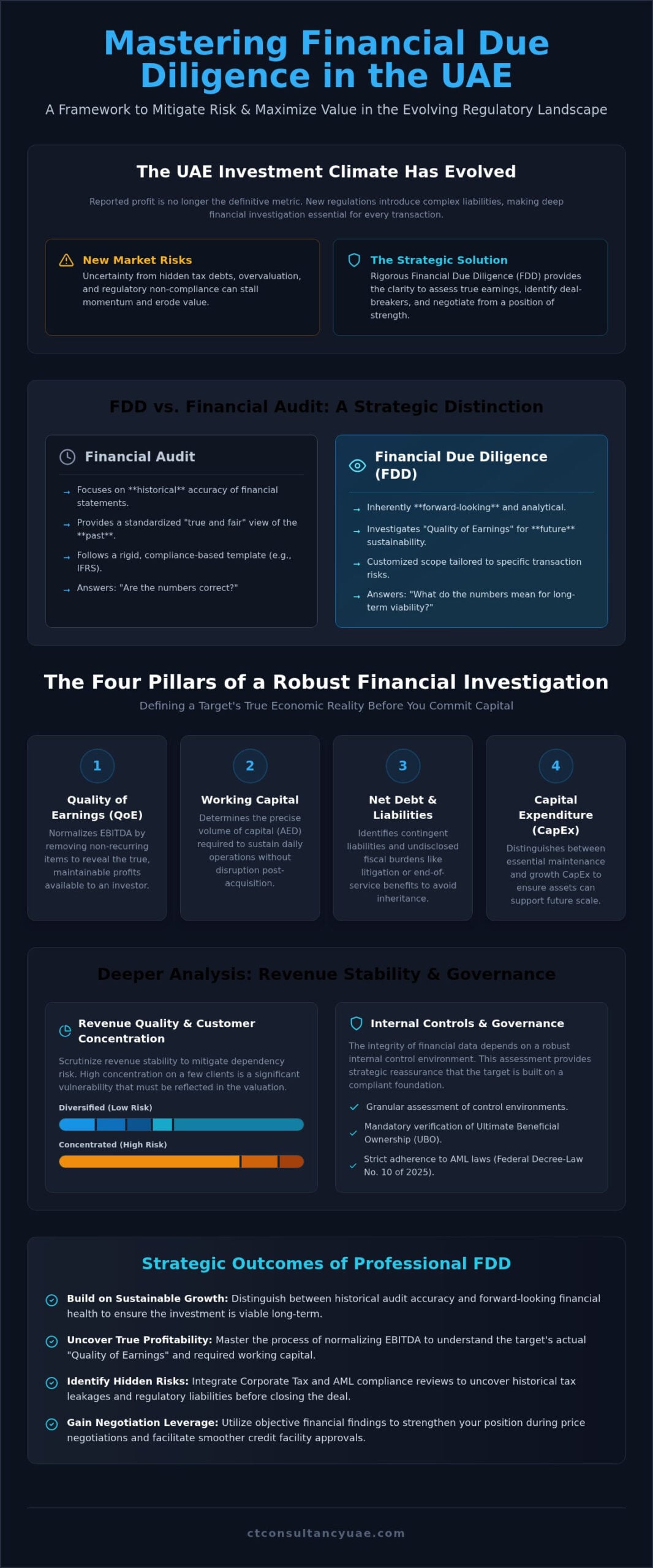
While a statutory audit focuses on the historical accuracy of financial statements in accordance with IFRS or local reporting standards, FDD is inherently forward-looking and analytical. Audits provide a standardized “true and fair” view of the past; however, FDD investigates the “Quality of Earnings” to determine if those profits are maintainable post-acquisition. This investigation is highly customized, tailoring its scope to the unique risks of the specific transaction rather than following a rigid, compliance-heavy template. It doesn’t just ask if the numbers are right; it asks what those numbers mean for the long-term viability of the enterprise.
As the UAE’s regulatory framework continues to mature, investors prioritize transparency to navigate the complexities of Corporate Tax and AML mandates effectively. Rigorous FDD provides the empirical evidence needed for an accurate business valuation, empowering both buyers and sellers to negotiate from a position of strength. For vendors, conducting sell-side due diligence removes friction during the divestment process by identifying potential deal-breakers early. For acquirers, it ensures that the capital deployed is protected against unforeseen fiscal erosion, making it an indispensable component of modern corporate governance.
A comprehensive investigation rests on four fundamental pillars that collectively define a target’s economic reality. First, the Quality of Earnings (QofE) analysis normalizes EBITDA by stripping away non-recurring gains, one-off subsidies, or extraordinary expenses, revealing the true maintainable profits available to an investor. Second, we evaluate Working Capital to determine the volume of AED required to sustain daily operations without operational disruption post-acquisition. Third, identifying Net Debt and contingent liabilities, such as pending litigation or unrecorded employee end-of-service benefits, is essential to avoid inheriting undisclosed fiscal burdens. Finally, a Capital Expenditure (CapEx) review distinguishes between essential maintenance and growth investments, ensuring the physical or digital assets are capable of supporting future scale.
Investors must scrutinize the stability of revenue streams to mitigate the risk of high dependency on a single client or product line. We verify the recurring nature of income by analyzing historical retention rates and contract longevity across multiple cycles. If a significant percentage of turnover originates from a handful of accounts, the valuation must reflect this vulnerability. Losing one key relationship could destabilize the entire enterprise, making revenue diversification a primary metric for long-term viability.
The integrity of financial data depends on the robustness of a company’s internal architecture. Leveraging internal audit services during financial due diligence dubai allows for a granular assessment of control environments. This process includes the mandatory verification of Ultimate Beneficial Ownership (UBO) to ensure strict adherence to Federal Decree-Law No. 10 of 2025 regarding Anti-Money Laundering. Establishing these governance benchmarks provides the strategic reassurance that the target is built on a compliant foundation. If you require a detailed assessment of your target’s governance, our business advisory team can provide the necessary oversight.
The 2026 regulatory environment necessitates the integration of specialized tax consultancy services directly into the FDD framework to identify historical tax leakage. Beyond simple verification, we assess the target’s readiness for Corporate Tax reporting, specifically focusing on potential deferred tax liabilities that could impact future liquidity. Evaluating VAT compliance history is equally vital. Acquirers must ensure they aren’t inheriting administrative penalties from the Federal Tax Authority due to past filing errors. Verifying the target’s AML compliance and goAML registration status is non-negotiable under Federal Decree-Law No. 10 of 2025 to prevent severe financial exposure and personal liability for management.
The standard 9% Corporate Tax rate on taxable income exceeding AED 375,000 has fundamentally altered valuation multiples within the region. During financial due diligence dubai, we analyze how these tax outflows affect projected cash flows and the overall internal rate of return. A critical component of this review is the examination of Transfer Pricing documentation for group transactions. This ensures all inter-company dealings align with arm’s length principles, preventing post-deal adjustments by authorities that could erode the investment’s value.
It’s necessary to confirm that Economic Substance Regulations (ESR) filings are accurate and up to date for all relevant activities. Non-compliance with ESR or failing to meet the substance test can lead to significant financial penalties and reputational risks that diminish deal value. For comprehensive protection against these regulatory hurdles, consider engaging our experts for a Corporate Tax and compliance audit. Establishing this level of regulatory standing provides the strategic reassurance required for high-stakes transactions.
The findings derived from a rigorous financial due diligence dubai exercise serve as the primary leverage during the final stages of a transaction. By quantifying identified risks, investors can justify price reductions or structure “Earn-out” agreements that protect capital if specific performance targets aren’t achieved. Beyond the negotiation table, these reports facilitate smoother banking relationships. Regional lenders view a professional FDD report as empirical evidence of thorough risk management, which often accelerates the approval of credit facilities for acquisition financing. This level of transparency builds the trust necessary to secure competitive lending terms in the UAE market.
A professional FDD report accelerates the legal drafting of Sale and Purchase Agreements (SPA) by providing clear data for specific warranties and indemnities. This expert oversight removes significant friction during the transition period, ensuring both parties have a shared understanding of the company’s financial state. Additionally, the process identifies operational synergies that might have been overlooked during initial assessments. These insights allow for immediate value creation once the deal is finalized, transforming raw data into a strategic roadmap for post-merger integration.
National expertise is indispensable when interpreting UAE-specific financial practices and specialized accounting services. Local knowledge ensures that nuances in mainland and free zone regulations are fully accounted for in the final valuation. Transitioning from initial due diligence to ongoing CFO advisory services ensures that post-acquisition growth is built on a stable, compliant foundation. CTC Tax & Accounting acts as your elite partner, providing the meticulous financial oversight and strategic planning required for long-term stability. Taking a proactive approach to due diligence ensures your investment remains resilient and profitable within the nation’s evolving regulatory framework.
It’s no longer enough to rely on audited statements; successful investment in the nation’s maturing economy requires a shift toward proactive risk management. By prioritizing a “Quality of Earnings” analysis and integrating Corporate Tax and AML compliance into your investigation, you ensure that every transaction is built on economic substance rather than surface-level projections. This strategic approach to financial due diligence dubai uncovers hidden liabilities while providing the empirical leverage required for robust price negotiations and sustainable banking relationships.
Our elite consultants provide the specialized UAE regulatory knowledge and customized frameworks necessary to navigate these high-stakes complexities. We offer a holistic integration of Tax, AML, and CFO advisory services to ensure a friction-free transition into your next growth phase. Secure your next investment with expert financial due diligence from CTC Tax & Accounting. With meticulous planning and expert oversight, your journey into the UAE market will be defined by stability and long-term profitability.
The timeline for completing a comprehensive report varies based on the target entity’s complexity and the availability of high-quality financial data. Typically, an investigation requires two to four weeks for execution. This period allows for meticulous data room analysis, management interviews, and the identification of potential deal-breakers. Engaging elite consultants early in the transaction lifecycle ensures the process remains efficient while providing the strategic reassurance required for high-stakes decision-making.
While not legally mandated by UAE federal law, financial due diligence dubai is a strategic necessity for small business acquisitions to mitigate significant transaction risks. Small enterprises often lack the robust internal controls found in larger corporations; this makes them susceptible to unrecorded liabilities or inflated earnings. Conducting a targeted investigation protects the acquirer’s capital by validating the accuracy of financial statements and ensuring the business is capable of sustaining future growth.
Yes, a robust investigation identifies historical tax leakages and assesses the target’s readiness for the 9% Corporate Tax regime on income above AED 375,000. Analysts examine past filings, deferred tax liabilities, and the adequacy of Transfer Pricing documentation for inter-company transactions. This scrutiny prevents the acquirer from inheriting undisclosed administrative penalties from the Federal Tax Authority, ensuring that the post-acquisition cash flow projections remain accurate and protected from unforeseen regulatory enforcement actions.
Buy-side due diligence is commissioned by the acquirer to identify risks and validate the purchase price before commitment. Conversely, sell-side due diligence is initiated by the vendor to prepare the business for divestment. This proactive approach identifies compliance gaps early, allowing the seller to rectify issues or adjust valuations before engaging with buyers. Both processes aim to remove friction during the transaction, though their primary objectives regarding risk and value maximization differ.