
Most UAE business leaders assume that a simple 9% calculation applied to their bottom line represents the final word on their fiscal obligations. In reality, your accounting profit is merely the baseline for a meticulous journey of regulatory adjustments. You likely feel the pressure of determining how to calculate corporate tax in uae correctly, particularly as the Federal Tax Authority maintains a rigorous stance on compliance and enforces a fixed AED 10,000 penalty for registration delays. The transition from standard financial reporting to a tax-ready filing is often complex when you’re balancing deductible expenses against the nuances of qualifying free zone income.
We’ve designed this guide to demystify the 2026 strategic formula, empowering you to convert accounting profit into taxable income with absolute precision. You’ll discover a structured framework for identifying non-deductible costs and optimizing your liability while ensuring full alignment with the latest Ministerial Decisions. This approach moves beyond basic arithmetic to provide a sophisticated roadmap for long-term corporate stability and professional peace of mind.
The landscape of corporate taxation in the United Arab Emirates has transitioned from a new implementation to a settled regulatory standard. For executive decision makers, the initial challenge involves identifying whether their entity falls within the scope of the law. Resident persons, which encompass both legal entities incorporated within the UAE and specific natural persons, are subject to tax on their global income. Non-resident persons are taxed on income derived from a Permanent Establishment in the UAE or from UAE-sourced income. Determining your status is the essential first step in understanding how to calculate corporate tax in uae accurately.
Precision in classification remains vital during the initial assessment phase. While most commercial enterprises are taxable, certain entities enjoy exempt status to support national interests. These include government entities, government-controlled entities, and businesses involved in the extraction of natural resources, provided they meet specific criteria. Natural persons, such as freelancers or sole proprietors, only enter the tax net if their business turnover exceeds AED 1 million within a calendar year. Understanding these nuances prevents the misallocation of resources during the filing process.
The 2026 fiscal environment maintains a tiered tax structure designed to foster SME growth while ensuring larger enterprises contribute to the national economy. Taxable income is subject to a 0% rate on the first AED 375,000, with a 9% rate applied to any amount exceeding this figure. This calculation is performed on a cumulative basis for each tax period, which typically aligns with the company’s financial year. To ensure your financial records accurately reflect these tiers, many firms utilize integrated VAT and Corporate Tax services to maintain continuous compliance. It’s vital to remember that accounting profit is rarely the final taxable figure. Adjustments for non-deductible expenses and exempt income are mandatory under the law, making a robust reconciliation process a priority for every CFO.
The journey toward a compliant tax return begins with the Net Profit or Loss figure extracted from your IFRS-compliant financial statements. This accounting baseline acts as the starting point for a series of mandatory fiscal adjustments. When determining how to calculate corporate tax in uae, you’ll find that accounting standards and tax regulations often diverge. These discrepancies, known as permanent and temporary differences, must be reconciled to arrive at the final taxable income figure. This process ensures that your fiscal reporting aligns with the specific mandates of the Federal Tax Authority.
Many common business costs aren’t fully deductible under the current regime. You must identify and add back non-deductible items such as administrative fines, penalties, and expenses that don’t serve a clear business purpose. A specific 50% cap applies to entertainment expenditure, covering costs related to customers, shareholders, and suppliers. Precise record-keeping is essential here, as interest deduction limitations are also enforced to ensure that financing costs don’t disproportionately reduce the tax base.
Managing transactions between related parties requires rigorous attention to detail. The Arm’s Length Principle is a core requirement for taxable income validation, mandating that all intra-group dealings occur at fair market value. Proper Transfer Pricing documentation is vital for justifying these charges during an audit. You also need to account for timing differences, particularly regarding depreciation and amortization. These occur when the Official UAE Corporate Tax Law prescribes different asset lifespans than your internal accounting policies. Understanding how to calculate corporate tax in uae correctly requires balancing these nuances with precision.
Achieving this level of accuracy is often the primary hurdle for growing enterprises. Our specialized Accounting Services can help you navigate these complex reconciliations, ensuring your financial data is fully optimized for tax submission.
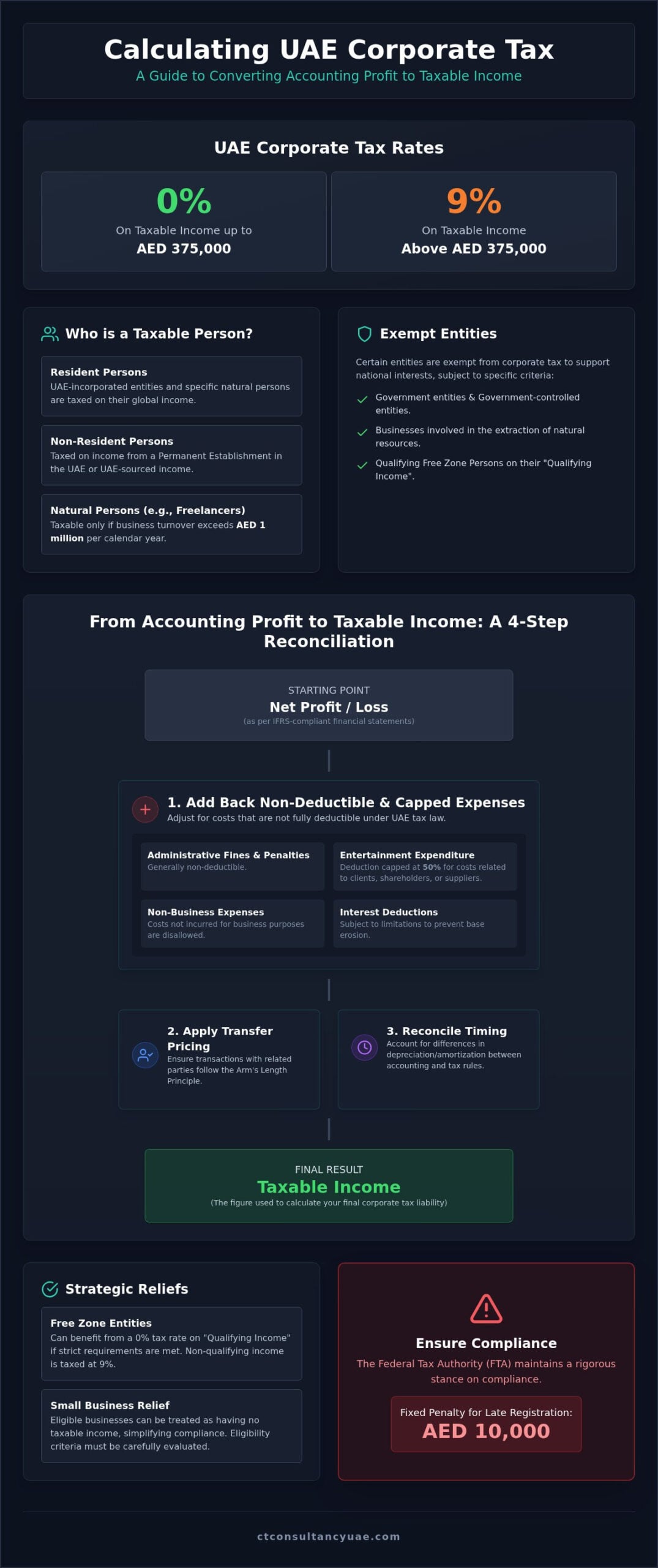
The 2026 tax landscape offers specific mechanisms to mitigate liability for eligible entities. Navigating these requires more than basic arithmetic; it demands a deep understanding of statutory reliefs and their long-term implications. For many, the question of how to calculate corporate tax in uae is simplified by electing for Small Business Relief (SBR), provided the revenue ceiling of AED 3 million isn’t exceeded. This relief allows eligible resident persons to be treated as having no taxable income for a specific period, significantly reducing the administrative burden on growing firms.
Eligible businesses must actively elect for SBR to benefit from its provisions. Once elected, the entity is exempt from the standard 9% rate on income exceeding AED 375,000, provided they maintain revenue below the AED 3 million threshold. This strategic choice is a cornerstone of Strategic Financial Management for emerging enterprises. It simplifies compliance by removing the need to reconcile complex tax adjustments, though proper record-keeping remains a statutory requirement to prevent FTA penalties.
Free Zone entities operate under a dual-taxation framework that rewards substantive local operations. While a 0% rate applies to Qualifying Income, any income derived from mainland sources or non-qualifying activities is taxed at the standard 9%. To maintain Qualifying Free Zone Person status, businesses must adhere to the “De Minimis” rule, which limits non-qualifying revenue to 5% of total revenue or AED 5 million, whichever is lower. The Official UAE Corporate Tax Law provides the definitive criteria for these distinctions.
Strategic planning also involves utilizing tax loss carry-forwards. You can carry forward losses indefinitely to offset future taxable income, though the deduction is capped at 75% of the taxable income in any single period. For a comprehensive review of your eligibility for these specific reliefs, our Corporate Tax Advisory team provides the technical expertise needed to optimize your 2026 fiscal position.
Mastering the sophisticated nuances of how to calculate corporate tax in uae requires a transition from basic data entry to an elite level of fiscal management. CTC Tax & Accounting serves as a primary friction-remover for national enterprises by integrating Corporate Tax Advisory directly into monthly bookkeeping workflows. This strategic synergy ensures that every transaction is categorized with its specific tax implications in mind, effectively preventing the frantic year-end reconciliations that often lead to oversight. With decades of international financial experience, our team provides the reliability needed to navigate the 2026 regulatory landscape with absolute confidence.
Proactive documentation remains the most effective defense against the Federal Tax Authority’s rigorous scrutiny. Our internal audit protocols are designed to identify calculation risks and potential discrepancies long before a tax return is submitted. We focus on reconciling permanent and temporary differences with clinical precision, shielding your entity from costly administrative penalties. This professional authority is particularly vital when navigating complex FTA audits, where having a seasoned partner ensures a composed and frictionless resolution that protects your corporate reputation.
We empower executive decision makers to move beyond reactive compliance and toward proactive strategic leadership. By leveraging our CFO Advisory Services, you can align your 2026 tax strategy with broader corporate objectives and long-term stability. This customized approach ensures that your understanding of how to calculate corporate tax in uae translates into optimized liability rather than just a mandatory filing. To secure your business’s growth and ensure total compliance, Request a customized Corporate Tax calculation consultation from CTC Tax & Accounting today.
Navigating the complexities of the current fiscal regime requires more than just a basic understanding of the standard 9% rate. It demands a rigorous reconciliation process that aligns your financial statements with specific FTA mandates. By mastering the nuances of deductible expenses and identifying the strategic benefits of Small Business Relief, you position your enterprise for long-term stability. Understanding exactly how to calculate corporate tax in uae is the first step toward transforming a regulatory requirement into a tool for financial optimization. Since 2015, CTC Tax & Accounting has provided the specialized expertise needed to manage VAT, Corporate Tax, and AML compliance with clinical precision. Our CFO-level advisory services ensure that your tax strategy remains a proactive driver of growth rather than a reactive administrative burden. Secure your business with expert Corporate Tax advisory from CTC Tax & Accounting. With the right partner, you can approach the next filing period with absolute confidence and professional peace of mind.
The fundamental formula begins with the Net Profit or Loss as stated in your IFRS-compliant financial statements. You must then add back non-deductible expenses, such as certain fines or 50% of entertainment costs, and subtract exempt income, such as dividends from subsidiary companies. This resulting figure is your Taxable Income. Understanding this sequence is essential for anyone learning how to calculate corporate tax in uae with technical precision.
Not all expenditures qualify for deduction under the current 2026 regulatory framework. While most expenses incurred wholly and exclusively for business purposes are deductible, the law imposes specific restrictions. Administrative penalties, fines, and 50% of entertainment costs are strictly non-deductible. Additionally, interest expenses are subject to specific caps based on earnings. Proactive documentation is necessary to ensure these disallowed items don’t incorrectly reduce your tax base during a formal audit.
The AED 375,000 threshold serves as the dividing line for the UAE’s tiered tax system. Taxable income up to this amount is subject to a 0% rate, while any income exceeding this figure is taxed at 9%. This threshold applies to the cumulative taxable income for each tax period. It’s a strategic baseline that protects the profitability of SMEs while ensuring that larger enterprises contribute fairly to the national economy through standardized filings.
You can carry forward tax losses indefinitely to offset taxable income in future periods. However, the law restricts the amount of loss that can be utilized to 75% of the taxable income in any single tax period. This mechanism provides long-term stability for businesses during growth phases or market fluctuations. Correctly accounting for these losses is a vital component of how to calculate corporate tax in uae for multi-year fiscal planning.
Miscalculation or errors in tax returns can trigger administrative penalties and late payment interest from the Federal Tax Authority. While a fixed penalty of AED 10,000 specifically applies to late registration, filing inaccuracies often result in fines based on a percentage of the unpaid tax. These penalties emphasize the importance of precision in your initial reconciliation. Utilizing professional internal audit services can identify these risks before they result in significant financial consequences.
Every Free Zone entity must register and calculate its taxable income regardless of its eligibility for a 0% rate. You are required to submit an annual tax return and maintain audited financial statements to demonstrate that your revenue meets the criteria for Qualifying Income. Failure to perform these calculations or meet the strict substance requirements can result in your entire income being taxed at the standard 9% rate for that period.