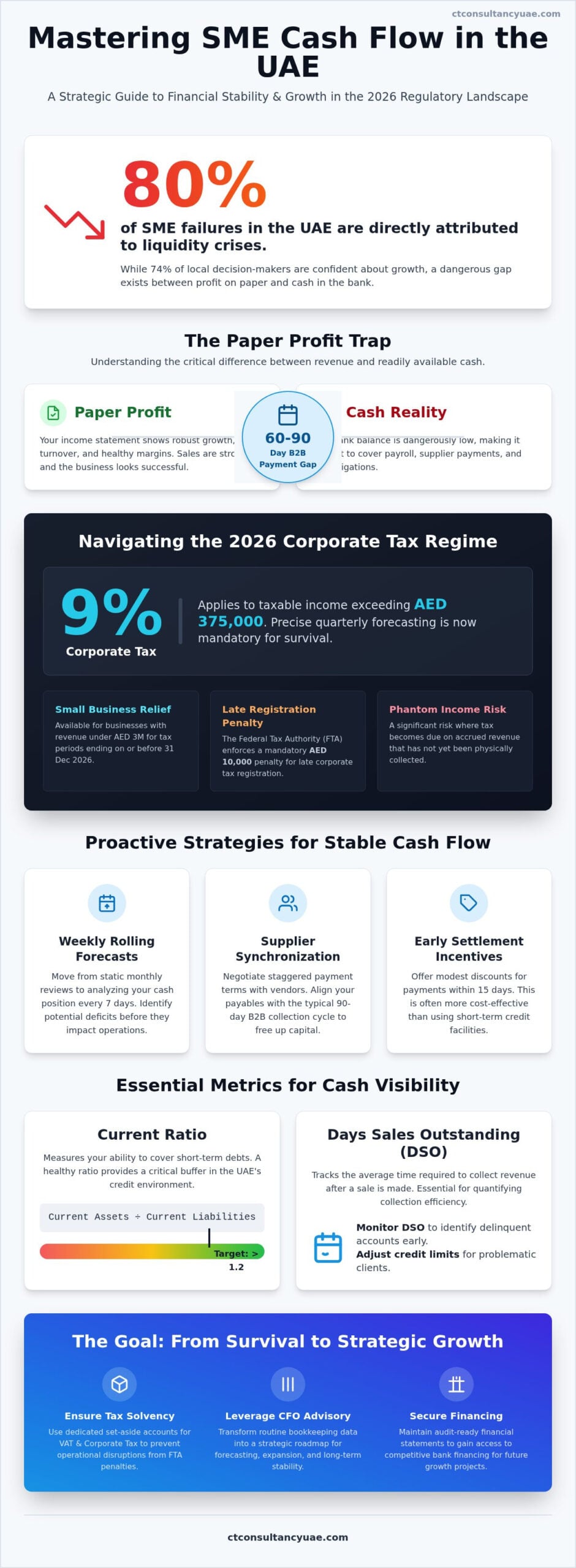
Over 80% of SME failures in the United Arab Emirates are directly attributed to liquidity crises. While 74% of local decision-makers remain confident about their growth, the reality of 90-day payment cycles often creates a dangerous disconnect between paper profits and available capital. Masterful cash flow management for SMEs in UAE has evolved into a mandatory compliance tool; it’s essential as the Federal Tax Authority intensifies its enforcement of the 9% Corporate Tax regime throughout 2026.
You’re likely familiar with the strain of balancing rapid scaling against the strict requirements of VAT and Corporate Tax solvency. This guide provides a sophisticated roadmap to help you eliminate late payment penalties and secure predictable reserves. We’ll explore how to navigate the new 2026 e-invoicing mandate, leverage strategic CFO advisory for accurate forecasting, and maintain the audit-ready financial statements required for competitive bank financing. By aligning your operational rhythm with regional regulatory updates, you can transform financial volatility into a foundation for long-term stability.
Key Takeaways
- Understand the critical distinction between paper profits and actual liquidity to navigate the high-stakes market dynamics of the United Arab Emirates.
- Bridge the common 60-90 day B2B payment gap through weekly forecasting and optimized supplier terms, essential components of effective cash flow management for SMEs in UAE.
- Ensure tax solvency by integrating dedicated set-aside accounts for VAT and Corporate Tax liabilities, preventing operational disruptions from Federal Tax Authority penalties.
- Utilize CFO advisory insights to transform routine bookkeeping into a strategic expansion roadmap and maintain audit-ready statements for future financing.
The 2026 UAE Cash Flow Landscape: Why Profit is Not Enough
Cash flow is the net amount of cash being transferred into and out of a UAE business during a specific reporting period. Beyond a simple accounting metric, effective cash flow management for SMEs in UAE represents the strategic synchronization of operational inflows with financial obligations. While it’s helpful to understand the foundational mechanics of What is Cash Flow?, applying this concept within the Emirates requires a deep understanding of local credit behaviors and regulatory timelines. In this market, liquidity is the primary determinant of long-term solvency.
Many entrepreneurs fall into the "Paper Profit Trap," where the income statement reflects robust growth while the bank balance remains dangerously low. This discrepancy often arises from the common 60 to 90-day B2B payment cycles prevalent across the region. You might record a significant sale today, but the actual cash won’t materialize for months. Without rigorous financial management for smes, this timing gap can lead to technical insolvency despite high turnover and healthy margins.
The Impact of UAE Corporate Tax on Liquidity
The 2026 regulatory environment adds a layer of complexity with the now-mature 9% Corporate Tax regime on taxable income exceeding AED 375,000. Businesses must maintain precise quarterly forecasts to ensure tax liabilities are covered before they’re due. A significant risk for growing firms is "phantom income," where tax becomes due on accrued revenue that hasn’t been physically collected yet. Consider these critical factors for your 2026 planning:
- Small Business Relief: This remains available for businesses with revenue under AED 3 million for tax periods ending on or before 31 December 2026.
- Registration Deadlines: The Federal Tax Authority enforces a mandatory AED 10,000 penalty for late corporate tax registration.
- Tax Solvency: Setting aside 9% of monthly taxable profits ensures you don’t accidentally deploy tax capital for operational expenses.
Strategies for Bridging the UAE’s 60-90 Day Payment Gap
Navigating the structural delays of the UAE’s payment gap requires a proactive alignment of your cash conversion cycle with local market realities. Robust cash flow management for SMEs in UAE involves more than just tracking expenses; it’s about the strategic anticipation of liquidity fluctuations. Businesses must move beyond reactive accounting to maintain operational stability during extended B2B collection cycles.
- Weekly Rolling Forecasts: Move away from static monthly reviews. Analyze your position every seven days to identify potential deficits before they impact your ability to meet payroll or tax obligations.
- Supplier Synchronization: Negotiate staggered terms with your vendors. Aligning your payables with the typical 90-day B2B collection cycle in the Emirates prevents capital from being trapped in the supply chain.
- Early Settlement Incentives: Offer modest discounts for payments received within 15 days. This small concession often proves more cost-effective than utilizing expensive short-term credit facilities or alternative secured options like V8Loans to manage immediate cash needs.
Utilizing outsourced bookkeeping provides the high-fidelity data needed to monitor Aged Receivables with precision. This clarity allows you to identify delinquent accounts early and initiate recovery protocols before they threaten your solvency. Implementing these rigorous strategies ensures that cash flow management for SMEs in UAE remains a proactive driver of growth rather than a reactive survival tactic. For those seeking to optimize their internal structures, professional business advisory can help refine these financial processes.
Leveraging Ratio Analysis for Cash Visibility
Sophisticated financial statement analysis transforms raw data into actionable intelligence. Two metrics are particularly vital for SMEs in the national market:
- Current Ratio: This compares your current assets to current liabilities. Maintaining a ratio above 1.2 ensures you have the buffer required to navigate the UAE’s unique credit environment.
- Days Sales Outstanding (DSO): This metric tracks the average time required to collect revenue after a sale. Monitoring DSO helps you quantify the efficiency of your collection efforts and adjust credit limits for problematic clients.
Integrating VAT and Corporate Tax into Cash Flow Planning
Effective cash flow management for SMEs in UAE now dictates that tax obligations be treated as non-negotiable liabilities rather than secondary expenses. Implementing rigorous cash flow management for SMEs in UAE ensures that you aren’t caught off guard by the Federal Tax Authority’s enforcement cycles. One common pitfall is the accidental utilization of VAT collections to fund daily operations. To mitigate this risk, sophisticated firms establish dedicated tax set-aside accounts. By segregating the 5% VAT collected from customers immediately, you ensure that funds remain available for quarterly filings.
This proactive approach is essential given the unique financial challenges for UAE SMEs, where regulatory pressure often meets liquidity constraints. Aligning your annual reviews with corporate tax consultants allows you to synchronize cash flow audits with tax planning. This ensures that deductible expenses are optimized before the fiscal year-end, preventing unnecessary cash outflows. Meticulous planning transforms tax season from a liquidity crisis into a managed operational milestone.
Audit readiness also requires identifying spending "red flags." Irregular patterns or large, undocumented transfers can trigger federal audits or Anti-Money Laundering (AML) inquiries. Maintaining a clean trail of transactions isn’t just about compliance; it’s about preserving the reputation necessary for future financing. Clear documentation removes the friction often associated with high-level corporate governance.
Maintaining Regulatory Solvency
Cash flow health is intrinsically linked to Economic Substance Regulations (ESR) compliance. Demonstrating adequate "directed and managed" activities requires consistent financial reporting and liquidity. Businesses must also prepare for the final Corporate Tax settlement. While small business relief may apply to those under the AED 3 million revenue threshold until late 2026, others must reserve 9% of taxable income. Failing to plan for this annual outflow causes severe year-end distress. Secure your business’s future by engaging professional tax compliance services today.
The Role of CFO Advisory in Strategic Cash Management
Raw financial data often obscures more than it reveals for the high-growth entrepreneur. Implementing sophisticated CFO advisory services allows you to transform static balance sheets into a dynamic expansion roadmap. This outsourced expertise provides the executive-level clarity required to navigate the 2026 regulatory environment without the prohibitive overhead of a full-time financial officer. It’s a strategic partnership that removes the friction of financial forecasting while ensuring your liquidity supports your long-term vision.
Beyond day-to-day operations, rigorous cash flow analysis serves as the empirical foundation for specialized business advisory and feasibility studies. Whether you’re evaluating a new market entry or a significant capital investment, understanding the precise timing of your capital requirements is paramount. A systematic monthly review process allows you to adjust budgets based on actual performance, ensuring your expansion remains sustainable even during periods of national market volatility. This disciplined approach is the hallmark of professional cash flow management for smes in uae.
Implementing a Professional Financial Roadmap
A structured approach to financial governance ensures your business remains resilient and attractive to institutional lenders. Establishing this roadmap requires a deliberate progression through three critical stages:
- Step 1: Audit Readiness. Standardize monthly financial statements to ensure transparency for stakeholders and satisfy the rigorous documentation requirements of UAE banks.
- Step 2: Strategic Tax Alignment. Conduct quarterly reviews with a tax expert to synchronize operational spending with upcoming Corporate Tax and VAT obligations.
- Step 3: Dynamic Forecasting. Continuously adjust your 2026 projections to capitalize on growth opportunities while mitigating the liquidity risks inherent in the regional credit market.
Securing Your Competitive Advantage in the 2026 UAE Market
Mastering cash flow management for SMEs in UAE has transitioned from a back-office task to a critical pillar of strategic survival. By synchronizing your operational rhythm with the 9% Corporate Tax and VAT cycles, you ensure that regulatory compliance strengthens rather than strains your liquidity. Bridging the structural 90-day B2B payment gap requires more than just reactive bookkeeping; it demands the foresight provided by professional forecasting and audit-ready financial statements.
As the 2026 regulatory landscape continues to mature, the precision of your financial governance will define your ability to scale within the national market. You don’t have to navigate these complexities alone. With decades of international financial experience and specialized expertise in UAE Corporate Tax and VAT guidance, our team provides the support necessary for national SMEs and entrepreneurs to thrive. Secure your business’s financial future with strategic CFO advisory from CTC Tax & Accounting. Your commitment to meticulous planning today will create the frictionless growth of tomorrow.
Frequently Asked Questions
How do UAE Corporate Tax payments affect an SME’s daily cash flow?
The 9% Corporate Tax on taxable income exceeding AED 375,000 creates a periodic cash outflow that necessitates proactive reserving. It’s not merely a year-end concern; it affects daily liquidity by requiring the systematic segregation of funds from operational capital. Failure to plan for these settlements can lead to severe liquidity crises when the final tax liability becomes due, especially if your capital is currently tied up in uncollected receivables.
What is the difference between cash flow and profit for a UAE business?
Profit is an accounting metric representing revenue minus expenses, while cash flow reflects the actual timing of liquid capital movement. In the Emirates, a profitable entity can face technical insolvency if its wealth is trapped in long-term receivables. Effective cash flow management for SMEs in UAE focuses on the strategic timing of inflows to ensure that immediate obligations, such as VAT and payroll, are satisfied regardless of the paper profit.
How can I manage cash flow if my UAE clients take 90 days to pay?
Bridging the common 90-day B2B payment gap requires a combination of early payment incentives and the negotiation of staggered terms with your own suppliers. By aligning your payables with your collection cycle, you prevent capital from being trapped in the supply chain. Implementing weekly rolling forecasts helps you anticipate liquidity shortfalls, ensuring you maintain the reserves necessary to fund operations while waiting for high-value client settlements to clear.
Why is a cash flow forecast required for SME bank loans in the UAE?
UAE financial institutions demand cash flow forecasts to verify your capacity to service debt amidst regional market volatility. Lenders scrutinize these projections to ensure your business can maintain liquidity while meeting interest payments and tax obligations simultaneously. A professional forecast demonstrates that you have a disciplined plan for cash flow management for SMEs in UAE, significantly reducing the perceived risk for the bank and improving your financing terms.
Should I use automated accounting software for UAE cash flow management?
Utilizing automated accounting software is essential for achieving real-time visibility into your Aged Receivables and projected tax liabilities. These platforms facilitate the integration of e-invoicing, which is a critical component of the 2026 regulatory landscape. While automation reduces manual errors and provides high-fidelity data, it should be paired with expert CFO advisory. This ensures that complex local nuances, such as VAT and Corporate Tax compliance, are correctly interpreted within the software.