The transition from basic accounting to a sophisticated tax regime signifies a fundamental shift in how businesses must approach financial governance. Many executives feel trepidation regarding the 9% threshold application and the stringent Federal Tax Authority penalty structures. Managing corporate tax filing in the UAE requirements is no longer a matter of simple record-keeping; it’s a strategic mandate that demands precision. You’ve likely recognized that the margin for error has narrowed, and a robust, compliant framework is now critical for maintaining long-term stability.
This guide provides the professional clarity you require to master the complexities of the UAE’s fiscal landscape. We’ll outline a comprehensive framework for calculating taxable income while ensuring your 2026 filing remains seamless and compliant. By the end of this briefing, you’ll possess a clear roadmap for liability estimation, an understanding of applicable reliefs like the AED 3 million Small Business Relief, and the assurance that your regulatory obligations are met. We’ll explore the nuances of deductible expenses and free zone criteria to help you secure every legitimate advantage under the law.
Key Takeaways
- Master the dual-rate framework to accurately distinguish between the 0% threshold for income up to AED 375,000 and the standard 9% rate applied to exceeding profits.
- Identify the critical adjustments required to convert net accounting profit into taxable income, specifically regarding non-deductible expenses and audited financial validations.
- Navigate the specific eligibility criteria for Small Business Relief to treat taxable income as zero for entities with annual revenues not exceeding AED 3 million.
- Secure a seamless 2026 corporate tax filing in the UAE experience by integrating professional advisory to ensure full FTA compliance and strategic long-term optimization.
The UAE Corporate Tax Landscape: Framework and Thresholds for 2026
The implementation of corporate tax represents a milestone in the evolution of Taxation in the United Arab Emirates, aligning the nation with global OECD standards. This framework isn’t merely a revenue mechanism; it’s a strategic pillar for sustainable economic growth and fiscal transparency. The Federal Tax Authority (FTA) oversees this regime, ensuring that corporate tax filing in the UAE processes remain consistent across all emirates while enforcing national compliance standards through rigorous oversight.
Key Tax Rates and Statutory Thresholds
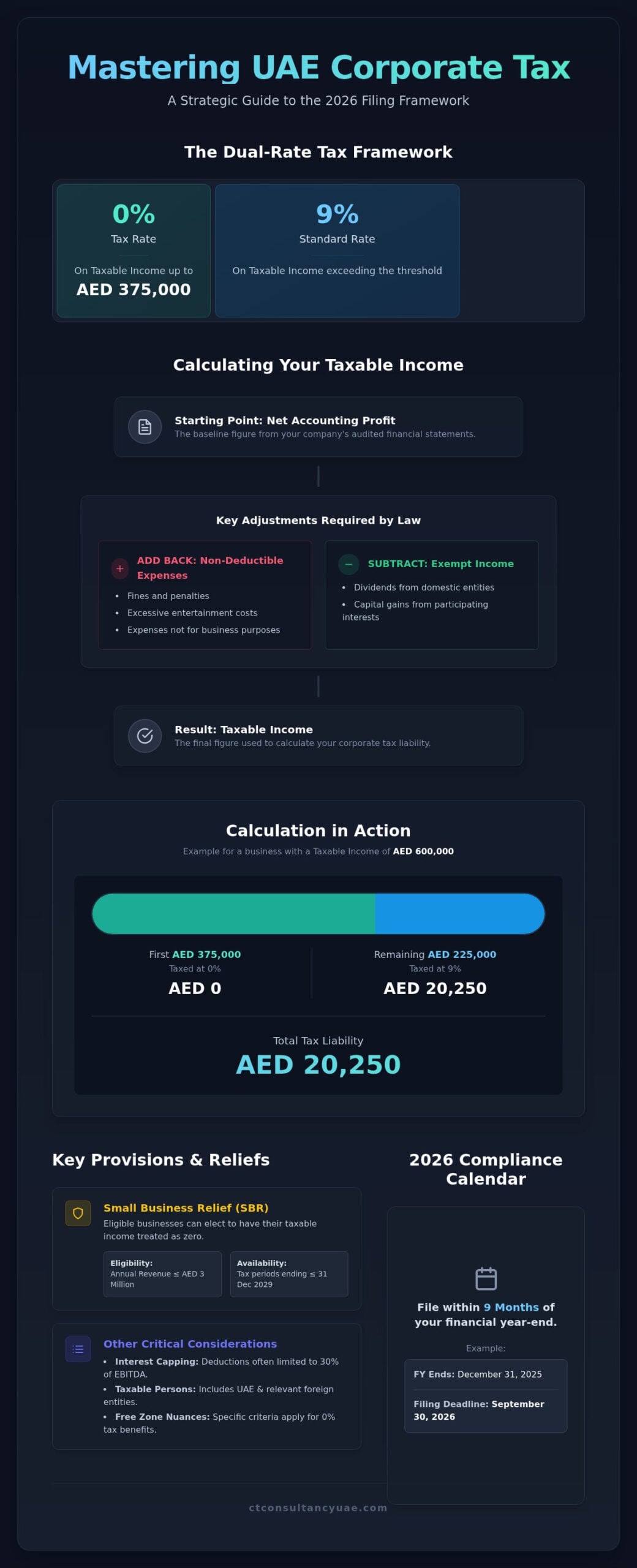
The UAE employs a progressive dual-rate system designed to support smaller enterprises while ensuring larger entities contribute to national development. A 0% rate applies to taxable income up to AED 375,000, while a standard 9% rate is levied on any income exceeding this threshold. It’s vital to understand that the 9% rate is marginal; it only applies to the portion of profit above the lower limit. Under the Decree-Law, a "Taxable Person" includes any UAE-incorporated legal entity, as well as foreign entities with a permanent establishment or nexus within the country. This distinction ensures that SMEs are not disproportionately burdened by the new requirements. Identifying your status is the first step in establishing a compliant fiscal footprint.
For entrepreneurs looking to navigate these new fiscal requirements with confidence, check out Crystal Richmond for professional tax services and community-based support.
The 2026 Compliance Calendar: Critical Deadlines
Precision in timing is as essential as accuracy in calculation. For the 2026 cycle, businesses must adhere to a strict nine-month filing window following the conclusion of their financial year. For instance, if your financial year ends on December 31, 2025, your submission deadline is September 30, 2026. The Tax Period refers to the 12-month duration for which tax is calculated. While Small Business Relief (SBR) currently allows businesses with revenue below AED 3 million to elect for zero taxable income, this provision is currently slated for tax periods ending on or before December 31, 2029. Proactive management through Corporate Tax Advisory ensures that corporate tax filing in the UAE requirements are met without friction.
Calculating Your Taxable Income: A Step-by-Step Filing Preparation Guide
Precision in corporate tax filing in the UAE begins with a systematic reconciliation of financial data. It’s a common misconception that accounting profit equals taxable profit. The process necessitates a multi-stage adjustment framework to align your internal reporting with statutory requirements. Start by establishing the net accounting profit derived from accurate, audited financial statements. This provides the verified baseline required by the FTA and ensures that your starting figure is defensible under scrutiny.
- Identify non-deductible expenses. These include non-business fines and excessive entertainment costs. According to Official UAE Government Corporate Tax Information, certain expenditures are restricted to ensure fiscal integrity.
- Deduct exempt income. This typically includes dividends from domestic entities and capital gains from participating interests.
- Apply the AED 375,000 threshold to determine the final marginal liability.
From Accounting Profit to Taxable Income
Adjustments often involve complex technicalities like depreciation schedules and interest capping rules. Specifically, interest deductions are often restricted to 30% of EBITDA, requiring careful year-end modeling. Managing these nuances requires the precision of specialized accounting services to ensure your ledgers are fully audit-ready and free of structural errors before submission.
Visualizing the 9% Marginal Tax Impact
Consider a business with a taxable income of AED 600,000. The calculation isn’t a flat 9% on the total. Instead, the first AED 375,000 is taxed at 0%. The 9% rate applies only to the remaining AED 225,000, resulting in a liability of AED 20,250. This progressive structure supports reinvestment while ensuring compliance. Maintaining itemized audit trails for every adjustment is vital for substantiating these figures during an FTA review. For those seeking a friction-free transition, engaging with Corporate Tax Advisory can prevent costly miscalculations and optimize your final position.
Navigating Small Business Relief and Free Zone Tax Nuances
Maximizing Relief Provisions in the 2026 Fiscal Year
Eligibility for SBR is restricted to resident taxable persons and cannot be claimed by members of multinational enterprise groups with consolidated revenues exceeding AED 3.15 billion. The election process requires meticulous documentation within the tax return to prevent future disputes with the FTA. For specialized guidance on navigating these specific elections, consulting with CTC Tax & Accounting provides the technical assurance needed to secure your relief status without administrative friction.
Corporate Tax Obligations for Free Zone Entities
A common misconception exists that Free Zone registration equates to a blanket 0% tax rate. In reality, the UAE Government Corporate Tax framework mandates that Free Zone Persons must meet "adequate substance" requirements and derive only Qualifying Income to benefit from the preferential rate. Income is strictly bifurcated; revenue from mainland transactions or non-qualifying activities is typically taxed at the standard 9% rate. Understanding Permanent Establishment (PE) rules is crucial, as certain mainland activities can inadvertently shift your tax profile. To ensure your entity maintains its competitive edge, a comprehensive Corporate Tax Advisory review of your corporate tax filing in the UAE strategy is highly recommended.
From Calculation to Submission: Ensuring Frictionless FTA Compliance
While rudimentary digital tools offer a surface-level estimate, they often fail to capture the multi-layered complexities inherent in the Federal Tax Authority’s specific requirements. Relying on a generic calculator for corporate tax filing in the UAE can lead to significant discrepancies, particularly regarding interest capping or the treatment of unrealized gains. This is where CFO Advisory Services become indispensable, transforming a mandatory compliance task into a strategic opportunity for long-term tax optimization and fiscal health.
The FTA mandates that businesses maintain comprehensive financial records for a minimum of seven years. This requirement ensures that every adjustment made during the reconciliation process is backed by a verifiable audit trail. CTC Tax & Accounting acts as a primary friction-remover in this transition, moving your entity from basic bookkeeping to a state of total submission readiness. It’s about building a fortress of data that stands up to the most rigorous scrutiny.
Mitigating Risks: Penalties and Audit Readiness
Partnering for Strategic Tax Excellence
Sophisticated SMEs recognize that tax compliance is a floor, not a ceiling. Moving beyond simple filing toward proactive financial management allows your business to leverage available reliefs and optimize group structures. For a broader perspective on driving business growth through financial discipline, explore our guide on Strategic Financial Management for SMEs. Securing your company’s future requires a partner with deep regional expertise and a commitment to precision. Consult with the tax experts at CTC for a professional assessment to ensure your 2026 obligations are handled with elite proficiency.
Securing Your Fiscal Legacy in a Shifting Regulatory Landscape
The landscape of UAE taxation is no longer a peripheral concern but a core component of corporate governance. Success in 2026 requires more than a reactive approach to the 9% marginal tax rate or the AED 375,000 threshold. It demands a sophisticated alignment of accounting profit with statutory requirements, ensuring that every deduction and relief election is substantiated by rigorous audit trails. Mastering corporate tax filing in the UAE obligations involves navigating the expiration of current Small Business Relief provisions and the intricate substance requirements of Free Zone jurisdictions. By prioritizing precision today, you insulate your entity against penalties and position it for sustainable growth. CTC Tax & Accounting provides the specialized expertise in Federal Tax Authority regulations and decades of international governance experience necessary to deliver comprehensive, friction-free financial solutions. Secure your business compliance with expert Corporate Tax Advisory from CTC. Your commitment to meticulous planning today ensures a stable and prosperous tomorrow.
Frequently Asked Questions
What is the corporate tax rate in the UAE for 2026?
The standard corporate tax rate for the 2026 period remains 0% for taxable income up to AED 375,000 and 9% for any amount exceeding this threshold. Large multinational groups with consolidated global revenues surpassing €750 million are subject to a 15% rate under the Domestic Minimum Top-up Tax. This progressive structure ensures that the fiscal burden is distributed equitably across the national economy while supporting smaller enterprises.
How do I calculate taxable income for my UAE-based business?
Calculation begins with the net accounting profit reported in your audited financial statements, followed by adjustments for non-deductible expenses and exempt income. You must add back items like excessive entertainment costs or administrative fines and subtract dividends received from domestic entities. This reconciliation process is essential for accurate corporate tax filing in the UAE, ensuring that your final taxable balance aligns with Federal Tax Authority standards and reporting requirements.
Does Small Business Relief still apply for the 2026 tax period?
Yes, Small Business Relief remains applicable for tax periods ending on or before December 31, 2029, which includes the 2026 cycle. Resident taxable persons with gross revenue not exceeding AED 3 million can elect for this relief to treat their taxable income as zero. This provision is not automatic; you must actively select the election within your tax return to benefit from the reduced compliance burden and financial relief.
Are Free Zone companies required to file a corporate tax return in 2026?
Every taxable person, including entities registered in Free Zones, must file a corporate tax return regardless of their tax liability or income status. Even if your entity qualifies for the 0% rate on Qualifying Income, the obligation to submit a return remains mandatory. Failure to comply with these corporate tax filing in the UAE requirements can result in significant administrative penalties and the potential loss of your preferential tax status.
What documents are required for corporate tax filing in the UAE?
Essential documentation includes audited financial statements, a detailed trial balance, and records of all tax-deductible adjustments made during the period. You should also maintain copies of VAT returns, ownership structures, and evidence of any applied reliefs or exemptions. The Federal Tax Authority requires these records to be preserved for seven years to ensure readiness for potential audits and to validate the accuracy of your formal submission.