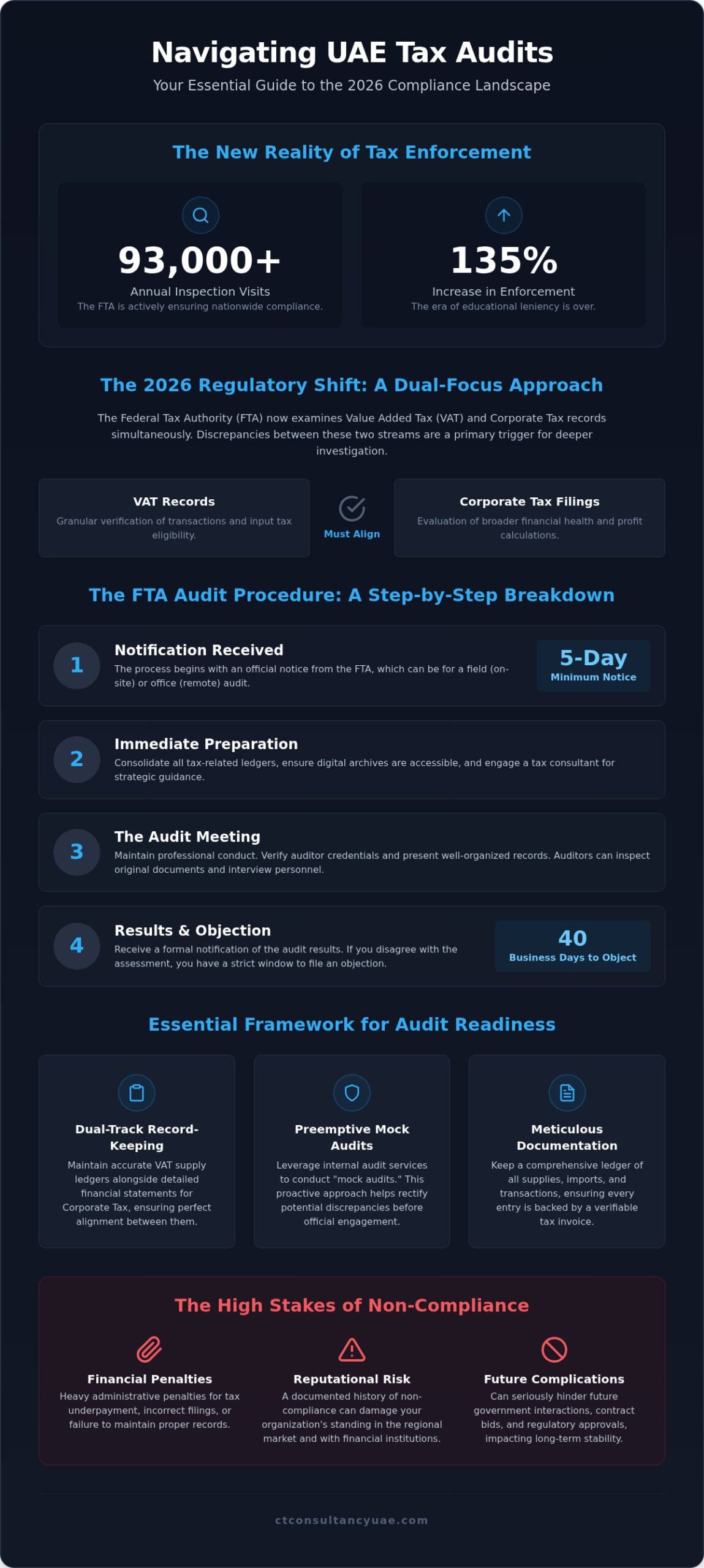
With the Federal Tax Authority conducting over 93,000 inspection visits annually, representing a 135% increase in enforcement, the era of educational leniency has reached its definitive end. It’s natural to feel a sense of trepidation when considering the implications of a tax audit in the UAE, especially as the 2026 regulatory framework introduces significantly more stringent oversight. You likely face concerns regarding the compressed five-day notification window or the technical complexities of reconciling your Corporate Tax records with VAT documentation under the newest legislative amendments.
We recognize that maintaining continuous audit-readiness is a high-stakes endeavor that demands absolute precision and strategic foresight. This comprehensive guide is designed to serve as your authoritative roadmap, ensuring your organization remains a model of financial integrity within this increasingly complex jurisdiction. We will examine the sophisticated mechanics of the FTA audit procedure, provide meticulous insights for internal record-keeping, and outline the exact protocols required to secure a friction-free compliance experience throughout 2026.
Key Takeaways
- Identify the specific operational requirements of the five-day notification period to ensure a composed response to both field and office assessments.
- Establish a dual-track record-keeping system that accurately maintains VAT supply ledgers alongside detailed financial statements for Corporate Tax compliance.
- Leverage internal audit services to conduct preemptive “mock audits,” allowing your firm to rectify potential discrepancies before official government engagement.
- Gain a comprehensive understanding of the 2026 regulatory shift to navigate a tax audit in the UAE with the strategic reassurance of a fully compliant enterprise.
The Evolution of Tax Audit in the UAE: 2026 Landscape
The landscape of Taxation in the United Arab Emirates has matured rapidly, transitioning from an educational phase to a rigorous enforcement model. A tax audit in the UAE is formally defined as a procedure where the Federal Tax Authority (FTA) examines the records and commercial data of a taxable person to ensure adherence to the Tax Procedures Law. By 2026, the FTA’s methodology has evolved into a dual-focus strategy. It doesn’t just verify the accuracy of tax liabilities; it ensures the absolute integrity of the collection and reporting timeline.
Modern audits are characterized by their integrated nature. The FTA now frequently examines VAT and Corporate Tax records simultaneously during a tax audit in the UAE. This unified approach eliminates the silos between transactional data and annual profit declarations, requiring businesses to maintain professional authority over their financial narratives. Discrepancies between these two tax streams are primary triggers for deeper investigation.
VAT vs. Corporate Tax Audits: Key Differences
While VAT audits focus on the granular verification of transactions and input tax eligibility, Corporate Tax assessments evaluate the broader financial health and profit calculations of a firm. The FTA utilizes VAT returns as a baseline to cross-reference Corporate Tax filings. If your reported revenue in VAT filings doesn’t align with your Corporate Tax income, it serves as an immediate red flag. Precision in accounting services is therefore paramount to ensure consistency.
The Consequences of Non-Compliance
Failing a government assessment carries heavy administrative weight. Beyond the immediate financial impact of penalties for underpayment or over-claiming input tax, there’s a profound reputational risk. A documented history of non-compliance can complicate future government interactions and hinder your organization’s standing in the regional market. Maintaining audit-readiness isn’t merely about avoiding fines; it’s about securing your business’s long-term stability.
The FTA Tax Audit Procedure: A Step-by-Step Breakdown
Receiving an official notification from the UAE Federal Tax Authority (FTA) marks the commencement of a highly structured regulatory process. A tax audit in the UAE typically manifests in two distinct forms: a field audit conducted on-site at your business premises or an office audit performed remotely via digital submission. In either scenario, the auditor is granted extensive legal powers to inspect original documents, secure physical samples, and interview personnel to verify the absolute accuracy of reported data. It’s a precise examination where every ledger entry must align with the underlying commercial reality.
Managing the 5-Day Notice Window
The FTA mandates a minimum five-day notification period before an audit commences. This window is exceptionally brief. Upon receipt of such a notice, executives must immediately consolidate all tax-related ledgers and ensure that digital archives are fully accessible and reconciled. Engaging an expert tax consultant during these first few hours is a critical strategic maneuver. This ensures your initial response is technically precise and protects your rights as a taxable person. Proactive coordination prevents the administrative friction that often arises from last-minute record retrieval.
The Audit Meeting: Professional Conduct
During the assessment, maintaining a composed and professional environment is paramount for a successful outcome. You possess the legal right to verify the auditor’s official credentials before granting access to your sensitive financial records. Presentation is a silent indicator of integrity. Well-organized digital folders and clearly indexed physical archives signal a robust internal culture of compliance. Once the auditor concludes their investigation, a formal notification of the results is issued. If your organization disagrees with the assessment, a strict 40-business-day window exists to file an objection. Leveraging professional business advisory services during this phase provides the strategic reassurance needed to navigate a tax audit in the UAE with complete confidence.
Essential Record-Keeping and Preparation Framework
Achieving total compliance during a tax audit in the UAE requires a meticulous approach to documentation that transcends basic bookkeeping. Organizations must maintain a comprehensive ledger of all supplies and imports for VAT purposes, ensuring every transaction is backed by verifiable tax invoices. Simultaneously, Corporate Tax mandates necessitate detailed financial statements and rigorous business valuations. It’s imperative that all accounting services strictly align with International Financial Reporting Standards (IFRS), as deviations can be interpreted as systemic failures in reporting integrity.
According to the Official FTA Tax Audit Procedure, the burden of proof rests entirely with the taxable person. Implementing a systematic digital filing system is no longer optional; it’s a strategic necessity for rapid retrieval within the five-day notice window. A disorganized archive is often viewed by auditors as a proxy for unreliable tax reporting, which can lead to deeper scrutiny of your commercial activities.
The Role of Technology in Audit Readiness
Modern compliance relies on automated bookkeeping to eliminate human error in complex tax calculations. Real-time financial oversight prevents the "late submission" triggers that often invite unwanted attention from regulators. By digitizing workflows, you ensure that your records are not only accurate but also instantly accessible. This digital maturity allows your firm to navigate a tax audit in the UAE with the composed assurance of a prepared executive.
Common Triggers for an FTA Audit
While the FTA employs "random selection" at its discretion, certain risk factors significantly increase the probability of an assessment. High-volume transactions, a history of late filings, or inconsistent data between VAT and Corporate Tax returns are primary red flags. Precision in your daily operations is the only reliable defense against these triggers. To ensure your records meet these rigorous 2026 standards, consider a professional review of your accounting services today.
Mitigating Risk Through Strategic Internal Audits
Proactive defense is the hallmark of a resilient enterprise. Rather than waiting for an official notice, sophisticated firms utilize internal audit services to conduct comprehensive mock audits. This pre-emptive assessment evaluates risk management and control processes, identifying reporting gaps before a government official arrives. This exercise transforms a potential tax audit in the UAE from a source of anxiety into a standard validation of internal rigor. By simulating the FTA’s methodology, you can rectify inconsistencies in VAT treatment or Corporate Tax deductions in a controlled environment.
Coordinating internal and external audits ensures financial statements reach final certification without delay. This alignment is significantly strengthened by a CFO advisory partner who understands the nuances of the 2026 regulatory landscape. High-level oversight ensures every strategic decision is made with an eye toward long-term stability. This partnership bridges the gap between daily bookkeeping and high-stakes regulatory requirements, providing a seamless flow of information that satisfies the most rigorous government assessments.
The Benefits of a Friction-Free Audit Experience
Preparation breeds professional calm. When internal records are verified and your team is briefed, the auditor’s visit becomes a routine procedural check. This friction-free experience allows executives to focus on growth rather than damage control. Meticulous financial planning provides the long-term stability required to thrive. You’ll gain the confidence that your business isn’t just following the law, but is setting a regional standard for corporate governance.
Partnering with CTC Tax & Accounting for National Compliance
CTC Tax & Accounting acts as a primary friction-remover for businesses operating across the UAE. Our seasoned consultants provide the technical proficiency needed to navigate the high-stakes nature of modern tax laws. We offer personalized solutions that reject one-size-fits-all approaches. Contact CTC Tax & Accounting for a comprehensive compliance health check to ensure your organization is fully prepared for any tax audit in the UAE.
Securing Your Corporate Legacy in a Maturing Regulatory Environment
Navigating the complexities of a tax audit in the UAE in 2026 requires more than reactive bookkeeping; it demands a proactive culture of compliance and strategic foresight. As the Federal Tax Authority transitions toward integrated assessments that scrutinize VAT and Corporate Tax simultaneously, the margin for error has effectively vanished. By implementing a rigorous record-keeping framework and conducting pre-emptive internal audits, your organization can transform a high-stakes government assessment into a routine validation of its financial integrity. This systematic preparation ensures that the five-day notification window is met with composed confidence rather than administrative friction.
Leveraging over a decade of regional expertise, CTC Tax & Accounting provides the specialized oversight necessary to mitigate risks for SMEs through our dedicated internal audit team. We deliver comprehensive VAT and Corporate Tax advisory, ensuring your internal controls are resilient enough to withstand the most meticulous scrutiny. Secure your business with CTC Tax & Accounting’s strategic tax audit and compliance services. We’re committed to ensuring your journey through the UAE’s evolving regulatory landscape is both seamless and successful.
Frequently Asked Questions
How long does a UAE tax audit usually take to complete?
A tax audit in the UAE typically concludes within five to ten business days for standard office assessments, though complex field audits may extend over several weeks. The duration depends on the volume of transactions and the organization of your digital archives. If the FTA requires additional documentation or clarifications, the timeline shifts accordingly. Meticulous preparation significantly accelerates the process by reducing the back and forth between your team and the auditor.
Can the FTA conduct an audit without prior notice?
The FTA generally provides a five-day notice period, but they possess the legal authority to conduct unannounced audits under specific circumstances. These surprise inspections occur if the authority suspects tax evasion or believes that prior notification would jeopardize the audit’s integrity. While rare for compliant firms, the possibility underscores the necessity of constant audit-readiness. Maintaining real-time financial oversight ensures your organization is prepared for any government interaction at any moment.
What is the most common reason for receiving a tax audit notice in 2026?
Discrepancies between VAT returns and Corporate Tax filings are the primary triggers for a tax audit in the UAE in 2026. The FTA utilizes sophisticated risk-driven analytics to identify inconsistent data patterns across different tax streams. Other common factors include a history of late submissions or unusually high volumes of input tax claims. Precision in your reporting and professional reconciliation of all financial data points are the most effective ways to avoid these red flags.
Are businesses in Free Zones exempt from UAE tax audits?
Free Zone entities aren’t exempt from government scrutiny and must adhere to all relevant tax procedures. While certain Free Zone businesses may benefit from a 0% Corporate Tax rate on qualifying income, they remain taxable persons under the law. The FTA conducts audits to verify that these entities meet the specific substance requirements and qualifying criteria necessary for their tax status. Professional compliance remains a universal requirement for all commercial operations within the national borders.
What happens if I disagree with the findings of an FTA tax audit?
You have the legal right to contest an assessment through a structured dispute resolution process. A formal application for reconsideration must be submitted to the FTA within 40 business days of receiving the audit result. If the internal review doesn’t resolve the issue, the case can be escalated to the Tax Disputes Resolution Committee. For disputes exceeding AED 100,000, further appeals are possible through the federal court system to ensure a fair and transparent outcome.