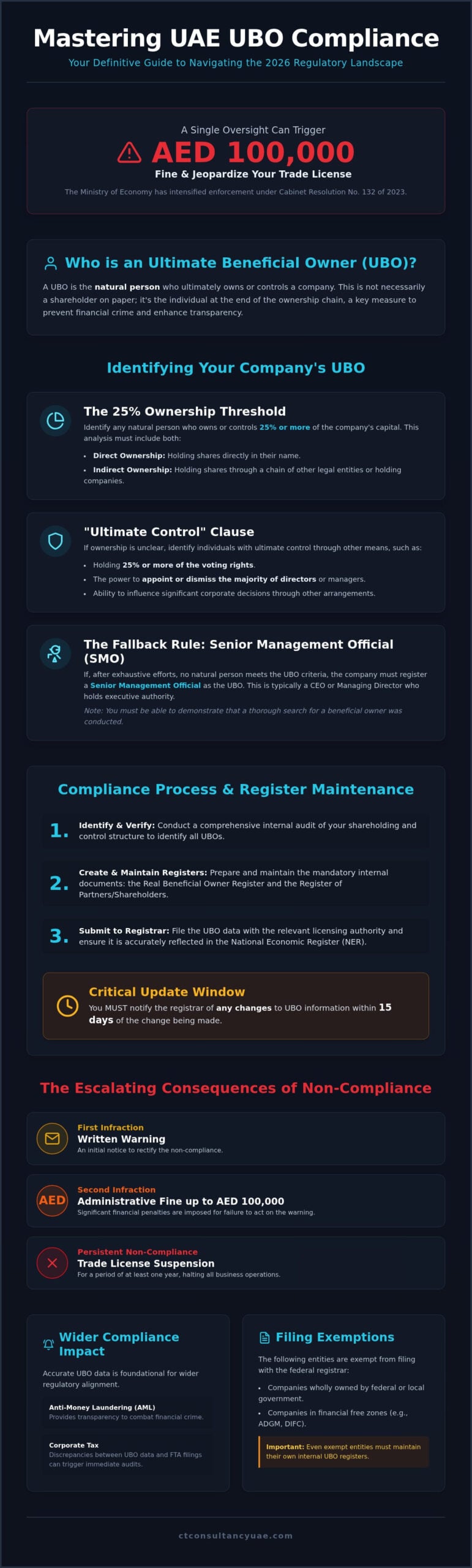
A single administrative oversight in your corporate registry can now trigger an AED 100,000 fine and jeopardize your trade license in a matter of weeks. As the Ministry of Economy intensifies its enforcement of Cabinet Resolution No. 132 of 2023, the margin for error in corporate governance has effectively vanished. It’s understandable if the nuances of indirect ownership through complex holding structures leave you feeling exposed to unnecessary risk. You aren’t alone in seeking clarity amidst these stringent transparency requirements. This comprehensive guide empowers you to master the complexities of UBO filing in the UAE, ensuring your entity remains fully aligned with the latest federal mandates. We’ll provide a definitive roadmap to navigating the 25% ownership threshold and maintaining a precise Real Beneficial Owner Register. By the end of this briefing, you’ll possess the strategic insight needed to mitigate financial penalties and secure a frictionless path for your business growth in 2026. We’ve structured this analysis to transform a high-stakes compliance burden into a streamlined component of your operational excellence.
Key Takeaways
- Understand the transition from Cabinet Decision No. 58 of 2020 to the 2026 enforcement landscape to ensure your entity remains aligned with the latest federal transparency mandates.
- Master the 25% ownership threshold and the complexities of indirect control to execute a precise UBO filing in the UAE that satisfies rigorous regulatory scrutiny.
- Learn the essential administrative protocols for maintaining the Real Beneficial Owner Register, including the mandatory 15-day window for reporting any corporate governance changes.
- Identify the severe financial and operational risks of non-compliance, ranging from initial written warnings to administrative fines reaching AED 100,000 and license suspension.
UAE UBO Filing Evolution: 2026 Regulatory Context
The regulatory landscape in 2026 represents a pivotal shift from mere registration to rigorous, data-driven enforcement. Central to this evolution is the mandate for UBO filing in the UAE, a requirement rooted in Cabinet Decision No. 58 of 2020 but significantly fortified by subsequent 2026 updates. This framework isn’t just about paperwork; it’s a strategic alignment with international standards to eliminate corporate anonymity and foster a secure investment environment.
To understand compliance, one must first ask: What is an Ultimate Beneficial Owner? In the UAE context, a UBO is the natural person who ultimately exercises ownership or control over a legal entity, whether through direct shareholding or indirect influence. Essentially, an Ultimate Beneficial Owner serves as the final link in the corporate chain, acting as a critical safeguard against the financial opacity that facilitates illicit activities.
Since the inception of the federal framework, the Ministry of Economy has meticulously integrated UBO data into national risk assessments to combat financial crime. By 2026, the integration with the National Economic Register (NER) has matured significantly, making real-time transparency a mandatory prerequisite for any entity wishing to maintain its trade license and operational eligibility in the Emirates. This level of corporate clarity is also indispensable when engaging with firms like Pinnacle Global Advisory to explore asset finance and other strategic levers for capital efficiency.
Synergy Between UBO, AML, and Corporate Tax
Effective UBO data acts as a foundational pillar for robust AML compliance, providing the transparency required to verify tax residency. The Federal Tax Authority (FTA) and local licensing registrars now operate with unprecedented synchronization. Discrepancies between your UBO filing in the UAE data and Corporate Tax filings can trigger immediate audits. Maintaining consistent data across these platforms ensures your corporate standing remains beyond reproach, facilitating a frictionless path for banking and market access.
Criteria for Identifying Ultimate Beneficial Owners
Identifying the correct individuals for UBO filing in the UAE requires a precise analysis of both equity and influence. The primary trigger is the 25% threshold. This applies to any natural person who directly or indirectly owns or controls 25% or more of the company’s capital. However, shareholding is only part of the equation. Control often manifests through voting rights or the ability to dictate corporate policy through private agreements.
Regulatory authorities also look for "ultimate control." This includes individuals who have the power to appoint or dismiss the majority of managers or influence significant corporate decisions through other means. When dealing with multi-layered holding companies or offshore entities, you must document every link in the ownership chain. This rigorous documentation is a direct response to the FATF Mutual Evaluation of UAE, which emphasized the need for transparency in complex corporate vehicles. If your structure involves several jurisdictions, securing expert advisory services can prevent costly misidentification.
The Senior Management Official Fallback
If no natural person meets the 25% ownership or control criteria after exhaustive research, the entity must designate a Senior Management Official (SMO) as the UBO. This individual is typically a person with executive authority, such as a CEO or Managing Director. It’s not a choice of convenience; it’s a fallback mechanism to ensure every entity has a registered point of accountability. You must be prepared to prove to the registrar that you’ve attempted to identify a beneficial owner before defaulting to an SMO.
Exemptions to UBO Filing Requirements
Certain entities are exempt from filing with the federal registrar, though they aren’t exempt from the principle of transparency. This includes government-owned companies and entities registered in financial free zones like ADGM or DIFC, which maintain their own independent beneficial ownership rules. Crucially, even exempt entities must maintain internal registers of partners and directors at their registered office to satisfy potential audits. Failure to keep these records accessible can still lead to administrative scrutiny during routine inspections.
The UBO Filing Process and Register Maintenance
Executing a successful UBO filing in the UAE requires a systematic approach to corporate transparency that extends beyond simple digital submissions. The process begins with a comprehensive internal audit of your shareholding structure to trace all natural persons who ultimately hold interest. Following this identification, you must meticulously prepare three distinct internal documents: the Real Beneficial Owner Register, the Register of Partners, and the Register of Directors. Many entities overlook the Register of Partners, yet it’s a mandatory internal record that must mirror your UBO data to ensure total consistency during regulatory inspections.
Once your internal documentation is finalized, the declaration must be submitted through the relevant licensing authority, such as a designated government department for mainland entities or the specific registrar of your Free Zone. Compliance isn’t a static event. You must implement a rigorous 15-day protocol to report any changes in UBO data or corporate structure to the registrar. This event-driven approach is vital. It ensures that your UBO filing in the UAE remains accurate even as your company evolves, thereby avoiding the automatic triggers for administrative warnings.
Essential Documentation for Compliance
The filing process demands granular data for every identified individual to satisfy the Ministry of Economy’s standards. You’ll need to compile high-resolution passport copies, Emirates ID numbers, and verified residency status for all beneficial owners. The regulations also mandate the designation of a UAE-resident individual to serve as the official point of contact for the registrar. This person must be authorized to provide requested information during an inquiry or audit. To ensure your registers are structurally sound and audit-ready, you can utilize our UBO Filing services to manage these complex protocols with professional precision.
Enforcement and Strategic Compliance Management
The 2026 enforcement landscape has transitioned from a period of regulatory education to one of strict accountability. Under the provisions of Cabinet Resolution No. 132 of 2023, the Ministry of Economy has established a tiered penalty framework that commands immediate attention. Initial infractions typically result in a written warning, but subsequent failures to maintain an accurate Real Beneficial Owner Register trigger administrative fines of AED 50,000, escalating to AED 100,000 for repeated violations. Beyond these financial setbacks, persistent non-compliance can lead to the suspension of trade licenses, effectively halting all commercial operations within the Emirates.
Strategic compliance extends far beyond avoiding administrative penalties. Inaccurate UBO filing in the UAE data directly impacts your broader fiscal health and operational stability. Financial institutions now prioritize UBO verification as a non-negotiable prerequisite for maintaining corporate bank accounts and securing credit facilities. Integrating these requirements with your accounting services ensures that your corporate structure remains transparent to both lenders and regulators. Our specialized tax services further safeguard your standing by aligning UBO declarations with Corporate Tax filings, eliminating the discrepancies that often invite Federal Tax Authority audits. CTC Tax & Accounting acts as your strategic partner, providing the meticulous planning required to mitigate these high-stakes risks.
Remediating Compliance Gaps
If your entity receives a violation notice, immediate action is paramount to prevent escalating fines. You must first identify the specific data discrepancy cited by the registrar and rectify the internal register within the mandated timeframe. Conducting a retrospective audit allows you to clean up historic ownership data and trace any undocumented transfers of control. This proactive remediation demonstrates a commitment to transparency, which is critical during administrative appeals. Our team facilitates these "friction-less" setups, ensuring that even the most complex corporate structures meet the rigorous standards of the 2026 regulatory environment.
Future-Proofing Your Corporate Governance in the UAE
The 2026 regulatory landscape demands a transition from passive registration to proactive, event-driven governance. Identifying the individuals behind the 25% threshold is only the first step; the true challenge lies in the continuous maintenance of your internal registers to mirror real-time corporate shifts. As the Ministry of Economy tightens its oversight, the margin for administrative error has vanished. Mastering UBO filing in the UAE is no longer just a legal mandate but a foundational pillar of your company’s financial reputation and operational longevity.
Since 2015, CTC Tax & Accounting has provided expert AML and UBO advisory to help SMEs navigate these complex structures across all UAE jurisdictions. Our specialized support ensures your corporate standing remains beyond reproach, allowing you to focus on strategic growth while we manage the intricacies of regulatory oversight. Don’t leave your trade license to chance in this high-stakes environment. Secure your business compliance with CTC Tax & Accounting and ensure a frictionless path forward for your enterprise. Your commitment to transparency today is the ultimate safeguard for your commercial success tomorrow.
Frequently Asked Questions
Who is considered an Ultimate Beneficial Owner in the UAE?
An Ultimate Beneficial Owner is any natural person who ultimately owns or controls 25% or more of a legal entity’s capital or voting rights. This definition also includes individuals with the power to appoint or dismiss the majority of the board of directors. If no individual meets these specific criteria, the Senior Management Official is designated as the UBO to ensure accountability during UBO filing in the UAE.
What are the penalties for failing to file UBO data in 2026?
Failure to maintain an accurate register results in a tiered penalty framework under Cabinet Resolution No. 132 of 2023. A first violation earns a written warning, while a second instance triggers an administrative fine of AED 50,000. Third-time offenders face an AED 100,000 penalty and potential license suspension. These measures underscore the high stakes of regulatory compliance for every business operating within the Emirates.
Do Free Zone companies need to file UBO declarations?
Most free zone entities must comply with federal transparency mandates by submitting declarations to their specific registrars. While companies in the ADGM and DIFC are governed by independent beneficial ownership regulations, other commercial free zones align with the national framework. Ensuring a precise UBO filing in the UAE is a critical step for free zone businesses to secure their corporate standing and facilitate frictionless banking relationships.
How often must the Real Beneficial Owner Register be updated?
You’re required to update your internal Real Beneficial Owner Register and notify the registrar within 15 days of any change. This continuous requirement covers share transfers, changes in voting control, or updates to a UBO’s passport and residency details. Adhering to this strict 15-day window prevents administrative warnings and demonstrates a commitment to the UAE’s rigorous anti-money laundering and transparency standards.
Can a corporate entity be listed as a UBO?
A corporate entity cannot be designated as a UBO because the law mandates the identification of a natural person. You must trace the ownership structure through every layer of holding companies until a physical individual is identified. If no natural person owns 25% or more, the Senior Management Official serves as the designated point of responsibility to satisfy the Ministry of Economy’s transparency requirements.