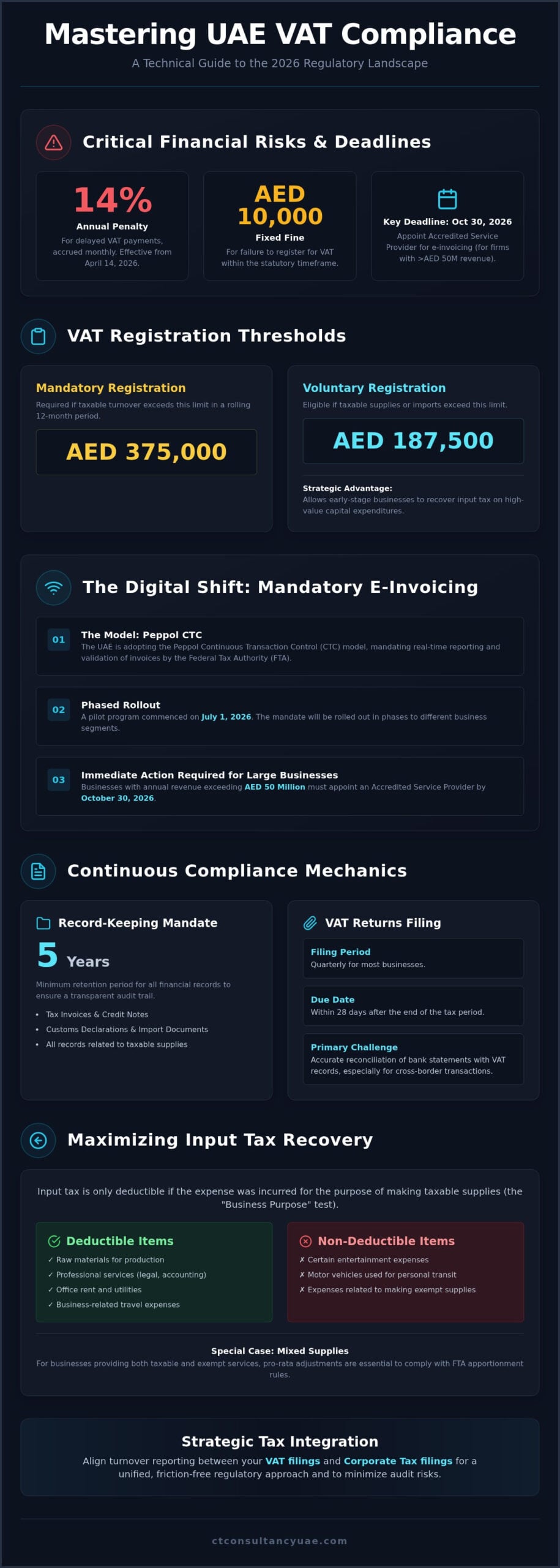
Did you know that as of April 14, 2026, a single delayed VAT payment now triggers a 14% annual penalty, accrued monthly? It’s understandable if the shifting regulatory landscape feels like a minefield, especially with the Federal Tax Authority now integrating digital audits and e-invoicing mandates into daily operations. You aren’t alone in feeling that the margin for clerical error has vanished. This guide provides the technical precision you need to master VAT compliance in the UAE requirements, ensuring your business remains audit-ready while maximizing your input tax recovery.
We’ll examine the implications of Federal Decree-Law No. 16 of 2025, clarify current registration thresholds like the AED 375,000 mandatory limit, and outline the strategic steps to align your VAT obligations with Corporate Tax for a friction-free financial year. By the end, you’ll have a roadmap to navigate the October 2026 deadline for accredited service providers and the phased rollout of mandatory e-invoicing with absolute confidence.
Key Takeaways
- Identify critical registration thresholds of AED 375,000 and AED 187,500 while preparing for the phased implementation of mandatory e-invoicing through the Peppol CTC model.
- Establish robust internal audit procedures to manage mandatory record-keeping requirements, ensuring all tax invoices and customs documents are preserved for the statutory five-year period.
- Mitigate significant financial risks by understanding the updated 14% annual penalty structure for late payments and eliminating common clerical errors that trigger FTA audits.
- Master the complexities of VAT compliance in the UAE by strategically aligning your turnover reporting with Corporate Tax filings for a unified and friction-free regulatory approach.
The 2026 UAE VAT Landscape: Thresholds and E-Invoicing
Value Added Tax (VAT) functions as a consumption-based tax applied to the majority of goods and services at a standard rate of 5% in the UAE. As the regulatory framework matures, achieving consistent VAT compliance in the UAE requires a granular understanding of registration triggers and the impending digital transformation of the invoicing ecosystem. The margins for error are slim, necessitating the use of reliable transaction recording systems; read more about how specialized restaurant management software can ensure accuracy. Precise adherence to these standards is now a prerequisite for sustainable market participation.
Determining Your Registration Obligation
Businesses must monitor their taxable turnover over a rolling 12-month period to identify if they’ve crossed the AED 375,000 mandatory threshold. If your taxable supplies or imports exceed AED 187,500, you’re eligible for voluntary registration. While early-stage startups might lack significant turnover, opting for voluntary registration serves as a strategic maneuver to recover input tax on high-value capital expenditures. This proactive approach ensures that tax obligations are integrated into the business model from inception, facilitating a smoother transition as the entity scales within the broader landscape of Taxation in the United Arab Emirates.
The Shift to Digital: Mandatory E-Invoicing
The introduction of the Peppol Continuous Transaction Control (CTC) model represents a paradigm shift in how the Federal Tax Authority (FTA) monitors commercial activity. This system mandates real-time reporting, where invoices are validated by the tax authority before being issued to the recipient. While a pilot program commenced on July 1, 2026, businesses with annual revenue exceeding AED 50 million must appoint an Accredited Service Provider by October 30, 2026. Preparing your accounting systems for this transition isn’t merely a technical hurdle; it’s a fundamental requirement for maintaining audit-ready status. Utilizing specialized tax services ensures that your digital infrastructure aligns with these rigorous FTA-compliant standards, preventing the friction of manual reporting errors.
The Mechanics of Continuous VAT Compliance: Records and Returns
Maintaining continuous VAT compliance in the UAE necessitates a disciplined approach to documentation and financial hygiene. The Federal Tax Authority mandates that businesses retain all tax invoices, credit notes, and customs declarations for a minimum of five years. This requirement ensures a transparent audit trail, allowing the authority to verify every transaction against reported figures. For specific nuances on document formatting and storage standards, the Federal Tax Authority VAT Guides serve as an essential reference for executive teams seeking to eliminate administrative friction.
Accurate VAT Return Preparation
The filing process demands absolute precision in reporting output tax collected against input tax paid. Most businesses operate on a quarterly tax period, with returns and payments due within 28 days following the period’s end. Reconciling bank statements with VAT records remains a primary challenge, particularly when dealing with cross-border transactions or reverse charge mechanisms. Discrepancies in these areas often signal systemic weaknesses to auditors. Ensuring your bookkeeping services are managed with professional rigor keeps your financial data audit-ready at all times.
Maximizing Input Tax Credits
Strategic tax management involves maximizing recovery while strictly adhering to the "Business Purpose" test. Input tax is only deductible if the expense was incurred for the purpose of making taxable supplies. Non-deductible items, such as certain entertainment expenses or motor vehicles used for personal transit, must be excluded to avoid over-claiming. For entities providing both taxable and exempt services, pro-rata adjustments are vital to ensure compliance with FTA apportionment rules. Navigating these complexities requires more than software; it requires expert oversight. If your current reporting feels fragmented, a consultation regarding our tax services can help align your recovery strategies with current regulations.
Mitigating Risk: Avoiding Common Pitfalls and Penalties
The financial consequences of oversight in vat compliance uae have become increasingly severe under the latest regulatory updates. Cabinet Decision No. 129 of 2025 introduced a 14% annual penalty for late payments, calculated monthly, while the failure to register within the statutory timeframe carries a fixed AED 10,000 fine. Beyond these direct costs, frequent clerical errors, such as misapplying tax point dates or transposing digits in a Tax Registration Number (TRN), can trigger automated flags within the EmaraTax platform. Engaging professional internal audit services provides a strategic safeguard, identifying these systemic weaknesses before they manifest as costly liabilities during a formal inspection.
Identifying Compliance Red Flags
One of the most common triggers for an audit is a discrepancy between cumulative VAT returns and the annual financial statements. Auditors prioritize entities where reported turnover appears inconsistent with bank credits or where documentation for zero-rated and exempt supplies remains incomplete. Maintaining a robust digital trail is essential; any ambiguity in export evidence or supplier verification can lead to the immediate rejection of input tax claims. Referencing the UAE Federal Tax Authority VAT Information portal helps teams stay aligned with shifting evidentiary standards.
Navigating FTA Audits with Confidence
A Federal Tax Authority inspection is a rigorous verification of your digital and physical records to ensure they reflect the reality of your commercial activities. During these proceedings, the presence of a dedicated tax consultant is indispensable for managing technical queries and providing precise justifications for complex transactions. This professional oversight removes the friction of regulatory anxiety, allowing executive leadership to focus on growth while we handle the intricacies of the audit process. To secure your business against unforeseen penalties, consider scheduling a comprehensive review with our tax advisory team today.
Strategic Tax Integration: Aligning VAT with Corporate Tax
In the current regulatory environment, treating VAT as a siloed administrative task is a high-risk strategy. The turnover reported through your monthly or quarterly VAT returns now serves as a primary data point for the Federal Tax Authority to monitor Corporate Tax registration obligations. Since the Corporate Tax regime applies a 9% rate on taxable profits exceeding AED 375,000, any discrepancy between VAT-reported income and Corporate Tax filings can trigger a comprehensive audit. Achieving holistic VAT compliance in the UAE requires a unified reporting framework where indirect and direct tax pillars are perfectly synchronized.
Consistency Across Tax Pillars
Precise reconciliation between your VAT returns and the Corporate Tax base is vital for maintaining institutional credibility. While VAT is a tax on turnover, Corporate Tax focuses on net profit; however, the two are linked through the EmaraTax platform. Income classified as VAT-exempt still contributes to the overall revenue figures that determine your Corporate Tax liability. Failure to align these figures suggests a lack of internal control, often leading to increased scrutiny from the authorities. Ensuring your tax services are integrated across both domains prevents the friction of conflicting data submissions.
The Value of Professional Tax Advisory
Transitioning from reactive filing to proactive tax planning is the hallmark of a mature enterprise. A CFO advisory approach provides the high-level oversight necessary to identify tax-saving opportunities while maintaining rigorous VAT compliance in the UAE standards. At CTC Tax & Accounting, we reject one-size-fits-all software solutions in favor of bespoke, strategic guidance. Our consultants analyze your specific commercial structure to ensure that every filing strengthens your long-term financial stability. Moving beyond basic compliance toward strategic optimization allows your leadership team to focus on market expansion with the reassurance that your tax architecture is both robust and efficient.
Future-Proofing Your Enterprise in an Evolving Tax Landscape
The 2026 regulatory environment demands more than simple bookkeeping; it requires a holistic approach to financial governance. As e-invoicing becomes the standard and the 14% late payment penalty takes effect, the cost of administrative friction has never been higher. Mastering VAT compliance in the UAE is no longer just about filing returns but about the strategic alignment of your entire tax architecture. By integrating VAT, Corporate Tax, and AML requirements into a single, cohesive framework, you ensure that your business remains resilient against audits while maximizing tax recovery.
Our firm brings over a decade of UAE regulatory expertise to every engagement, offering customized compliance frameworks designed specifically for the unique needs of SMEs and freelancers. We specialize in removing the technical and administrative hurdles that impede growth, allowing you to navigate the EmaraTax platform with absolute precision. Ensure your business is fully compliant-Consult our VAT experts today to secure a frictionless path toward long-term stability. Your success in this mature market depends on meticulous planning, and we’re ready to partner with you in achieving it.
Frequently Asked Questions
What are the mandatory VAT registration thresholds in the UAE for 2026?
The mandatory VAT registration threshold remains AED 375,000 for businesses whose taxable supplies and imports exceed this value over the previous 12 months. Companies may also register voluntarily if their taxable turnover or expenses exceed AED 187,500. Monitoring these figures is a core component of VAT compliance in the UAE, as exceeding the mandatory limit without registering triggers immediate fixed penalties from the Federal Tax Authority.
How often must a business file its VAT returns with the Federal Tax Authority?
Most businesses in the UAE are assigned a quarterly tax period, though the FTA may mandate monthly filings for entities with high annual turnover. Your specific tax period is defined in your VAT certificate available on the EmaraTax portal. Returns and associated payments must be submitted within 28 days following the end of each period to avoid late filing and payment repercussions.
Can a business recover VAT on all business-related expenses?
No, VAT recovery is restricted to expenses incurred exclusively for making taxable supplies. Certain costs, such as corporate entertainment, personal motor vehicle expenses, and specific employee benefits, are blocked from input tax recovery under FTA regulations. Accurate bookkeeping is essential to distinguish between deductible and non-deductible expenses. This ensures your claims remain valid during a digital audit or a formal inspection.
What are the penalties for late VAT registration in the UAE?
Failure to submit a registration application within the timeframe specified by the law results in a fixed penalty of AED 10,000. This fine applies regardless of whether the delay was intentional or a clerical oversight. Proactive monitoring of your 12-month rolling turnover ensures you apply for registration before crossing the mandatory threshold, preserving your capital and maintaining a clean compliance record.
How does the new e-invoicing mandate affect VAT compliance?
The e-invoicing mandate transitions VAT compliance in the UAE from periodic reporting to a real-time, continuous transaction control model. Under the Peppol framework, tax invoices must be validated by the FTA system before they are issued to customers. This shift requires updates to your accounting infrastructure, such as implementing a POS system for laundry UAE to ensure that digital records are transmitted accurately and stored in a format that meets the authority’s technical standards.
Is it necessary to hire a professional tax consultant for VAT filing?
While not legally mandated, engaging a professional consultant is a strategic decision to mitigate the risk of heavy financial penalties. Expert oversight ensures that complex transactions, such as reverse charge mechanisms or partial exemptions, are handled with technical precision. A consultant acts as a friction-remover. They provide the reassurance that your filings are audit-ready and aligned with the latest changes in UAE tax legislation.