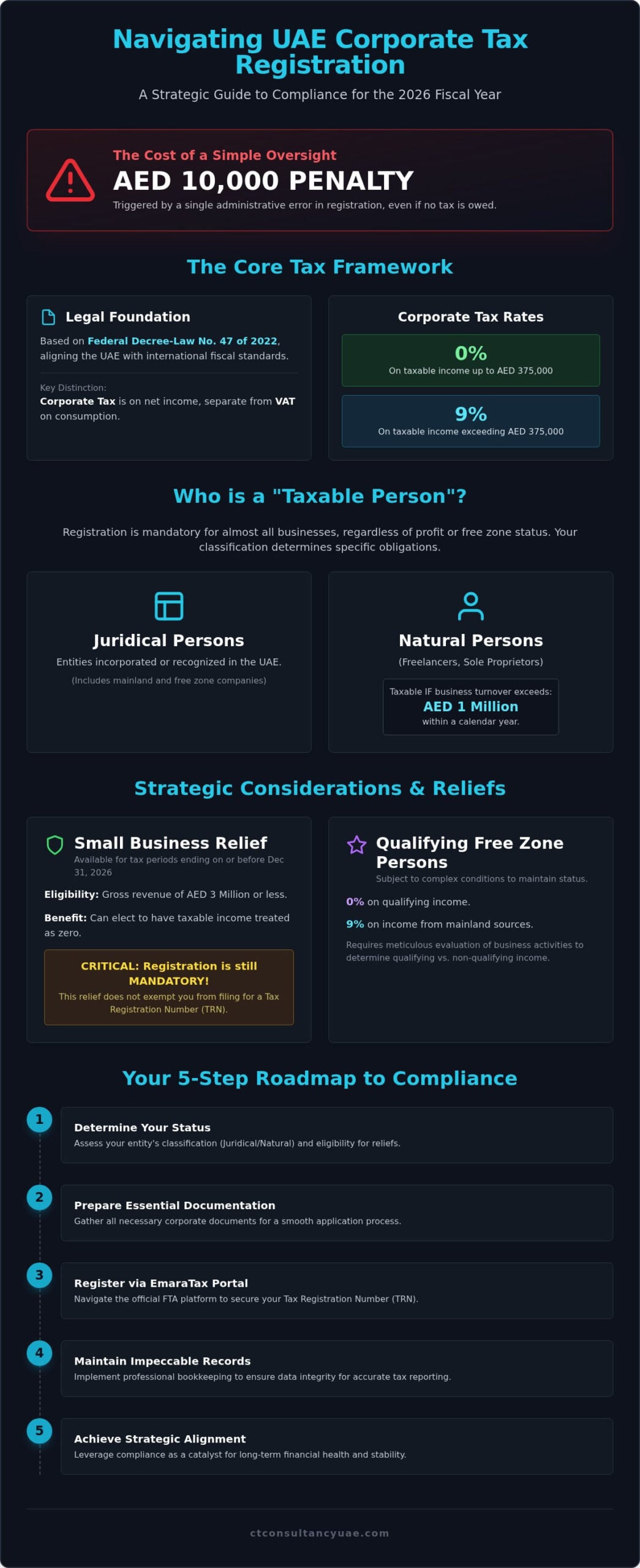
A single administrative oversight in your uae corporate tax registration process can trigger an immediate AED 10,000 penalty, regardless of whether your business actually owes a single dirham in taxes. It’s a sobering reality for executive decision-makers who find the technical nuances of the EmaraTax portal and the evolving regulatory landscape increasingly difficult to manage. You’ve worked hard to build a stable, growth-oriented enterprise; the last thing you need is the friction of non-compliance or the persistent ambiguity surrounding exempt versus taxable status.
We recognize that securing a Tax Registration Number (TRN) is not merely a checkbox; it’s a foundational strategic event that dictates your firm’s long-term financial health. This guide provides an expert-led framework to help you master the complexities of the registration process, ensuring full compliance and strategic alignment for the 2026 fiscal year. We’ll examine critical deadlines for juridical and natural persons, clarify documentation requirements for complex corporate structures, and outline a clear roadmap to mitigate all regulatory risks while positioning your business for frictionless growth.
Key Takeaways
- Understand the legislative framework governing the 2026 tax regime to ensure your entity aligns perfectly with the latest Federal Tax Authority mandates.
- Identify specific filing deadlines for resident and non-resident entities to execute a timely UAE corporate tax registration and avoid substantial administrative penalties.
- Streamline the technical application process by preparing essential corporate documentation and navigating the EmaraTax portal with professional precision.
- Recognize the critical role of professional bookkeeping and accounting in maintaining the data integrity required for accurate tax reporting and long-term regulatory compliance.
- Leverage the registration process as a strategic catalyst for broader financial alignment, utilizing expert advisory to secure your firm’s fiscal stability in a shifting market.
Understanding the UAE Corporate Tax Landscape and Registration Mandate
The implementation of Federal Decree-Law No. 47 of 2022 represents a fundamental shift in the regional economic structure, transitioning the Emirates into a sophisticated, tax-compliant jurisdiction. This legislation formalizes the taxation of corporations and businesses, ensuring the nation aligns with international standards for fiscal transparency. Under the administration of the Federal Tax Authority (FTA), the 2026 tax regime is characterized by rigorous enforcement and a reliance on the digital EmaraTax platform. Understanding the broader evolution of Taxation in the UAE is essential for any legal entity, as the mandate for UAE corporate tax registration extends to nearly every business, regardless of their current profit levels or Free Zone status.
The Legal Framework for Corporate Taxation
The current framework establishes a standard corporate tax rate of 9% on taxable income exceeding AED 375,000, while a 0% rate applies to income below this threshold to support the SME sector. It’s a common misconception that an existing VAT registration satisfies these new obligations. In reality, corporate tax is a distinct legal requirement focusing on net income rather than consumption. This distinction necessitates a specialized approach to bookkeeping and accounting services to ensure that taxable profit is calculated with absolute precision, avoiding the risk of misreporting that could lead to significant financial exposure.
The Strategic Importance of Early Registration
Proactive engagement with the registration process is the most effective way to safeguard your entity from administrative friction. The FTA has established strict windows for compliance, and waiting until the final deadline often leads to system bottlenecks or documentation errors that trigger a fixed AED 10,000 penalty. By initiating your UAE corporate tax registration early, you establish a verified Taxable Person profile within the EmaraTax portal. This early setup serves as a strategic anchor, allowing your leadership team to move beyond basic compliance and into high-level CFO advisory services that align your tax obligations with long-term growth objectives.
Identifying Taxable Persons and Critical Registration Deadlines
Determining your entity’s classification is the first vital step in executing a compliant UAE corporate tax registration. The legislation distinguishes between resident and non-resident taxable persons, each carrying specific obligations. Resident persons generally encompass juridical entities incorporated or recognized within the UAE, including those operating within Free Zones. Natural persons, such as freelancers and sole proprietors, enter the tax net only if their total turnover from business activities in the Emirates exceeds the AED 1 million threshold within a single calendar year. Understanding these distinctions ensures that your leadership team doesn’t misinterpret exempt status for a lack of registration requirements.
Small Business Relief offers a critical strategic advantage for eligible entities, permitting those with gross revenue of AED 3 million or less to elect for a zero-tax position. This relief is currently available for tax periods ending on or before December 31, 2026. It’s essential to note that while this provision treats taxable income as zero, it doesn’t remove the mandatory requirement to register with the Federal Tax Authority. Failing to secure a Tax Registration Number (TRN) while assuming relief applies is a common pitfall that often results in unnecessary administrative friction.
Determining Your Taxable Status
The classification process requires a meticulous evaluation of business activities against established exempt categories. Free Zone entities, for instance, must navigate a complex set of conditions to maintain their status as a Qualifying Free Zone Person (QFZP). This status allows for a 0% tax rate on qualifying income, but any income derived from mainland sources is typically taxed at the standard 9% rate. For a comprehensive overview of these scopes and exemptions, the UAE Government Corporate Tax Portal serves as the primary authoritative resource for legislative updates.
2026 Registration Timeline and Penalty Risks
The FTA has implemented a structured timeline that demands immediate attention from new and established businesses alike. For juridical persons incorporated on or after March 1, 2024, the deadline for UAE corporate tax registration is strictly within three months from the date of incorporation. Natural persons meeting the turnover threshold must complete their registration by March 31st of the following year. Missing these windows triggers a fixed administrative penalty of AED 10,000. To manage these high-stakes deadlines effectively, many firms engage corporate tax consultants in the UAE to ensure every filing window is met with precision.
Securing your TRN is just the beginning of a long-term compliance strategy. Our specialists at CTC Tax & Accounting provide the tax services required to navigate these timelines with absolute confidence.
The Technical Registration Process: Documentation and FTA Procedures
The technical execution of UAE corporate tax registration is conducted through the EmaraTax portal, a sophisticated digital interface designed for centralized tax administration. This procedure is divided into four critical phases: account activation, documentation compilation, profile configuration, and final submission monitoring. While the portal is designed for efficiency, the precision required during the Taxable Person Profile setup leaves little room for error. Most entities find that a structured approach, beginning with a thorough audit of existing corporate records, is the most reliable way to avoid the friction of a rejected application.
Essential Documentation Checklist
To facilitate a seamless application, you must compile a comprehensive dossier of legal records that verify the identity and structure of your business. The Federal Tax Authority (FTA) Registration process requires high-resolution digital copies of the following:
- A valid Trade License and Certificate of Incorporation issued by the relevant licensing authority.
- The Memorandum of Association (MOA) or equivalent constitutive documents that outline the firm’s governance.
- Identification documents, including passports and Emirates IDs, for all authorized signatories.
- Proof of ownership for any individual or entity holding a stake of 25% or greater in the business.
- Specific partnership agreements or branch registration certificates for entities operating across multiple jurisdictions.
Common Pitfalls in the Application Process
Discrepancies between the data on your commercial license and the information provided during the registration process are the most frequent cause of application deferrals. It’s essential that your proof of authorization, whether a Power of Attorney or a formal Board Resolution, is current and explicitly grants the signatory the power to manage tax affairs. Minor clerical errors in the Taxable Person Profile can lead to a cycle of clarification requests that extend your compliance timeline. The Federal Tax Authority typically requires an estimated 20 business days to process and review a completed application.
If you’re navigating a complex corporate structure or managing multiple trade licenses, our specialists provide expert tax services to ensure your submission is accurate and fully compliant from the outset.
Strategic Compliance: Integrating Corporate Tax into Your Financial Operations
Successful UAE corporate tax registration is merely the inaugural phase of a sophisticated fiscal journey. Once the Tax Registration Number is secured, the focus must shift from administrative entry to the establishment of a permanent compliance mindset. This transition requires a meticulous re-evaluation of your internal systems to ensure that every financial transaction is recorded with the precision necessary for accurate tax reporting. Relying on professional bookkeeping and accounting is no longer optional; it’s a strategic imperative for businesses seeking to avoid the scrutiny of the Federal Tax Authority (FTA) while maintaining financial transparency.
Strategic alignment of your fiscal year with FTA requirements further optimizes your filing schedule, providing the necessary window to reconcile accounts and verify data integrity. By utilizing strategic business advisory, leadership teams can move beyond reactive filing and begin to optimize their tax liability through informed, data-driven decisions. This integration ensures that your tax strategy isn’t an isolated administrative task but a core component of your broader corporate governance framework.
Building a Robust Tax Accounting Framework
A resilient framework necessitates the implementation of rigorous internal controls designed to distinguish between taxable and non-taxable income streams. This segregation is vital for entities managing diverse revenue sources or those operating within Free Zones where income classification determines tax rates. Regular internal audits serve as a critical defense mechanism, identifying potential discrepancies before they escalate into regulatory violations. For organizations with international revenue streams, particularly those involving UK real estate, Cornerstone Tax offers the specialist expertise needed to navigate Stamp Duty Land Tax and other property tax complexities. This proactive approach ensures that your entity remains in a constant state of tax readiness, minimizing the risk of last-minute corrections during the nine-month filing window.
For those managing broader UK-based business interests or seeking a chartered perspective on international accounts, you can learn more about Fair View Accounting Services to ensure your financial governance is seamless across jurisdictions.
Why Professional Advisory is Essential
The intersection of Transfer Pricing and Economic Substance Regulations (ESR) creates a complex layer of compliance that requires specialized expertise. Professional UAE tax compliance services act as a primary friction-remover, navigating these intricate legal landscapes to protect your firm’s interests. Secure your business future and ensure long-term stability by scheduling a comprehensive Corporate Tax consultation today to refine your registration and reporting strategy.
Securing Your Enterprise’s Future in a New Regulatory Era
Navigating the 2026 fiscal landscape requires more than just meeting deadlines; it demands a fundamental shift in how your business perceives regulatory obligations. From the technical intricacies of the EmaraTax portal to the strategic necessity of a robust accounting framework, every step you take today defines your firm’s long-term stability. A successful UAE corporate tax registration is the first essential milestone in this journey, serving as a safeguard against administrative penalties while positioning your entity for frictionless growth within the Emirates.
At CTC Tax & Accounting, we provide the specialized precision required to manage these high-stakes transitions. Our team leverages deep regional expertise to ensure your registration is handled with meticulous care, offering comprehensive support that spans VAT, Corporate Tax, and AML compliance. By partnering with us, you gain a supportive advisor dedicated to removing administrative friction and ensuring your financial operations remain perfectly aligned with Federal Tax Authority standards. We invite you to Secure Your Corporate Tax Compliance with CTC Tax & Accounting and transform this regulatory requirement into a strategic advantage for your business.
Frequently Asked Questions
Is corporate tax registration mandatory for all UAE companies?
Registration is mandatory for nearly all legal entities in the UAE, including those that anticipate zero tax liability or qualify for Small Business Relief. The Federal Tax Authority requires every taxable person to establish a formal profile on the EmaraTax portal to maintain compliance with Decree-Law No. 47 of 2022. Even if your business operates within a Free Zone or falls below the taxable income threshold, you must still secure a Tax Registration Number to remain in good standing.
What is the deadline for corporate tax registration in 2026?
For juridical persons incorporated on or after March 1, 2024, the deadline for UAE corporate tax registration is within three months from the date of incorporation. Natural persons, such as freelancers, who exceed the AED 1 million turnover threshold in a calendar year must complete their registration by March 31st of the following year. It’s critical to monitor these windows closely as they’re determined by the specific date of your trade license issuance or incorporation.
Can a business register for corporate tax without a VAT TRN?
A business can and must register for corporate tax even if it doesn’t possess a VAT Tax Registration Number. These two tax regimes operate under distinct legislative frameworks; VAT focuses on consumption and supply while corporate tax addresses net business income. An entity may be below the mandatory VAT registration threshold of AED 375,000 but still be required to register for corporate tax based on its legal structure or turnover.
What are the penalties for late corporate tax registration in the UAE?
The Federal Tax Authority imposes a fixed administrative penalty of AED 10,000 for failure to submit a UAE corporate tax registration application within the specified timeline. This fine is applied per entity and is enforced strictly to ensure nationwide compliance. Beyond the immediate financial cost, late registration can lead to increased scrutiny from the FTA and potential complications during future tax audits or filing periods.
How long does the FTA take to process a corporate tax registration application?
The Federal Tax Authority typically requires an estimated 20 business days to process a completed registration application and issue a Tax Registration Number. This timeline can fluctuate depending on the complexity of your corporate structure or the accuracy of the documentation provided. Submitting a comprehensive and error-free application is the most effective way to ensure your profile is approved without unnecessary clarification requests or delays.
Do Free Zone companies need to register for corporate tax?
Yes, Free Zone companies are legally required to register for corporate tax to maintain their standing as a taxable person within the UAE. Registration is a prerequisite for any entity seeking to benefit from the 0% tax rate on qualifying income. Without a valid Tax Registration Number, a Free Zone entity cannot demonstrate its compliance with the necessary conditions to be considered a Qualifying Free Zone Person, potentially exposing it to the standard 9% tax rate.