Your year-end net profit is not the final word on your fiscal obligation to the state. As the 2026 tax period approaches, many executive decision-makers realize that a simple 9% calculation on their accounting profit often leads to inaccurate projections and avoidable compliance risks. Mastering the UAE corporate tax calculation requires a disciplined approach to identifying the permanent and timing differences that bridge the gap between your standard financial statements and your actual taxable base.
We recognize that the fear of FTA penalties or the confusion surrounding Free Zone qualifying income can create unnecessary friction in your strategic planning. This guide provides the professional precision you need to transition from accounting profit to taxable income with absolute confidence. You’ll gain a clear understanding of the AED 375,000 threshold, learn how to leverage Small Business Relief if your revenue remains below AED 3,000,000, and establish a robust roadmap for timely filing to safeguard your business growth. We will examine the specific adjustments required by Federal Decree-Law No. 47 of 2022, ensuring your 2026 liability is managed with strategic foresight rather than reactive guesswork.
Key Takeaways
- Identify the specific financial thresholds that trigger tax liability, including the 0% rate for profits up to AED 375,000.
- Discover how to accurately adjust your accounting profit to reflect taxable income by accounting for non-deductible expenses and IFRS adjustments.
- Streamline your UAE corporate tax calculation by determining eligibility for Small Business Relief if your annual revenue is below AED 3,000,000.
- Evaluate the nuances of the Free Zone regime to protect your 0% tax status on qualifying income through meticulous compliance.
- Master the administrative requirements for FTA registration and the nine-month filing window to ensure long-term regulatory stability.
The UAE Corporate Tax Framework: Rates and Thresholds
The introduction of Federal Decree-Law No. 47 of 2022 represents a transformative shift in the history of Taxation in the United Arab Emirates. UAE Corporate Tax is a direct levy on the net profit of businesses. It’s designed to align the nation’s fiscal policy with global transparency standards while maintaining a competitive environment for growth. This regime applies to "Taxable Persons," a category that encompasses juridical entities incorporated in the Emirates and natural persons conducting business activities with an annual turnover exceeding AED 1,000,000. Understanding your UAE corporate tax calculation begins with recognizing that the tax base isn’t simply your year-end bank balance; it’s a specific legal construct known as "Taxable Income."
The distinction between accounting profit and taxable income is the foundation of strategic tax planning. While your financial statements reflect accounting profit according to IFRS standards, the Federal Tax Authority (FTA) requires specific adjustments to reach the taxable base. This process involves adding back non-deductible expenses and applying various reliefs. For businesses seeking to optimize their position, our tax services provide the technical oversight to ensure these adjustments are mathematically sound and legally compliant.
The AED 375,000 Threshold Explained
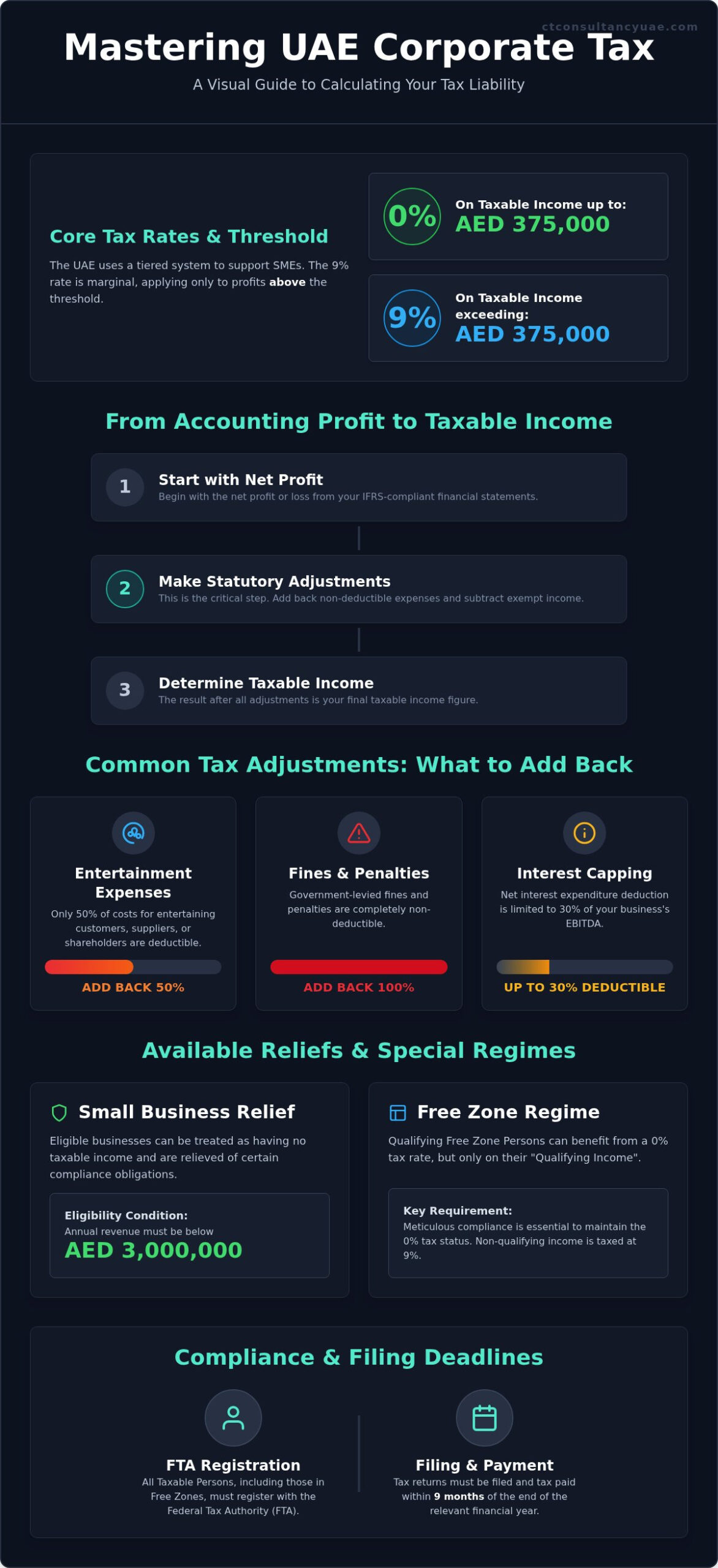
The UAE utilizes a progressive, tiered rate structure to support the SME ecosystem. Taxable income up to and including AED 375,000 is subject to a 0% rate. Any amount exceeding this threshold is taxed at 9%. It’s a marginal tax. The 9% rate only applies to the portion of profit above the limit, not the entire sum. Businesses must remain vigilant regarding "Related Parties" and "Connected Persons." The FTA monitors these relationships closely to prevent the artificial fragmentation of profits across multiple entities to exploit the 0% threshold multiple times.
Effective Dates and Financial Years
The corporate tax regime became effective for financial years starting on or after June 1, 2023. For companies operating on a standard January to December cycle, the first tax period commenced on January 1, 2024. Precise alignment with FTA requirements is mandatory. You must ensure your accounting periods are consistent and that your first UAE corporate tax calculation reflects the correct duration of your initial tax year. This temporal accuracy is vital for establishing a reliable filing history and avoiding late registration penalties.
Step-by-Step Methodology for Calculating Taxable Income
Accurate UAE corporate tax calculation begins with a robust financial foundation. The process starts with the Net Profit or Loss as stated in your audited financial statements, typically prepared in accordance with International Financial Reporting Standards (IFRS). However, your commercial profit rarely aligns perfectly with your fiscal liability. Under the UAE Corporate Tax Law, businesses must perform a series of statutory adjustments to bridge the gap between accounting records and the taxable base. This involves a systematic addition of non-deductible expenses and the subtraction of exempt income categories to ensure the final figure reflects the specific requirements of the Federal Tax Authority (FTA).
To reach the final taxable figure, you must also account for adjustments related to depreciation, unrealized gains or losses, and specific interest caps. For instance, income derived from certain dividends and capital gains may be exempt from tax, meaning they should be removed from your accounting profit before the 9% rate is applied. Conversely, expenses that don’t meet the "wholly and exclusively" business purpose test must be added back to increase the taxable base.
Common Tax Adjustments for UAE Businesses
Identifying which outgoings are deductible is essential for minimizing your liability while maintaining compliance. While standard operational costs are generally deductible, the law imposes strict limitations on specific items:
- Non-deductible Add-backs: All government fines and penalties must be added back to your profit.
- Entertainment Expenses: Only 50% of costs related to entertaining customers, shareholders, or suppliers are deductible.
- Interest Capping: The General Interest Deduction Limitation Rule restricts the net interest expenditure that can be deducted to 30% of EBITDA, ensuring that highly leveraged entities don’t excessively erode the tax base.
Managing Tax Losses and Carry-forwards
If your business experiences a fiscal loss, the UAE regime offers a supportive mechanism for long-term stability. You can carry forward tax losses indefinitely to offset future taxable income in subsequent financial years. It’s important to note that the law limits the amount of brought-forward losses that can be utilized in a single tax period to 75% of the taxable income for that year. Maintaining meticulous ledgers is vital for tracking these losses accurately over several years. Utilizing professional accounting services ensures that your loss carry-forward schedules remain audit-ready and compliant with FTA standards. For complex scenarios involving group relief or interest caps, engaging with a specialized Corporate Tax Advisory can provide the strategic reassurance needed to protect your bottom line.
Maximizing Reliefs: Small Business Relief and Free Zone Nuances
Strategic tax planning involves more than just applying rates; it requires a deep understanding of the exemptions that protect your liquidity. The UAE Corporate Tax Framework introduces specific reliefs designed to foster a robust SME ecosystem and maintain the competitive edge of Free Zone jurisdictions. Integrating these reliefs into your UAE corporate tax calculation is essential for any entity seeking to optimize its fiscal position in 2026. We often find that businesses overlook these provisions, leading to an overestimation of their liability and a failure to utilize statutory benefits.
A common misconception among entrepreneurs is that Free Zone status provides an unconditional exemption. In reality, the 0% rate is reserved for Qualifying Free Zone Persons (QFZPs) who meet stringent criteria, including the maintenance of adequate substance and the generation of "Qualifying Income." Income derived from excluded activities or specific transactions with natural persons often attracts the standard 9% rate. This necessitates a precise bifurcation of revenue streams to ensure that your calculation remains accurate and compliant with Federal Tax Authority (FTA) standards.
Eligibility for Small Business Relief (SBR)
Resident taxable persons with gross revenue below AED 3,000,000 in a given tax period may elect for Small Business Relief. This election treats the business as having no taxable income for that period, which significantly reduces the administrative burden and reporting complexity. However, you must weigh this benefit against the inability to carry forward tax losses or deduct net interest expenditure during the relief period. This relief is currently available for tax periods ending on or before December 31, 2026, serving as a vital bridge for growing enterprises in the Emirates.
Free Zone Compliance and Substance Requirements
To preserve QFZP status, entities must maintain adequate substance within their respective Free Zone, which includes having sufficient assets, qualified employees, and operating expenditure. You must also prepare audited financial statements regardless of your turnover. Failure to meet these requirements can result in the loss of the 0% rate for a period of five years, creating a significant long-term financial impact. For organizations navigating these complex regulatory waters, our tax services offer the specialized advisory needed to ensure your corporate structure remains resilient and your exemptions remain secure.
Beyond the Calculator: Compliance, Registration, and Strategic Filing
Completing your UAE corporate tax calculation is a critical milestone, but it’s merely the first step in a broader cycle of regulatory compliance. The Federal Tax Authority (FTA) requires all taxable persons to register through the EmaraTax portal, a mandatory procedure regardless of whether your business currently meets the AED 375,000 profit threshold. Once registered, the responsibility shifts toward timely and accurate filing. You must submit your Corporate Tax return and settle any outstanding liability within nine months from the end of the relevant tax period. Failure to adhere to these timelines or providing inaccurate data can lead to significant financial repercussions and reputational damage.
Registration Deadlines and Penalties for Non-Compliance
The FTA has implemented phased registration deadlines based on the month of license issuance. It’s vital to identify your specific window to avoid the AED 10,000 penalty for late registration. Beyond registration, inaccurate filings stemming from calculation errors often result in underpayment fines. These pitfalls are typically avoided by maintaining precise ledgers and ensuring that your tax base is reviewed by experts who understand the nuances of the UAE market.
The Strategic Value of Professional Tax Advisory
A basic calculator provides a snapshot, but it cannot replace a comprehensive CFO advisory review for businesses with complex structures or multi-jurisdictional operations. Long-term stability is achieved through meticulous tax planning that aligns with financial management for smes. By integrating tax strategy into your broader corporate governance, you transform a compliance burden into an opportunity for structured growth. To ensure your business is fully prepared for the 2026 fiscal landscape, Book a Strategic Tax Consultation with CTC Experts to secure your business future.
Securing Your Fiscal Resilience in the 2026 Tax Landscape
The transition to a formal tax regime represents a maturation of the Emirates’ business environment. A precise UAE corporate tax calculation is not merely a mathematical exercise; it’s a strategic imperative that requires a deep understanding of statutory adjustments and the nuanced application of Small Business Relief. By distinguishing between accounting profit and your final taxable base, you ensure that your organization remains both compliant and competitive. Proactive registration and a disciplined approach to the nine-month filing window are the final pillars in maintaining your firm’s regulatory standing.
At CTC Tax & Accounting, we offer over a decade of UAE regulatory expertise to transform these complex requirements into a frictionless pathway for growth. Our team provides personalized compliance roadmaps for SMEs and end-to-end support from initial registration to final filing. We invite you to Book a Strategic Tax Consultation with CTC Experts to refine your 2026 tax strategy. With the right professional partner, you can navigate these changes with absolute confidence and focus on the long-term expansion of your enterprise.
Essential Questions Regarding UAE Corporate Tax
Is corporate tax the same as Value Added Tax (VAT) in the UAE?
No, Corporate Tax and VAT are distinct fiscal mechanisms with entirely different objectives. VAT is an indirect consumption tax levied at a standard rate of 5% on the supply of goods and services at each stage of the supply chain. In contrast, Corporate Tax is a direct levy applied to the annual net profit of a business. While VAT is collected from consumers on behalf of the government, Corporate Tax is a liability calculated on the entity’s own financial performance.
Can I rely on accounting software for my UAE corporate tax calculation?
Standard accounting software is indispensable for maintaining accurate ledgers, but it cannot independently finalize a UAE corporate tax calculation. Most platforms generate an accounting profit based on IFRS; however, they don’t automatically account for specific statutory adjustments such as the 50% entertainment cost cap or non-deductible government penalties. Professional oversight is required to bridge the gap between your digital records and the final taxable income reported to the Federal Tax Authority.
What are the obligations for businesses with taxable income below AED 375,000?
Businesses with taxable income below the AED 375,000 threshold are subject to a 0% tax rate but aren’t exempt from administrative duties. You’re still legally required to register for Corporate Tax and submit an annual return to the FTA through the EmaraTax portal. This process confirms your eligibility for the 0% rate and ensures your business remains in good standing within the national regulatory framework while avoiding late registration penalties.
Are Free Zone entities required to register if they qualify for the 0% regime?
Registration is mandatory for all Free Zone entities regardless of their potential tax liability or status as a Qualifying Free Zone Person (QFZP). Even if your entire income qualifies for the 0% rate, the FTA requires registration to monitor compliance and substance requirements. Failing to register can result in an AED 10,000 penalty, which compromises your standing as a compliant entity and may lead to increased scrutiny during future audits.
How frequently must a corporate tax return be submitted?
Taxable persons must file their Corporate Tax return and settle any payable tax once per tax period. This annual submission must be completed within nine months from the end of the relevant financial year. For instance, if your financial year concludes on December 31, your filing and payment deadline would be September 30 of the following year. Precise adherence to this window is essential to avoid non-compliance penalties and maintain long-term fiscal stability.