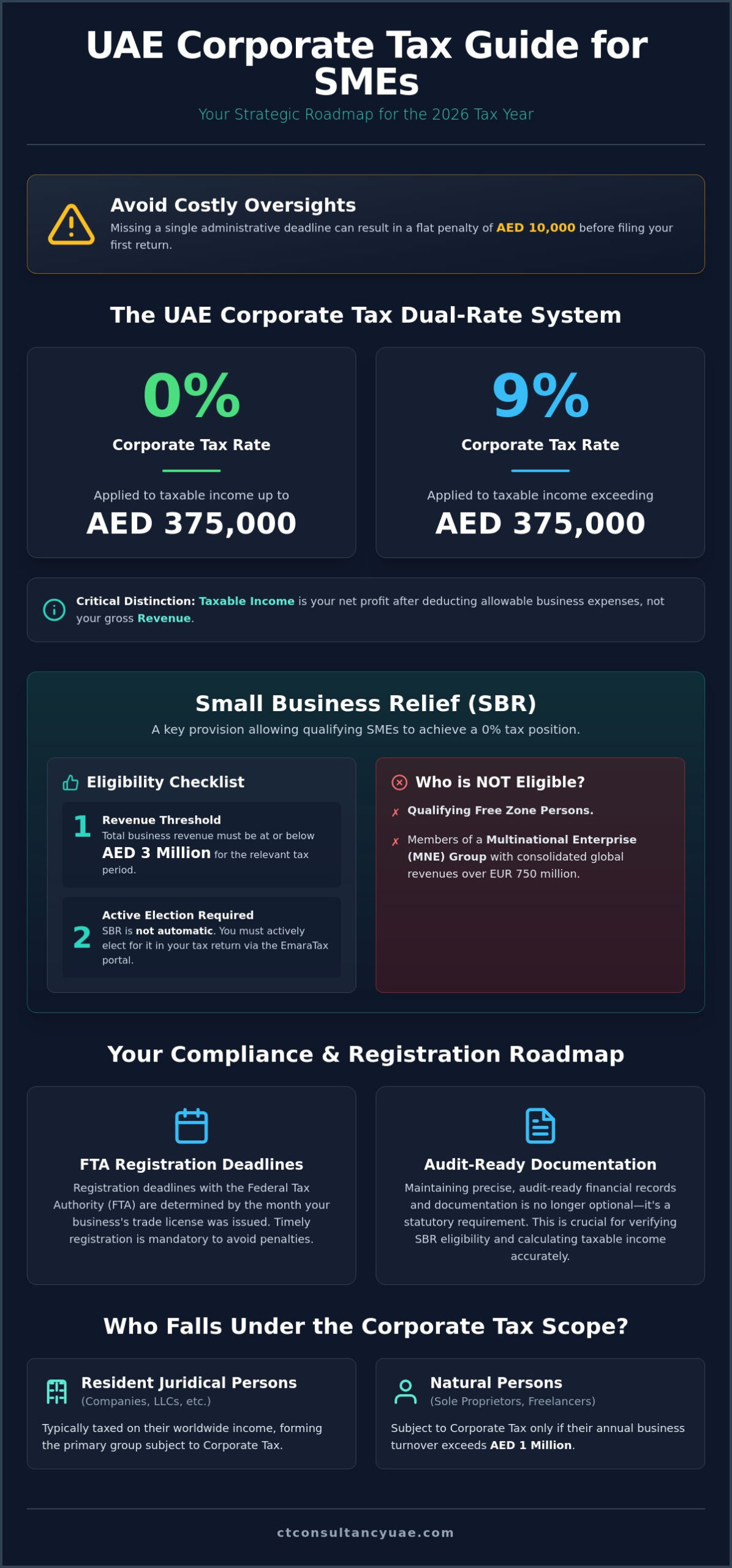
p>Missing a single administrative deadline within the UAE’s current regulatory framework can cost your firm a flat AED 10,000 in penalties before you’ve even filed your first return. As the 2026 deadline for Small Business Relief approaches, understanding the specific requirements for corporate tax for small business in the UAE has become a critical priority for every SME owner. It’s understandable if you feel a sense of urgency or confusion regarding the distinction between your total revenue and your taxable income. The administrative burden of maintaining audit-ready books can often feel like a distraction from your core growth objectives.
This guide is designed to remove that friction by providing a clear, strategic roadmap for the 2026 tax year. You’ll learn exactly how to elect for Small Business Relief if your revenue remains at or below the AED 3 million threshold, ensuring your business maintains a 0% tax position legally and efficiently. We will break down the FTA registration timelines based on your trade license issuance, explore the nuances of the AED 375,000 profit threshold, and outline the exact documentation you need to satisfy future audits. By the end of this briefing, you’ll have the professional insight required to transform compliance from a statutory hurdle into a structured advantage for your business.
Key Takeaways
- Navigate the dual-rate system of corporate tax for small business uae, focusing on the strategic application of the 0% threshold for income up to AED 375,000.
- Evaluate your eligibility for Small Business Relief (SBR) and master the active election process required for entities maintaining revenue under the AED 3 million threshold.
- Secure your compliance by aligning with specific Federal Tax Authority registration deadlines tailored to your trade license issuance month to mitigate the risk of administrative penalties.
- Implement robust internal documentation and bookkeeping protocols to ensure your enterprise remains audit-ready and fully aligned with evolving regulatory standards.
- Transition from basic compliance to strategic optimization by utilizing corporate tax data to inform long-term financial planning and organizational growth.
Table of Contents
The Framework of UAE Corporate Tax for SMEs in 2026
Federal Decree-Law No. 47 of 2022 established the modern landscape for Taxation in the United Arab Emirates, creating a structured fiscal environment for all commercial entities. By 2026, the initial transition period has concluded, making the corporate tax for small business in the UAE a permanent fixture of the local economy. The system utilizes a dual-rate mechanism where taxable income up to AED 375,000 is taxed at 0%, and any amount surpassing this limit is taxed at 9%. This tiered approach provides a significant buffer for growing enterprises, allowing them to reinvest capital during their formative years.
Distinguishing between Resident Juridical Persons and Natural Persons is essential for accurate filing. While companies are typically taxed on their global income, individuals operating as sole proprietors or freelancers only fall within the scope if their annual turnover exceeds AED 1 million. Regardless of current profit levels, every entity must now view compliance as a non-negotiable pillar of their operational strategy. Precise record-keeping is no longer optional; it’s a statutory requirement that ensures long-term stability.
Revenue vs. Taxable Income: A Critical Distinction
Gross revenue serves as the initial benchmark for threshold assessment, but it doesn’t represent your final tax liability. Deductible business expenses and specific legislative adjustments significantly influence the final figure, often lowering the effective tax burden. Understanding what qualifies as a deductible expense is vital for optimizing your position. Taxable Income is the net profit of a business as determined by accounting standards, adjusted for specific items stipulated by the Corporate Tax Law.
The Role of the Federal Tax Authority (FTA)
The EmaraTax portal functions as the central digital hub for all interactions, from registration to final submission. It’s a sophisticated platform designed to streamline the reporting process, yet it requires meticulous attention to detail to avoid errors. Maintaining a flawless compliance record isn’t just about avoiding penalties; it directly impacts future Strategic Financial Planning and overall business valuation. A history of precision on the portal instills confidence in potential investors and financial institutions alike.
Small Business Relief (SBR): Eligibility and Benefits
Small Business Relief (SBR) represents a vital provision under the current regime, designed to alleviate the fiscal burden on early-stage and medium-sized enterprises. The primary determinant for eligibility is the AED 3 million revenue ceiling, which applies to both the current tax period and any preceding periods starting on or after June 1, 2023. According to the UAE Government Corporate Tax guidelines, this relief allows qualifying entities to be treated as having no taxable income for the relevant period. This status also grants simplified transfer pricing rules, significantly reducing the administrative complexity often associated with corporate tax for small business in the UAE.
Crucially, SBR is not an automatic status. Businesses must actively elect this relief within their tax return via the EmaraTax portal. This distinction is where many firms falter, assuming their size grants them immunity without formal declaration, which can lead to unintended tax liabilities. It’s also vital to recognize that certain entities are excluded from this relief, specifically Qualifying Free Zone Persons and members of Multinational Enterprise (MNE) Groups with consolidated revenues exceeding EUR 750 million. Engaging with specialized Corporate Tax Advisory can help you navigate these nuances with precision.
Conditions for Electing Small Business Relief
Maintaining the revenue ceiling across consecutive tax periods is essential to avoid a clawback of benefits. If your revenue exceeds the AED 3 million limit in any given year, you lose the relief for that period and must transition to the standard 9% rate for income above AED 375,000. Furthermore, businesses must still comply with the Arm’s Length Principle for all related party transactions, even when SBR is elected. CTC provides comprehensive Internal Audit Services to verify your eligibility and ensure your transaction records meet these rigorous regulatory standards.
The 2026 Sunset Clause and Future Outlook
While SBR provides a supportive environment, it’s currently defined as a transitional measure valid for tax periods ending on or before 31 December 2026. Small businesses shouldn’t view this as a permanent exemption but rather as a window to strengthen their internal financial structures. Preparing for a post-2026 environment, where the standard 9% rate may apply more broadly, is a strategic necessity for long-term stability. Establishing robust bookkeeping practices now ensures a frictionless transition when these relief measures eventually expire.
Compliance Roadmap: Registration and Documentation
Registration represents the first critical milestone in successfully managing corporate tax for small business in the UAE. While many entrepreneurs mistakenly believe that qualifying for Small Business Relief removes the need for formal engagement with the authorities, the UAE Corporate Tax Law mandates that every taxable person must obtain a registration number. This requirement applies regardless of whether your entity expects to pay tax or stay within the 0% bracket. The EmaraTax portal serves as the primary gateway for this process, requiring precise data entry to ensure your application isn’t rejected for administrative inconsistencies.
Timing is everything. You must register for your Tax Registration Number (TRN) within three months of receiving your trade license to remain compliant. Failing to meet this window triggers a flat administrative penalty of AED 10,000. Common pitfalls during the registration process include selecting the incorrect legal entity type or providing expired identification documents. These errors lead to prolonged delays and potential fines, making it essential to approach the initial setup with meticulous care to avoid application rejection.
Essential Documentation for SME Tax Filing
To facilitate a smooth filing process, you’ll need a structured dossier of documents. This includes your valid trade license, the Passport or Emirates ID of all authorized signatories, and comprehensive financial statements for the tax period. Maintaining these records through professional Bookkeeping and Accounting Services is the only way to ensure your numbers are defensible during an FTA inquiry. Corporate tax returns and any due tax must be submitted within nine months after the end of the tax period.
Penalty Risks and Compliance Monitoring
The cost of non-compliance is high. Beyond the AED 10,000 late registration fee, businesses face a late payment penalty of 14% per year, calculated monthly on any outstanding balance. Regular internal reviews of your tax position and accounting records prevent these costly errors from surfacing during an official audit. You can secure your business’s future and remove the friction of the EmaraTax portal by letting our experts handle your Corporate Tax Registration and compliance requirements today.
Strategic Tax Planning for Growing UAE Businesses
Strategic tax planning serves as the bridge between statutory compliance and long-term enterprise value. By leveraging the data collected for corporate tax for small business in the UAE, executives can engage in Strategic Financial Planning that accounts for upcoming fiscal obligations. This proactive approach ensures that the synergy between Corporate Tax, VAT, and AML compliance remains a bedrock of stability rather than a source of administrative friction. High-growth firms must look beyond the current filing cycle to understand how their tax structure influences their overall competitive positioning.
Scaling Beyond the AED 3 Million Threshold
Crossing the AED 3 million revenue limit represents a pivotal moment for any SME. The transition from Small Business Relief to the standard 9% regime requires precise cash flow management to accommodate new tax liabilities. Utilizing a professional Business Valuation during this phase helps owners understand how these tax obligations influence the net worth of their company. Preparing for this shift well before the December 2026 sunset clause prevents the sudden liquidity constraints that often accompany rapid scaling in a maturing regulatory environment.
Why Professional Advisory is a Growth Investment
Navigating the complexities of multi-license structures and inter-company transactions demands specialized Corporate Tax Advisory. CTC Tax & Accounting serves as a dedicated partner, providing a frictionless compliance experience that allows entrepreneurs to focus entirely on market expansion. Our team ensures your organization is optimized for the AED 375,000 0% bracket while maintaining full alignment with FTA standards. Secure your business’s financial future and ensure long-term stability by scheduling a tailored consultation with our seasoned consultants today.
Securing Your Enterprise Value in a Mature Tax Landscape
The transition into a comprehensive fiscal regime represents a defining moment for the UAE’s private sector. Successfully managing corporate tax for small business in the UAE requires a shift from reactive filing to proactive financial stewardship. By prioritizing the active election of Small Business Relief and maintaining meticulous, audit-ready records, you’ve already mitigated the most significant risks of non-compliance. It’s essential to remember that registration remains a mandatory gateway, regardless of your current profit levels or eligibility for the 0% bracket.
Navigating these regulatory complexities doesn’t have to be a source of operational friction. Our consultants specialize in expert EmaraTax portal navigation and strategic SME-focused planning to ensure your business remains resilient across VAT, CT, and AML frameworks. With a structured approach to your 2026 obligations, you can transform compliance from a statutory burden into a pillar of long-term stability. Consult our Corporate Tax experts to secure your SBR status today. You have the vision to grow your business; we have the precision to protect it.
Frequently Asked Questions
Do I need to register for Corporate Tax if my business makes a loss?
Yes, you must register for corporate tax even if your business is currently operating at a loss. The Federal Tax Authority requires all taxable persons to obtain a Tax Registration Number (TRN) to track financial activities and allow for the carry-forward of tax losses into future profitable periods. Failing to register within the stipulated timeframe based on your trade license issuance month results in a flat administrative penalty of AED 10,000.
Can a freelancer in the UAE qualify for Small Business Relief?
Freelancers operating as natural persons can qualify for Small Business Relief provided their annual business turnover remains at or below the AED 3 million threshold. It’s important to note that individuals are only subject to corporate tax for small business in the UAE if their annual turnover exceeds AED 1 million. If you meet these criteria, you may elect for relief to be treated as having no taxable income for tax periods ending on or before December 31, 2026.
What is the deadline for Corporate Tax registration for a new business established in 2026?
For a new business established in 2026, the deadline for corporate tax registration is exactly three months from the date your trade license was issued. This timeline is strictly enforced by the FTA to ensure all new entities are integrated into the federal tax system promptly. Missing this window triggers an immediate fine, so it’s vital to initiate the application on the EmaraTax portal as soon as your commercial operations commence.
Is the AED 3 million threshold based on profit or revenue?
The AED 3 million threshold for Small Business Relief is based entirely on gross revenue, not net profit. This means your total turnover before deducting any business expenses or adjustments must not exceed this limit within the relevant tax period. Understanding this distinction is critical because even a business with high operational costs and low profit margins must transition to the standard tax regime if its top-line revenue surpasses the threshold.
How does Small Business Relief affect my VAT filing obligations?
Electing for Small Business Relief has no direct impact on your VAT filing obligations, as these are governed by separate legislative frameworks. While SBR may reduce your corporate tax liability to zero, you must still maintain VAT compliance if your taxable supplies exceed the AED 375,000 mandatory registration threshold. Maintaining synchronized records for both corporate tax for small business in the UAE and VAT ensures a comprehensive and accurate compliance profile during FTA audits.