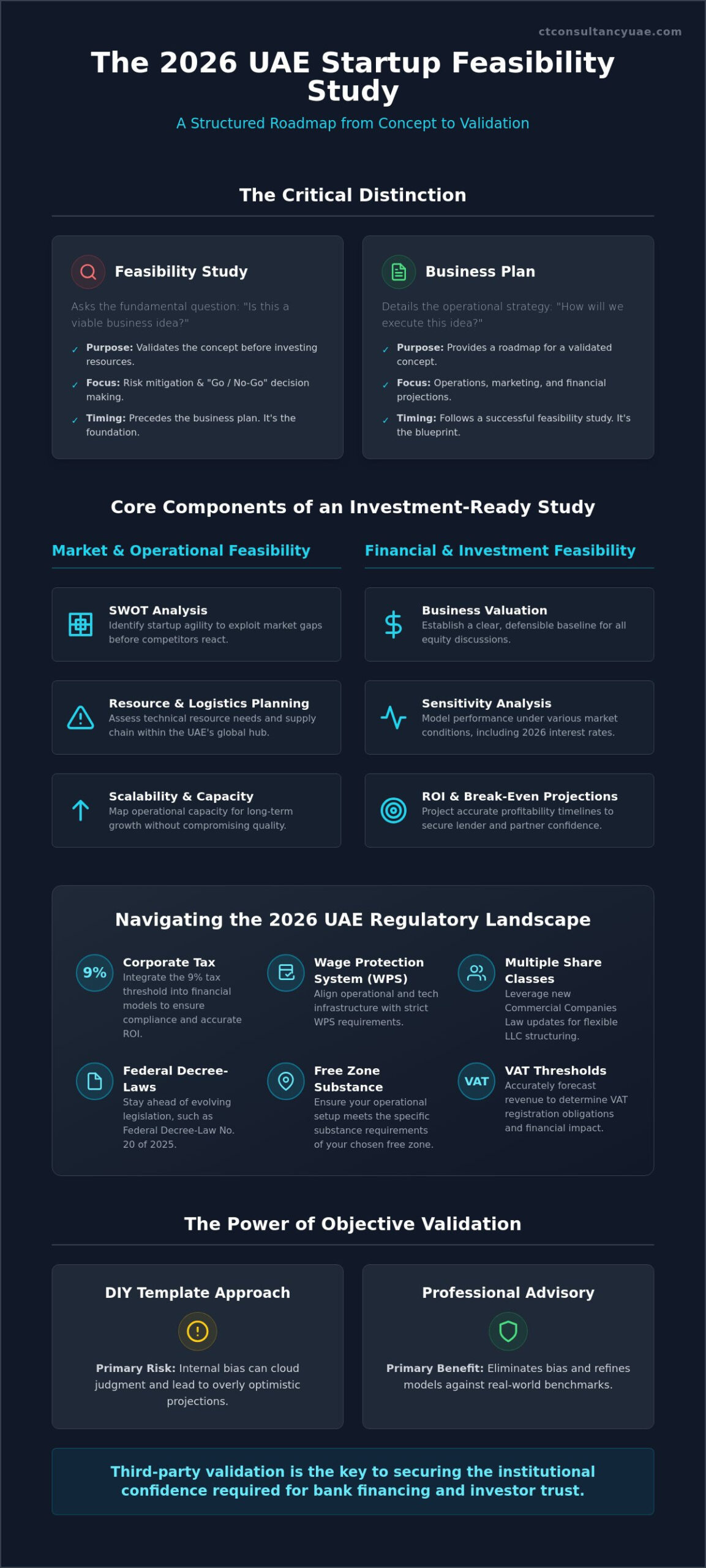
In the UAE’s 2026 business environment, a brilliant idea is no longer enough to secure market entry; precision in regulatory and financial modeling is the only currency that truly matters. Many founders struggle with the weight of potential market rejection or the risk of non-compliance with the 9% corporate tax threshold. It’s natural to feel uncertain when navigating the latest Federal Decree-Law No. 20 of 2025 or the strict requirements of the Wage Protection System. This guide provides a comprehensive startup feasibility study template designed to transform these uncertainties into a structured roadmap for validation. By mastering this framework, you’ll ensure your project aligns with local tax laws and demonstrates the rigorous ROI projections necessary to secure investor confidence. We’ll examine the essential components of a professional study, from substance requirements in free zones to the strategic use of multiple share classes, providing you with a definitive path toward a frictionless launch.
Key Takeaways
- Distinguish between a standard business plan and a multi-dimensional viability assessment to navigate the sophisticated economic landscape of 2026.
- Implement a professional startup feasibility study template that prioritizes market penetration analysis alongside technical and operational resource assessment.
- Integrate critical UAE-specific regulatory factors, including Corporate Tax implications and VAT thresholds, into your financial modeling to ensure accurate ROI projections.
- Evaluate the necessity of professional third-party validation to eliminate internal bias and secure the institutional confidence required for bank financing.
- Align your entrepreneurial vision with the latest Commercial Companies Law updates to ensure a frictionless and compliant market entry.
Table of Contents
Understanding the Architecture of a Startup Feasibility Study Template
Launching a venture in the UAE requires more than an inspired vision; it demands a rigorous interrogation of the project’s foundational logic. A well-constructed startup feasibility study template serves as this interrogation tool, functioning as a multi-dimensional viability assessment that examines every facet of the proposed enterprise. Understanding What is a Feasibility Study? involves recognizing it as a strategic filter that separates high-potential investments from those destined for failure. It provides the strategic reassurance that executive decision-makers require before committing substantial capital to a market defined by rapid regulatory evolution.
Many entrepreneurs mistakenly conflate a business plan with a feasibility study. While a business plan outlines the operational roadmap for an established concept, the feasibility study precedes it by determining if the concept should exist at all. In 2026, this distinction is critical as startups navigate the statutory recognition of multiple share classes for LLCs and stricter Wage Protection System rules. A structured template acts as a primary friction-remover, guiding the founder through a logical progression of validation steps that ensure no regulatory or financial blind spots remain. By utilizing a standardized framework, you transform abstract ideas into a concrete document that speaks the language of institutional investors and banks.
The Strategic Objectives of Your Study
The primary objective is the identification of “Go/No-Go” decision points early in the development cycle, preventing the waste of resources on non-viable paths. By establishing a baseline for financial management for SMEs, the study ensures that the startup is built on a foundation of fiscal discipline. The core purpose of feasibility is to mitigate capital risk through data-driven logic. This rigorous approach is a precursor to effective business advisory, allowing founders to present a case that is both logically sound and investment-ready. It’s about moving from speculation to certainty by addressing the high-stakes nature of tax and legal compliance from the very first day.
Core Components of an Investment-Ready Feasibility Template
An investment-ready startup feasibility study template must transcend descriptive prose to provide a granular, data-driven defense of the business case. It serves as the primary instrument for securing institutional confidence, requiring a rigorous examination of market, technical, and financial pillars. In the competitive UAE landscape of 2026, where market penetration is increasingly complex, your study must prove that a theoretical opportunity can translate into a sustainable commercial reality.
Market and Operational Analysis
Success begins with a SWOT analysis specifically tailored to startup agility, identifying how your venture can exploit market gaps before larger competitors pivot. You’ll need to assess technical resource requirements and supply chain logistics with precision, especially considering the UAE’s role as a global logistics hub. Evaluating operational capacity for long-term scalability is essential; your template should detail how the business will handle growth without compromising service quality or regulatory compliance. This includes mapping out the technology stack required to meet the new Wage Protection System rules and other statutory obligations.
Financial and Investment Feasibility
The financial section is where most independent studies falter. A robust framework incorporates a comprehensive business valuation to establish a clear baseline for equity discussions. Beyond simple cash flow projections, you must build sensitivity analysis into your financial modeling to test how the venture performs under varying market conditions. It’s vital to remember that financial feasibility must account for the 2026 interest rate environment to ensure debt service coverage ratios remain sustainable. By projecting accurate ROI and break-even points, you provide the strategic reassurance that lenders and partners demand. Engaging with specialized business advisory services can help refine these models against real-world benchmarks, ensuring your projections are both ambitious and grounded in local fiscal reality.
Navigating UAE-Specific Regulatory Feasibility for 2026
A generic startup feasibility study template often neglects the intricate fiscal realities of the Middle East, yet for a UAE venture, these factors are the primary determinants of long-term stability. As we approach 2026, the introduction of the 9% corporate tax on taxable income exceeding AED 375,000 has fundamentally altered the financial modeling required for new entrants. Your study must move beyond basic revenue projections to incorporate a sophisticated tax-aware strategy that accounts for these statutory obligations. It’s no longer a matter of operational preference; it’s a requirement for institutional credibility.
Taxation and Compliance Feasibility
Initial budgeting must go beyond setup fees to include specialized Corporate Tax advisory, ensuring your startup leverages available incentives such as Small Business Relief. This relief, available for businesses with revenues of AED 3 million or less until the end of 2026, can significantly preserve early-stage cash flow. Simultaneously, evaluating the impact of the 5% VAT on operational liquidity is essential, as the timing of collections versus payments can create unforeseen gaps. Compliance is a non-negotiable line item. Your operational plan should explicitly budget for Anti-Money Laundering (AML) and Ultimate Beneficial Ownership (UBO) filings to avoid the high-stakes penalties associated with oversight. Successful founders treat these as strategic investments in their firm’s reputation rather than mere administrative burdens.
Licensing and Legal Structures
The choice between a Mainland and Free Zone setup remains a critical decision point that influences market access and tax positioning. Free zone companies may benefit from a 0% corporate tax rate on qualifying income, but this requires maintaining “adequate substance” and audited financial statements. Conversely, the 2025 update to the Commercial Companies Law now permits LLCs to issue multiple share classes, offering founders more flexible ways to attract investment. Assessing the legal feasibility of these structures ensures your business model is compatible with your long-term exit strategy. For comprehensive support in aligning your structure with current laws, consider exploring our specialized tax and compliance services to ensure a frictionless entry into the market.
Executing Your Study: DIY Template vs. Professional Advisory
While a startup feasibility study template provides a useful starting point for conceptualizing a venture, it’s often insufficient for projects requiring substantial capital or complex regulatory navigation. The precision required for a successful UAE launch in 2026 demands more than a fill-in-the-blank approach. Professional advisory transforms a static document into a dynamic strategic asset. This transition is essential for founders who need to move beyond theory into a state of investment readiness. Relying solely on a generic framework can lead to significant oversights in financial modeling and regulatory alignment.
The Limitations of Self-Administered Templates
Self-led assessments frequently suffer from confirmation bias. Founders inadvertently overlook data that contradicts their vision because they are emotionally invested in the outcome. Internal market assessments might miss nuanced shifts in local demand or emerging competitor strategies. Without the distance of a third party, it’s difficult to identify operational blind spots that could derail a project in its first year. A professional study eliminates these risks by applying a cold, analytical lens to every assumption, ensuring the project is truly viable before capital is committed.
Leveraging Elite Financial Expertise
CTC Tax & Accounting brings specialized authority to the validation process, ensuring that your financial models are grounded in decades of international experience. We integrate internal audit principles into your operational feasibility, creating a robust framework that stands up to the scrutiny of banks and private investors. This level of rigor is a direct precursor to successful CFO advisory services, where the initial feasibility study evolves into a long-term roadmap for growth. By moving from simple validation to strategic execution, you ensure your startup isn’t just a viable idea, but a bankable enterprise positioned for stability in the UAE’s evolving economy. Professional validation is the final step in removing friction from your market entry.
Positioning Your Venture for Long-Term UAE Stability
Navigating the UAE’s sophisticated market requires a swift transition from theoretical planning to empirical validation. While a startup feasibility study template provides the initial structural logic, the complexities of the 2026 regulatory landscape demand a higher level of precision. We’ve explored how integrating Corporate Tax implications and strategic shareholding structures can differentiate a viable project from a high-risk gamble. It’s the difference between a speculative idea and a bankable enterprise. Ensuring your financial modeling accounts for the latest statutory updates is the only way to secure the institutional confidence required for bank financing. Our firm provides expert financial modeling for UAE startups and strategic regulatory alignment to offer the strategic reassurance founders need. Secure your startup’s future with a professional feasibility study from CTC Tax & Accounting. With CFO-level advisory for new ventures, you don’t just launch; you build a foundation for enduring success in a global business hub. Your vision deserves a roadmap that is as ambitious as it is meticulous.
Frequently Asked Questions
What is the difference between a business plan and a feasibility study?
A feasibility study is a diagnostic tool used to determine if a business concept is viable before any capital is committed. It focuses on the “Go/No-Go” decision by analyzing market demand and regulatory hurdles. In contrast, a business plan is a strategic roadmap created for a concept that has already been validated. While the plan focuses on execution, the study focuses on the fundamental logic of the venture’s existence.
How much does a professional startup feasibility study cost in the UAE?
The investment for a professional assessment varies based on the project’s scale, the industry sector, and the complexity of the required financial modeling. Larger industrial projects or ventures requiring dual-licensing analysis typically demand more intensive data gathering than small-scale service businesses. It’s best to request a customized proposal that accounts for your specific technical requirements and the depth of market research needed for your jurisdiction.
Can I use a feasibility study template for bank loan applications?
While a startup feasibility study template provides a logical structure for your data, UAE banks generally require professional validation from an authorized financial advisor. Financial institutions prioritize third-party objectivity and audited projections to mitigate their lending risks. A self-administered template often lacks the technical depth and professional endorsement necessary to satisfy the rigorous standards of a bank’s credit committee or a private investor.
What are the 5 main types of feasibility included in a standard template?
A comprehensive startup feasibility study template includes technical, economic, legal, operational, and scheduling feasibility. Technical assessment examines resource availability, while economic analysis projects ROI and break-even points under current tax laws. Legal feasibility is particularly vital in 2026 to ensure alignment with the Commercial Companies Law No. 20 of 2025. Operational and scheduling pillars analyze the venture’s ability to maintain long-term stability within projected timelines.
How long does it take to conduct a comprehensive startup feasibility study?
A thorough study typically requires between four and eight weeks to complete, depending on the complexity of the business model. This timeframe allows for the collection of primary market data, sophisticated financial modeling, and a detailed review of regulatory requirements. Rushing this process can lead to critical oversights in tax-aware modeling or compliance costs, which can jeopardize the startup’s stability during its first year of operation.