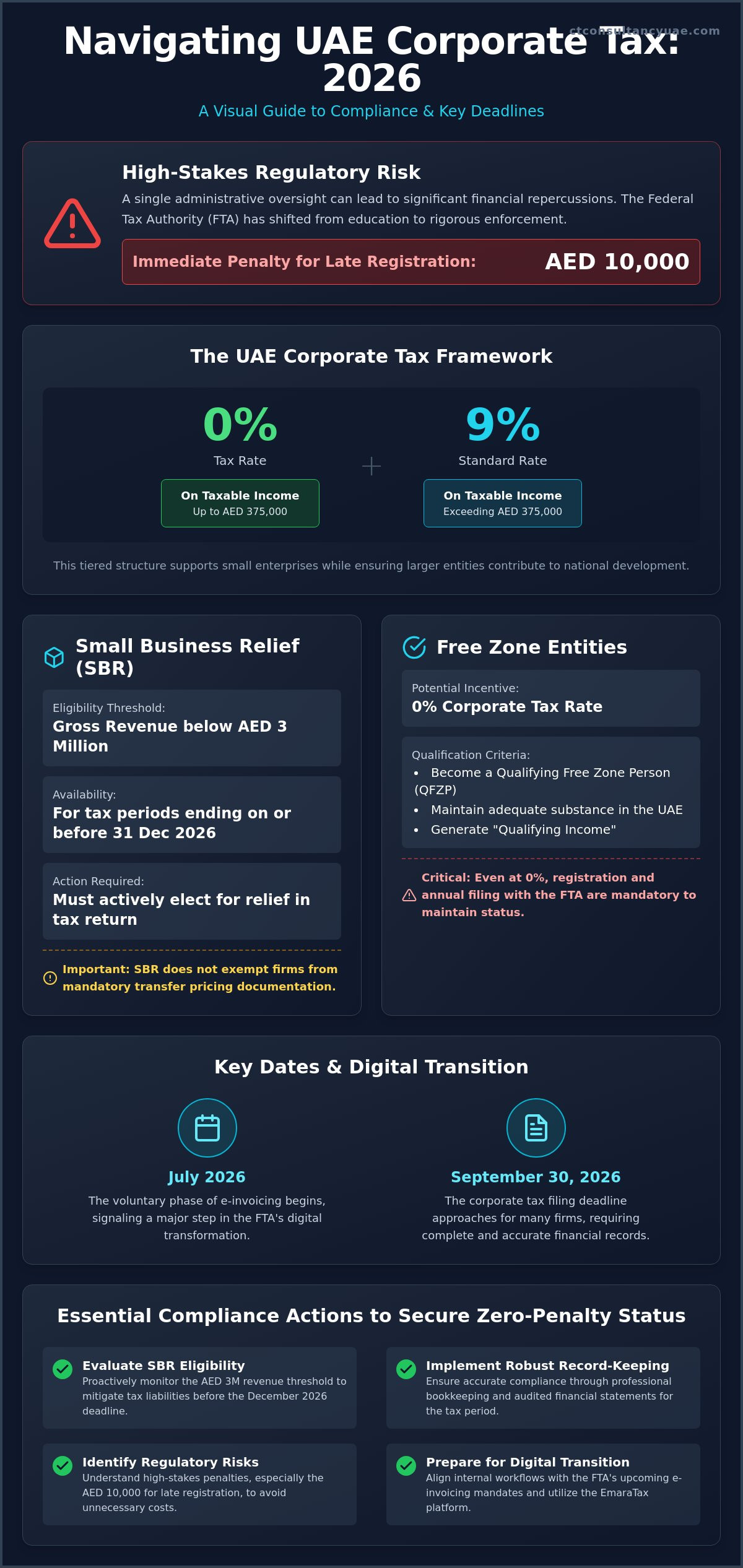
A single administrative oversight in your registration timeline can now result in an immediate AED 10,000 penalty. This shift signals that the Federal Tax Authority has moved decisively from a period of initial education to one of rigorous enforcement. It’s understandable if the transition from VAT-only accounting to a full corporate tax framework feels daunting, particularly as the September 30, 2026 filing deadline approaches for many firms. Achieving robust UAE corporate tax compliance requires more than just basic filing; it demands a sophisticated alignment of your financial records with the latest regulatory standards.
This strategic guide provides the professional reassurance and technical clarity you need to maintain a zero-penalty status while legally optimizing your tax liability. You’ll gain a comprehensive understanding of the 9% taxable income threshold, the specific requirements for Small Business Relief ending in December 2026, and the evolving landscape of Free Zone exemptions. We will preview the essential steps for seamless reporting integration, including the voluntary phase of e-invoicing starting in July 2026, to ensure your business remains resilient and fully compliant in this high-stakes environment.
Key Takeaways
- Understand the tiered tax structure, specifically the application of the 9% rate on taxable income exceeding AED 375,000 for the 2026 period.
- Evaluate eligibility for Small Business Relief to mitigate tax liabilities for entities with revenues below AED 3 million while maintaining mandatory transfer pricing documentation.
- Implement robust financial record-keeping to ensure UAE corporate tax compliance remains accurate through professional bookkeeping and audited financial statements.
- Identify high-stakes regulatory risks, including the AED 10,000 late registration penalty, and the role of internal audits in securing a zero-penalty status.
- Prepare for the digital transition by aligning internal workflows with the Federal Tax Authority’s upcoming e-invoicing mandates and filing deadlines.
Table of Contents
Understanding the UAE Corporate Tax Framework in 2026
The UAE Corporate Tax represents a significant evolution in the regional fiscal environment, functioning as a federal levy applied to the adjusted accounting net profits of businesses. Under the current UAE Corporate Tax Framework, a tiered rate structure is utilized to support small enterprises while ensuring larger entities contribute to national development. For the 2026 tax period, a 0% rate applies to taxable income up to AED 375,000; a standard 9% rate is levied on any income exceeding this threshold. This distinction is vital for maintaining UAE corporate tax compliance, as it dictates the precise calculation of a firm’s tax liability.
The law distinguishes between juridical persons, such as incorporated companies, and natural persons, which include individuals conducting business activities in the UAE. Determining your status as a resident person is a foundational step in identifying your global tax obligations. Resident persons are generally taxed on their worldwide income, whereas non-resident persons are only taxed on income derived from a permanent establishment or a nexus within the UAE. This categorization ensures that the tax base is clearly defined and that revenue is captured where the economic activity actually occurs.
The Role of the Federal Tax Authority (FTA)
The Federal Tax Authority (FTA) serves as the primary regulatory body responsible for the administration and enforcement of federal taxes. It’s essential for businesses to engage with the EmaraTax platform, which acts as the centralized digital hub for registration, filing, and payment. Utilizing professional corporate tax advisory services ensures that your interactions with the FTA remain accurate and timely, mitigating the risk of administrative penalties that can arise from simple filing errors.
Free Zone vs. Mainland Compliance Nuances
Mainland companies follow standard regulations, but Free Zone entities may qualify for a 0% incentive if they meet the criteria of a Qualifying Free Zone Person. This status depends on maintaining adequate substance and generating qualifying income. Even if your entity is eligible for a 0% rate, you’re still required to complete registration and annual filing. Neglecting these procedural steps can jeopardize your tax-exempt status and lead to significant financial repercussions for your organization.
Small Business Relief and Key Exemptions
Small Business Relief (SBR) serves as a vital instrument for eligible resident taxable persons to manage their fiscal obligations during these initial implementation years. This relief is available to entities whose gross revenue does not exceed AED 3 million for the relevant tax period and all previous tax periods ending on or before 31 December 2026. To utilize this relief, a taxable person must make an active election in their tax return for each relevant tax period. While SBR offers significant tax savings, it doesn’t exempt a business from the broader UAE corporate tax compliance framework, particularly regarding transfer pricing. Even under this relief, businesses must ensure that transactions with related parties and connected persons are conducted at an arm’s length, maintaining the integrity of their financial reporting.
Beyond SBR, the Official UAE Corporate Tax Law defines specific categories of “Exempt Persons.” This group includes government entities, extractive businesses, and qualifying public benefit entities. These organizations are generally outside the scope of corporate tax, provided they maintain their status through stringent adherence to regulatory requirements. If you’re uncertain about your entity’s status, seeking specialized corporate tax advisory can prevent costly misclassifications and ensure your registration is handled correctly from the outset.
Monitoring the AED 3 Million Revenue Threshold
Maintaining eligibility for SBR requires precise monitoring of gross revenue, which includes all income generated without deducting expenses. If your revenue surpasses the AED 3 million threshold in a current tax period, you’ll lose the relief for that year. It’s also important to note that the relief is currently slated for tax periods ending on or before 31 December 2026, making strategic planning essential for the transition to the standard 9% rate.
Corporate Tax for Multinational Groups
For large-scale multinational enterprises, the introduction of the Domestic Minimum Top-up Tax (DMTT) marks a shift toward global tax alignment. This tax applies to groups with consolidated annual revenues exceeding €750 million, ensuring they meet a 15% effective tax rate. This mechanism integrates UAE’s national tax landscape into the global Pillar Two framework, requiring sophisticated reporting that goes beyond standard domestic requirements.
Operationalizing Compliance: From Bookkeeping to Filing
Effective UAE corporate tax compliance isn’t a year-end administrative task; it’s the culmination of a rigorous, month-on-month accounting discipline. To meet the Federal Tax Authority’s standards, businesses must prepare their financial statements in accordance with International Financial Reporting Standards (IFRS). This ensures that adjusted accounting net profits are calculated with the precision required for accurate tax reporting. For many entities, especially those exceeding specific revenue thresholds, maintaining audited or certified financial statements is a mandatory requirement to validate the integrity of their tax submissions.
The accuracy of your final return depends heavily on the quality of your bookkeeping and accounting services. Errors in initial data entry can cascade into significant discrepancies during the filing process, potentially triggering audits or penalties. It’s also vital to remember the strict timeline: you have exactly nine months after the end of your financial year to complete both your filing and tax payment. For a financial year ending December 31, 2025, your deadline is September 30, 2026. Adhering to the UAE Transfer Pricing Guidelines during this period is equally critical for transactions involving related parties.
The Tax Registration Process on EmaraTax
Securing your Tax Registration Number (TRN) is the first operational milestone for UAE corporate tax compliance. This process is managed via the EmaraTax portal and requires a comprehensive set of documentation, including your valid trade license, passport copies of authorized signatories, and clearly defined financial year-end dates. Early registration is essential to avoid the AED 10,000 late penalty, ensuring your business remains in good standing from the outset.
Monthly Maintenance for Annual Accuracy
Monthly reconciliations serve as the primary defense against year-end filing bottlenecks. By integrating your existing VAT compliance data with your corporate tax records, you create a unified financial workflow that captures necessary data in real-time. This proactive approach allows for the early identification of tax-deductible expenses and potential liabilities. If you require assistance in streamlining these processes, our team can help you implement a robust accounting framework tailored to these new requirements.
Risk Mitigation and the Value of Professional Advisory
The penalty landscape for non-compliance is rigorous, with the Federal Tax Authority (FTA) imposing significant financial burdens for administrative failures. A late registration alone incurs an immediate AED 10,000 fine, while recurring errors in data submission or the failure to maintain records can lead to even more severe fiscal repercussions. Engaging in internal audit services provides a proactive shield, allowing your organization to identify and rectify discrepancies before they escalate into formal tax disputes. Beyond mere risk avoidance, maintaining high standards of UAE corporate tax compliance serves as a hallmark of corporate health. When undergoing a business valuation, a clean and transparent tax history significantly bolsters investor confidence and enhances the overall marketability of the enterprise.
Navigating FTA Audits and Clarifications
During an FTA audit, the authority meticulously examines the alignment between your general ledger and the figures reported on your tax returns. Preparation requires the systematic organization of at least seven years of financial records, including contracts, invoices, and bank statements. If your business occupies a complex tax position, seeking a private clarification from the FTA offers a formal route to regulatory certainty. This process provides a definitive ruling on how the law applies to your specific circumstances, effectively neutralizing future liabilities and providing a clear path forward for your financial team.
Strategic CFO Oversight for Tax Efficiency
Strategic CFO advisory services ensure that tax planning isn’t just a reactive measure but a core component of sustainable business growth. By aligning tax efficiency with broader operational goals, these services provide the high-level oversight necessary for long-term stability in a changing market. A seasoned tax agent acts as your primary navigator through the 2026 regulatory environment, managing the nuances of UAE corporate tax compliance so you can focus on scaling your operations. This partnership ensures that your compliance journey is characterized by professional calm and meticulous planning rather than administrative friction.
Future-Proofing Your Enterprise for the 2026 Fiscal Cycle
As the UAE’s transition to a mature tax jurisdiction solidifies, the distinction between simple administrative filing and strategic tax management becomes paramount. Success in this new era depends on the absolute precision of your financial records and the timely election of available reliefs before the December 2026 deadlines. Maintaining rigorous UAE corporate tax compliance isn’t merely a regulatory hurdle; it’s a foundational pillar for long-term corporate stability and enhanced business valuation. By aligning your internal workflows with IFRS standards and the Federal Tax Authority’s digital mandates, you position your organization for frictionless growth.
Navigating these multi-layered requirements requires a partner with decades of international experience in finance and corporate governance. CTC Tax & Accounting provides specialized expertise in UAE-specific regulatory frameworks, including ESR and AML, offering customized financial solutions tailored for SMEs and entrepreneurs. You don’t have to face these high-stakes complexities alone. Secure your business with expert UAE corporate tax compliance services from CTC Tax & Accounting and ensure your enterprise remains resilient. With the right advisory, your business can navigate these changes with total confidence and professional calm.
Frequently Asked Questions
When is the deadline for UAE Corporate Tax registration in 2026?
Registration deadlines are determined by the month in which your original trade license was issued, as stipulated by the Federal Tax Authority Decision No. 3 of 2024. It’s imperative to verify your specific registration window on the EmaraTax portal immediately to avoid the AED 10,000 late registration penalty. Missing this window represents a significant lapse in UAE corporate tax compliance, which may lead to intensified regulatory scrutiny during future financial audits.
Can a Free Zone company benefit from a 0% Corporate Tax rate?
Free Zone entities can access a 0% corporate tax rate provided they meet the stringent criteria of a Qualifying Free Zone Person. This status requires the business to maintain adequate economic substance within the UAE, generate only Qualifying Income, and adhere to all transfer pricing documentation standards. Even if your entity qualifies for this incentive, you’re still legally obligated to complete the registration process and submit an annual tax return to the authority.
What are the penalties for non-compliance with UAE Corporate Tax laws?
The Federal Tax Authority utilizes a structured penalty framework designed to enforce rigorous administrative discipline. A failure to register within the prescribed timeframe results in a fixed fine of AED 10,000. Beyond registration, businesses may face substantial financial penalties for the late filing of returns, the submission of inaccurate financial data, or a failure to retain mandatory supporting documentation for the required seven-year period. These costs can significantly impact an organization’s bottom line.
Is Small Business Relief (SBR) automatic for companies earning less than AED 3 million?
Small Business Relief isn’t granted automatically; it requires an active election within your annual tax return. Eligible resident persons with gross revenue below the AED 3 million threshold must choose to apply this relief for each relevant tax period ending on or before 31 December 2026. While this election is a powerful tool for UAE corporate tax compliance, it doesn’t exempt the business from the fundamental requirements of registration or maintaining precise financial records to substantiate revenue claims.
Does a business need to file a tax return if it has no taxable income?
Every registered taxable person must file an annual corporate tax return, even if the business has generated no taxable income or has incurred a financial loss. This requirement ensures that the Federal Tax Authority maintains a transparent and comprehensive record of all commercial activities within the jurisdiction. Filing is a mandatory procedural step that confirms your entity’s adherence to the law and prevents the imposition of non-filing penalties that apply regardless of your actual tax liability.