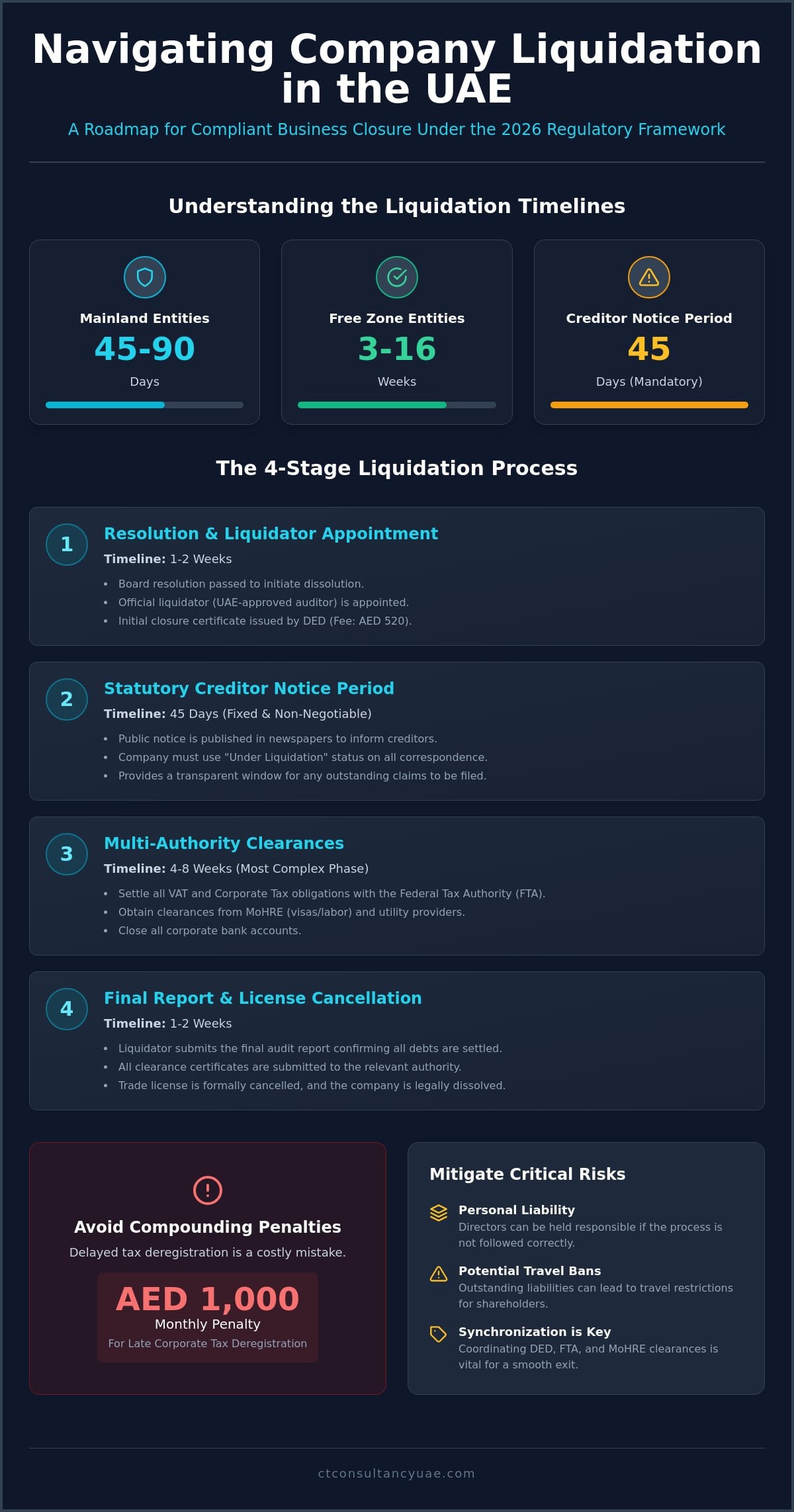
The true cost of a mismanaged business exit in the Emirates is rarely found in the government fees, but rather in the compounding penalties of missed tax deadlines. For many directors, the primary concern remains exactly how long does company liquidation take in the UAE given the stringent 2026 regulatory framework. It’s understandable that you feel a sense of urgency to resolve visa cancellations and bank closures without incurring the AED 1,000 monthly penalties associated with late corporate tax de-registration.
This guide provides a definitive roadmap for navigating the dissolution process under Federal Decree-Law No. 20 of 2025. You will discover the precise statutory timelines, including the mandatory 45-day creditor notice period for mainland entities and the varying three to sixteen-week windows for free zone closures. We will analyze the critical synchronization required between the Department of Economic Development and the Federal Tax Authority to ensure your transition is both compliant and strategically sound. By understanding these modern compliance standards, you can secure a frictionless closure that protects your professional reputation and financial standing.
Key Takeaways
- Establish a realistic expectation for closure by analyzing the standard 45 to 90-day timeline mandated for mainland entities under the 2026 regulatory framework.
- Determine precisely how long does company liquidation take in the UAE by examining the mandatory 45-day statutory notice period required for formal creditor notification.
- Synchronize your exit strategy with Federal Tax Authority requirements to avoid the compounding financial penalties associated with delayed VAT and corporate tax de-registration.
- Mitigate the risk of personal liability and potential travel bans by transitioning from active status to legal dissolution through a structured, multi-authority clearance process.
- Recognize the jurisdictional variations in free zone liquidation processes, which can range from three to sixteen weeks depending on specific authority requirements.
The Standard Timeline for Company Liquidation in the UAE
Within the sophisticated UAE Corporate Law Framework, company liquidation represents the formal dissolution of a legal entity, a process that terminates its legal personality and settles all outstanding obligations. For executive decision-makers, the central inquiry is often how long does company liquidation take in the UAE, as this timeline directly impacts capital repatriation and future ventures. While the baseline for most limited liability entities typically spans three to six months, the 2026 regulatory updates have introduced more rigorous synchronization requirements between tax and labor authorities.
Dissolution generally occurs through two primary channels. Voluntary liquidation is shareholder-led, initiated when the board determines the company has fulfilled its purpose or requires closure for strategic reasons. Conversely, compulsory liquidation is court-ordered, often involving insolvency or regulatory breaches. Under the 2026 standards, both pathways require meticulous coordination with the Federal Tax Authority (FTA) and the Ministry of Human Resources and Emiratisation (MoHRE) to ensure all liabilities are extinguished before the final license cancellation.
Mainland vs. Free Zone Duration
The administrative velocity of your exit depends heavily on your jurisdiction. When assessing how long does company liquidation take in the UAE for mainland companies, the process generally adheres to a 45 to 90-day cycle. In contrast, specialized Free Zone Authorities (FZAs) maintain independent regulations. Certain jurisdictions, such as the DMCC or ADGM, may offer expedited de-registration paths for dormant entities with no active liabilities, whereas complex free zone closures can extend to 16 weeks depending on specific audit requirements and authority approvals.
Statutory vs. Administrative Timeframes
It’s vital to distinguish between fixed legal mandates and variable processing times. UAE law requires a mandatory 45-day public notice period for mainland entities, during which creditors may formally submit claims. This statutory window is non-negotiable and serves as the bedrock of creditor protection. However, administrative phases, such as obtaining clearances from utility providers or finalizing tax compliance, fluctuate based on the accuracy of your corporate records and the responsiveness of various government departments.
Stage-by-Stage Breakdown of the Liquidation Process
The path to a compliant business closure is structured around four distinct phases, each requiring meticulous attention to regulatory detail. Initially, the process commences with Stage 1, involving the board resolution and the formal appointment of a liquidator, which typically facilitates the issuance of a preliminary closure certificate from the Department of Economic Development (DED) within one to two weeks. This initial step, carrying a government fee of AED 520 for mainland entities, sets the legal machinery in motion.
Stage 2 is defined by the 45-day statutory notice period. This fixed window is non-negotiable and serves as a transparent mechanism for creditor protection. During this time, a Step-by-Step Guide to Company Liquidation emphasizes that the company must maintain its "Under Liquidation" status on all official correspondence. If no valid claims are filed, the process transitions to Stage 3, which is often the most complex phase. Over four to eight weeks, the entity must secure multi-authority clearances. Under the April 2026 Federal Tax Authority guidelines, this includes filing a corporate tax de-registration application within three months of dissolution and ensuring all VAT obligations are settled. Finally, Stage 4 concludes with the submission of the liquidator’s final report and the formal cancellation of the Trade License within one to two weeks.
The Role of the Registered Liquidator
Only UAE-approved auditors possess the legal authority to issue the final liquidation report required for license cancellation. A proactive liquidator does more than audit books; they strategically synchronize visa cancellations with the closure of corporate bank accounts to prevent administrative bottlenecks. This coordination is essential when determining how long does company liquidation take in the UAE, as any delay in Ministry of Human Resources and Emiratisation (MoHRE) clearances can stall the entire timeline. Engaging experts for VAT and Corporate Tax compliance early in this stage ensures that tax-related hurdles don’t extend the process indefinitely.
The 45-Day Public Notice Requirement
Legal compliance necessitates advertising the liquidation in two local newspapers, including at least one Arabic publication. This 45-day window allows creditors to submit claims against the company’s assets. If a claim is filed, the liquidator must adjudicate the debt before the process can proceed. Failure to adhere to this transparency requirement can lead to personal liability for directors, making this statutory block a critical safeguard in the UAE’s regulatory environment.
Critical Factors That Influence Your Liquidation Speed
While the statutory stages provide a structured framework, the actual velocity of a business closure is often dictated by operational variables. When evaluating how long does company liquidation take in the UAE, directors must account for the "Bank Account Bottleneck." Financial institutions require exhaustive documentation to close corporate accounts, a process that frequently adds four to eight weeks to the overall timeline. This delay often occurs because banks must ensure all outstanding facilities, letters of credit, and corporate guarantees are fully extinguished before releasing the final clearance letter.
Tax Compliance and Deregistration
Securing a Tax Clearance Certificate from the Federal Tax Authority (FTA) has become a primary gatekeeper for efficient closures. Under the 2026 regulations, the FTA scrutinizes all historical filings to ensure no outstanding liabilities remain. For entities that haven’t maintained rigorous records, this stage can become a major point of friction. Understanding the nuances of VAT registration services in the UAE is essential, as the deregistration process mirrors the complexity of the initial setup and requires precise tax synchronization.
Administrative Readiness and Documentation
The speed of Stage 1 is entirely dependent on the quality of your corporate records. Before the liquidator is even appointed, you must prepare audited financial statements, board resolutions, and proof of utility settlements. Utilizing professional internal audit services allows your team to identify potential liabilities and documentation gaps months before the formal process begins. This proactive stance transforms a potentially chaotic exit into a controlled, professional transition. If you require a tailored assessment of your current compliance status, our team provides comprehensive Company Liquidation Services to streamline your exit strategy.
Ensuring a Frictionless and Efficient Liquidation Strategy
Formal liquidation should be viewed as a strategic defensive maneuver rather than a mere administrative end-point. By pursuing a legal de-registration, shareholders effectively insulate themselves from future liabilities, trade license renewal arrears, and the risk of travel bans. The temptation to "ghost" or abandon an entity carries severe consequences in the 2026 regulatory environment, including compounding penalties for non-compliance with the Federal Tax Authority and potential personal liability for directors. A clean exit isn’t just a legal requirement; it’s a prerequisite for any future entrepreneurial ventures in the region.
CTC Tax & Accounting utilizes a methodology centered on meticulous planning to reduce administrative friction. We address the core concern of how long does company liquidation take in the UAE by conducting exhaustive pre-liquidation reviews that resolve documentation gaps before the 45-day statutory clock begins. This proactive synchronization ensures that when the liquidator is appointed, the path toward MoHRE and FTA clearances is already cleared of foreseeable hurdles. Navigating the 2026 UAE regulatory landscape requires this level of precision to maintain long-term stability and professional reputation.
Beyond Closure: Strategic Exit Planning
A successful exit involves more than just cancelling a license. It requires a sophisticated approach to asset distribution and tax positioning. Our CFO advisory services provide the necessary oversight to value remaining assets accurately, ensuring equitable distribution among shareholders. Simultaneously, working with Corporate Tax consultants allows for a finalized tax position that mitigates the risk of future audits or unexpected levies after the company has ceased to exist.
Selecting Your Liquidation Partner
Choosing the right liquidator is the most significant factor in determining how long does company liquidation take in the UAE. The ideal partner must possess deep local expertise, a high regulatory standing with the Department of Economic Development, and a commitment to transparency. At CTC Tax & Accounting, we provide a structured, end-to-end solution that transforms a complex regulatory burden into a steady, informative, and highly structured progression. Consult with CTC Tax & Accounting for a seamless UAE business closure and secure your professional future with an elite consulting partner.
Securing Your Professional Legacy through Compliant Dissolution
CTC Tax & Accounting provides decades of international expertise in UAE regulation, offering comprehensive end-to-end management of all tax and administrative clearances. Our specialized support for SMEs and freelancers ensures that even the most complex closures are handled with meticulous accuracy and professional calm. Secure a compliant and stress-free company liquidation with CTC Tax & Accounting to protect your interests. Your business transition deserves the same level of strategic care as its inception, and we’re ready to facilitate your next chapter with precision and reliability.
Frequently Asked Questions
Can I liquidate a UAE company without an auditor?
Most legal entities in the Emirates, particularly Limited Liability Companies and mainland establishments, cannot be dissolved without the formal appointment of a licensed liquidator. Regulatory authorities require a comprehensive final liquidation report, which only registered auditors with specific local accreditation possess the legal standing to issue. This report serves as the definitive financial verification that all corporate assets have been distributed and liabilities settled in accordance with Federal Law.
What happens to my residency visa during company liquidation?
All residency visas associated with the trade license must be formally cancelled or transferred before the final dissolution certificate is granted. This administrative requirement often dictates how long does company liquidation take in uae, as Ministry of Human Resources and Emiratisation (MoHRE) clearances are contingent upon the documented settlement of all end-of-service benefits. Failure to resolve these statuses can stall the entire progression and prevent the ultimate cancellation of the commercial license.
Is it possible to expedite the 45-day notice period in the UAE?
The 45-day public notice period is a statutory mandate under the UAE Commercial Companies Law and cannot be bypassed or shortened for mainland entities. This fixed window is architected to protect third-party creditors by providing a transparent duration for them to file claims against the entity’s remaining assets. While other administrative tasks can be managed concurrently to optimize the overall schedule, this legal block remains a non-negotiable element of the timeline.
Do I need to cancel my VAT registration before liquidating?
You must submit an application for VAT de-registration to the Federal Tax Authority within 20 business days of the company becoming eligible for dissolution. Under the 2026 tax framework, the FTA requires a final tax return and the full settlement of any outstanding liabilities before issuing a clearance certificate. This deregistration is a critical factor in determining how long does company liquidation take in the UAE, as tax-related bottlenecks are a primary source of administrative friction.
What are the penalties for not liquidating a dormant UAE company properly?
Neglecting the formal liquidation of a dormant entity exposes directors to significant financial and legal risks, including late corporate tax de-registration penalties of AED 1,000 per month. These fines are capped at AED 10,000, but they’re often accompanied by ongoing trade license renewal arrears and potential travel bans for shareholders. Improper closure can also lead to personal liability if creditors seek legal recourse due to a lack of transparent and documented dissolution.