What if your production floor’s operational success is actually obscuring a significant compliance risk under the 2026 UAE Corporate Tax regime? For many industrial leaders, the disconnect between shop-floor performance and financial reporting has become a high-stakes vulnerability. You likely recognize that maintaining a robust internal audit checklist for manufacturing company operations is no longer just about quality control; it’s a critical safeguard against the 9% standard tax rate and the stringent new e-invoicing mandates beginning this year.
It’s understandable to feel the pressure of aligning complex manufacturing cycles with the Federal Tax Authority’s evolving expectations. We’re here to help you bridge that gap with a unified audit framework designed to ensure your resource allocation remains efficient while your regulatory exposure stays minimal. This guide provides a comprehensive breakdown of the essential controls you need to implement to secure operational transparency and master your financial oversight in this sophisticated regulatory landscape.
- Learn why the maturing 2026 regulatory environment in the UAE necessitates a shift from basic quality control to a more integrated, risk-based audit approach.
- Utilize a detailed internal audit checklist for manufacturing company workflows to identify inefficiencies in production cycles and supply chain lead times.
- Secure your financial standing by verifying that VAT documentation and deductible manufacturing costs meet the stringent evidentiary standards of the Federal Tax Authority.
- Discover how to leverage internal audit data to drive strategic financial optimization and improve your organization’s long-term stability and market valuation.
Within the sophisticated industrial landscape of the UAE, the function of internal auditing has transitioned from a routine administrative task to a high-level strategic imperative. It serves as a systematic evaluation of an organization’s risk management and internal control processes, ensuring that every operational gear turns in harmony with financial objectives. For leadership teams, this oversight provides the clarity needed to navigate a market that demands both high-speed production and total regulatory transparency.
The year 2026 represents a critical turning point for the sector. With the UAE Corporate Tax regime now fully matured and Anti-Money Laundering (AML) frameworks seeing heightened enforcement, manufacturers face unprecedented scrutiny. Moving beyond a “compliance-only” mindset is essential for SMEs aiming to maintain a competitive edge. A robust internal audit checklist for manufacturing company operations transforms raw data into value-add strategic oversight, effectively identifying fiscal vulnerabilities before they escalate into regulatory liabilities. Furthermore, these internal reviews facilitate a significantly smoother external audit process, ensuring that the final certification of financial statements proceeds without friction or unexpected adjustments.
Risk Mitigation and Operational Resilience
Operational resilience is built upon the early identification of production bottlenecks that lead to financial leakage. Whether it’s an unmonitored spike in scrap rates or a delay in equipment maintenance, these inefficiencies directly erode the bottom line. By establishing a professional problem-solution framework, firms can address internal control failures with precision rather than guesswork. Internal audits act as a safeguard for long-term stability and meticulous planning.
In specialized manufacturing fields where technical precision is critical, you can discover Auto Industries Factory LLC to see how industry leaders manage complex fabrication projects while maintaining operational integrity.
Aligning Production with Financial Governance
For a manufacturing entity to remain compliant under the 2026 tax laws, the factory floor and the accounting department must operate from a unified data source. Discrepancies between inventory logs and balance sheets are primary red flags for tax authorities. Utilizing professional accounting services ensures that your ledgers remain audit-ready at all times. This alignment ensures that every dirham spent on the production line is accurately reflected in your financial reporting, protecting your eligibility for 0% tax on qualifying income where applicable.
As the UAE manufacturing sector is projected to contribute $25 billion to the national GDP by 2026, the complexity of managing large-scale production alongside strict financial governance has intensified. Executing a comprehensive internal audit checklist for manufacturing company operations requires more than a cursory glance at safety signs. It demands a rigorous verification of adherence to Standard Operating Procedures (SOPs), an analytical review of scrap rates to identify hidden losses, and a deep dive into equipment maintenance logs to ensure operational uptime.
Financial integrity begins on the procurement line. Auditing vendor selection processes and monitoring raw material pricing variances prevents inflationary pressure from eroding margins. Simultaneously, verifying labor law compliance and specialized safety certifications protects the entity from the heavy penalties associated with the UAE’s evolving employment regulations. Ensuring these operational pillars are sound creates the foundation for a stable, tax-efficient business model.
Production Floor and Asset Management
Precision in asset management is vital for optimizing tax positions. Auditors must verify machinery utilization rates to ensure depreciation schedules accurately reflect wear and tear. A critical checklist item involves cross-referencing maintenance records with capital expenditure (CapEx) budgets to prevent the misclassification of expenses. Additionally, auditing “Work in Progress” (WIP) valuation ensures that your financial reporting reflects the true value of unfinished goods, providing a clear picture for CFO advisory services to analyze and optimize.
Warehouse and Logistics Integrity
The warehouse serves as the final checkpoint for fiscal accuracy. Evaluating the security of finished goods and the precision of outbound shipping logs is essential to prevent inventory shrinkage. For manufacturers dealing with time-sensitive materials, auditing the “First-In, First-Out” (FIFO) method is mandatory to avoid obsolescence and waste. Validating physical stock against the Fixed Asset Register and digital ledgers remains the most effective way to maintain a friction-free transition into the 2026 tax year, ensuring that your balance sheet remains beyond reproach during regulatory inspections.
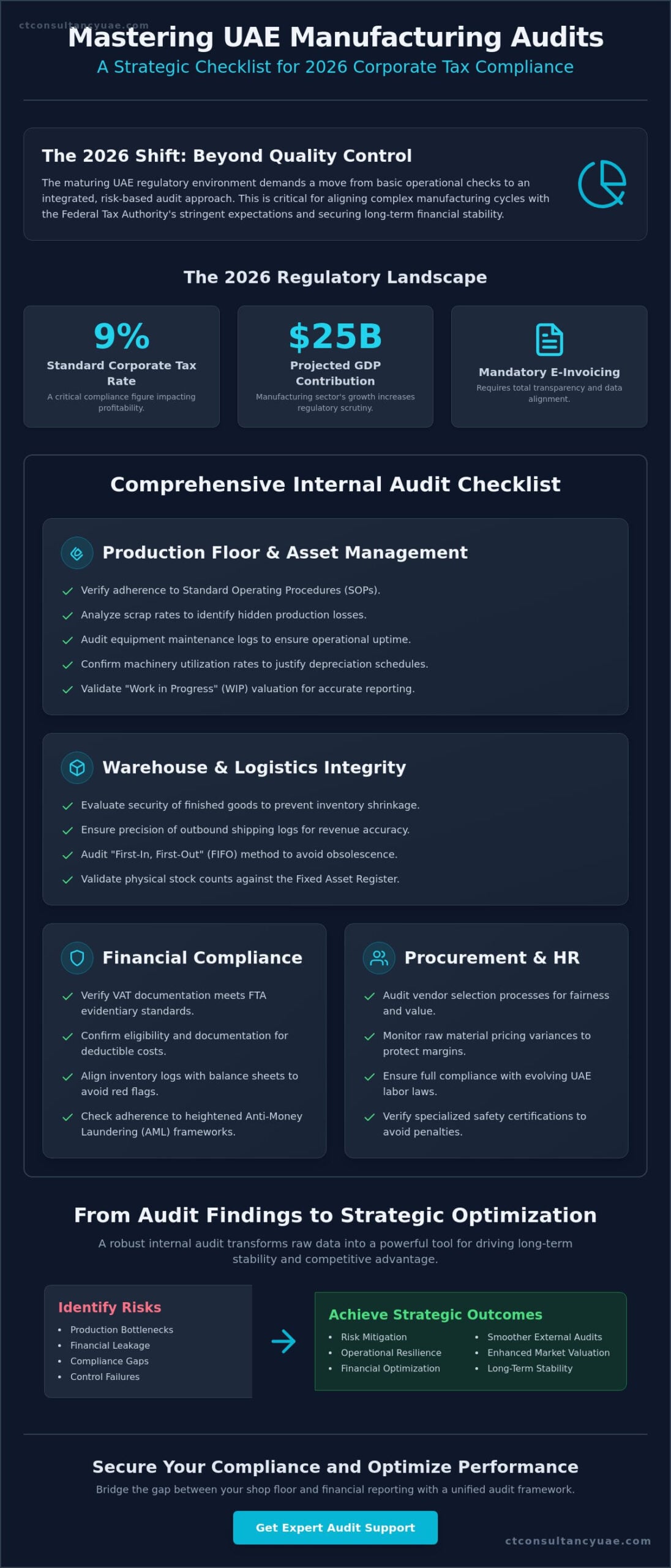
Achieving financial integrity in the 2026 fiscal year requires a seamless integration between industrial output and tax reporting. A robust internal audit checklist for manufacturing company compliance ensures that every export is backed by the requisite documentation to justify its zero-rated VAT status. Without this evidentiary trail, domestic sales and international shipments risk being misclassified, leading to substantial back-taxes and penalties during a Federal Tax Authority (FTA) inspection. This level of precision is non-negotiable for modern industrial leaders.
With the 9% corporate tax rate now a standard reality for income exceeding AED 375,000, the verification of deductible manufacturing expenses is paramount. Every raw material purchase and utility payment must be supported by FTA-compliant invoices to ensure full deductibility. Implementing structured audits reduces friction with the FTA, effectively transforming potential regulatory hurdles into a predictable, manageable component of your fiscal strategy. It’s the most effective way to prevent costly penalties before they arise.
Navigating the 2026 Tax Landscape
Ensuring your firm’s accounting practices align with corporate tax consultants dubai recommendations is the most reliable way to maintain compliance. A critical audit point involves reviewing transfer pricing, especially if the manufacturing unit serves related entities or international branches. Regulatory “safe” standards are merely the baseline for biologically optimal business health. Maintaining records that exceed these minimums ensures your entity remains resilient against future policy shifts.
AML and ESR Compliance for Manufacturers
Manufacturers must verify that Ultimate Beneficial Ownership (UBO) filings are current to avoid severe administrative fines. Additionally, auditing Economic Substance Regulations (ESR) is mandatory if your firm engages in “Relevant Activities” such as distribution or operating service centers. Implementing “Know Your Supplier” (KYS) protocols in the procurement chain further protects the entity from inadvertently engaging in illicit financial flows. For comprehensive support in these high-stakes areas, explore our specialized tax services to ensure your entity remains fully aligned with UAE law.
The transition from identifying discrepancies to implementing strategic improvements is where the true value of an internal audit resides. Once the internal audit checklist for manufacturing company operations has highlighted high-risk financial or operational gaps, leadership must develop a prioritized post-audit action plan. This process isn’t merely about rectification; it’s about transforming raw data into intelligence for business advisory and valuation models. By integrating these findings, you refine your organization’s financial narrative, ensuring that every dirham of capital is utilized with surgical precision.
Leveraging these insights allows for sophisticated cash flow management and strategic budgeting for the 2027 fiscal year. Professional cfo advisory services play a pivotal role here, interpreting complex results to drive executive growth and long-term stability. This analytical approach ensures that your manufacturing entity doesn’t just survive regulatory scrutiny but thrives within it.
Implementing Corrective and Preventive Actions (CAPA)
Moving beyond the simple “fixing” of errors is essential for operational excellence. It involves redesigning friction-free financial workflows that prevent the recurrence of non-compliance. By embedding these findings into your strategic financial management for smes framework, you ensure that compliance becomes a natural byproduct of your daily operations. This proactive stance eliminates the stress of last-minute corrections before tax deadlines.
Scaling with Confidence
Audit-validated data is a powerful asset when seeking to secure bank financing or attract high-level investors. It provides a transparent, verified view of your company’s health that instills immediate confidence in creditors. In the UAE market, regular internal oversight builds a brand of reliability and security. It signals to stakeholders that your entity has mastered the nuances of regional regulations and is prepared for sustainable, low-risk expansion into new territories.
The UAE manufacturing landscape is evolving into a high-stakes environment where precision and transparency are the ultimate currencies. By integrating a rigorous internal audit checklist for manufacturing company workflows, you transform compliance from a reactive burden into a proactive strategic advantage. It’s the most effective way to ensure your production floor data aligns perfectly with Federal Tax Authority expectations, protecting your margins from penalties while identifying opportunities for operational cost control and resource optimization.
At CTC Tax & Accounting, we provide the specialized expertise needed to navigate this transition with total confidence. Our team combines deep knowledge of UAE Federal Tax Authority regulations with decades of international experience in strategic financial planning. Whether you manage an SME or a large-scale production plant, we offer customized audit solutions designed to foster long-term stability and growth. Secure your manufacturing operations with a professional internal audit from CTC Tax & Accounting. We look forward to partnering with you to ensure your enterprise remains a pillar of reliability and excellence in the regional market.
How often should a manufacturing company conduct an internal audit in the UAE?
Manufacturing entities should ideally conduct internal audits on a quarterly or semi-annual basis to maintain alignment with the UAE’s rigorous tax deadlines. While annual reviews were once sufficient, the complexity of 2026 Corporate Tax and VAT requirements necessitates more frequent oversight. Regular assessments allow leadership to detect operational inefficiencies and financial discrepancies early, preventing them from compounding into significant regulatory liabilities during an official Federal Tax Authority inspection.
What is the difference between a process audit and a financial internal audit?
A process audit evaluates the efficiency and compliance of factory floor operations, such as adherence to SOPs and safety protocols. In contrast, a financial internal audit scrutinizes the accuracy of balance sheets, tax filings, and general ledgers. For a unified approach, an internal audit checklist for manufacturing company operations must bridge these two disciplines, ensuring that physical production data accurately reflects the organization’s financial reporting and tax obligations.
Can a manufacturing company perform its own internal audit, or is a consultant required?
While a manufacturing firm can technically utilize an in-house team, engaging an external consultant is often preferred to ensure total objectivity and specialized local expertise. Professional consultants provide a detached perspective that internal staff might overlook, particularly regarding nuanced UAE regulatory updates. This external oversight instills greater confidence in stakeholders and financial institutions, as it guarantees that the audit process remains free from internal bias.
What are the specific penalties for VAT non-compliance in the UAE manufacturing sector?
Penalties for VAT non-compliance in the UAE are substantial and strictly enforced to maintain market integrity. Common administrative fines are triggered by late tax return submissions, failure to maintain proper financial records, or issuing incorrect tax invoices. For manufacturing entities, these financial repercussions can be severe, especially when errors in documenting zero-rated exports are discovered during an FTA audit, potentially leading to the loss of tax-exempt status for those transactions.
How does an internal audit checklist help with UAE Corporate Tax registration?
Utilizing a structured internal audit checklist for manufacturing company registration ensures that all financial statements are accurate and fully supported by evidentiary documentation before they’re submitted to the authorities. This preparation is vital for determining taxable income and verifying eligibility for specific reliefs, such as those available to Free Zone entities. A meticulous audit serves as a final filter, removing errors that could otherwise trigger a regulatory investigation or result in registration delays.