Why would a growing UAE enterprise commit AED 70,000 every month to a full-time executive when the same strategic oversight is accessible at a 60% discount? Many leadership teams find themselves trapped between the basic functionality of bookkeeping and the high-stakes demands of the 2026 regulatory environment, often resulting in unexpected billing spikes. Selecting the right outsourced CFO pricing model is no longer just a procurement task; it’s a strategic decision that determines your ability to navigate the 9% Corporate Tax threshold and complex AML compliance without exhausting your capital.
It’s understandable if you’re concerned about the distinction between routine accounting fees and the premium required for board-level advisory. This guide provides the clarity you need to master fractional CFO fee structures, ensuring you secure elite financial expertise that scales with your business. We’ll examine the shift toward value-based retainers and provide a framework to achieve predictable monthly costs while preparing your firm for the new tax procedure rules under Federal Decree Law No. 17 of 2025.
- Distinguish between clerical bookkeeping and strategic financial leadership to ensure your executive team receives high-level advisory rather than simple data entry.
- Evaluate the primary outsourced CFO pricing model to determine whether a fixed monthly retainer or a project-based structure offers the best value for your growth phase.
- Understand how evolving UAE regulations, including Corporate Tax and AML compliance, impact the complexity and frequency of necessary financial oversight.
- Learn to transition from ad-hoc troubleshooting to a scalable advisory framework that supports long-term stability and precise board-level reporting.
The financial landscape for UAE businesses has undergone a fundamental transformation since the widespread implementation of Corporate Tax. Traditional engagement methods are yielding to more sophisticated outsourced CFO pricing models that prioritize long-term stability over mere compliance. While some executives might still ask What is a Virtual CFO?, the reality in 2026 is that these experts act as primary strategic partners. They don’t just record history; they architect future growth. This evolution marks a shift from transactional interactions to a growth-oriented advisory model that aligns with the specific needs of the regional market.
Modern fee structures have transitioned from the unpredictability of hourly billing to value-based retainers. This shift ensures that the advisory relationship remains focused on outcomes like capital efficiency and regulatory resilience. For many UAE firms, the fractional model offers a superior alternative to the high overhead of a full-time executive. It provides the same caliber of leadership without the burden of an annual salary that can reach AED 900,000. By choosing a scalable framework, companies can access elite expertise that expands alongside their operational footprint.
Transactional Accounting vs. Strategic CFO Advisory
Bookkeeping focuses on the past, ensuring that every transaction is categorized correctly for VAT and Corporate Tax compliance. CFO advisory looks forward. It involves intricate financial modeling and scenario planning that informs board-level decisions. Pricing for these services reflects the expert’s seniority and the complexity of the data interpretation required. A bookkeeper maintains the ledger, but a CFO interprets that data to mitigate risk and identify expansion opportunities in a competitive economy.
The ROI of Fractional Financial Leadership
Investing in high-level financial oversight isn’t a sunk cost. It’s a mechanism for cash flow optimization. A strategic partner identifies hidden efficiencies and ensures that your tax positioning is robust. Incorporating professional internal audit services within your financial framework provides a layer of cost-avoidance that protects the company from regulatory penalties. This proactive approach ensures that the pricing model pays for itself by securing the company’s fiscal health and long-term stability.
Selecting among the available outsourced CFO pricing models requires a nuanced understanding of how each structure influences executive performance and fiscal predictability. The monthly retainer has emerged as the industry standard for UAE enterprises seeking continuous strategic oversight and board-level support. This model ensures that the CFO remains a permanent fixture in the leadership circle, providing the steady hand needed to manage long-term objectives. Conversely, hourly billing is often reserved for ad-hoc troubleshooting or specific financial inquiries that don’t require daily involvement. For discrete, high-impact events such as business valuations or detailed feasibility studies, project-based pricing offers a clear, finite cost structure. Many sophisticated firms now utilize a hybrid model, where a base retainer covers core compliance and advisory, while specific capital-raising or restructuring efforts are handled as project add-ons.
The cost of a fractional CFO is ultimately determined by the depth of integration required. A well-defined billing model prevents the friction of unexpected expenses, allowing leadership to focus on expansion rather than administrative disputes.
When to Choose a Fixed Monthly Retainer
Predictability remains the primary advantage of the retainer model. It allows for precise budgeting and cash flow management, which is vital for firms navigating the 9% Corporate Tax landscape. Beyond the financial mechanics, retainers foster a deeper consultant-client relationship. This continuity enables the CFO to engage in proactive planning, identifying risks before they manifest as crises. It transforms the service from a reactive expense into a foundational asset for the company’s growth strategy.
The Limitations of Hourly Pricing for Strategic Roles
Hourly billing can create an incentive misalignment, potentially penalizing the efficiency that a seasoned expert brings to the table. For strategic leadership, where the value lies in wisdom and rapid problem-solving, counting minutes is often counterproductive. While hourly rates are appropriate for emergency audit support or brief consultations, they rarely support the deep immersion required for board-level decision-making. Aligning your operational needs with a customized advisory structure ensures long-term stability without the risk of billing spikes.
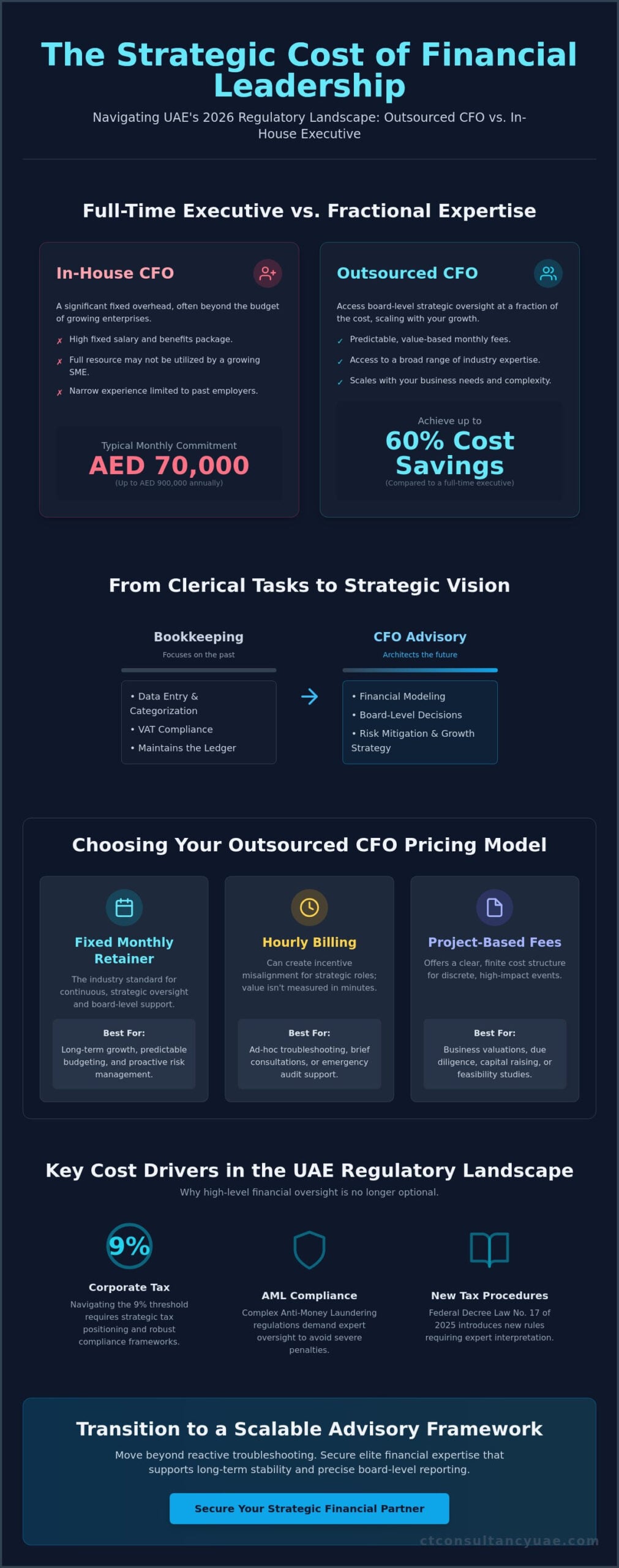
The pricing of executive financial oversight in the UAE is intrinsically linked to the escalating complexity of the local regulatory framework. Since the introduction of the 9% Corporate Tax regime, the "compliance premium" has become a standard component of outsourced CFO pricing models. It’s no longer sufficient to simply balance the books; businesses must now navigate intricate Anti-Money Laundering (AML) protocols and Economic Substance Regulations (ESR) that demand constant, high-level vigilance. Fees are often adjusted based on transaction volume and whether a firm operates across multiple free zones or international jurisdictions. Many organizations find that specialized tax consultancy services are most effective when integrated directly into the CFO advisory function, ensuring a holistic approach to risk mitigation.
A CFO’s involvement is often dictated by the frequency of reporting required to remain in good standing with federal authorities. As regulatory rigor increases, the time investment from a senior advisor scales accordingly to protect the entity from substantial non-compliance penalties.
Corporate Tax and Compliance Complexity
The shift to a taxable environment has transformed the CFO role from a luxury for large corporations into a necessity for any firm exceeding the AED 375,000 threshold. Managing tax groups and navigating the nuances of cross-border transfer pricing requires a level of technical proficiency that goes beyond basic accounting. Pricing reflects this shift, as the work involved in preparing for the new tax procedure rules under Federal Decree Law No. 17 of 2025 necessitates more intensive reporting and strategic planning.
Strategic oversight also involves identifying international cost-saving opportunities; for example, you can visit Trump Tariff Relief to learn how businesses are claiming IEEPA tariff refunds following recent legal precedents.
Sector-Specific Financial Oversight Requirements
Regulated sectors like finance and real estate carry a higher burden of proof and reporting, which naturally influences the tier of advisory expertise required. These industries face frequent audits and strict capital requirements that demand meticulous financial management for SMEs. When a business operates in a high-stakes environment, the cost of the CFO service is a reflection of the specialized knowledge needed to maintain stability and investor confidence. You can secure your firm’s future by choosing a partner who understands these comprehensive compliance requirements.
The selection of specific outsourced CFO pricing models is rarely a static decision; it must evolve in tandem with your organization’s fiscal architecture. For early-stage SMEs, the priority is foundational stability. At this maturity level, hourly rates or small project-based fees are often sufficient to manage initial VAT registration and internal control setups. As a company enters the growth phase, the need for continuous oversight becomes paramount. Transitioning to a retainer model supports ongoing cfo advisory services, providing the strategic bandwidth necessary to manage rapid scaling and complex working capital requirements.
Mature enterprises require a different caliber of engagement. These organizations often utilize full-scale fractional CFOs to lead sophisticated initiatives such as M&A activity, detailed business valuations, and long-term exit strategies. At this stage, the investment is measured against the successful execution of high-stakes corporate maneuvers rather than billable hours. To ensure fee transparency during procurement, consider this checklist:
-
Does the proposal clearly distinguish between administrative accounting and strategic advisory?
-
Are there defined triggers for additional project-based billing?
-
Is the scope of regulatory compliance, including ESR and Corporate Tax, explicitly outlined?
-
Does the provider offer a scalable framework that adjusts as your revenue grows?
The Hidden Costs of Low-Cost Providers
It’s vital to distinguish between a strategic partner and a senior bookkeeper. Some providers offer the "CFO" title at a significant discount, yet they focus almost exclusively on transactional recording. True professional authority requires a premium investment. Choosing a lower-tier provider can lead to a lack of strategic reassurance, potentially leaving your firm vulnerable during complex audits or board-level inquiries. A discount on fees often results in a deficit of actionable insight.
Next Steps: Aligning Your Budget with Your Vision
A tailored approach is the only way to ensure your financial leadership aligns with your corporate vision. We invite you to explore CFO Advisory Services Dubai to identify the specific friction-removing solutions your business requires in 2026. A consultation will help determine which pricing structure provides the most robust support for your current and future objectives, ensuring your capital is deployed with maximum efficiency.
Mastering the nuances of outsourced CFO pricing models is a fundamental step toward achieving long-term fiscal stability in the UAE’s increasingly complex market. By transitioning from transactional bookkeeping to a strategic advisory framework, your leadership team gains the board-level insight required to navigate the 9% Corporate Tax threshold and rigorous AML compliance requirements. Whether your organization is an emerging SME or a mature enterprise, aligning your fee structure with your business maturity ensures that you only pay for the executive oversight you actually need. This proactive approach transforms financial management from a cost center into a primary driver of capital efficiency.
As your business evolves, maintaining mental clarity is as vital as fiscal health; Paramount Shift provides professional hypnotherapy in Dubai to help leaders manage the emotional demands of strategic transformation.
With over a decade of international experience, CTC Tax & Accounting provides the specialized expertise in UAE Corporate Tax and AML compliance necessary to protect your interests. Our bespoke financial solutions are designed specifically for high-growth SMEs seeking a frictionless path to expansion. Don’t let regulatory uncertainty or unpredictable billing hinder your progress. Secure a strategic financial consultation with CTC Tax & Accounting today to refine your financial strategy and empower your next phase of growth. We’re ready to help you build a resilient financial foundation.
How much does an outsourced CFO cost per month in the UAE?
The investment required for executive financial oversight is significantly lower than the AED 70,000 monthly expenditure typically associated with a full-time hire. Specific fees are determined by the complexity of your corporate structure and the depth of advisory required to maintain compliance with the 9% Corporate Tax regime. Most outsourced CFO pricing models are tailored to reflect the seniority of the expert and the frequency of board-level involvement necessary to drive strategic growth.
What is the difference between a virtual CFO and a fractional CFO pricing model?
Virtual CFO models often focus on cloud-based reporting and remote oversight, making them a cost-effective choice for firms prioritizing digital automation. Fractional CFO pricing generally reflects a deeper level of integration where the advisor functions as a part-time member of your leadership team. This model provides the strategic reassurance needed for complex decision-making and investor relations, whereas virtual models may lean toward standardized financial dashboards.
Do outsourced CFO pricing models typically include software subscriptions?
Professional advisory fees usually cover the expertise and time of the consultant rather than the underlying technology licenses. While your advisor may utilize AI-powered tools for forecasting and real-time performance tracking, the cost of ERP or accounting software subscriptions is generally billed as a separate operational expense. It’s advisable to clarify whether implementation and configuration are included in your base retainer or treated as individualized projects.
Can I switch from an hourly model to a retainer model as my business grows?
Transitioning between different outsourced CFO pricing models is a hallmark of a scalable financial strategy. Many SMEs begin with hourly billing for foundational tasks and move to a fixed monthly retainer as their operational complexity increases. This shift provides the predictability required for precise cash flow management and ensures that your CFO has the dedicated bandwidth to act as a primary friction-remover during rapid expansion.
Is a project-based fee better for a business valuation or a feasibility study?
Project-based fees are ideal for discrete, one-off deliverables that have a clearly defined scope and timeline. This structure provides a fixed cost for high-stakes tasks like business valuations, protecting your budget from the unpredictability of hourly billing. It ensures that the focus remains on delivering a meticulous, end-to-end solution that supports critical board-level decisions or fundraising efforts without financial surprises.