The era of the annual AML compliance checkbox has officially ended in the UAE, replaced by a mandate for dynamic, role-specific vigilance. You likely recognize that keeping pace with the shifting expectations of the Central Bank of the UAE and the Ministry of Economy feels like a moving target, especially following the enactment of Federal Decree-Law No. 10 of 2025. It’s natural to feel the pressure of potential administrative penalties when your internal protocols must now account for sophisticated risks like proliferation financing and trade-based money laundering. This guide provides a definitive roadmap to mastering AML training for employees in the UAE, ensuring your team transitions from passive observers to active defenders of your firm’s integrity. We’ll examine the critical 2026 regulatory updates, the shift toward effectiveness-based evaluation, and the precise methods for building a culture of risk awareness that transforms audits into a frictionless formality. By the end of this briefing, you’ll possess the strategic insight required to protect your business from financial crime while maintaining total audit readiness in a high-stakes environment.
- Understand how Federal Decree-Law No. 10 of 2025 reshapes enforcement and why DNFBPs must now adopt a risk-based approach to avoid heavy administrative penalties.
- Implement a structured schedule for AML training for employees in the UAE that adheres to the 30-day onboarding mandate and includes essential annual refreshers to maintain compliance.
- Identify region-specific red flags and the three stages of money laundering to transform your staff into a proactive front line against financial crime.
- Master the “if it isn’t documented, it didn’t happen” rule by establishing a centralized training log that meets the rigorous evidentiary standards of UAE regulators.
- Discover how aligning your AML protocols with corporate tax and VAT compliance creates a holistic framework for long-term stability and friction-free operations.
The legal architecture governing financial integrity in the Emirates has undergone a significant transformation, culminating in the enactment of Federal Decree-Law No. 10 of 2025. This legislation, which annuls the previous 2018 decree, serves as the primary instrument for aligning the nation with global anti-money laundering (AML) standards. For corporate leaders, this shift necessitates a transition from basic awareness to a sophisticated, role-specific strategy for AML training for employees in the UAE. The mandate extends beyond traditional banking institutions to include Designated Non-Financial Businesses and Professions (DNFBPs). This category encompasses real estate brokers, dealers in precious metals and stones, independent legal professionals, and accounting firms. The Executive Office for Control and Non-Proliferation (EOCN) now maintains rigorous oversight, ensuring that national training standards aren’t just met, but are demonstrably effective. Failure to implement these educational protocols risks more than just administrative penalties, which have significantly increased under the 2025 law; it endangers the very reputation of the enterprise in a market that values transparency.
The Legal Basis for Employee Education
Regulatory expectations from the Central Bank of the UAE (CBUAE) and the Ministry of Economy (MoE) emphasize that awareness shouldn’t be confined to the compliance department. Effective AML training for employees in the UAE must permeate every level of the organizational hierarchy, including functional heads, directors, and shareholders. These stakeholders hold fiduciary responsibilities that require a deep understanding of how financial crime might intersect with their specific business lines. UAE AML training is a mandatory, risk-calibrated educational framework for all financial stakeholders. By tailoring curriculum to specific roles, companies ensure that the individuals most likely to encounter suspicious transactions are equipped to identify them in real time. This targeted approach moves beyond generic modules to address the specific vulnerabilities inherent in different corporate functions.
For executives overseeing these critical areas, professional development through the Illuminations Well-Being Center can provide the mental clarity and stress management tools needed to maintain peak performance during intense regulatory transitions.
Regulatory Bodies and Their Oversight
The interplay between the Financial Intelligence Unit (FIU) and corporate reporting requirements forms the backbone of the UAE’s defensive strategy. Training directly impacts the quality and precision of Suspicious Activity Reports (SARs) submitted via the goAML platform. When employees are poorly trained, the resulting data is often insufficient for the FIU to conduct meaningful investigations, which can trigger unwanted regulatory scrutiny. Integrating these compliance measures with broader tax services ensures that a business maintains a unified front against audit risks. This holistic approach prevents the operational silos that often lead to oversight failures. Meticulous planning at this stage guarantees that your reporting mechanisms are robust, ensuring long-term stability and a frictionless relationship with national regulators.
Designing an effective framework for AML training for employees in the UAE requires more than a cursory review of legal texts. It demands a curriculum that mirrors the operational realities of the local market while aligning with the UAE’s National Strategy on Anti-Money Laundering. A foundational module must dissect the mechanics of money laundering, specifically the stages of placement, layering, and integration. Placement involves the initial entry of illicit funds into the financial system, while layering utilizes complex transactions to obscure the audit trail. Integration is the final phase where funds reappear as legitimate capital. Staff must also be trained to recognize region-specific red flags, such as unusually complex corporate structures or transactions involving high-risk jurisdictions that lack clear economic substance.
Beyond traditional money laundering, the 2026 standards prioritize awareness of Combating the Financing of Terrorism (CFT) and Proliferation Financing (PF). Employees must understand that even small, seemingly innocuous transactions can facilitate global instability. Establishing clear internal reporting lines is equally vital. Your team needs to know exactly how to escalate concerns to the Money Laundering Reporting Officer (MLRO) without "tipping off" the customer. This "tipping off" is a critical error that carries its own legal consequences, making it a non-negotiable component of any robust training session. For firms seeking to fortify these internal controls, engaging with professional AML compliance advisors can provide the necessary technical edge to ensure your team’s readiness.
KYC, CDD, and UBO Fundamentals
A sophisticated training program differentiates between Standard Customer Due Diligence (CDD) and Enhanced Due Diligence (EDD), ensuring that high-risk clients receive the appropriate level of scrutiny. Central to this is the identification of the Ultimate Beneficial Owner (UBO), the individual who ultimately controls the entity. This focus on transparency mirrors the requirements found in ESR compliance UAE, where demonstrating genuine economic activity is paramount. Understanding these links helps employees see the broader regulatory picture, ensuring they don’t treat compliance as an isolated task but as a cornerstone of corporate integrity.
Sanctions Screening and Compliance
Real-time screening against the UAE Local Terrorist List and the UN Consolidated List is no longer optional for cross-border operations. Training should cover the technical aspects of screening software and the procedural management of "False Positives." Staff need the confidence to pause transactions when names match restricted lists, ensuring that every alert is investigated with precision rather than dismissed as a system glitch. Providing AML training for employees in the UAE that includes practical drills on sanctions handling ensures your business remains a primary friction-remover in the world of international finance while staying perfectly aligned with national security mandates.
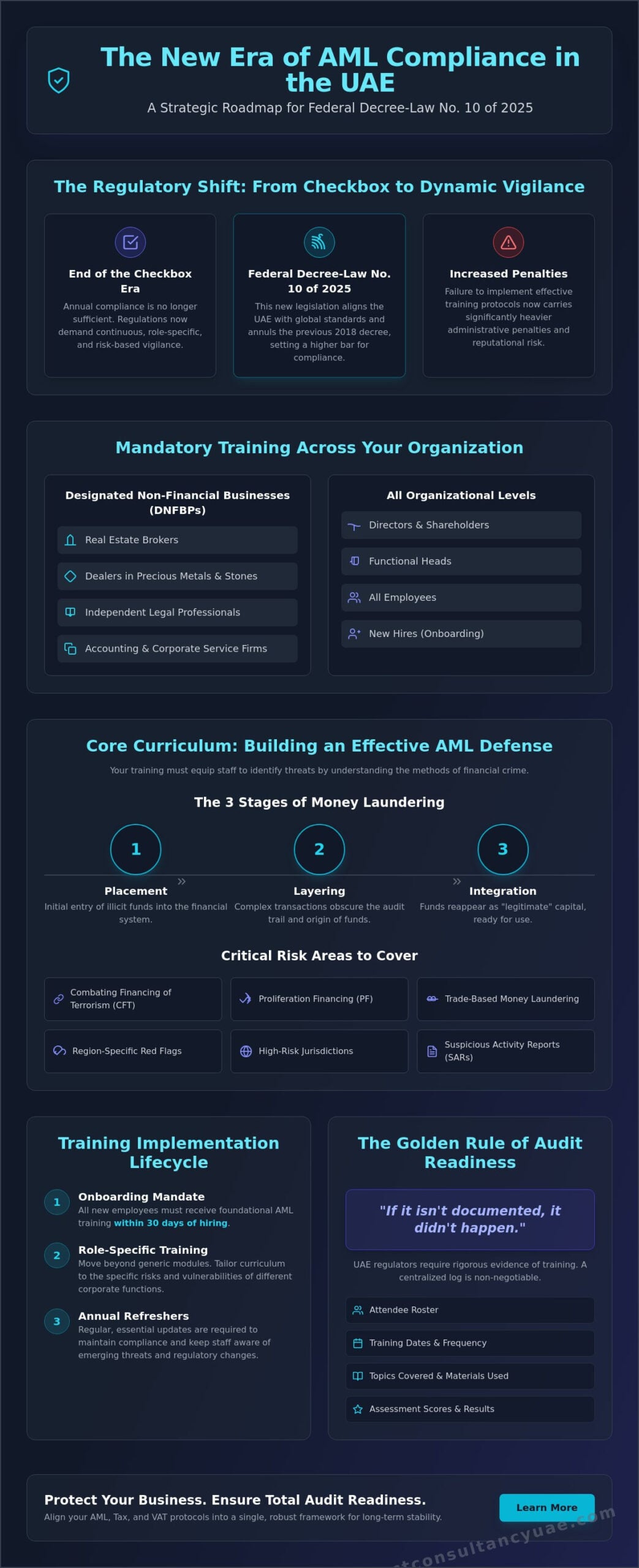
Establishing a precise operational cadence for AML training for employees in the UAE is a strategic imperative that ensures your compliance framework remains resilient against evolving financial threats. The shift from a static, "check-the-box" mentality to a dynamic, event-driven strategy is essential for maintaining alignment with the 2026 standards. Regulators now expect training to be triggered not just by the calendar, but by significant internal or external shifts. These triggers include the introduction of new financial products, expansion into high-risk geographic markets, or legislative updates such as the recent Federal Decree-Law No. 10 of 2025. By integrating these educational touchpoints into the corporate lifecycle, firms demonstrate a proactive commitment to risk mitigation that extends beyond mere technical adherence.
The 30-Calendar-Day Onboarding Window
A critical, yet often overlooked, requirement in the UAE regulatory rulebook is the mandatory 30-calendar-day window for new joiners. Before an employee is permitted to interact with customers or manage financial transactions independently, they must complete a foundational AML induction. This protocol applies equally to permanent staff, temporary employees, and third-party contractors who perform regulated functions. To ensure audit readiness, the HR and compliance departments should maintain a synchronized log that pairs hiring dates with training completion certificates. This documentation serves as primary evidence during a CBUAE or Ministry of Economy inspection, proving that no untrained individual was positioned to facilitate illicit activity. For businesses restructuring their internal processes, seeking business advisory support can help streamline these onboarding workflows to eliminate compliance gaps.
Calibrating Frequency to Risk Exposure
The frequency and depth of your educational modules shouldn’t be uniform across the organization. A one-size-fits-all approach often leads to "compliance fatigue" in low-risk roles while leaving high-risk functions under-prepared. A robust training matrix, as suggested by CBUAE Rule 16.23.3, categorizes staff based on their exposure to money laundering vulnerabilities. Customer-facing roles and those managing cross-border remittances require intensive, semi-annual deep dives into emerging red flags and sanctions updates. In contrast, back-office support functions may only require an annual refresher focused on internal reporting lines and general awareness. The frequency of AML training in the UAE must be directly proportional to the specific money laundering risks inherent in an employee’s daily duties. This risk-calibrated approach ensures that resources are deployed where they’re most effective, fostering a culture of genuine vigilance rather than superficial compliance.
Maintaining this level of vigilance requires significant mental focus, and many firms now supplement technical education with professional well-being support from providers like Citizen Coaching and Counselling to help staff manage the stress and pressure associated with high-stakes compliance roles.
In the rigorous regulatory environment of the Emirates, the principle of evidentiary weight is absolute: if an action isn’t documented with precision, it effectively didn’t happen. For compliance officers, maintaining a centralized training log is no longer a peripheral task but a core defensive strategy. Following the enforcement of Federal Decree-Law No. 10 of 2025, inspectors from the Ministry of Economy and the Central Bank of the UAE (CBUAE) have intensified their focus on the quality of internal records. A robust log must go beyond a simple list of names; it should serve as a comprehensive narrative of your firm’s commitment to financial integrity. Every entry should include the employee’s specific role, the date of completion, the precise curriculum version, and the credentials of the training provider. This level of procedural rigor ensures that when an onsite inspection occurs, your business can present a clear, chronological account of its AML training for employees in the UAE without hesitation.
Documentation Standards for 2026
Modern compliance demands a shift toward secure, digital record-keeping systems that allow for real-time retrieval and long-term data retention. While physical attendance sheets are still accepted, digital logs provide a more reliable audit trail, especially when managing remote teams or multiple branch locations. Essential evidence for any audit includes not only the attendance record but also the specific assessment scores and a copy of the training materials used. This granular data proves that the education provided was relevant to the specific risks identified in your internal risk assessment. Aligning these documentation standards with high-level CFO advisory services ensures that compliance costs are optimized while maximizing regulatory protection. For businesses aiming to achieve total audit readiness, engaging professional AML compliance support can remove the friction typically associated with complex record management.
Testing and Evaluation Methods
Moving beyond mere attendance is the hallmark of a sophisticated compliance culture. Regulators now look for proof of verified understanding rather than just a signature on a page. Implementing post-training quizzes and annual competency tests allows management to identify and rectify knowledge gaps before they result in a reporting failure. When an employee fails to meet the established awareness threshold, a structured remedial training protocol must be initiated and documented. This proactive approach demonstrates to auditors that your firm doesn’t tolerate mediocrity in its defensive line. Utilizing internal audit services to periodically validate the effectiveness of these assessments adds an extra layer of strategic reassurance. It transforms your AML training for employees in the UAE from a mandatory burden into a dynamic asset that safeguards your corporate reputation and ensures long-term operational stability.
Achieving excellence in financial integrity requires a transition from reactive compliance to a proactive, strategic posture. CTC Tax & Accounting serves as a dedicated partner for UAE-based enterprises, delivering bespoke AML training for employees in the UAE that addresses the specific risk profiles of your business sector. We recognize that SMEs often face unique challenges, such as limited internal resources or complex cross-border transaction volumes. Our modules are designed to bridge these gaps, providing the high-level expertise of a global consultancy with the nuanced understanding of a local specialist. By aligning your educational protocols with the latest requirements of Federal Decree-Law No. 10 of 2025, we ensure your team is equipped to handle the increased enforcement expected throughout 2026.
The integration of AML education with Corporate Tax and VAT compliance is a cornerstone of our service philosophy. We don’t view these regulatory pillars as isolated silos; they’re interconnected facets of a single corporate health framework. This unified approach provides strategic reassurance to executive leadership, significantly reducing the administrative weight of managing multiple compliance streams. As regulatory shifts occur in real-time, our continuous support model guarantees that your training materials remain current, protecting you from the reputational and financial risks of outdated protocols.
Beyond Checkbox Compliance
Our firm positions your business as a primary friction-remover in the UAE market by establishing elite standards that satisfy both local regulators and international banking partners. There is a deep operational synergy between outsourced bookkeeping and robust AML transaction monitoring. When your ledgers are maintained with meticulous precision, the identification of suspicious patterns becomes an efficient, data-driven exercise rather than a chaotic search for missing information. We leverage our extensive international experience to foster local excellence, ensuring that your compliance culture reflects global best practices while remaining firmly rooted in UAE law.
Taking the Next Step toward Security
Securing your organization’s future begins with a precise evaluation of your current standing. We invite you to initiate a comprehensive compliance health check to scrutinize your existing AML training for employees in the UAE and rectify any latent vulnerabilities. A meticulously planned strategy is more than a defense against penalties; it’s a commitment to long-term stability in a rapidly maturing financial market. Contact CTC Tax & Accounting today to discuss how our expert AML training solutions can fortify your business against financial crime and ensure total audit readiness.
The evolution of the UAE regulatory landscape demands more than just technical compliance; it requires a culture of genuine vigilance. By prioritizing the 30-day onboarding mandate and adopting a risk-calibrated approach, your firm can transform a mandatory requirement into a strategic asset. Meticulous record-keeping remains your ultimate defense during CBUAE or Ministry of Economy inspections, ensuring that every educational touchpoint is verifiable and effective. Implementing robust AML training for employees in the UAE is the most critical step you can take to safeguard your corporate reputation and operational stability.
Founded in 2015, CTC Tax & Accounting brings decades of international expertise to the specific needs of UAE SMEs and DNFBPs. We provide end-to-end strategic advisory that spans from meticulous bookkeeping to high-level internal audits, ensuring your business remains a primary friction-remover in the global market. Don’t leave your firm’s security to chance in an era of heightened enforcement. Secure your business with professional AML compliance services and navigate the complexities of 2026 with confidence. We’re ready to help your enterprise achieve long-term growth through precision and planning.
Is AML training mandatory for all employees in the UAE?
Yes, AML training is mandatory for all employees within regulated sectors, including financial institutions and Designated Non-Financial Businesses and Professions (DNFBPs). This requirement ensures that every individual, from front-line staff to senior management, understands their role in preventing financial crime. It’s a foundational pillar of the UAE’s national strategy to maintain a transparent and secure economic environment.
How often should employees undergo AML refresher training?
Refresher sessions should occur at least annually to maintain compliance with evolving standards. However, event-driven training is necessary when new laws are enacted or when your firm introduces high-risk products. Regular AML training for employees in the UAE prevents knowledge gaps and ensures your team remains vigilant against sophisticated money laundering techniques that change over time.
What is the deadline for new employees to complete AML training?
New hires must complete their initial induction within 30 calendar days of their start date. It’s critical that they don’t interact with customers or handle transactions independently until this training is finalized. This strict timeline is a key focus for CBUAE and Ministry of Economy inspectors during onsite audits.
Can we use generic international AML training for our UAE staff?
Generic international modules are insufficient because they lack the necessary focus on UAE-specific legislation and reporting mechanisms. Effective AML training for employees in the UAE must incorporate Federal Decree-Law No. 10 of 2025 and the use of the local goAML platform. Relying on global templates without local calibration risks leaving your staff unprepared for specific regional red flags.
What are the penalties for failing to provide AML training to employees?
Non-compliance results in significant administrative penalties, which can include heavy fines and the potential suspension of your business license. The 2025 decree law has expanded the scope of these penalties to reflect the high-stakes nature of financial integrity. Beyond financial loss, the resulting reputational damage can disrupt your relationships with correspondent banks and international partners.
Do directors and shareholders need to participate in AML training?
Yes, directors and shareholders are required to participate in training sessions to fulfill their fiduciary duties. Their involvement is essential because they oversee the firm’s risk appetite and internal control frameworks. Regulators expect the leadership team to demonstrate a top-down commitment to compliance and a deep understanding of the entity’s vulnerabilities.
How should a business document its AML training for an audit?
You should maintain a centralized training log that records the date, attendee names, specific curriculum topics, and assessment results. Digital records are preferred for their ease of retrieval during an audit. This documentation serves as the primary evidence that your firm has met its legal obligations for staff awareness and competency.
What is the difference between AML and CFT training?
AML training focuses on preventing the placement and layering of illicit funds into the financial system, while CFT training targets the movement of funds to terrorist organizations. While AML deals with the source of funds, CFT often addresses the destination. Both are integrated into a comprehensive compliance program to mitigate diverse financial risks.