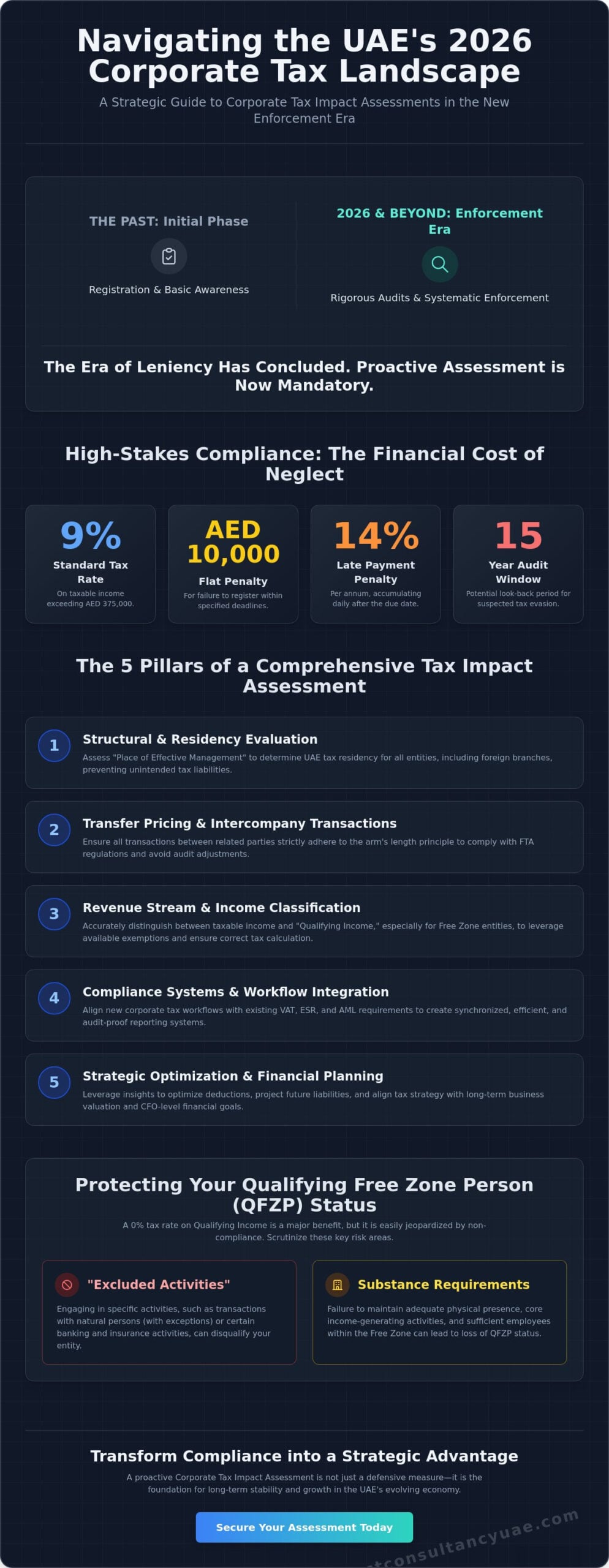
By the end of 2026, the margin for error in UAE tax planning will have effectively vanished as the Federal Tax Authority initiates its first major audit cycles. For many business leaders, the initial phase of registration was merely the beginning of a much deeper shift toward permanent operational transparency. Conducting a comprehensive corporate tax impact assessment in the UAE is no longer a discretionary exercise; it’s a mandatory strategic pivot for any entity seeking to protect its bottom line from the 9% standard rate or the AED 10,000 penalties associated with filing oversights.
You’re likely feeling the pressure of navigating the ambiguity surrounding "Qualifying Income" for Free Zone entities, especially while attempting to align new tax workflows with existing AML and ESR requirements. This guide provides the strategic reassurance you need by offering a comprehensive framework to master these complexities. We’ll outline a clear roadmap for tax-efficient restructuring and demonstrate how to minimize liability through legal exemptions. By following this structured approach, you’ll achieve a seamless integration of tax and accounting workflows, transforming a high-stakes compliance obligation into a foundation for long-term stability and growth.
Key Takeaways
- Understand the critical transition from initial registration to the 2026 enforcement era, where rigorous audits demand a proactive and holistic diagnostic approach.
- Master the five essential pillars of a corporate tax impact assessment in the UAE to ensure precise entity classification and accurate distinction between taxable and qualifying income streams.
- Identify the specific “Excluded Activities” and substance requirements that could jeopardize your Qualifying Free Zone Person status and trigger the standard 9% tax rate.
- Implement a multi-phased strategic framework designed to identify regulatory gaps and provide a clear roadmap for tax-efficient operational restructuring.
- Learn how to leverage CFO advisory insights to align tax compliance with long-term business valuation and strategic financial planning.
Understanding the Evolving UAE Corporate Tax Landscape in 2026
The initial phase of corporate tax implementation in the Emirates focused primarily on registration and basic awareness. As we progress through 2026, that era of leniency has concluded. The Federal Tax Authority (FTA) has transitioned from an educational posture to one of rigorous enforcement and systematic auditing. This shift necessitates a comprehensive UAE Corporate Tax Landscape review. A corporate tax impact assessment in the UAE is now a holistic diagnostic tool designed to evaluate how your current structure aligns with the clarified regulations of Federal Decree-Law No. 47 of 2022.
Relying on "set it and forget it" strategies is the primary risk factor for UAE firms today. It’s a high-stakes environment where precision is the only currency. Structures established in 2023 may no longer be compliant or tax-efficient as the FTA refines its monitoring standards. For instance, the reformed penalty system that took effect on April 14, 2026, demonstrates a significant hardening of the regulatory environment. The FTA’s audit window can now be extended to 15 years in cases where tax evasion is suspected, meaning decisions made today carry long-term consequences. Without a periodic corporate tax impact assessment in the UAE, businesses risk falling into a trap where their initial registrations are mismatched with their actual operational realities.
The Strategic Necessity of a 2026 Assessment
A rigorous assessment evaluates the 9% tax threshold impact on consolidated group profits, ensuring that taxable income exceeding AED 375,000 is accurately calculated. Many firms possess "blind spots" in their early-stage tax registrations, particularly regarding the fluid definitions of Qualifying Income for Free Zone entities. They don’t just assess current numbers; they project future liabilities. The 2026 assessment serves as a strategic safeguard, fortifying the enterprise against the imminent wave of Federal Tax Authority audit cycles.
Financial and Operational Consequences of Neglect
The cost of administrative neglect has escalated. Failure to register within specified deadlines now incurs a flat penalty of AED 10,000. Even more concerning for cash flow is the late payment penalty of 14% per annum, which accumulates daily after the due date. These financial leaks directly erode shareholder dividends and limit the capital available for reinvestment. Beyond these direct costs, operational friction arises when accounting and tax periods are misaligned, leading to reporting discrepancies that trigger FTA scrutiny. Proper planning through Corporate Tax Advisory ensures these workflows remain synchronized and efficient.
The Five Pillars of a Comprehensive Tax Impact Assessment
To ensure a business remains resilient against the evolving regulatory climate, a corporate tax impact assessment in the UAE must be constructed upon five foundational pillars. These pillars move beyond basic compliance to provide a high-level diagnostic of the firm’s legal and financial standing. By systematically evaluating entity classification, revenue streams, and intercompany transactions, decision-makers can identify latent risks before they manifest as audit triggers. This structured approach facilitates the optimization of deductions and the seamless integration of tax workflows with existing VAT and ESR reporting cycles.
Pillar 1: Structural and Residency Evaluation
The concept of "Place of Effective Management" serves as a critical determinant in modern tax planning. Even if an entity is incorporated in a foreign jurisdiction, it may be classified as a UAE tax resident if its key commercial and management decisions are executed within the country. Assessing the tax status of foreign branches and subsidiaries is essential to prevent unintended tax residency. Strategic restructuring may be required to ensure that the corporate hierarchy remains optimized for the current regime while maintaining operational flexibility.
Pillar 2: Transfer Pricing and Intercompany Transactions
Under the rigorous guidance of the UAE Federal Tax Authority, transactions between related parties must adhere strictly to the arm’s length principle. Documentation is no longer a discretionary task; it’s the primary defense during an FTA inquiry. Benchmarking studies must now utilize robust, localized data to reflect 2026 market standards, as generic global datasets often fail to satisfy specific regulatory scrutiny. Proactive documentation helps businesses avoid the "red flags" that typically precipitate comprehensive transfer pricing audits.
Pillar 3: Fiscal Impact on Cash Flow and Margins
Understanding the variance between the statutory 9% rate and your organization’s actual effective tax rate is vital for accurate financial forecasting. This analysis must include provisions for deferred tax, which significantly influences balance sheet health and long-term liquidity. Integrating these tax obligations into strategic financial management for smes allows for more precise dividend planning and reinvestment strategies. It ensures that tax liabilities don’t disrupt the momentum of business growth or shareholder expectations.
A successful assessment requires more than technical tax knowledge; it demands the strategic foresight of an elite consultant. Engaging with professional CFO Advisory Services can provide the necessary oversight to align these complex tax pillars with your broader business objectives, ensuring long-term stability in a high-stakes environment.
Free Zone vs. Mainland: Navigating Qualifying Income Nuances
The distinction between Free Zone and Mainland operations has evolved into a complex regulatory puzzle that requires meticulous attention. While the allure of a 0% tax rate remains a primary driver for investment in the Emirates’ diverse free zones, the requirements for attaining and maintaining Qualifying Free Zone Person (QFZP) status have become significantly more stringent as we enter the 2026 audit cycles. A robust corporate tax impact assessment in the UAE must prioritize the granular analysis of revenue sources to distinguish between qualifying and non-qualifying income. It’s no longer enough to be "in a Free Zone"; your entity must actively meet specific conditions to avoid the standard 9% corporate tax rate.
A critical component of this evaluation is the "De Minimis" rule, which dictates the threshold for non-qualifying revenue. For a QFZP to retain its 0% status, its non-qualifying income must not exceed 5% of its total revenue or AED 5 million, whichever is lower. Exceeding this limit, or engaging in "Excluded Activities" such as banking, insurance, or certain intellectual property exploitations, can jeopardize the entire tax incentive. Failure to satisfy these conditions doesn’t merely result in a single year of taxation; it triggers a mandatory 9% rate on all income for a subsequent five-year period, creating a significant long-term financial burden.
Maintaining the 0% Benefit in 2026
In 2026, maintaining "adequate substance" within your specific Free Zone jurisdiction is non-negotiable. This involves ensuring that core income-generating activities are performed locally with sufficient employees and operating expenditures. Additionally, the preparation of audited financial statements is a mandatory requirement for QFZPs. Many firms falter by neglecting these administrative pillars, leading to an immediate loss of tax benefits. A structured corporate tax impact assessment in the UAE identifies these operational gaps before they are flagged during a Federal Tax Authority audit.
Mainland Expansion and Tax Implications
Strategic growth often leads Free Zone entities to establish mainland branches, yet this expansion introduces significant cross-jurisdictional complexity. Income sourced from the UAE mainland is generally subject to the 9% tax rate, and mismanaging the interaction between these jurisdictions can lead to double taxation or compliance failures. Navigating these nuances requires a sophisticated approach to intra-group transactions and cost allocations. Engaging with specialized corporate tax consultants dubai ensures that your expansion remains tax-efficient and fully compliant with the latest regulatory updates, providing the clarity needed for frictionless market entry and growth.
Executing the Assessment: A Multi-Phased Strategic Framework
Moving from the theoretical understanding of the 2026 tax regime to its practical application requires a disciplined, multi-phased approach. A professional corporate tax impact assessment in the UAE serves as the primary mechanism for this transition, providing a structured timeline for aligning financial data with regulatory expectations. This framework is designed to eliminate the friction typically associated with new compliance mandates, replacing uncertainty with a logical progression toward audit readiness. By following this strategic roadmap, businesses can ensure that their operational structures are not only compliant but also optimized for long-term fiscal efficiency.
Phase 1: The Diagnostic Deep-Dive
The execution begins with a rigorous review of historical financial statements to identify tax-relevant adjustments that may have been overlooked during the initial registration phase. This diagnostic phase involves mapping all intercompany flows and complex ownership structures to identify potential permanent establishment risks. We leverage data already gathered through VAT registration services in the UAE to create a unified compliance profile. This ensures that the information provided to the Federal Tax Authority remains consistent across all tax heads, reducing the likelihood of discrepancies that could trigger an inquiry.
Phase 2: Risk Mitigation and Gap Analysis
Once the data is consolidated, the focus shifts to quantifying potential tax exposures under current operations. This gap analysis identifies specific areas where documentation may be insufficient for Economic Substance Regulations (ESR) or Ultimate Beneficial Ownership (UBO) requirements. By prioritizing risks based on their projected financial impact and the current focus areas of the Federal Tax Authority, we develop a targeted mitigation strategy. This phase ensures that the most significant vulnerabilities are addressed first, providing immediate protection to the firm’s balance sheet.
Following the risk identification, Phase 3 focuses on strategic restructuring and optimization recommendations. This involves adjusting intercompany agreements or legal structures to maximize legitimate exemptions and credits. These recommendations are tailored to the specific needs of the entity, rejecting one-size-fits-all solutions in favor of a customized architecture that supports sustainable growth.
For organizations with a presence in the UK, coordinating these efforts with specialists like Recoup Capital ensures that global incentives, such as R&D tax credits and corporate finance optimizations, are fully integrated into the firm’s broader fiscal planning.
Phase 4: Technology and System Alignment
Precision in 2026 requires the configuration of advanced accounting services capable of tracking taxable, exempt, and qualifying income in real-time. Modern accounting systems must be calibrated to handle the nuances of the UAE tax code, including the automated calculation of tax provisions to ensure predictable cash flow management. The integration of specialized 2026 tax software significantly reduces the probability of human error during the final filing process, ensuring that every submission is accurate and defensible. This technological alignment transforms tax from a manual burden into a streamlined, automated workflow.
Finally, Phase 5 establishes a protocol for continuous monitoring and audit readiness. The tax landscape is not static, and ongoing vigilance is required to adapt to new FTA clarifications or changes in business activity. To secure your organization’s financial future, you should initiate a comprehensive corporate tax impact assessment uae with a partner who understands the intricacies of the 2026 strategic landscape.
Beyond Compliance: Integrating Tax Assessment into CFO Advisory
Viewing tax obligations solely through the lens of regulatory adherence is a missed opportunity for strategic value creation. In the 2026 environment, a corporate tax impact assessment in the UAE serves as a vital data source that informs long-term business valuation and feasibility studies. By identifying the true effective tax rate and its impact on net margins, executive teams can project more accurate ROI for future capital expenditures. This level of transparency is particularly critical when positioning a business for investment or a potential exit, as sophisticated buyers prioritize entities with clean, defensible tax histories and optimized structures.
A well-executed assessment provides the clarity needed to transform a mandatory cost into a manageable variable. It allows leadership to understand how tax liabilities interact with existing debt covenants and dividend policies. When tax planning is integrated into the broader corporate strategy, it ceases to be a year-end hurdle and becomes a continuous driver of fiscal discipline. This proactive stance instills confidence in stakeholders and financial institutions, signaling that the organization is managed with precision and foresight.
The Friction-Remover: CFO-Level Tax Strategy
Strategic tax data allows for more precise budgeting and proactive cash flow management. Instead of reacting to tax liabilities as they arise, firms can utilize cfo advisory services to build predictive models that account for seasonal fluctuations and tax payment cycles. Accessing high-level expertise through an outsourced CFO in Dubai provides the specialized oversight needed to develop custom, tax-efficient models for new project feasibility. This approach ensures that every expansion or new venture is evaluated not just for its gross revenue potential, but for its actual after-tax contribution to shareholder wealth.
Unified Compliance: The CTC Advantage
The modern regulatory environment demands a synchronized approach to compliance that rejects one-size-fits-all solutions. A primary friction-remover in this landscape is the consolidation of accounting, internal audit, and tax functions under a single expert partner. This integration reduces the risk of contradictory filings that often occur when Corporate Tax, Anti-Money Laundering (AML), and Economic Substance Regulations (ESR) are managed in silos. For instance, the data within a corporate tax impact assessment in the UAE must align perfectly with Ultimate Beneficial Ownership (UBO) reporting to avoid red flags during FTA audits. Comprehensive business advisory ensures that your tax strategy isn’t just a compliance exercise; it’s a robust pillar that supports your broader growth goals and long-term organizational stability.
Securing Long-Term Resilience in the 2026 Tax Era
The landscape of UAE taxation has matured from an introductory phase into a period of rigorous enforcement and systematic scrutiny. Success in 2026 requires more than a simple registration; it demands a precise alignment of your corporate structure with the evolving definitions of Qualifying Income and the strict substance requirements of Free Zone jurisdictions. By implementing a multi-phased diagnostic framework, your organization can identify latent risks and optimize its fiscal profile before the first major audit cycles commence.
Conducting a rigorous corporate tax impact assessment in the UAE is the definitive step toward transforming a complex regulatory burden into a streamlined operational advantage. Our expert team brings decades of international finance and UAE regulatory experience to every engagement, offering comprehensive end-to-end solutions that integrate tax, internal audit, and CFO advisory. We have a proven track record in navigating high-stakes compliance for both SMEs and freelancers, ensuring that your business remains resilient and ready for future growth.
Secure your 2026 fiscal future with a professional Corporate Tax Impact Assessment from CTC Tax & Accounting
Your path to frictionless compliance and long-term stability begins with a single, strategic decision today.
Frequently Asked Questions
What exactly is a Corporate Tax Impact Assessment in the UAE?
It’s a comprehensive diagnostic review designed to evaluate how the UAE’s corporate tax regime affects a specific business’s financials, operations, and legal structure. This process identifies tax residency, permanent establishment risks, and the classification of income streams. The assessment ensures that the entity is prepared for the 9% tax rate on income exceeding AED 375,000 while maintaining alignment with other regulatory pillars like Economic Substance Regulations and Anti-Money Laundering requirements.
Does my Free Zone company really need a tax assessment if the rate is 0%?
Yes, because the 0% rate is conditional rather than automatic. A Free Zone entity must meet the criteria of a Qualifying Free Zone Person, which includes maintaining adequate substance and preparing audited financial statements. A corporate tax impact assessment in the UAE is vital to ensure you don’t inadvertently engage in "Excluded Activities" that could trigger the 9% rate for a mandatory five-year period, significantly impacting your long-term fiscal projections.
When is the best time to conduct a Corporate Tax Impact Assessment?
The ideal time is immediately, particularly before the conclusion of your current financial year. Early assessment allows for strategic restructuring and the implementation of tax-ready accounting systems before the Federal Tax Authority’s audit cycles begin. Proactive planning ensures that any identified gaps in documentation or substance are rectified well in advance of filing deadlines to avoid the AED 10,000 late registration or filing penalties that apply in 2026.
How does the AED 375,000 threshold work for small businesses in 2026?
Taxable income up to AED 375,000 is subject to a 0% tax rate, while any income exceeding this amount is taxed at 9%. Businesses with annual revenue below AED 3 million may also elect for Small Business Relief, which reduces their taxable income to zero. It’s important to recognize that this relief is currently set to expire for financial years ending on or after December 31, 2026, making precise income tracking essential for future planning.
Can I perform a Corporate Tax Impact Assessment internally?
What documents are required for a comprehensive tax impact review?
You’ll need audited financial statements, trial balances, existing VAT returns, and all intercompany agreements. Documentation regarding Economic Substance Regulations (ESR) and Ultimate Beneficial Ownership (UBO) filings is also necessary to ensure cross-regulatory consistency. A thorough review examines organizational charts and contracts with mainland clients to determine the exact nature of your income streams and tax residency status, ensuring that no details are missed before filing.
How does Corporate Tax affect my VAT filings in the UAE?
Corporate Tax and VAT are separate systems, but their data must be perfectly synchronized to avoid triggering a Federal Tax Authority audit. Discrepancies between the revenue reported on VAT returns and the income declared for corporate tax are common "red flags" for regulators. A corporate tax impact assessment in the UAE ensures that your accounting workflows are integrated, allowing for consistent reporting across both tax heads and reducing the administrative friction that often leads to filing errors.
What happens if the assessment identifies significant non-compliance?
Identifying non-compliance early allows you to take corrective action before the Federal Tax Authority initiates an inquiry or imposes penalties. This might involve restructuring intercompany transactions to meet arm’s length principles or updating your legal status to satisfy substance requirements. Addressing these issues proactively minimizes financial exposure to late payment penalties, which are currently charged at 14% per annum, and protects the firm’s reputation in the international market.