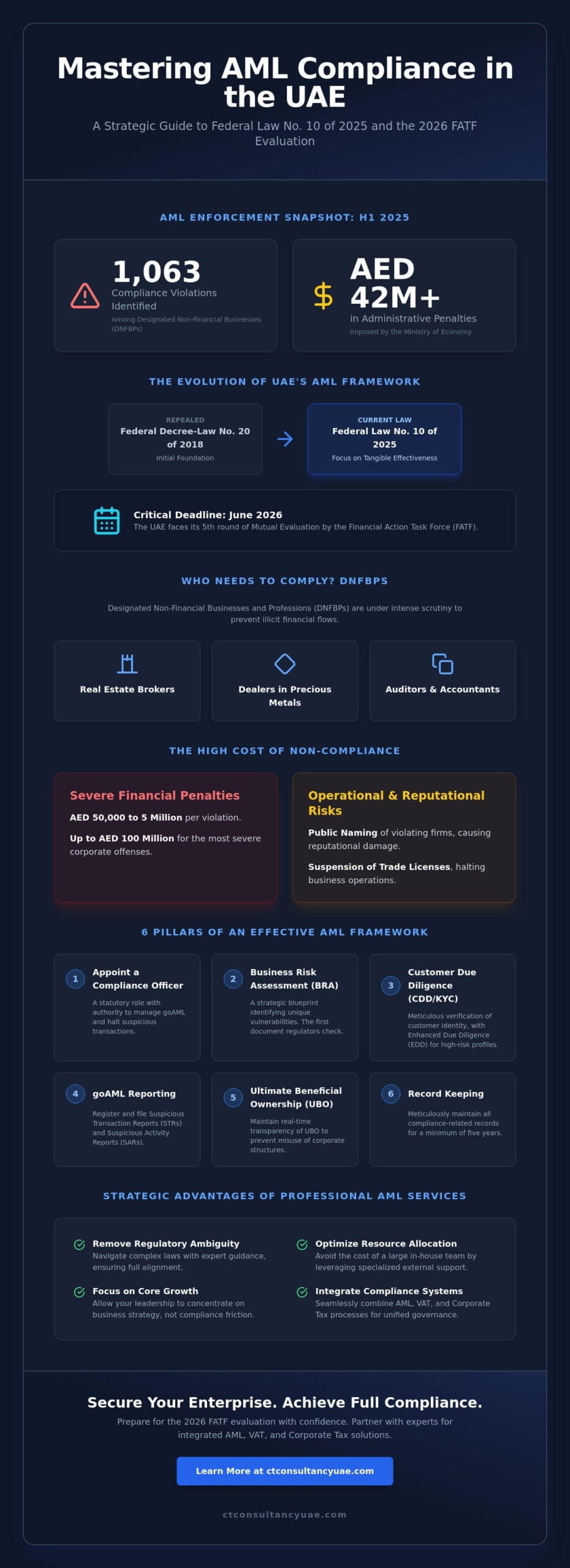
In the first half of 2025 alone, the UAE Ministry of Economy identified 1,063 AML compliance violations among DNFBPs, resulting in over AED 42 million in administrative penalties. It’s understandable if the escalating enforcement climate and the rigorous requirements of Federal Law No. 10 of 2025 feel daunting to even the most seasoned executive. To secure your firm’s standing in the global financial ecosystem, leveraging professional AML compliance services in Dubai is no longer a mere administrative choice but a strategic pillar of corporate governance.
We recognize that the complexity of the goAML reporting system and the shift toward demonstrating tangible control effectiveness can create significant operational friction. This guide provides a comprehensive roadmap to mastering the latest federal decrees, ensuring your business achieves full regulatory alignment while maintaining its growth momentum. You’ll discover how to integrate robust risk mitigation frameworks with your existing tax and accounting processes, preparing your organization for the June 2026 FATF evaluation with absolute confidence and professional calm.
Key Takeaways
- Grasp the critical updates within Federal Law No. 10 of 2025 to ensure your entity remains aligned with the latest UAE oversight from the Ministry of Economy.
- Identify the essential elements of an effective AML framework, including the execution of comprehensive Business Risk Assessments and robust Customer Due Diligence protocols.
- Evaluate the strategic advantages of outsourcing to professional aml compliance services dubai to remove the friction of regulatory ambiguity and optimize resource allocation.
- Acquire a clear, step-by-step understanding of the goAML registration process and the technical distinctions between filing Suspicious Transaction Reports and Suspicious Activity Reports.
- Learn how to seamlessly integrate your AML obligations with VAT and Corporate Tax processes to establish a unified, long-term foundation for corporate governance.
Table of Contents
Navigating the 2026 AML Regulatory Landscape in the UAE
The regulatory environment in the United Arab Emirates has undergone a profound transformation. While Federal Decree-Law No. 20 of 2018 served as the initial foundation, it has been repealed and replaced by Federal Law No. 10 of 2025. This new legislation, supported by Cabinet Resolution No. 134 of 2025, aligns the nation with the global anti-money laundering (AML) framework. It’s essential for business leaders to recognize that the Ministry of Economy and the Financial Intelligence Unit (FIU) now prioritize the tangible effectiveness of controls over mere procedural completion. Most entities operating outside the traditional banking sector, specifically Designated Non-Financial Businesses and Professions (DNFBPs), are now under intense scrutiny. This category includes real estate brokers, dealers in precious metals, auditors, and accountants. Seeking specialized aml compliance services dubai ensures that these high-risk sectors maintain a robust defense against illicit financial flows.
The Evolution of Compliance: From 2018 to 2026
The transition from the 2018 foundational laws to the 2025 mandate reflects a strategic shift toward a mature, risk-based approach. By June 2026, the UAE faces its fifth round of Mutual Evaluation by the Financial Action Task Force (FATF). This looming deadline has accelerated the frequency of unannounced spot checks and significantly heightened the requirements for periodic internal audits. Authorities are no longer satisfied with static, off-the-shelf policies. Instead, they demand real-time transparency regarding Ultimate Beneficial Ownership (UBO) to prevent the misuse of complex corporate structures. It’s a move toward deep-level visibility that requires meticulous record-keeping for a minimum of five years.
Understanding the Consequences of Non-Compliance
Failing to align with these federal decrees carries heavy financial and operational costs that can jeopardize a firm’s existence. Penalties for AML violations now range from AED 50,000 to AED 5 million per instance, while the most severe corporate offenses can trigger fines up to AED 100 million. Beyond the immediate fiscal impact, non-compliance often leads to the public naming of violators and the eventual suspension of trade licenses. These measures are designed to preserve the integrity of the UAE as a secure global financial hub. Engaging professional AML compliance services in Dubai doesn’t just check boxes; it acts as a critical safeguard. It ensures your enterprise doesn’t inadvertently facilitate financial crime, protecting your reputation and long-term stability in an increasingly transparent market.
Essential Components of an Effective AML Compliance Framework
A defensive posture against financial crime requires more than a collection of policy documents; it demands an integrated system of controls that function in real-time. Central to this architecture is the Compliance Officer, a role that carries significant statutory weight under the UAE’s AML-CFT legislation. This individual must possess the technical proficiency to manage the goAML portal and the authority to halt suspicious transactions. Utilizing professional AML compliance services in Dubai ensures that this role is supported by specialized expertise, allowing your leadership to focus on core growth while the compliance function operates with surgical precision.
Risk Assessment and Mitigation Strategies
The Business Risk Assessment (BRA) serves as the strategic blueprint for all AML activities, identifying specific vulnerabilities unique to the firm’s operations and geographic footprint. It’s the primary document regulators examine to determine if a business understands its own exposure. Low-risk profiles, such as established local entities with transparent ownership, require standard controls. Conversely, high-risk profiles involving complex cross-border structures or high-value cash transactions necessitate aggressive mitigation. A documented "Risk Appetite" statement is no longer optional; it’s a mandatory declaration that defines the boundaries of your firm’s commercial engagements.
KYC and Enhanced Due Diligence (EDD)
Robust Customer Due Diligence (CDD) involves the meticulous verification of identity and the identification of Ultimate Beneficial Owners. When dealing with Politically Exposed Persons (PEPs) or entities from high-risk jurisdictions in the 2026 landscape, Enhanced Due Diligence (EDD) becomes the standard requirement. This involves deeper scrutiny into the source of wealth and funds. By integrating these protocols with professional accounting services, firms can ensure that critical data is captured seamlessly during the initial onboarding phase. This alignment prevents the operational friction often caused by retrospective data collection.
Beyond the initial setup, the framework’s integrity relies on ongoing monitoring and continuous employee training. Periodic reviews of client activity are far more critical than one-time checks, as they allow for the detection of evolving patterns of suspicious behavior. Creating a culture of compliance at every level of the organization ensures that every team member acts as a vigilant guardian of the firm’s reputation. If you’re looking to fortify your corporate governance, consider how our business advisory team can customize a framework for your specific needs.
Strategic Advantages of Professional AML Advisory for DNFBPs
The burden of regulatory ambiguity often acts as a significant drag on operational efficiency for UAE-based enterprises. Expert advisory serves as a primary friction-remover, translating complex federal decrees into actionable corporate protocols that don’t disrupt your commercial velocity. While some firms consider maintaining a full-time internal department, the cost-benefit analysis often favors outsourcing. The overhead of recruiting, training, and retaining a qualified Compliance Officer, combined with the continuous need for technical upskilling, can be prohibitive for many mid-sized entities. By leveraging professional AML compliance services in Dubai, businesses gain access to an elite pool of consultants who possess real-time insights into the latest enforcement trends. This strategic move doesn’t just mitigate risk; it actively facilitates smoother banking relationships and accelerates credit facility approvals, as financial institutions prioritize clients who demonstrate rigorous adherence to Financial Action Task Force (FATF) standards.
AML for Real Estate and High-Value Asset Dealers
Specific sectors face unique challenges under the 2026 mandate. Real estate agents, for instance, must navigate strict reporting thresholds for high-value cash transactions that trigger immediate scrutiny. Similarly, dealers in precious metals and stones are required to implement granular monitoring systems that track the provenance of every asset. These requirements are not mere suggestions. In the first half of 2025, the Ministry of Economy identified 1,063 AML compliance violations, highlighting the high stakes of oversight. Engaging specialized business advisory helps high-risk sectors build customized frameworks that address these niche vulnerabilities with surgical precision.
The Role of Auditors and Accountants in AML
Financial professionals occupy a unique position as "gatekeepers" within the national economy. They’re tasked with the dual responsibility of managing client finances and identifying potential red flags before they escalate. An effective internal audit function is essential to verify the tangible effectiveness of an AML program, ensuring that controls aren’t just present on paper but active in daily practice. This level of scrutiny complements our broader tax services, as the 2025 law clarifies that tax evasion is a predicate offense to money laundering. By unifying these functions, enterprises create a seamless compliance ecosystem that values long-term stability. Our AML compliance services in Dubai ensure that your firm remains a trusted partner in the eyes of both regulators and international investors.
Operationalizing Compliance: goAML Registration and Reporting
Transitioning from theoretical compliance to operational execution requires a deep technical understanding of the UAE Financial Intelligence Unit’s (FIU) goAML portal. Registration on this platform is a mandatory requirement for all Designated Non-Financial Businesses and Professions (DNFBPs). Neglecting this obligation is a high-stakes oversight, as UAE authorities levy a fixed fine of AED 50,000 for failure to register. The process involves a two-stage authentication that requires the formal appointment of a qualified Compliance Officer and the submission of comprehensive corporate documentation. Utilizing professional AML compliance services in Dubai ensures that this registration is executed with surgical precision, preventing the administrative delays that can stall market entry or expansion.
Once registered, the focus shifts to the nuances of reporting. It’s vital to distinguish between a Suspicious Transaction Report (STR) and a Suspicious Activity Report (SAR). An STR is triggered by a specific, identifiable financial movement that appears illicit. Conversely, a SAR is utilized when a client’s behavior, patterns, or background raise red flags, even in the absence of a completed transaction. In both instances, the "Reason for Suspicion" narrative must be meticulous and analytical. It serves as the primary evidence for the FIU, and a vague narrative can lead to further regulatory inquiries. Furthermore, the 5-year statutory rule for record-keeping remains absolute; every document related to Customer Due Diligence and reported activity must be archived and readily accessible for inspection.
The goAML Reporting Workflow
Timing is a critical factor in the reporting lifecycle. Under current enforcement protocols, STRs must be filed through the goAML portal immediately upon suspicion, typically within a 24 to 48-hour window. Maintaining confidentiality during this process is a legal imperative. The "Anti-Tipping Off" rules strictly prohibit informing a client that they are under investigation or that a report has been filed. The FIU acts as the central hub for reviewing these submissions, often cross-referencing them with broader law enforcement data to identify systemic risks.
Technology and Automation in AML
Modern compliance frameworks rely heavily on the integration of name screening and transaction monitoring software. These tools are designed to cross-reference client data against global sanction lists and databases of Politically Exposed Persons (PEPs) in real-time. However, the true value of these systems lies in expert calibration. Without precise tuning, firms often face a deluge of "False Positives" that create unnecessary operational drag. By aligning these automated checks with professional accounting services, businesses ensure that the data fed into screening systems is accurate and comprehensive. If your firm requires assistance with technical registration or the calibration of reporting protocols, our team provides expert AML compliance services in Dubai to ensure your operational workflow remains beyond reproach.
Securing Your Enterprise with CTC’s Integrated Compliance Solutions
Establishing a robust defense against financial crime requires more than isolated policy updates; it demands a unified strategy that bridges the gap between daily financial operations and complex legal mandates. CTC Tax & Accounting serves as this essential link, offering comprehensive AML compliance services in Dubai that address the full spectrum of corporate governance. We recognize that for most businesses, the primary challenge isn’t just understanding the law but operationalizing it without disrupting commercial momentum. By providing a single point of accountability for VAT, Corporate Tax, and AML advisory, we eliminate the fragmentation that often leads to oversight and regulatory friction.
The CTC Approach: Precision and Reliability
Founded in 2015, our firm brings decades of international expertise to the specific nuances of the UAE market. We operate as a primary friction-remover, helping entrepreneurs and executive decision-makers navigate the transition from foundational 2018 decrees to the rigorous 2026 enforcement environment. We don’t believe in templates. Our consultants develop customized AML manuals and policy documentation tailored specifically to your business model and risk profile. This individualized approach ensures that your controls are both effective and proportionate. We invite you to engage in a strategic consultation to assess your current compliance gaps and fortify your standing before the next regulatory cycle begins.
Comprehensive Financial Oversight
The synergy between tax reporting and AML compliance is a critical pillar of modern corporate stability. Since tax evasion is now explicitly recognized as a predicate offense to money laundering under Federal Law No. 10 of 2025, an integrated oversight model is no longer optional. Our CFO advisory services provide the high-level strategy needed to align these functions, ensuring that every transaction is documented with surgical precision. This level of oversight is complemented by our broader tax services, creating a seamless flow of data that satisfies both the Ministry of Economy and the Federal Tax Authority.
Maintaining a state of permanent audit-readiness is the only way to secure long-term success in the UAE’s evolving financial landscape. Our team provides ongoing support and periodic health checks, ensuring that your internal audit functions remain sharp and your goAML filings are beyond reproach. Don’t wait for a spot check to reveal vulnerabilities in your framework. Schedule your 2026 AML compliance audit with CTC Tax & Accounting today to ensure your enterprise remains a model of integrity and reliability. Our integrated AML compliance services in Dubai are designed to provide the strategic reassurance you need to scale your business with absolute confidence.
Future-Proofing Your Corporate Governance in the UAE
The transition to the 2026 regulatory landscape represents a significant evolution in how UAE businesses must approach financial integrity. By moving beyond a simple checklist to a robust, risk-based framework, your entity doesn’t just avoid severe administrative penalties; it builds a foundation of international trust. Mastering the technicalities of goAML registration and the nuances of Suspicious Activity Reporting is essential for maintaining operational continuity in an increasingly transparent market. Leveraging specialized AML compliance services in Dubai ensures that these complex requirements are integrated seamlessly into your existing financial workflows, removing the friction that often stalls corporate growth.
Since 2015, CTC Tax & Accounting has served as a strategic partner for SMEs and DNFBPs, offering specialized expertise in UAE Federal Decrees and decades of international financial experience. We provide the meticulous planning and precision required to navigate this high-stakes environment with professional calm. Secure your business with expert AML compliance services from CTC Tax & Accounting. Your commitment to rigorous compliance today is the most reliable safeguard for your firm’s growth and stability tomorrow.
Frequently Asked Questions
What is the goAML system and who must register for it in the UAE?
The goAML system is the integrated digital platform managed by the UAE Financial Intelligence Unit (FIU) for the submission of suspicious activity and transaction reports. Registration is mandatory for all Designated Non-Financial Businesses and Professions (DNFBPs), including real estate agents, precious metal dealers, and auditors. Failing to register on this portal incurs a fixed administrative fine of AED 50,000, as it’s the primary channel for regulatory communication.
What are the penalties for non-compliance with AML regulations in 2026?
Penalties for AML violations under the current federal framework range from AED 50,000 to AED 5 million per individual violation. For the most severe corporate offenses, administrative fines can escalate to AED 100 million. Beyond these fiscal impacts, non-compliant entities risk the public naming of their firm and the potential suspension of their trade license by the Ministry of Economy to preserve national economic integrity.
How often should a business conduct an AML risk assessment?
A Business Risk Assessment (BRA) should be conducted at least annually to ensure alignment with the evolving regulatory landscape and national risk assessments. It’s also imperative to update this assessment whenever significant changes occur in your business model, customer demographics, or geographic footprint. Regular reviews demonstrate the "tangible effectiveness" that UAE regulators now prioritize over a static, box-ticking approach to corporate governance.
Can an SME outsource the role of the AML Compliance Officer?
SMEs can utilize external AML compliance services in Dubai to fulfill the technical and advisory requirements of the compliance function, though the appointed Compliance Officer must be a resident and possess the necessary qualifications. This outsourcing model provides access to specialized expertise and real-time regulatory updates without the overhead of a full-time internal department. The enterprise remains ultimately responsible for the effectiveness of its internal controls.
What is the difference between CDD and Enhanced Due Diligence (EDD)?
Customer Due Diligence (CDD) involves the standard verification of a client’s identity and the identification of their Ultimate Beneficial Owners. Enhanced Due Diligence (EDD) is required for high-risk profiles, such as Politically Exposed Persons (PEPs) or clients from jurisdictions under increased monitoring. EDD demands deeper scrutiny into the source of wealth and the specific nature of the business relationship to mitigate heightened risks of financial crime; for instance, when dealing with the Brazilian market, tools like Verifica Processo are used to perform detailed judicial consultations.
What is "Tipping Off" and why is it a criminal offense in AML?
"Tipping off" occurs when a business or employee informs a client that a suspicious transaction report has been filed or that they are under regulatory investigation. This is a criminal offense because it alerts the subject, potentially allowing them to hide assets or obstruct law enforcement efforts. Maintaining absolute confidentiality during the reporting process is a cornerstone of the UAE’s legal framework for combating money laundering.
How long must AML-related records be kept by a UAE business?
All compliance-related documentation, including transaction records and Customer Due Diligence files, must be maintained for a minimum of five years. This statutory period begins from the date of the transaction or the termination of the business relationship. Records must be stored in a manner that allows for immediate retrieval during inspections by the Ministry of Economy or the Financial Intelligence Unit.
Is AML compliance mandatory for Free Zone companies in the UAE?
Yes, AML compliance is mandatory for all entities registered in the UAE, including those operating within Free Zones and Financial Free Zones like the DIFC or ADGM. While specific free zone authorities may have their own additional rules, the overarching requirements of Federal Law No. 10 of 2025 apply nationwide. Every business identified as a DNFBP must register on goAML and implement a robust risk-based framework.