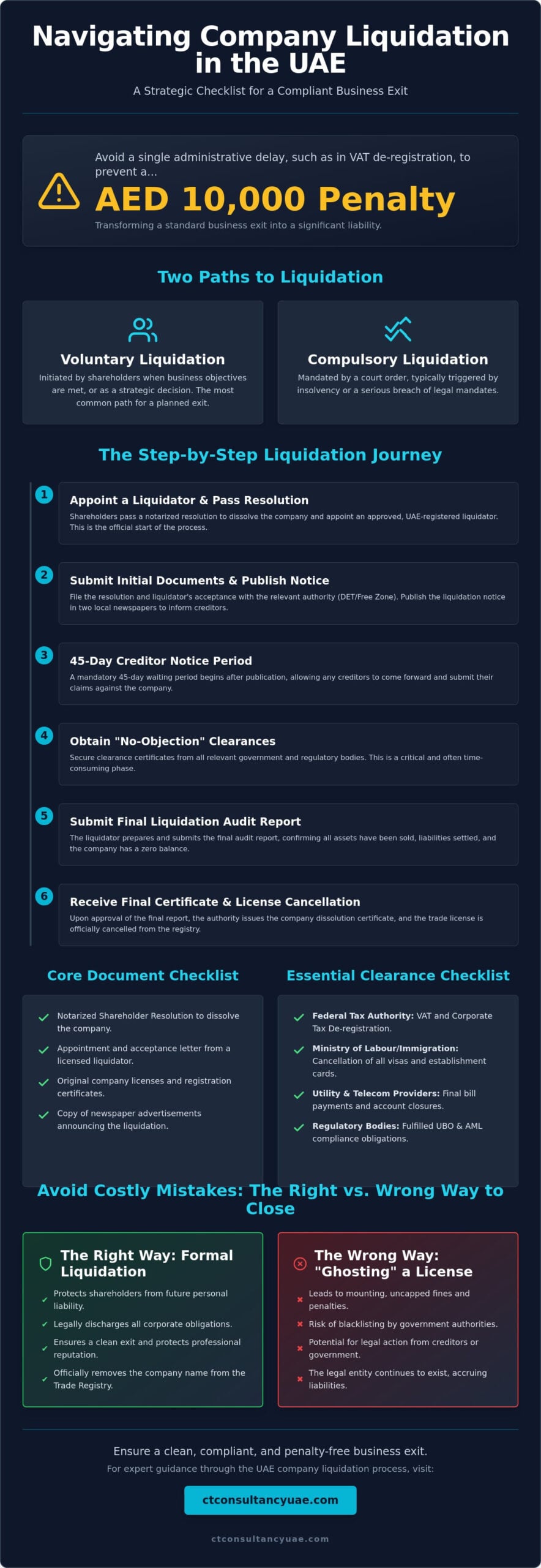
A single administrative delay in your VAT de-registration can trigger a penalty of AED 10,000, transforming a standard business exit into a significant and avoidable liability. We understand that the decision to close a business entity is often accompanied by a desire for a clean break, yet many entrepreneurs find themselves concerned by the intricate web of fiscal and legal obligations. It’s a common anxiety that hidden liabilities or unresolved tax mandates might emerge long after the final shareholder resolution is signed. Identifying the exact documents required for company liquidation in the UAE is the first step toward mitigating these risks and ensuring a frictionless transition for your corporate structure.
This comprehensive guide serves as your strategic checklist for 2026, providing the clarity needed to navigate the 45-day notice period and the liquidator’s appointment with absolute precision. You’ll gain a thorough understanding of the essential "no-objection" clearances required from various regulatory bodies, including updated protocols for Corporate Tax and Anti-Money Laundering compliance. We provide an end-to-end breakdown of the necessary filings to protect your professional reputation and secure long-term stability.
Key Takeaways
- Establish a firm understanding of the legislative landscape, specifically Federal Decree Law No. 32 of 2021, to ensure your dissolution process is legally sound.
- Compile a precise inventory of the primary documents required for company liquidation in the UAE, including notarized shareholder resolutions and original licensing records.
- Safeguard your enterprise from substantial fines by mastering the complexities of VAT de-registration and final liquidation audit submissions.
- Navigate the procedural milestones of the 2026 compliance landscape, from receiving provisional certificates to managing mandatory public announcements.
- Maintain long-term regulatory integrity by fulfilling ongoing obligations related to Ultimate Beneficial Ownership (UBO) and Anti-Money Laundering (AML) standards.
Understanding the Legal Framework for UAE Company Liquidation
In the United Arab Emirates, the cessation of business operations is a highly regulated procedure that demands meticulous attention to statutory detail. Understanding Liquidation involves recognizing it as the formal legal process where a company’s existence is terminated, its assets are liquidated into cash, and its liabilities are settled with creditors. This transition is primarily governed by Federal Decree Law No. 32 of 2021 on Commercial Companies, which provides the foundational legal structure for every entity operating within the state. Navigating these requirements often benefits from specialized business advisory to ensure that every regulatory obligation is met with precision.
The process generally bifurcates into two distinct categories: voluntary and compulsory. Voluntary liquidation occurs when shareholders decide to dissolve the entity, perhaps due to the achievement of business objectives or a strategic pivot. In contrast, compulsory liquidation is mandated by a court order, typically triggered by insolvency or a breach of legal mandates. Central to either path is the appointment of a Liquidator. This professional acts as the company’s legal representative during the winding-up phase, assuming control of the assets and ensuring that the final distribution complies with UAE law. Identifying the specific documents required for company liquidation uae is essential for the liquidator to execute these duties without regulatory friction.
The Liquidator’s role isn’t merely administrative; it’s a fiduciary responsibility of the highest order. They must be an approved, UAE-registered professional who can certify the accuracy of the final accounts. Their appointment is a public act, requiring notification to the relevant registry to signal that the company is "under liquidation." This status alerts creditors to come forward within a statutory timeframe, usually 45 days, to present any claims against the entity before the final strike-off occurs.
The Importance of a Formal Winding-Up
Closing a business correctly is about more than just stopping operations; it’s a strategic de-risking exercise. A formal liquidation protects shareholders and directors from future personal liability by ensuring all corporate obligations are legally discharged. Some entrepreneurs mistakenly believe they can simply "ghost" a license by letting it expire. This approach is fraught with risk. Failing to complete a formal cancellation often leads to mounting fines, blacklisting by authorities, and potential legal action from creditors or government entities. Removing the company name from the Trade Registry is the only way to confirm that the legal personality of the business has officially ceased to exist.
Mainland vs. Free Zone Jurisdictions
While the overarching legal principles remain consistent, the administrative requirements vary depending on whether the entity is registered in a Mainland jurisdiction or one of the many UAE Free Zones. Each licensing authority, such as the Department of Economy and Tourism (DET) or various Free Zone authorities, maintains its own specific procedural nuances. However, federal tax obligations, such as VAT and Corporate Tax de-registration, remain uniform across all jurisdictions. This guide focuses on the universal federal requirements and the primary documents required for company liquidation uae that are applicable regardless of your specific licensing authority.
Primary Documents Required to Initiate Liquidation
Initiating the dissolution of a corporate entity requires a precise assembly of legal instruments to satisfy both local registries and federal oversight bodies. The primary documents required for company liquidation in the UAE serve as the formal evidence of the shareholders’ intent and the legitimacy of the winding-up process. Without these foundational records, the licensing authorities cannot issue the provisional liquidation certificate, which is the necessary precursor to the public notice period. The Legal Framework for UAE Company Liquidation emphasizes that the resolution must explicitly state the appointment of a licensed liquidator to ensure the process remains compliant with Federal Law.
To begin, you must submit the following core documentation to the relevant Department of Economy and Tourism (DET) or Free Zone authority:
- The original Trade License and the Memorandum of Association (MOA), including all subsequent amendments or addendums.
- A notarized Shareholders’ Resolution confirming the collective decision to dissolve the entity.
- A formal Appointment Letter for the registered liquidator, accompanied by their official acceptance of the role.
- Clear copies of passports and Emirates IDs for all partners, directors, and the appointed liquidator.
While many generic guides overlook this detail, mainland companies must also prepare for the eventual submission of a Liquidation Audit Report. This document is not merely an internal review but a statutory requirement that validates the company’s financial position at the time of closure. If your documentation trail is complex, seeking professional business advisory can help streamline the preparation phase and prevent administrative rejections.
The Shareholders Resolution: Legal Specifics
The resolution is the most critical document in the initial phase. It must be notarized by the UAE Notary Public to be considered legally binding. For companies with foreign shareholders, the process is more rigorous; any resolution signed outside the UAE requires legalization by the UAE Embassy in the country of origin and subsequent attestation by the Ministry of Foreign Affairs (MOFA) within the Emirates. The document must explicitly detail the liquidator’s powers and the proposed method for asset distribution to avoid future litigation.
Corporate Identity Documentation
Precision in identity documentation is non-negotiable. If a representative is signing the resolution on behalf of a shareholder, a notarized Power of Attorney (POA) must be provided. Corporate shareholders must submit their Certificate of Incorporation and a board resolution from the parent company authorizing the liquidation. It’s essential to ensure that all foreign-language documents are translated into Arabic by a certified legal translator recognized by the UAE Ministry of Justice to ensure acceptance by government portals.
Financial Clearances and Regulatory Tax Documentation
Financial accountability serves as the cornerstone of a successful exit strategy in the Emirates. The Federal Tax Authority (FTA) and various licensing bodies require definitive evidence that all fiscal obligations have been extinguished before a company can be formally struck from the register. When evaluating the documents required for company liquidation in the UAE, the focus shifts from corporate identity to financial transparency. This phase is designed to ensure that no lingering debts or tax liabilities remain to potentially compromise the shareholders after the entity has been dissolved. Understanding the Step-by-Step Procedural Journey within the GCC context reveals that the UAE maintains some of the most rigorous financial reporting standards in the region, demanding a coordinated effort to secure clearances from multiple authorities.
In 2026, the complexity of this process has increased with the full integration of the Corporate Tax regime. Beyond the basic requirements, companies must provide a Bank Account Closure Letter or a formal statement from their financial institution confirming that all corporate facilities, including credit lines and commercial loans, have been fully settled. This documentation acts as a safeguard, preventing the dissolution of an entity that still possesses active financial encumbrances.
Navigating Tax De-registration
The FTA enforces strict timelines for winding down tax profiles to maintain the integrity of the national revenue system. For VAT-registered entities, the application for de-registration must be submitted within 20 business days of the company ceasing to make taxable supplies. Failure to adhere to this specific window results in a mandatory penalty of AED 10,000. Additionally, the current compliance landscape requires a final Corporate Tax return and a subsequent clearance certificate. This ensures the company has met its 9% tax obligations for its final period of operation. Securing professional tax services is often the most efficient way to manage these concurrent deadlines and avoid costly administrative errors.
The Liquidation Audit Report
A comprehensive Liquidation Audit Report serves as the definitive financial snapshot of the company at the commencement of its dissolution. Prepared by a UAE-registered auditing firm, this report verifies that all assets have been correctly valued and that the company maintains no outstanding liabilities to third parties. It’s the primary document used by the liquidator to justify the final distribution of capital to shareholders. Utilizing specialized accounting services for this preparation ensures that the audit withstands the statutory scrutiny of the licensing authority and facilitates a smoother transition to the final stage of the liquidation process.
The Step-by-Step Procedural Journey
The transition from an active corporate entity to a dissolved one follows a structured, two-stage administrative path designed to protect the interests of shareholders, creditors, and the state. The journey begins with the formal submission of the preliminary documents required for company liquidation in the UAE to the relevant licensing authority. Once the regulator approves the initial resolution and the liquidator’s appointment, they issue a "Provisional Liquidation Certificate." This document serves as the legal signal to the market that the company has entered its winding-up phase and can no longer engage in new commercial activities.
Following the issuance of the provisional certificate, the law mandates a transparency phase. You’re required to publish a formal liquidation announcement in two local Arabic newspapers. This public disclosure isn’t merely a procedural formality; it’s a statutory requirement that provides a fair opportunity for any stakeholders to raise objections or present outstanding claims against the entity before its legal personality is extinguished.
Managing the Creditor Notice Period
The mandatory 45-day waiting period following the newspaper publication is the most critical window for regulatory risk management. During this time, the liquidator acts as the primary mediator. If a creditor presents a valid claim, the liquidator must investigate its legitimacy and ensure it’s settled from the company’s remaining assets. If no claims are registered within this 45-day timeframe, the liquidator can proceed with the final report. Managing this period with precision is vital, as any unresolved disputes can halt the entire process and lead to protracted legal complications.
Visa Cancellations and Labor Clearances
Parallel to the creditor notice period, the company must finalize its obligations to its workforce and local service providers. This involves the formal cancellation of all employee visas and labor cards, a process that requires documentary evidence from the General Directorate of Residency and Foreigners Affairs (GDRFA) or the Federal Authority for Identity and Citizenship (ICP). You must also obtain a "No Objection Certificate" (NOC) from the Ministry of Human Resources and Emiratisation (MOHRE). Additionally, clearances from utility providers, such as DEWA or Etisalat, are necessary to confirm that all corporate accounts are settled and closed. These clearances are prerequisite for the final filing.
Once the notice period concludes and all departmental NOCs are secured, the liquidator submits the final report to the authority. Upon successful review, you’ll receive the "Cancellation Certificate," which marks the official strike-off of the company from the Trade Registry. If you’re concerned about managing these overlapping deadlines, our business advisory team provides the strategic oversight needed to ensure a frictionless exit.
Ensuring Long-Term Compliance: ESR, UBO, and AML
Formal dissolution doesn’t grant immediate immunity from regulatory oversight. Instead, the final phase of a corporate exit focuses on securing long-term compliance through the maintenance of the Ultimate Beneficial Ownership (UBO) register and the finalization of Economic Substance Regulation (ESR) obligations. While the "Cancellation Certificate" signals the end of your trade license, the documents required for company liquidation in the UAE include records that must remain accessible long after the company’s name is struck from the registry. The UAE has significantly strengthened its regulatory framework, evidenced by the central bank issuing over AED 370 million in AML-related fines in 2025 alone. This underscores the necessity of a meticulous close-out process that prioritizes regulatory de-risking over speed.
A critical component of this de-risking involves the Ultimate Beneficial Ownership (UBO) register under Cabinet Decision No. 109 of 2023. You must maintain and update this register until the very moment of final strike-off; any changes in ownership during the liquidation phase must be reported within 15 days to avoid penalties that start at AED 50,000. Additionally, while ESR filings for financial years ending after December 31, 2022, are now integrated into the Corporate Tax framework, the liquidator must ensure all prior notifications and reports are finalized. Utilizing professional business advisory helps ensure these overlapping federal requirements are managed without administrative gaps.
Archiving and Record Keeping
The legal requirement to maintain corporate records extends well beyond the date of dissolution. Under current UAE legislation, including Anti-Money Laundering (AML) regulations such as Federal Decree-Law No. 10 of 2025, companies must archive their financial and customer due diligence records for a period typically ranging from five to ten years. The liquidator assumes the formal responsibility for safeguarding these archives. Our CFO services can assist in establishing a structured digital archiving system, ensuring that if the Federal Tax Authority or other regulators initiate an audit post-liquidation, the necessary evidence is readily available and organized.
The Risks of Non-Compliance
The consequences of neglecting final compliance filings are severe and can lead to personal liability for directors or shareholders. Incomplete UBO data or a failure to file a final ESR notification can lead to significant delays in receiving the final cancellation certificate from the licensing authority. More importantly, it leaves the company’s former officers vulnerable to substantial fines even after the business has ceased to exist. CTC Tax & Accounting serves as your strategic partner for a frictionless, compliant exit. We ensure that every regulatory hurdle is cleared with precision, allowing you to transition to your next venture with the confidence that your previous corporate obligations are fully and legally discharged.
Securing Your Corporate Legacy Through Compliant Dissolution
Navigating the final stages of a business lifecycle in the Emirates demands more than just administrative filing; it requires a strategic commitment to regulatory precision. By mastering the documents required for company liquidation in the UAE and securing the necessary clearances from the Federal Tax Authority, you protect your professional reputation and shareholder interests. A successful exit is defined by the meticulous settlement of liabilities and the structured archiving of corporate records to meet long-term AML and UBO standards. This organized approach ensures that your transition away from an entity is as seamless as your initial entry into the market.
At CTC Tax & Accounting, we provide the steady hand needed to manage this complex landscape. Our team brings decades of international financial experience and specialized expertise in 2026 UAE Corporate Tax compliance to every engagement. We offer end-to-end management of regulatory clearances, acting as your primary friction-remover during the winding-up phase. Contact CTC Tax & Accounting for professional company liquidation support today. You’ve built a successful enterprise; let us help you close this chapter with the professional rigor and peace of mind you deserve as you look toward your next strategic growth opportunity.
Frequently Asked Questions
How long does the company liquidation process take in the UAE?
The standard timeline for company liquidation typically spans between three and six months. This duration accounts for the mandatory 45-day creditor notice period and the time required to secure clearances from various government departments. Free zone timelines can vary based on specific authority protocols; however, the structured nature of mainland processes through the Department of Economy and Tourism generally follows this established window.
Can I liquidate my UAE company if it still has outstanding debts?
A company cannot be formally dissolved until all outstanding debts are settled or a formal settlement agreement is reached with creditors. During the 45-day public notice period, creditors have the legal right to present claims. If the entity is insolvent and cannot meet its obligations, the shareholders must pivot from voluntary liquidation to formal insolvency proceedings as mandated by UAE federal law.
Do I need to cancel all employee visas before starting liquidation?
All employee visas and labor cards must be formally canceled before the final "Cancellation Certificate" is issued. While you can initiate the process and receive a provisional certificate, the licensing authority won’t grant the final strike-off without a No Objection Certificate from the Ministry of Human Resources and Emiratisation. This ensures all labor rights and final settlements are honored before the legal entity ceases to exist; for those managing UK-based staff and facing potential employment disputes during a wind-down, TribunalReady offers professional guidance for navigating tribunal cases.
What is the role of the liquidator in a voluntary liquidation?
The liquidator acts as the official legal representative of the company throughout the winding-up phase. Their primary responsibilities include verifying the documents required for company liquidation in the UAE, realizing the company’s assets, and settling liabilities with creditors. They’re also responsible for preparing the final liquidation report, which confirms that all corporate obligations have been fulfilled in accordance with Federal Law.
Is a liquidation audit report mandatory for all UAE companies?
A liquidation audit report is a mandatory requirement for mainland companies and the majority of UAE free zone entities. This report must be prepared by an approved, UAE-registered auditing firm to provide an accurate financial snapshot of the entity. It serves as independent verification that the company possesses no outstanding third-party liabilities and that the remaining assets are ready for distribution among shareholders.
What happens to the company’s assets after the liquidation is finalized?
After all creditors are paid and liquidation costs are covered, the remaining assets are distributed among the shareholders according to their ownership percentages. This distribution must be explicitly detailed in the final liquidator’s report. It’s essential to ensure that this process aligns with the notarized shareholders’ resolution to prevent any post-dissolution disputes regarding capital repatriation or asset transfer.
For businesses that need to liquidate a corporate fleet or individual company vehicles before final distribution, you can visit Carwa – UAE Online Car Auctions & Marketplace to access a professional platform for transparent and efficient asset disposal.
Can a company be re-registered after it has been liquidated in the UAE?
Once a company has been formally struck off the Trade Registry and the "Cancellation Certificate" is issued, it cannot be re-registered or reactivated. The legal personality of the entity is permanently extinguished. Entrepreneurs wishing to resume operations must apply for an entirely new trade license, obtain new tax registrations, and fulfill all current regulatory setup requirements from the beginning.
Are there specific documents required for free zone company liquidation versus mainland?
While the core documents required for company liquidation in the UAE, such as the notarized resolution and original trade license, are universal, free zones often require authority-specific forms. Mainland companies typically focus on clearances from the Department of Economy and Tourism and local municipalities. In contrast, free zone entities must secure specialized clearances from their respective Free Zone Authority and may face unique requirements for lease terminations.