A single administrative oversight in your corporate registry can now trigger a twelve-month suspension of your trade license and a six-figure fine. Understanding the penalties for not filing UBI in the UAE is no longer a peripheral task for legal departments; it’s a critical prerequisite for operational survival in the Emirates’ sophisticated regulatory environment. You likely recognize that the UAE’s successful exit from the FATF "grey list" signaled a permanent shift toward uncompromising transparency, yet the nuances of identifying a "Real Beneficiary" often create significant anxiety for even the most diligent entrepreneurs.
This article provides a comprehensive analysis of the financial and administrative consequences of non-compliance and delivers a strategic framework for immediate remediation. We’ll examine the tiered penalty ladder established by Cabinet Resolution No. 53 of 2021, ranging from initial written warnings to the freezing of corporate bank accounts. By the conclusion of this guide, you’ll possess a clear roadmap to rectify missed deadlines and implement a sustainable compliance structure that protects your long-term business interests and ensures frictionless growth.
Key Takeaways
- Identify the evolving legislative landscape and the specific criteria used to define a “Real Beneficiary” under the most current UAE regulatory standards.
- Examine the tiered structure of administrative sanctions, including the specific penalties for not filing UBO in the UAE that escalate to AED 100,000 for repeated violations.
- Understand the operational “penalty toolkit” utilized by authorities, such as the suspension of trade licenses and the resulting friction within corporate banking facilities.
- Learn the step-by-step remediation process for rectifying inaccurate filings or missed deadlines through immediate voluntary disclosure and corrective action.
- Discover how a strategic partnership with specialized consultants can mitigate compliance risk and ensure long-term stability in a high-stakes regulatory environment.
The UAE UBO Regulatory Framework: Why Compliance is Mandatory
The UAE regulatory landscape underwent a decisive transformation with the introduction of Cabinet Decision No. 109 of 2023. This legislation superseded Cabinet Resolution No. 58 of 2020, establishing a more rigorous framework for corporate transparency and accountability. The Ministry of Economy maintains federal-level oversight, ensuring that the approximately 513,000 regulated companies across 38 licensing authorities adhere to international standards. This intensification of enforcement directly correlates with the UAE’s successful efforts to align with Financial Action Task Force (FATF) recommendations, which facilitated the nation’s removal from the "grey list" in February 2024.
Failure to grasp these legislative nuances exposes entities to severe penalties for not filing UBI in the UAE, as the "Real Beneficiary" concept extends far beyond simple shareholding percentages. The Ultimate Beneficial Owner (UBO) is defined as the natural person who ultimately owns or controls a legal entity. By prioritizing this level of transparency, the UAE authorities seek to eliminate the use of opaque corporate vehicles for illicit financial activities, positioning the jurisdiction as a secure and reliable hub for legitimate global commerce.
Identifying the ‘Real Beneficiary’ in Complex Structures
Identification follows a strict three-tier hierarchy to ensure no entity remains anonymous. First, authorities look for any natural person who directly or indirectly owns or controls 25% or more of the company’s capital. If no individual meets this threshold, the second tier assesses who exercises "control" through other means, such as significant voting rights or the power to appoint or dismiss the majority of directors. In cases where no specific controller is identified, the third tier designates the person holding the position of "Senior Management Official" as the UBO. This methodology ensures every entity has a clearly identifiable natural person accountable for its operations, even within complex trust or multi-layered corporate structures.
The Three Mandatory Registers Every Entity Must Maintain
Compliance requires the meticulous maintenance of three distinct registers at the company’s registered headquarters. The Register of Real Beneficiaries must include comprehensive data points, including identification numbers, residential addresses, and the specific date the individual attained UBO status. The Register of Partners or Shareholders must distinguish between legal ownership and beneficial interest, tracking all internal transfers within 15 days. Finally, the Register of Nominee Directors is mandatory for entities utilizing shadow management, requiring full disclosure of those acting on behalf of another person. Neglecting to update these records is a primary trigger for the penalties for not filing UBI in the UAE that many firms face during routine audits. Maintaining these documents is a core component of professional business advisory protocols to avoid escalating administrative sanctions.
Tiered Penalties for Not Filing UBO in the UAE
The administrative sanctions framework in the UAE is designed to ensure absolute compliance with global transparency standards. Under the provisions of Cabinet Decision No. 109 of 2023, the Ministry of Economy has empowered licensing authorities to apply a rigorous penalty toolkit. The penalties for not filing UBI in the UAE follow a structured escalation path, moving from corrective warnings to substantial financial burdens. While mainland entities adhere to a unified federal fee schedule, various Free Zones may impose additional administrative processing fees for rectifying non-compliance through their specific digital portals. It’s vital to distinguish between a simple late filing and the provision of false information; the latter often triggers immediate referral for deeper regulatory investigation.
The Financial Penalty Ladder: 1st, 2nd, and 3rd Violations
Sanctions are applied with increasing severity to discourage persistent negligence. A first violation typically results in a formal written warning, serving as a final opportunity for the entity to rectify its registers without immediate financial loss. However, a second violation within one year of the first triggers a significant escalation. For instance, failing to maintain a Register of Beneficial Owners leads to a flat AED 50,000 fine upon the second offense. If the non-compliance reaches a third violation, the financial penalty doubles to AED 100,000. At this stage, the authorities transition from purely financial measures to operational restrictions, which often include the suspension of the trade license for a minimum of twelve months.
Administrative Fines for Specific Record-Keeping Failures
Beyond the total failure to file, specific procedural lapses carry their own weight. Understanding the nuanced penalties for not filing UBI in the UAE requires a granular look at the 15-day statutory window. Any change to UBO data must be reported within this timeframe; failure to do so can result in fines starting at AED 10,000 for a second offense. Additionally, every entity must appoint a natural person residing in the UAE as a point of contact for the Registrar. Neglecting this requirement leads to a tiered fine structure, starting at AED 1,000 and doubling for subsequent violations. These administrative hurdles can create significant friction in daily operations. Engaging a dedicated advisor to oversee your business advisory needs ensures that your entity remains on the correct side of these regulatory thresholds, preventing avoidable financial outflows and license disruptions.
While the immediate financial burden of administrative fines is substantial, the true danger to a business lies in the operational paralysis that follows regulatory non-compliance. The UAE’s regulatory architecture is an increasingly interconnected ecosystem where a failure in one area triggers a cascade of restrictions across others. These measures are designed to ensure the nation maintains the international standards required for a robust financial environment. Consequently, the broader penalties for not filing UBI in the UAE extend into the very infrastructure that allows a company to function daily, transforming a clerical oversight into a significant corporate crisis.
This integrated approach means that a "red flag" in the Ultimate Beneficial Ownership registry is visible to multiple government agencies simultaneously. This visibility creates a domino effect that impacts your standing with the Federal Tax Authority (FTA) regarding Corporate Tax and VAT compliance. When an entity is flagged for UBO non-compliance, it signals a high-risk profile for Anti-Money Laundering (AML) purposes, leading to intensified scrutiny that can delay routine tax filings or trigger comprehensive audits that would otherwise be avoided.
License Suspension and Visa Restrictions
The most immediate and debilitating non-financial sanction is the suspension of the trade license. Licensing authorities, whether mainland or free zone, possess the capability to block an entity’s access to their digital service portals instantly. This system lock prevents the company from processing any corporate changes, renewing the license itself, or, most critically, managing employee visas. An entity under suspension cannot issue new entry permits or renew existing residency visas for its staff, leading to legal complications and potential labor disputes. Additionally, the company’s status is updated on the National Economic Register (NER), providing a public record of non-compliance that can deter potential partners and investors who prioritize transparency and stability.
Banking Friction and Account Freezing
Financial institutions in the UAE operate under stringent Know Your Customer (KYC) requirements that are directly linked to the national UBO database. Banks regularly cross-reference their internal records with the information held by the Registrar to ensure accuracy. If a discrepancy is found or if the entity’s license is marked as non-compliant, banks are often mandated to freeze corporate accounts until the situation is rectified. This cessation of cash flow can be fatal for small to medium enterprises. Beyond account freezing, a history of penalties for not filing UBI in the UAE makes securing corporate financing or credit lines nearly impossible. Lenders view UBO negligence as a fundamental failure in corporate governance, categorizing the business as a high-risk client and effectively cutting off access to the capital necessary for growth.
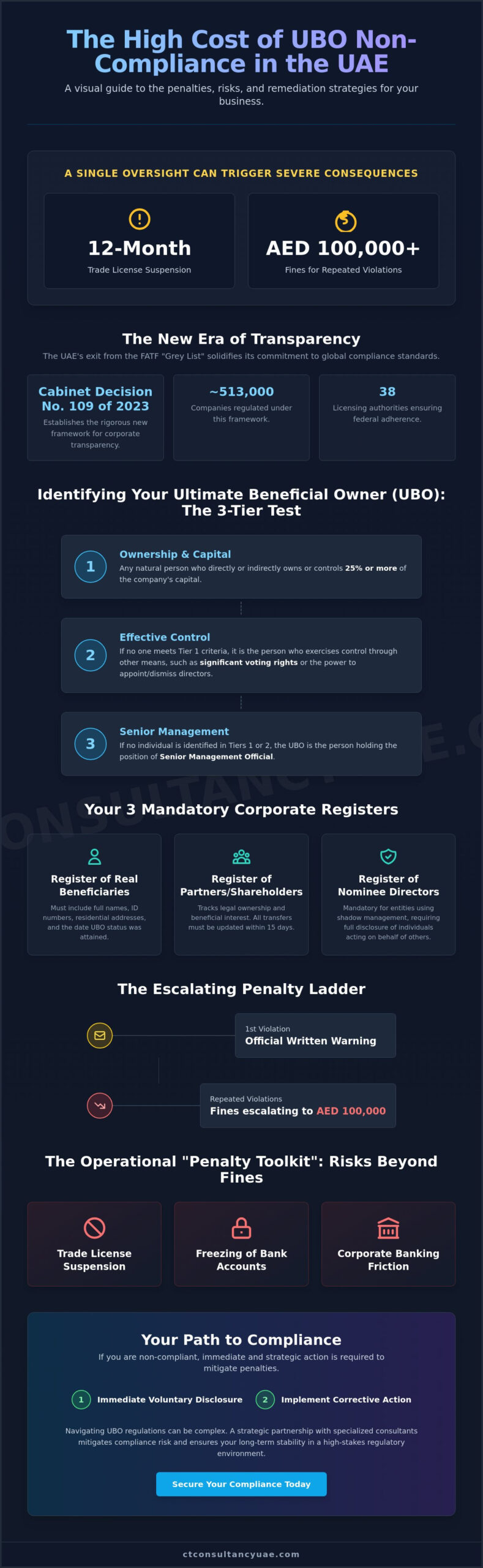
Discovering an inconsistency in your corporate records can be a moment of significant stress, yet proactive remediation remains the most effective defense against escalating penalties for not filing UBI in the UAE. Authorities generally favor entities that demonstrate a commitment to transparency through voluntary disclosure rather than those identified during a formal audit. If you suspect your registers are outdated or were never filed, immediate action is required to stop the "domino effect" of operational restrictions. Learn more about our business advisory services to understand how we can facilitate this transition with minimal friction.
The rectification process follows a precise sequence to ensure the removal of administrative blocks and the restoration of your standing on the National Economic Register (NER). This structured approach minimizes the risk of further sanctions:
- Conduct a comprehensive internal audit of your existing Register of Real Beneficiaries.
- Update all data points to reflect the current natural person exercising ownership or control.
- Submit the corrected data through your licensing authority’s specific digital portal.
- Settle any accrued administrative fines immediately to trigger the system’s "clear" status.
The Grievance and Appeal Process
If your entity has been served with an administrative fine that you believe is unjustified, the UAE legal framework provides a structured path for recourse. You typically have a strict 30-day window from the date of notification to submit a formal appeal to the grievances committee. Success in this process hinges on the quality of your documentation; you must provide clear evidence of compliance or compelling justification for any delays. Engaging a professional tax consultant in the UAE is often the deciding factor in these disputes, as they possess the technical expertise to navigate the complex evidentiary requirements of the committee.
Establishing an Ongoing Compliance Framework
Preventing future penalties for not filing UBI in the UAE requires shifting from a reactive posture to a structured compliance regime. We recommend implementing a quarterly review cycle for all mandatory registers to ensure they reflect real-time corporate changes. Internal teams must be specifically trained on the 15-day statutory rule for reporting ownership shifts, ensuring no oversight leads to a written warning. By integrating UBO maintenance into your monthly accounting services, you transform a complex regulatory burden into a seamless, automated component of your corporate governance. For personalized guidance on securing your license and reputation, contact our expert consultants today to ensure your business remains fully compliant with the latest standards.
Mitigating Compliance Risk with CTC Tax & Accounting
Successful navigation of the UAE’s corporate landscape requires a partner who understands that compliance is a strategic pillar of growth, not merely a bureaucratic hurdle. CTC Tax & Accounting provides a sophisticated, friction-free path to regulatory adherence, ensuring your entity remains insulated from the severe penalties for not filing UBI in the UAE. Our elite consultants bring a global perspective to local expertise, offering an end-to-end approach that covers everything from initial UBO identification to the meticulous quarterly maintenance of your registers. This proactive stance allows you to focus on market expansion while we manage the granular complexities of your fiduciary obligations.
Businesses across the Emirates trust our firm because we reject one-size-fits-all solutions. We recognize that every corporate structure has unique nuances, particularly when dealing with multi-layered ownership or nominee arrangements. By integrating your UBO filing within a broader framework of internal audit and risk management, we provide a level of security that internal teams often struggle to maintain alone. This meticulous attention to detail ensures that your business continuity is never threatened by sudden license suspensions or banking friction, positioning your firm as a reliable participant in the global economy.
Customized Compliance Solutions for SMEs
For small and medium enterprises, the regulatory burden can often feel disproportionate to operational capacity. Our CFO advisory services bridge this gap by integrating high-level corporate governance directly into your growth strategy. We ensure that your UBO status is perfectly aligned with your tax services requirements, preventing discrepancies that often trigger federal audits or internal AML flags. This holistic view of your financial and legal standing creates a seamless environment where compliance supports, rather than hinders, your commercial objectives.
Secure Your Business Continuity Today
Maintaining audit-readiness is the only reliable way to protect your reputation and operational freedom in a high-stakes market. A comprehensive compliance health check with our team identifies potential vulnerabilities before they escalate into administrative warnings or financial fines. We provide the strategic reassurance needed to navigate the 2026 regulatory landscape with confidence and precision. To secure your firm’s future and implement a robust framework for your registers, book a consultation with our compliance experts today. Our team is ready to provide the precision and reliability your business deserves to thrive in the UAE.
Future-Proofing Your Corporate Compliance in the UAE
Maintaining an accurate Register of Real Beneficiaries has evolved from a routine administrative task into a fundamental pillar of corporate survival. As the UAE continues to refine its regulatory landscape to meet international transparency standards, the risks associated with negligence have never been higher. It’s essential to understand the tiered penalties for not filing UBI in the UAE, yet the ultimate goal is to avoid the operational paralysis of license suspensions and frozen bank accounts.
By implementing a rigorous internal audit process and adhering to the 15-day update rule, you’ll ensure your business remains a trusted participant in the global market. Our firm offers decades of international experience and specialized support for SMEs and freelancers, providing the meticulous oversight required to maintain audit-readiness. We invite you to secure your business with expert UBO and AML compliance services from CTC Tax & Accounting. Our comprehensive end-to-end financial and tax advisory ensures that your corporate governance remains a source of strength rather than a liability. You can navigate these complex requirements with absolute confidence and professional calm.
Frequently Asked Questions
What is the maximum fine for UBO non-compliance in the UAE?
The maximum administrative fine for a single violation of UBO regulations is AED 100,000. This threshold is typically reached upon the third violation of specific requirements, such as failing to maintain a Register of Beneficial Owners or a Register of Partners. These financial penalties for not filing UBI in the UAE are often accompanied by severe administrative sanctions, including the suspension of the entity’s trade license for a period of twelve months.
Can my trade license be cancelled for not filing UBO details?
While immediate cancellation is rare, authorities possess the power to suspend a trade license for up to twelve months for repeated non-compliance. This suspension effectively halts all business activities, visa processing, and corporate changes. If an entity remains non-compliant after the suspension period, the licensing authority may initiate further measures that could lead to the eventual revocation of the license to maintain the integrity of the national registry.
How often must I update my company’s UBO register?
You are legally mandated to update your UBO register within 15 days of any change occurring in the ownership or control structure of the company. This is an event-driven requirement rather than a periodic one. Even if no changes occur, we recommend a quarterly internal review to ensure all recorded data remains accurate and compliant with the latest standards established by Cabinet Decision No. 109 of 2023.
Do Free Zone companies need to file UBO declarations?
Yes, all companies registered in UAE Free Zones must comply with UBO filing requirements unless they fall under specific federal exemptions. While each Free Zone authority manages its own digital filing portal, the underlying federal regulations apply across the entire jurisdiction. Failure to file within a Free Zone triggers the same tiered penalty structure as mainland entities, potentially leading to restricted access to zone-specific services. For organizations navigating these jurisdictions, seeking guidance through comprehensive Business Setup and Corporate Services ensures that all entity registration and disclosure requirements are handled correctly from inception.
Who is exempt from UBO filing requirements in the UAE?
Exemptions are strictly limited to companies wholly owned by the federal or local government and those listed on a recognized stock exchange within the UAE or abroad. These entities are already subject to stringent disclosure requirements that satisfy the regulatory objectives of transparency. All other commercial companies, including those in the mainland and free zones, must maintain and file UBO registers to avoid administrative sanctions.
What happens if I miss the 15-day deadline to report a change in ownership?
Missing the 15-day deadline to report a change in ownership triggers a tiered penalty system starting with a formal written warning. For a second offense, the administrative fine is AED 10,000, which doubles to AED 20,000 for a third violation. These specific penalties for not filing UBI in the UAE updates emphasize the importance of immediate disclosure to maintain your firm’s regulatory standing and avoid unnecessary financial burdens.
Is UBO data made available to the public in the UAE?
UBO data is not accessible to the general public or for commercial purposes. The Ministry of Economy maintains strict confidentiality protocols, restricting access to designated official entities and law enforcement agencies during specific investigations. This ensures that while transparency is achieved for regulatory oversight and AML purposes, your corporate privacy remains protected from unauthorized third-party scrutiny or commercial exploitation.
How can I check if my UBO filing is currently compliant?
You can verify your compliance status by reviewing your entity’s profile on the relevant licensing authority’s digital portal or the National Economic Register (NER). However, a "clear" status on the portal doesn’t always guarantee that your internal registers meet the latest formatting standards. Conducting a professional compliance audit with a specialized advisor is the most reliable way to confirm your audit-readiness and ensure all mandatory data points are documented correctly.

