What if the most expensive aspect of closing your business isn’t the administrative fee, but the silence of a missed tax deadline? While many entrepreneurs focus on immediate charges, the true cost of liquidating a company in the UAE often hinges on the precision of your regulatory filings rather than just the base government fees. You’ve likely felt the mounting pressure of deciphering contradictory fee schedules between mainland and free zone jurisdictions, or perhaps you’re concerned about the stringent 2026 tax de-registration deadlines that now carry significant monthly penalties.
We understand that a clean exit is the foundation for your next strategic venture, and you deserve a roadmap that eliminates financial ambiguity. This guide provides a definitive financial breakdown of the 2026 landscape, including DED and free zone cancellation costs, mandatory newspaper publication expenses, and the critical tax clearance requirements under the latest Cabinet Decisions. You’ll gain a transparent budget framework and a compliance checklist designed to protect your professional reputation and your bottom line from unexpected regulatory friction.
Key Takeaways
- Differentiate between voluntary and compulsory liquidation frameworks to safeguard shareholder interests and maintain professional integrity during the exit process.
- Quantify the total cost of liquidating a company in the UAE by evaluating specific government filing fees alongside mandatory public notice requirements in mainland and free zone jurisdictions.
- Mitigate financial exposure by mastering the 2026 timelines for Corporate Tax and VAT de-registration to prevent the accrual of significant non-compliance penalties.
- Identify how a strategic partnership with a licensed liquidator streamlines creditor negotiations and ensures a friction-free transition out of the market.
Table of Contents
The Financial Landscape of Company Liquidation in the UAE
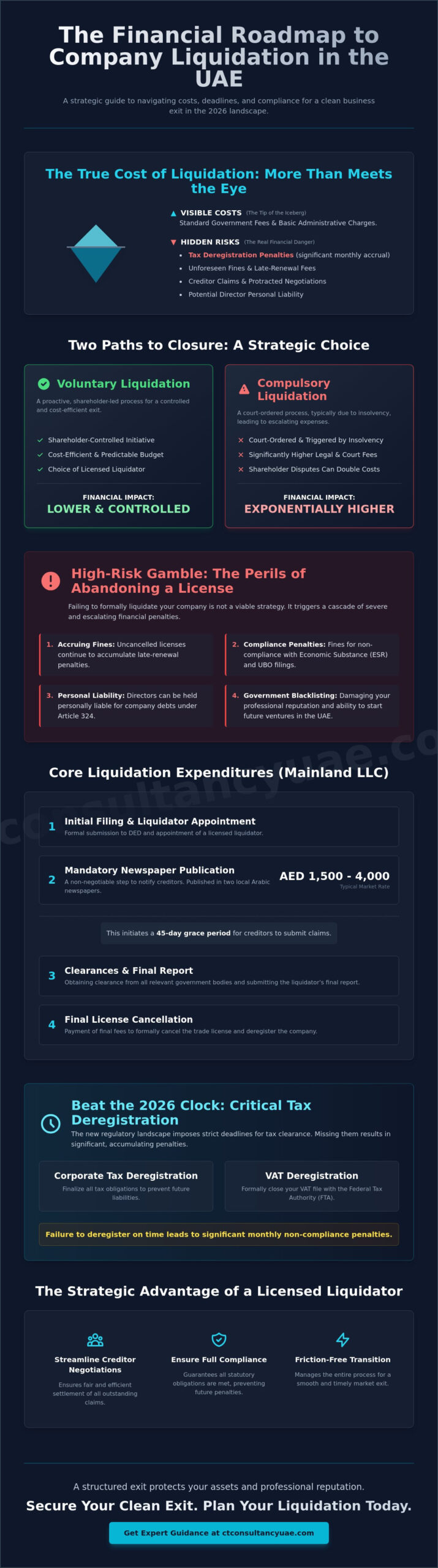
The UAE corporate landscape has evolved into a sophisticated regulatory environment where the cessation of business activities requires meticulous precision. Under the framework of Federal Decree-Law No. 32 of 2021 and the subsequent amendments in Federal Decree-Law No. 20 of 2025, the process of liquidation is no longer a mere administrative formality. It’s a high-stakes legal procedure that demands a comprehensive understanding of statutory obligations. For executive decision-makers, calculating the total cost of liquidating a company in the UAE is a vital component of long-term risk mitigation. This financial commitment is generally categorized into two distinct phases: the preliminary appointment of a licensed liquidator and the final discharge of liabilities leading to license cancellation.
Voluntary vs. Compulsory Liquidation Costs
The financial implications of a business exit depend heavily on whether the entity is solvent or insolvent. Voluntary liquidation is a shareholder-led initiative that allows for a controlled, cost-efficient exit. By proactively initiating the closure, directors can negotiate terms with creditors and choose a liquidator who aligns with their timeline. In contrast, compulsory liquidation is court-ordered and typically triggered by insolvency. These cases incur significantly higher legal fees and court costs. Additionally, shareholder disputes can act as a cost multiplier; if partners cannot agree on the distribution of assets, the resulting litigation can double the projected liquidation budget within months.
Why Budgeting for Exit is a Strategic Necessity
Abandoning a trade license without formal closure is a high-risk maneuver that often leads to severe financial repercussions. Trade licenses that aren’t properly cancelled continue to accrue late-renewal fines and penalties for non-compliance with Economic Substance Regulations (ESR) or Ultimate Beneficial Ownership (UBO) filings. Professional strategic financial management ensures that assets are protected and that the company’s exit doesn’t trigger personal liability for directors under Article 324 of the Companies Law. A structured exit plan preserves your professional reputation and ensures that your capital is legally freed for future ventures without the shadow of legacy debts or government blacklisting.
Direct Expenditure: A Breakdown of Government and Administrative Fees
Quantifying the total cost of liquidating a company in the UAE requires a granular examination of the administrative tolls imposed by both federal and local authorities. These expenditures aren’t consolidated into a single invoice; rather, they’re distributed across various stages of the dissolution process. For a standard Limited Liability Company (LLC) on the mainland, the financial commitment typically encompasses the initial filing for liquidation, the securement of a preliminary liquidation certificate, and the final cancellation of the trade license. While these fees are statutory, they fluctuate based on the legal structure of the entity and the specific requirements of the licensing authority.
Statutory Notification and Publication Expenses
A non-negotiable component of the mainland liquidation process is the public announcement of the company’s closure. Current 2026 market rates for mandatory newspaper advertisements range from AED 1,500 to AED 4,000. This requirement serves a critical legal function: it initiates a mandatory 45-day grace period during which creditors may formally submit their claims against the company. This notice must be published in two local Arabic newspapers to satisfy the Department of Economic Development (DED) requirements. Failing to adhere to this dual-language notification protocol can result in the rejection of the liquidation filing, leading to costly delays and potential legal exposure if creditors aren’t granted their statutory window for recourse.
License Cancellation and Registry Deregistration
Once the creditor notice period concludes without unresolved disputes, the company moves toward final de-registration. The government fees for cancelling a trade license with the DED typically range from AED 500 to AED 2,000. However, companies operating within Free Zones encounter a different fee structure, where cancellation charges generally span from AED 500 to AED 3,000 depending on the specific authority. These figures exclude the administrative costs for cancelling the Establishment Card and the variable fees associated with the number of business activities listed on the license. It’s often beneficial to engage a partner for specialized business advisory to ensure these payments are sequenced correctly, preventing the accrual of late-renewal penalties during the wind-down phase.
Human capital obligations represent the final layer of direct expenditure. Visa cancellation fees range from AED 300 to AED 800 per individual. Beyond the government fee, the company must demonstrate that all final settlements, including end-of-service gratuities and outstanding salaries, have been fully disbursed. The Ministry of Human Resources and Emiratisation (MoHRE) requires a clean clearance for all employees before the Establishment Card can be successfully cancelled. For an LLC with approximately three visa holders, the cumulative administrative and government expenditure often reaches between AED 7,000 and AED 20,000, illustrating why meticulous financial planning is indispensable for a clean market exit.
Structural Variations: Comparing Costs Across Jurisdictions
The jurisdiction you chose for market entry now dictates the complexity and final cost of liquidating a company in the UAE. While mainland entities face a multi-layered bureaucratic process involving various federal and local departments, free zone companies often benefit from centralized administration. However, this centralized approach doesn’t always translate to lower expenses. Each licensing authority maintains its own tariff for dissolution, and the procedural requirements for an entity in the Dubai International Financial Centre (DIFC) will differ vastly from those in a northern emirate free zone or a mainland LLC.
Financial Frameworks for Mainland Entities
The Department of Economy and Tourism (DET) serves as the primary regulator for mainland closures, where the financial burden is often tied to the number of external clearances required. Beyond the license cancellation fees, shareholders must account for Notary Public charges to formally dissolve the Memorandum of Association (MOA). This stage is essential; it represents the legal severance of the partners’ roles and carries its own statutory tariffs for attestation. Meticulous coordination is required to obtain clearances from utility providers, the Municipality, and other relevant government departments. Each of these entities may require the settlement of final bills or administrative service charges before they issue the "No Objection Certificate" (NOC) necessary for final de-registration.
Cost Dynamics Within UAE Free Zones
Free zones offer a more integrated approach, yet their fee structures remain highly individualized. Many authorities distinguish between a "Closure Fee," which covers the administrative strike-off, and a "Liquidation Fee," which pertains to the formal winding-up process. Total costs for a free zone liquidation generally range between AED 5,000 and AED 15,000, but high-tier jurisdictions like the DIFC command significantly higher filing fees, often ranging from USD 5,000 to USD 15,000. Facility inspections and lease terminations also influence the final budget. If a physical office is involved, the refund of the security deposit is usually contingent on a successful inspection and the formal handover of the premises. Utilizing business advisory services can help entrepreneurs navigate these specific nuances, ensuring that lease exits don’t result in unforeseen penalties or delayed refunds.
Offshore entities and Special Purpose Vehicles (SPVs) operate on a different financial plane. Their liquidation is typically managed through registered agents, where the primary expenditure is the agent’s professional fee alongside a flat registry strike-off charge. It’s vital to recognize that the choice of jurisdiction directly influences the professional liquidator’s quote. A mainland liquidation, requiring extensive physical coordination with multiple government offices, naturally commands a higher professional service fee than a streamlined offshore or free zone closure. Strategic planning at this stage ensures that you don’t overpay for administrative tasks that could be optimized through a clear understanding of jurisdictional requirements.
Mitigating "Hidden" Costs: Fines, Penalties, and Regulatory Compliance
The true cost of liquidating a company in the UAE is frequently underestimated because executive focus remains on transparent government fees while neglecting the opaque landscape of regulatory penalties. In the 2026 fiscal environment, the Federal Tax Authority (FTA) has intensified its oversight, making tax clearance a prerequisite for a clean exit. Failure to synchronize your operational wind-down with statutory filing deadlines can lead to a cascade of fines that quickly exceed the original liquidation budget. Strategic oversight is required to ensure that every regulatory obligation is met before the final strike-off occurs, as legacy liabilities can follow directors long after the license is cancelled.
Corporate Tax and VAT De-registration Obligations
The introduction of Corporate Tax has fundamentally altered the exit sequence for UAE businesses. A de-registration application must be submitted within three months of the company’s cessation or dissolution. Failure to meet this three-month deadline results in a penalty of AED 1,000 per month, capped at AED 10,000. This is a distinct requirement from VAT de-registration, which demands even swifter action. You must submit your VAT de-registration application within 20 business days of becoming eligible, typically when taxable supplies cease. Late VAT de-registration triggers an initial AED 1,000 penalty, followed by AED 1,000 for every subsequent month of delay, also capped at AED 10,000. Securing expert tax services is essential to navigate these tight windows and ensure that all final returns are filed accurately, preventing the FTA from blocking the liquidation process. The revised penalty framework effective from April 14, 2026, applies a 14% per annum late payment penalty for outstanding VAT, calculated monthly, which can significantly inflate the final settlement if not addressed promptly.
AML and UBO Compliance During the Exit Phase
Compliance obligations do not terminate the moment a liquidator is appointed. Firms must continue to adhere to Anti-Money Laundering (AML) reporting standards and maintain updated records of their Ultimate Beneficial Ownership (UBO) until the license is officially cancelled. Economic Substance Regulations (ESR) also play a role; companies must file a final notification and, if applicable, a substance report for the period leading up to liquidation. Neglecting these filings can result in substantial administrative fines that remain the personal liability of the directors. The Ultimate Beneficial Ownership (UBO) filing requirement mandates that companies maintain an accurate register of beneficial owners through the final dissolution stage to avoid significant administrative penalties prescribed under the latest cabinet decisions. To protect your assets and ensure a compliant exit, you should consult with our tax advisors to verify your standing before initiating the formal wind-up.
The Strategic Role of a Liquidator in Optimizing Exit Costs
Selecting a liquidator based solely on the lowest initial quotation is a strategic oversight that frequently inflates the total cost of liquidating a company in uae. While the liquidator’s fee is a visible line item, their true value lies in their ability to mitigate the financial risks associated with creditor disputes and regulatory rejection. A licensed liquidator serves as a fiduciary, tasked with preparing the "Statement of Affairs" and the "Final Liquidator’s Report." These documents are not merely administrative filings; they represent the definitive financial account of the company’s dissolution. An experienced professional uses these tools to negotiate with creditors, ensuring that settlements are reached within the company’s remaining asset pool and protecting shareholders from personal financial exposure.
Navigating Final Audits and Financial Clearances
In most UAE jurisdictions, the authorities mandate a Liquidation Audit Report to certify that all assets have been realized and all liabilities have been discharged. This audit is a critical milestone that can either expedite or stall the entire process. Utilizing professional accounting services facilitates a smooth audit by ensuring that the company’s books are reconciled and compliant with International Financial Reporting Standards (IFRS) before the liquidator begins their work. Beyond the financial statements, the liquidator must coordinate the securement of "No Objection Certificates" (NOCs) from various entities, including Dubai Customs, telecommunications providers, and the Ministry of Human Resources and Emiratisation. Each of these clearances requires meticulous follow-up to ensure that no minor outstanding balance prevents the final strike-off from the commercial register.
Professional Liquidation as a Capital-Saving Strategy
Expert oversight acts as a primary friction-remover in the business world, preventing the "rejection" of liquidation files by the Department of Economy and Tourism (DET) or Free Zone authorities. Every time a file is rejected due to incomplete documentation or missed tax clearances, the company remains "active" in the eyes of the law. This status triggers recurring costs, such as license renewal fees, office lease obligations, and ongoing penalties for late regulatory filings. A proficient liquidator reduces the duration of the liquidation process, often by several months, which directly saves the company from these avoidable overheads. They ensure that the 45-day creditor notice period is utilized effectively to resolve all claims, allowing for a swift and legal exit.
The complexity of the 2026 regulatory landscape demands a partner who understands the nuances of both federal law and local authority requirements. To ensure your business exit is handled with the necessary precision and authority, you may contact CTC Tax & Accounting for a customized liquidation cost assessment. Our team provides the strategic reassurance needed to navigate these high-stakes transitions, allowing you to focus on your next phase of growth with total peace of mind.
Strategizing Your Final Corporate Milestone
Mastering the cost of liquidating a company in the UAE requires shifting your perspective from simple administrative overhead to a comprehensive risk mitigation strategy. As 2026 brings more stringent enforcement of Corporate Tax and VAT de-registration timelines, the financial success of your exit depends on the synchronization of legal strike-off with full tax clearance. You’ve seen how jurisdictional nuances and mandatory publication requirements form the baseline of your budget; however, the true optimization of capital occurs when you proactively address AML and UBO obligations before they escalate into penalties.
Since 2015, our team has provided the regional expertise necessary to navigate these complex regulatory landscapes. We offer full-service compliance, from Corporate Tax advisory to strategic CFO-level guidance tailored for SMEs and freelancers. You don’t have to navigate this transition alone. Secure a Frictionless Business Exit with CTC Tax & Accounting and ensure your legacy remains untarnished as you prepare for your next venture. Your professional journey deserves a conclusion as meticulously planned as its commencement.
Frequently Asked Questions
How much does it cost to close a company in the UAE in 2026?
The total cost of liquidating a company in the UAE typically ranges from AED 7,000 to AED 20,000 for a mainland LLC with up to three visa holders. Free zone entities generally incur lower expenses, with estimates falling between AED 5,000 and AED 15,000. However, specialized jurisdictions like the DIFC command higher filing fees, often between USD 5,000 and USD 15,000, excluding professional liquidator remuneration.
Is it mandatory to appoint a licensed liquidator for all UAE companies?
Yes, the appointment of a licensed liquidator is a statutory requirement for most corporate structures under the UAE Commercial Companies Law. This individual or firm, typically a registered auditing or legal practice, manages the distribution of assets and the settlement of liabilities. Their formal appointment ensures that the process adheres to federal regulatory standards and provides a layer of security for both creditors and shareholders.
What are the penalties for late Corporate Tax de-registration during liquidation?
Failure to submit a Corporate Tax de-registration application within three months of cessation results in a penalty of AED 1,000 per month. This administrative fine is capped at a maximum of AED 10,000. Because tax clearance is now a prerequisite for final dissolution in 2026, missing this window can significantly inflate the cost of liquidating a company in the UAE and delay the final strike-off from the commercial register.
How long does the company liquidation process typically take?
The liquidation timeline is largely dictated by the mandatory 45-day creditor notice period, which cannot be shortened under UAE law. While the entire procedure usually spans three to six months, delays often arise from pending clearances from government departments or utility providers. Efficient coordination between the liquidator and the company’s internal accounting team is essential to maintain momentum and ensure a timely exit.
Can I close my company if it still has outstanding debts or liabilities?
A company cannot be formally dissolved until all outstanding debts and employee liabilities are fully settled or a formal settlement plan is agreed upon with creditors. If the entity is unable to meet its financial obligations, it must transition from a voluntary liquidation to an insolvency process under Federal Decree-Law No. 51 of 2023. This shift involves court oversight and typically incurs higher legal and administrative overhead.
What happens to the remaining funds in the corporate bank account after liquidation?
Remaining funds are distributed to shareholders in accordance with their ownership percentages after all creditors, employee gratuities, and government fees are satisfied. The liquidator prepares a final statement of affairs to certify that no liabilities remain before the bank account is closed. This final distribution represents the successful conclusion of the winding-up process and the formal return of capital to the investors.
Do I need to cancel all visas before starting the liquidation process?
Visa cancellations aren’t required to initiate the liquidation, but they must be completed before the final trade license cancellation is granted. The Ministry of Human Resources and Emiratisation (MoHRE) requires proof that all employee entitlements have been paid and visas have been formally closed. Each visa cancellation typically costs between AED 300 and AED 800, which should be factored into your preliminary exit budget.
Are there different costs for closing a branch vs. a limited liability company (LLC)?
Closing a branch office is generally less expensive than liquidating an LLC because branches often bypass the mandatory newspaper publication requirement and the formal appointment of a liquidator. LLCs face higher administrative costs due to the multi-stage process involving the Department of Economic Development and the mandatory 45-day notice window. While branch closures are more streamlined, they still require comprehensive clearances from the FTA and relevant municipal authorities.