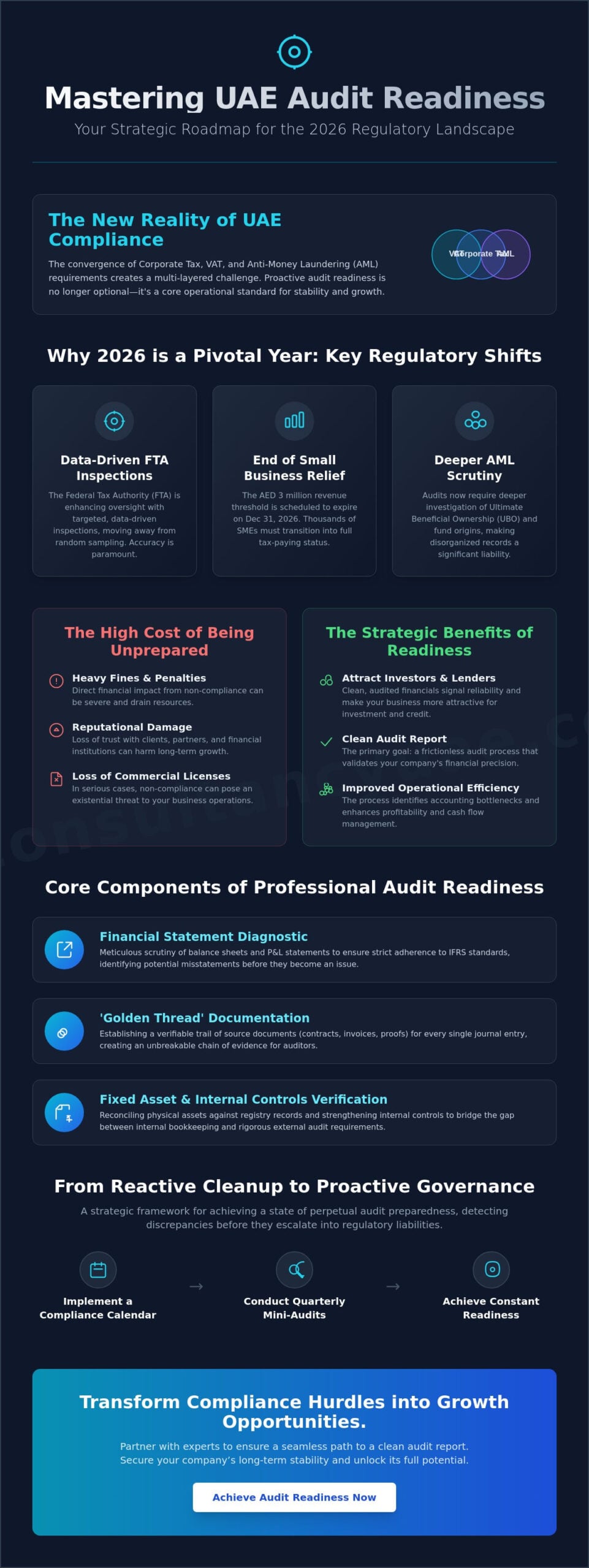
What if your next Federal Tax Authority inspection wasn’t a source of operational dread, but rather a formal validation of your company’s financial precision? You’ve likely felt the mounting pressure as the UAE’s regulatory landscape matures, where the convergence of Corporate Tax, VAT, and Anti-Money Laundering requirements creates a multi-layered challenge for even the most organized finance departments. It’s common to feel concerned about the transition to IFRS 18 or the nuances of the 9% corporate tax regime, especially when disorganized historical records threaten to attract heavy fines. By securing specialized audit readiness services in the UAE, organizations can transform these compliance hurdles into a streamlined framework that ensures a clean audit report while identifying legitimate tax saving opportunities through better data management. This guide provides a strategic roadmap for mastering the complexities of the 2026 regulatory environment, from the new e-invoicing mandates to the rigorous standards of the Domestic Minimum Top-Up Tax for large enterprises. We will explore how a proactive approach to financial governance can replace reactive cleanup efforts, positioning your business for long-term stability and frictionless growth.
Key Takeaways
- Understand the evolution of the UAE’s fiscal environment and why maintaining a state of constant audit preparedness is now a fundamental requirement for operational stability.
- Recognize the essential elements of a financial diagnostic, focusing on IFRS compliance and the creation of a ‘Golden Thread’ for transaction verification.
- Learn to implement a strategic compliance calendar and quarterly mini-audits to detect discrepancies before they escalate into regulatory liabilities.
- Discover how specialized audit readiness services in the UAE bridge the expectation gap between internal bookkeeping and the rigorous standards of external auditors.
- Gain insights into leveraging professional advisory to identify tax saving opportunities while ensuring a seamless path to a clean audit report.
Table of Contents
Navigating the 2026 UAE Regulatory Landscape: Why Audit Readiness is Critical
Audit readiness represents a state of perpetual financial preparedness where an organization maintains its records in a condition that allows for an immediate, frictionless examination by external authorities or independent auditors. It’s no longer a seasonal project; it’s a continuous operational standard. As the UAE matures into a sophisticated global financial hub, the transition from a tax-free environment to a multi-layered regulatory framework is nearly complete. By 2026, the grace periods associated with the early implementation of corporate tax have largely expired, leaving businesses to face the full weight of compliance requirements without the safety net of transitional leniency.
The Federal Tax Authority (FTA) has significantly enhanced its oversight capabilities, moving toward data-driven, targeted inspections rather than random samplings. Organizations that fail to prioritize audit readiness services in the UAE often find themselves navigating a high-stakes environment where the cost of non-compliance far outweighs the strategic investment in readiness. This cost isn’t just financial. While heavy fines are a direct threat, the reputational damage and potential loss of commercial licenses pose existential risks. Proactive preparation ensures that when the FTA requests documentation, the response is swift, accurate, and professional, reflecting a culture of corporate integrity.
The Evolution of UAE Compliance Requirements
The regulatory journey has evolved from basic VAT reporting to a complex, integrated system where Corporate Tax and VAT are inextricably linked. Under the foundational principles of UAE Corporate Law, businesses must now adhere to rigorous transparency standards. The year 2026 is particularly pivotal for SMEs because the Small Business Relief threshold of AED 3 million revenue is scheduled to expire on December 31. This means thousands of smaller entities must transition into full tax-paying status. Additionally, the impact of Anti-Money Laundering (AML) regulations means that standard financial audits now require deeper scrutiny of ultimate beneficial ownership and fund origins, making disorganized records a significant liability.
Strategic Benefits Beyond Avoiding Penalties
While avoiding penalties is a primary driver, the benefits of audit readiness extend into the core of business growth. A company with meticulous records and verifiable internal controls is significantly more attractive to investors. It gains a distinct competitive edge during business valuation exercises. In the UAE’s banking sector, lenders increasingly require audited financial statements to approve credit facilities or expansion capital. Clean records signal reliability. Beyond external perception, the process of becoming audit-ready identifies accounting bottlenecks and operational inefficiencies. This allows management to use accounting services not just for compliance, but as a tool for enhancing overall profitability and cash flow management.
Core Components of Professional Audit Readiness Services in the UAE
Professional audit readiness services in the UAE involve a meticulous examination of a company’s financial architecture to ensure alignment with global benchmarks. Central to this process is a comprehensive financial statement diagnostic. Our experts scrutinize balance sheets and profit and loss statements to verify strict adherence to International Financial Reporting Standards (IFRS), which serve as the mandatory accounting framework in the Emirates. This technical review identifies potential misstatements before they reach an external auditor’s desk, ensuring that revenue recognition and expense accruals are recorded with mathematical and logical precision.
Establishing a ‘Golden Thread’ of documentation is equally vital. Every journal entry must be supported by a verifiable trail of source documents, including contracts, invoices, and payment proofs. We also focus on fixed asset verification. This involves reconciling physical assets with the registry and ensuring that depreciation schedules comply with specific UAE legal requirements. For entities operating within groups, reviewing related-party transactions and transfer pricing documentation is now a non-negotiable component of Corporate Tax compliance. Auditors specifically look for arm’s length pricing to ensure that profits aren’t being artificially shifted. For organizations managing such complex transactions across international borders, it is helpful to visit CiDATax SRL for expert tax and regulatory services in the UK, EU, and United States.
Multi-Tax Reconciliation and Compliance
A common pitfall for UAE businesses is the lack of consistency between different tax filings. Professional readiness ensures that VAT returns perfectly align with Corporate Tax submissions. Discrepancy in these figures is an immediate red flag for the Federal Tax Authority. We verify input tax claims against export documentation and ensure that data reported for Economic Substance Regulations (ESR) matches the figures in your primary financial reports. This holistic approach prevents contradictory data from triggering an investigation. If you’re concerned about how these layers interact, our specialized tax advisory services can help harmonize your reporting across all regulatory fronts.
Internal Control and Policy Assessment
Beyond the numbers, auditors evaluate the environment in which those numbers are produced. We assess the strength of internal authorization levels and the segregation of duties to mitigate fraud risks. The adequacy of your accounting software and digital record-keeping protocols is also reviewed. Auditors often target ‘red flags’ in payroll and employee benefits. We help you identify these vulnerabilities early. Ensuring your payroll records match the Wage Protection System (WPS) data is a critical step in demonstrating full operational transparency. It’s this level of detail that transforms a standard set of books into an audit-proof financial record.
Internal Controls vs. External Audit Requirements: Bridging the Gap
Internal bookkeeping is inherently operational. Its primary goal is facilitating daily transactions and monitoring liquidity. In contrast, an external audit is a risk-based assessment of financial assertions. This creates a significant "Expectation Gap" where business owners believe their books are flawless because they balance, while auditors find them insufficient due to a lack of technical evidence. Specialized audit readiness services in the UAE bridge this divide by translating operational data into the language of audit risk and material accuracy. This ensures that the financial narrative presented to auditors is both robust and defensible.
By engaging a professional advisor to act as a pre-filter, businesses effectively mitigate the friction of information asymmetry. This proactive stance significantly reduces the "Audit Risk" for the certifying firm, as they are presented with reconciled, verified, and logically structured figures. When a firm utilizes audit readiness services in the UAE, the external auditor can focus on verification rather than correction. This doesn’t just speed up the process; it often leads to more favorable audit terms and fewer management letter points regarding internal control deficiencies.
Standard Accounting vs. Audit-Grade Reporting
Many internal teams focus heavily on cash-flow management, which often neglects the complexities of accrual-based reporting required by IFRS. Standard monthly bookkeeping frequently fails to capture the granular disclosures necessary for items like lease liabilities, asset impairment, or deferred tax assets. We provide the technical accounting memos required for complex or unusual transactions, ensuring that the auditor has a clear, logical basis for your accounting treatments from the outset. This precision prevents the common back-and-forth that delays final reporting.
Preparing the Audit File
The efficiency of an external audit depends almost entirely on the quality of the underlying Audit File. A disorganized collection of digital folders isn’t a professional file. A readiness engagement structures a comprehensive Working Paper file that includes:
-
Lead schedules for every balance sheet line item to ensure accuracy.
-
Comprehensive bank reconciliations supported by year-end statements.
-
Pre-prepared third-party confirmations for accounts receivable and payable.
-
Direct mapping that links your day-to-day accounting services to the final audit output.
This level of preparation ensures that the external review remains a formality rather than becoming a forensic investigation.
A Strategic Framework for Achieving Year-Round Audit Preparedness
Maintaining a state of permanent audit readiness requires a shift from reactive remediation to a structured, cyclical framework. At the heart of this strategy is a robust Compliance Calendar that maps out every critical UAE regulatory deadline. This includes monthly VAT filings, annual Corporate Tax returns, and the periodic updates required for Economic Substance Regulations (ESR) and Ultimate Beneficial Ownership (UBO) registers. By formalizing these dates, the finance department transitions from a state of emergency to one of organized momentum. It’s about building a rhythm where compliance is a byproduct of daily operations rather than a year-end hurdle.
Implementing audit readiness services in the UAE often involves the introduction of quarterly ‘mini-audits.’ These internal reviews serve as a diagnostic tool to identify discrepancies in real-time, preventing minor bookkeeping errors from compounding into material misstatements by year-end. This proactive approach is supported by a digital document management system that maps directly to the company’s chart of accounts. When an auditor asks for a specific sample, the supporting evidence should be accessible within seconds. Additionally, regularly updating the AML registers ensures that the business remains compliant with the tightening scrutiny on financial crime, particularly in high-risk sectors like real estate and precious metals trade.
Staff Training and Communication Protocols
The ‘human’ side of an audit is frequently overlooked, yet it’s often where the most significant friction occurs. We emphasize the importance of educating the finance team on professional interaction with auditors. It’s vital that staff understand the scope of the audit and provide clear, concise responses without offering extraneous, unverified data. Designating a Single Point of Contact (SPOC) prevents contradictory information from reaching the audit team and ensures that all requests are tracked and fulfilled systematically. Establishing a formal protocol for documenting audit findings allows the organization to build a cumulative knowledge base, ensuring that previous years’ mistakes aren’t repeated.
Leveraging Technology for Readiness
Modern compliance relies heavily on the intelligent application of technology. High-performing firms use ERP features to automate bank reconciliations and maintain immutable audit logs that track every change to the ledger. Data analytics tools can now be deployed to scan thousands of transactions for anomalies, such as duplicate payments or unauthorized manual journal entries, long before the external auditor arrives. Integrating specialized CFO services provides the high-level oversight needed to manage this technology stack effectively and ensure that digital records meet the FTA’s e-invoicing mandates. To begin building your own resilient compliance framework, consider exploring our strategic business advisory solutions today.
Partnering for Stability: How Professional Advisory Facilitates Frictionless Audits
Engaging a third-party expert to review your financial records before the official audit provides a critical layer of insulation between your internal finance team and the external examiner. This objective oversight identifies the subtle nuances that internal teams, often too close to daily operations, might overlook. By utilizing audit readiness services in the UAE, businesses can replace the chaotic "firefighting" that typically precedes an audit with a structured regime of financial governance. CTC Tax & Accounting provides the strategic reassurance necessary to navigate this high-stakes environment, ensuring that your financial disclosures are not just compliant, but also optimized for the specific expectations of UAE regulators. This proactive stance transforms the audit from a perceived threat into a routine validation of your company’s operational excellence.
Establishing a clean audit history is the most effective way to secure long-term stability in the Emirates. It serves as a foundation for future business advisory success, signaling to banks, investors, and government entities that your organization is managed with precision and integrity. When your records are in a state of permanent readiness, you’re better positioned to capitalize on market opportunities, such as mergers or acquisitions, where due diligence is a prerequisite. This transition from reactive compliance to proactive planning is what separates market leaders from their competitors in the 2026 regulatory landscape.
Customized Readiness Solutions for UAE SMEs
Next Steps: Securing Your 2026 Compliance
The journey toward a frictionless audit begins with a meticulous gap analysis of your current financial and tax records. This diagnostic identifies vulnerabilities in your documentation and highlights areas where your internal controls may be falling short of IFRS standards. For those managing the complexities of the new 9% regime, our Corporate Tax Consultants Dubai are available to provide specialized tax readiness. Don’t wait for an inspection notice to discover your records are disorganized. Take the first step toward strategic financial security and contact us for a comprehensive audit readiness assessment to ensure your business is fully prepared for the challenges of 2026.
Securing Your Corporate Legacy in a Maturing Regulatory Environment
The transition to a highly regulated fiscal landscape in the UAE demands a fundamental shift from seasonal preparation to a state of permanent financial integrity. As established throughout this guide, the integration of VAT, Corporate Tax, and AML requirements necessitates a "Golden Thread" of documentation that standard bookkeeping often fails to provide. By implementing professional audit readiness services in the UAE, organizations can transform potential regulatory liabilities into a strategic advantage, ensuring that every transaction is defensible and every filing is consistent across all tax fronts.
With decades of international financial experience and specialized expertise in the nuances of UAE VAT and Corporate Tax, CTC Tax & Accounting provides the meticulous oversight required to navigate 2026’s complexities. Whether you’re an established enterprise or a freelancer seeking personalized support, our team ensures your compliance framework is both robust and scalable. Don’t leave your corporate stability to chance; instead, position your business for frictionless growth through expert advisory. Schedule a strategic audit readiness consultation with CTC Tax & Accounting today. We’re here to ensure your path to compliance is clear, secure, and professionally managed.
Frequently Asked Questions
What is the difference between an internal audit and audit readiness services?
Internal audit is an ongoing function that evaluates the effectiveness of a company’s risk management and internal controls; whereas audit readiness is a targeted exercise specifically designed to prepare financial data for an external examination. While internal audits are broader and recurring, audit readiness services in the UAE focus on ensuring every ledger entry has a corresponding, audit-grade proof point. This preparation acts as a strategic dress rehearsal, identifying technical gaps before the official auditors arrive.
Is audit readiness mandatory for all companies in the UAE?
Audit readiness is not a legal term mandated by statute, but the underlying requirement to maintain accurate financial records for five to seven years is compulsory under UAE Commercial Companies Law and Tax Laws. Companies in many Free Zones or those exceeding specific revenue thresholds are legally required to submit audited financial statements. Failing to be "ready" effectively means failing to comply with the Federal Tax Authority’s mandatory record-keeping standards.
How long does the audit readiness process typically take?
The duration depends on the volume of transactions and the current state of your record-keeping, but a comprehensive assessment usually spans four to eight weeks. If a business has significant backlogs or complex inter-company transactions, the timeline may extend further. Starting the process at least one quarter before your financial year-end allows for the remediation of identified gaps without disrupting daily operations or causing unnecessary stress for your finance team.
Can audit readiness services help reduce my Corporate Tax liability?
Professional audit readiness often identifies over-accruals or legitimate deductible expenses that were overlooked during routine bookkeeping. By ensuring your records strictly follow IFRS, you can accurately classify "qualifying income" for Free Zone benefits or utilize Small Business Relief if your revenue is AED 3 million or less through 2026. Precise documentation ensures you only pay the 9% rate on profits that truly exceed the AED 375,000 threshold.
What documents are most commonly requested during a UAE tax audit?
Auditors primarily request the general ledger, VAT-compliant sales and purchase invoices, bank statements, and customs declarations for imports. You should also be prepared to provide the Ultimate Beneficial Ownership (UBO) register and proof of Wage Protection System (WPS) compliance for your employees. Having these structured in a digital document management system is essential for a frictionless inspection and prevents the heavy penalties associated with missing or disorganized documentation.
How do I prepare my SME for its first-ever external audit in 2026?
Begin by conducting a gap analysis to ensure your opening balances are verified and your accounting software is configured for accrual-based reporting. Since the Small Business Relief threshold may expire by the end of 2026, SMEs must transition from simple cash-flow tracking to full IFRS compliance. Appointing a single point of contact to manage auditor requests will prevent internal confusion and ensure the professional delivery of data to the examining firm.
What are the penalties for failing to maintain proper records under UAE law?
Administrative penalties for failing to keep required records or submitting incorrect data can range from AED 10,000 to AED 50,000 for initial violations. Repeated infractions or evidence of systemic negligence carry significantly higher financial burdens and potential legal ramifications. The Federal Tax Authority emphasizes that the burden of proof rests entirely on the taxpayer, making disorganized historical records a direct and avoidable financial risk for your organization.
Do I need audit readiness if I already have an in-house accountant?
In-house teams are often consumed by operational tasks and may lack the specific technical knowledge required for high-stakes external audits or complex IFRS-18 disclosures. Specialized audit readiness services in the UAE provide an objective, third-party perspective that identifies the "blind spots" an internal team might miss. This elite oversight acts as a quality control layer, ensuring that the work produced by your accountant meets the rigorous standards of external certifying firms.