Letting a trade license simply expire in the Emirates isn’t just an administrative oversight; it’s a high-stakes financial liability that can trigger severe penalties from the Federal Tax Authority. You’ve worked hard to build your enterprise, so it’s natural to feel that the prospect of voluntary liquidation in the UAE is a daunting gauntlet of hidden costs and complex filings. The maturity of the 9% Corporate Tax regime and the implementation of the Domestic Minimum Top-up Tax have fundamentally altered the dissolution process, transforming what was once a legal formality into a rigorous exercise in financial synchronization.
Key Takeaways
- Differentiate between shareholder-led dissolution and court-ordered insolvency to identify the most efficient path for solvent business closures.
- Understand the jurisdictional procedural differences between Mainland and Free Zone entities governed by Federal Decree-Law No. 32 of 2021.
- Secure the essential Tax Clearance Certificate from the FTA while managing VAT de-registration timelines to ensure a compliant voluntary liquidation in the UAE.
- Execute a strategic roadmap from the initial Statement of Affairs to the formal appointment of a liquidator for a frictionless market exit.
- Leverage integrated financial and tax advisory to mitigate the risk of successor liability for directors and shareholders during the de-registration process.
Understanding Voluntary Liquidation in the UAE Regulatory Landscape
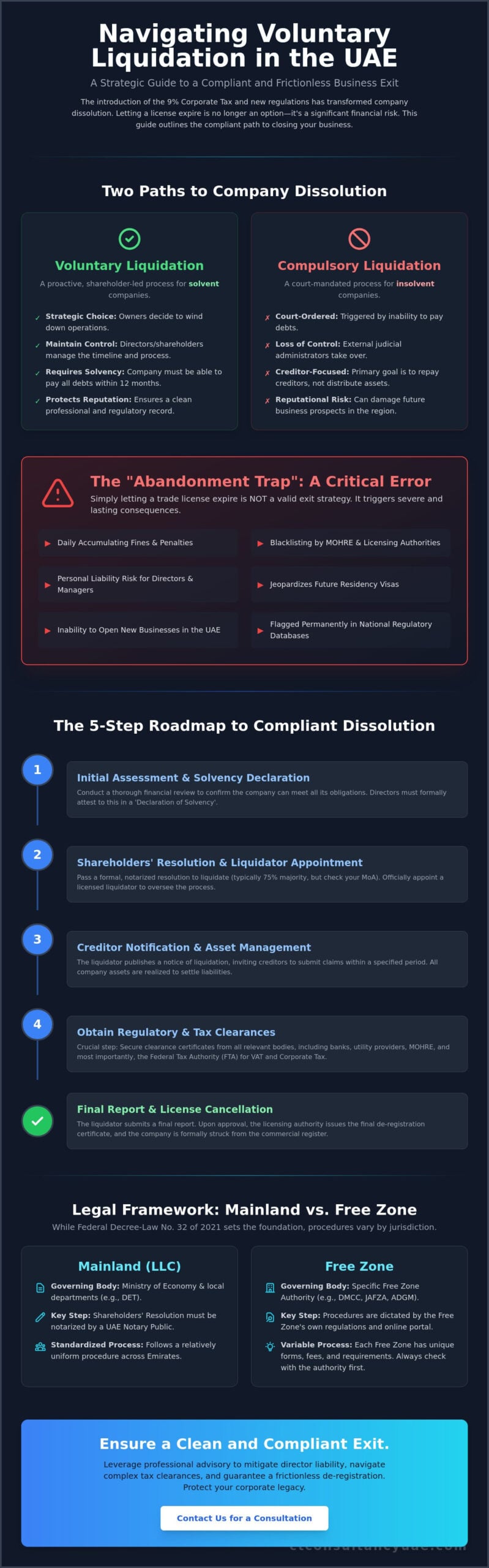
In the sophisticated commercial environment of the Emirates, closing a business requires the same degree of meticulous planning as its inception. A voluntary liquidation in the UAE represents a shareholder-led initiative to formally dissolve a solvent entity, ensuring that all remaining assets are distributed and liabilities are systematically extinguished. Unlike compulsory liquidation, which is mandated by a court order due to insolvency, the voluntary route is a strategic choice made by the company’s owners. This distinction is vital for maintaining a clean professional record within the region. Understanding Liquidation as a structured exit strategy allows directors to maintain control over the timeline and the appointment of experts, rather than surrendering the process to external judicial administrators.
Central to this process is the absolute requirement of solvency. Under the existing regulatory framework, directors must be certain that the company can settle all outstanding debts in full within 12 months of the commencement of winding up. Primary oversight for these procedures falls under the Ministry of Economy and the specific local licensing authorities, such as the Department of Economy and Tourism (DET) or various Free Zone administrations. Each entity maintains rigorous standards for financial transparency, requiring a clear trail of accounting and tax compliance before a company can be removed from the commercial register.
Solvent vs. Insolvent Liquidation: Tactical Differences
The legal foundation of a voluntary exit rests upon a formal Declaration of Solvency, a document where directors attest to the company’s ability to meet its financial obligations. If a liquidator discovers during the process that the entity cannot fulfill its debts, the procedure must transition to a creditor-led or court-ordered insolvency. This shift carries significant legal weight, as it moves the focus from asset distribution to creditor protection. For those seeking a smooth transition, utilizing professional business advisory services ensures that the initial financial assessment is accurate, preventing the reputational damage associated with unplanned insolvency proceedings.
The Dangers of License Abandonment
Many entrepreneurs fall into the "abandonment trap," mistakenly believing that simply letting a trade license expire is a cost-effective way to exit the market. This is a critical error. Abandoning a company without formal voluntary liquidation in the UAE leads to immediate blacklisting by the Ministry of Human Resources and Emiratisation (MOHRE) and the relevant licensing authorities. Administrative fines accumulate daily, and the risk of personal liability for directors and managers increases significantly. Beyond financial penalties, an improper closure can permanently jeopardize your ability to secure future residency visas or establish new business ventures in the UAE, as your name remains flagged in the national regulatory database.
The Legal Framework: Mainland vs. Free Zone Procedures
The legal landscape for a voluntary liquidation in the UAE is primarily anchored in Federal Decree-Law No. 32 of 2021 on Commercial Companies. This legislation dictates the broad strokes of dissolution, yet the specific execution often hinges on the provisions outlined in your Memorandum of Association (MoA). The MoA serves as the internal constitution; it may specify unique voting requirements or specific protocols that override general defaults. Navigating these nuances requires a meticulous review of the UAE Ministry of Economy company deregistration process to ensure that all federal mandates are satisfied before the local license is officially cancelled. While the federal law provides the skeleton, the local licensing authority provides the specific procedural muscle.
Mainland Liquidation: The Standard LLC Process
For Limited Liability Companies (LLCs) on the mainland, the process begins with a formal Shareholders’ Resolution. This document must be notarized by the UAE Notary Public to hold legal validity. Once the resolution is passed, typically requiring a 75% majority unless the MoA states otherwise, you must appoint a UAE-registered liquidator. The liquidator’s Acceptance Letter is a prerequisite for the initial approval from the Department of Economy and Tourism (DET) or the relevant local authority. A critical statutory requirement follows: the publication of a liquidation notice in two local daily newspapers, one of which must be in Arabic. This initiates a 45-day notice period, providing a legal window for creditors to submit their claims. It’s a period that demands high transparency and precise record-keeping to prevent future disputes.
Free Zone Nuances: From DIFC to ADGM and Beyond
Free Zone entities operate under the specific "winding-up" regulations of their respective registrars, which can differ substantially from mainland laws. Jurisdictions like the Dubai International Financial Centre (DIFC) or Abu Dhabi Global Market (ADGM) offer distinct pathways, such as Summary De-registration for entities with no outstanding liabilities. However, most standard closures require a comprehensive voluntary liquidation in the UAE process. A key differentiator here is the requirement for a final financial audit, which is mandatory in many zones to verify the company’s fiscal position. Additionally, the sequence of operational wind-downs is strict. You must cancel all employee visas and terminate office lease agreements before the final de-registration certificate is issued. If you’re navigating these jurisdictional variations for the first time, seeking specialized business advisory can help you avoid costly administrative delays and ensure every regulatory box is checked.
Navigating Tax and Regulatory Compliance Hurdles
In the 2026 regulatory environment, the Federal Tax Authority (FTA) acts as the ultimate arbiter of a successful company closure. Obtaining a Tax Clearance Certificate is the most critical milestone in a voluntary liquidation in the UAE, as it serves as the definitive proof that your entity has no lingering obligations to the state. This certificate is not granted lightly; it requires a comprehensive reconciliation of all tax accounts, ensuring that every dirham owed has been accounted for and settled. Without this clearance, the licensing authorities will not issue the final de-registration certificate, leaving the company in a state of legal limbo where administrative costs continue to accrue.
VAT De-registration and Final Tax Returns
Precision is mandatory when managing VAT obligations during dissolution. You must apply for VAT de-registration within 20 days of ceasing business activities to avoid late-filing penalties. This process involves submitting a final tax return that accounts for all transactions up to the date of cessation. A common pitfall involves assets retained by shareholders; from a VAT perspective, these are often treated as deemed supplies, requiring a final tax adjustment based on the fair market value. Ensuring these calculations are accurate is a core component of professional VAT compliance, preventing the FTA from rejecting the de-registration application due to understated liabilities.
Corporate Tax: The New Frontier of UAE Liquidation
The introduction of the 9% Corporate Tax on taxable income exceeding AED 375,000 has added a layer of complexity to the winding-up phase. Under the ‘Cessation of Business’ rules, liquidating entities must prepare an audited financial statement covering the final tax period. Even if your revenue falls below the AED 3 million threshold for Small Business Relief, you’re still required to notify the FTA of the dissolution. Failure to synchronize the liquidation timeline with Corporate Tax filing deadlines can trigger substantial fines. It’s essential to calculate the final taxable income precisely, accounting for any gains realized during the disposal of company assets or the settlement of long-term liabilities.
AML, UBO, and ESR: The Compliance Trifecta
Regulatory scrutiny extends beyond tax filings to the broader framework of financial transparency. You must update the Ultimate Beneficial Ownership (UBO) register to reflect the appointment of the liquidator and ensure that all Anti-Money Laundering (AML) records are archived for at least five years, as mandated by UAE law. Furthermore, Economic Substance Regulations (ESR) remain applicable until the very end. You must file a final ESR notification within six months of the financial year-end; failure to do so results in a penalty of AED 20,000. If a full ESR report is required but neglected, the penalty escalates to AED 50,000, underscoring the high stakes of a voluntary liquidation in the UAE in the modern era.
A Strategic Roadmap to Compliant Company Dissolution
Executing a voluntary liquidation in the UAE requires a multi-phased approach that begins long before the first document is notarized. It’s a project of strategic synchronization where financial records must align perfectly with legal filings to avoid administrative gridlock. Unlike the simplified summaries offered by generic guides, a professional dissolution involves a rigorous internal audit to identify potential liabilities before they become public record. This meticulous planning ensures that the transition from an active entity to a dissolved one remains entirely frictionless for shareholders and directors.
The roadmap to a successful closure follows a specific, five-stage progression:
- Phase 1: Internal Audit and Statement of Affairs. A comprehensive review of the balance sheet is conducted to prepare the Statement of Affairs, which serves as the financial foundation for the entire process.
- Phase 2: Formal Appointment and Interim Approval. Shareholders pass a notarized resolution to appoint a licensed liquidator, triggering the issuance of an interim ‘Liquidation Certificate’ from the authorities.
- Phase 3: The Statutory Notice Period. A 45-day window begins following the publication of the liquidation notice in local newspapers, allowing creditors to formally submit their claims.
- Phase 4: Asset Realization and Final Reporting. The liquidator settles valid claims, distributes remaining assets, and prepares the final Liquidator’s Report.
- Phase 5: Final De-registration. The licensing authority cancels the trade license and issues the final de-registration certificate, officially ending the entity’s legal existence.
The Liquidator’s Role: Beyond Simple Documentation
The liquidator acts as the primary liaison between your organization and the UAE regulatory bodies. Their responsibility extends beyond mere paperwork; they must verify the valuation of company assets and ensure that all creditor settlements are handled with absolute transparency. During this phase, it’s a regulatory requirement to update the Ultimate Beneficial Ownership (UBO) register to reflect the liquidator’s control. A seasoned liquidator ensures that the final accounts are prepared with the precision required to withstand scrutiny from the Ministry of Economy, safeguarding the professional reputations of the company’s management.
Practical Logistics: Bank Accounts and Visa Cancellations
Operational wind-down involves complex logistics that must be sequenced correctly to prevent "trapped" capital. Corporate bank accounts should remain active until the final VAT refund or creditor payment is processed, yet they must be closed before the final de-registration certificate is issued. Simultaneously, you must coordinate the cancellation of all establishment cards, labor files, and employee visas. Securing final clearances from utility providers like DEWA or FEWA and telecommunications companies is a prerequisite for the final submission. To ensure your exit strategy is managed with this level of technical proficiency, consider engaging professional business advisory services to oversee the entire transition.
The Strategic Advantage of Professional Liquidation Advisory
While the roadmap outlined in the previous section provides a structural blueprint, the execution of a voluntary liquidation in the UAE within the 2026 regulatory framework demands a multi-disciplinary approach. Relying on a single point of view is no longer sufficient when tax, legal, and accounting requirements are so deeply intertwined. Professional advisory acts as a primary friction-remover, ensuring that every regulatory update is integrated into the dissolution process in real-time. This level of oversight is not merely about closing an entity; it’s about incorporating the exit into a broader strategic financial management plan that protects the long-term interests of the stakeholders involved.
One of the most significant risks in modern company dissolution is ‘successor liability.’ This occurs when unresolved tax debts or compliance failures follow directors and shareholders into their next ventures. Meticulous planning and professional validation of the final accounts mitigate this risk, providing a formal discharge of liabilities that is recognized by the Ministry of Economy. By utilizing expert oversight, businesses can accelerate the de-registration timeline, moving from the initial resolution to the final certificate with a precision that avoids the common delays associated with incomplete documentation or rejected FTA filings.
Friction-Free Compliance with CTC Tax & Accounting
Our approach to dissolution is characterized by precision and reliability. We provide expert Corporate Tax Advisory to ensure that all taxable income statements are reconciled and that clean FTA clearances are obtained without delay. For entities with complex balance sheets, our CFO Advisory services offer essential support for asset valuation and the development of a robust distribution strategy. We manage the entire lifecycle of the liquidation audit and regulatory filings, allowing you to focus on future growth while we handle the complexities of the wind-down process.
Protecting Your Future Business Reputation
A ‘clean exit’ is a vital asset for any entrepreneur in the Emirates. It preserves your eligibility for future UAE licenses and ensures that your professional standing remains untarnished in the eyes of local authorities. Beyond the issuance of the de-registration certificate, UAE law mandates that financial records be archived for a statutory period of 5 to 10 years, depending on the jurisdiction. We ensure that your record-keeping meets these archival standards, providing a secure foundation should any retrospective inquiries arise. Contact CTC today for a customized liquidation roadmap tailored to your specific corporate structure and jurisdictional requirements. We’re committed to delivering an efficient, meticulous, and deeply knowledgeable solution for your voluntary liquidation in the UAE.
Strategizing Your Professional Exit from the UAE Market
Closing a corporate entity in the Emirates is a high-stakes transition that demands a meticulous alignment of legal, financial, and tax obligations. We’ve established that a successful voluntary liquidation in the UAE hinges on more than just administrative filing; it requires a proactive synchronization with the Federal Tax Authority and a sophisticated understanding of jurisdictional nuances. By prioritizing a structured roadmap and addressing the compliance trifecta of AML, UBO, and ESR, you ensure that your corporate legacy remains untarnished while protecting your future ventures from successor liabilities.
With over a decade of UAE regulatory expertise and a specialized team focused on Tax and AML compliance, CTC serves as a primary partner for a seamless market exit. We maintain a proven track record with both Mainland and Free Zone authorities, providing the strategic reassurance needed to navigate this final chapter with technical precision. Secure a Frictionless Exit with Professional Liquidation Services. Your successful transition today sets a reliable foundation for your next professional milestone in the region’s evolving economy.
Frequently Asked Questions
What is the difference between company de-registration and voluntary liquidation in the UAE?
De-registration is the final administrative act of removing an entity from the commercial register, while voluntary liquidation in the UAE is the formal statutory process required to reach that conclusion. Liquidation involves the systematic settlement of all creditor claims and the distribution of remaining assets under a licensed professional’s supervision. De-registration only occurs once the licensing authority accepts the final liquidator’s report and confirms all tax clearances are in place.
How long does the voluntary liquidation process typically take for a Mainland LLC?
The timeline for a Mainland LLC typically spans between three and six months from the initial shareholders’ resolution. This duration is largely dictated by the mandatory 45-day public notice period required by Federal Decree-Law No. 32 of 2021. Delays often occur if VAT reconciliations or employee visa cancellations aren’t managed with precision before the final submission to the Department of Economy and Tourism.
Can I liquidate my UAE company if I have outstanding VAT or Corporate Tax liabilities?
You cannot finalize a company dissolution while outstanding tax liabilities remain on the entity’s record with the Federal Tax Authority (FTA). The FTA requires full settlement of all VAT and Corporate Tax obligations before they’ll issue the essential Tax Clearance Certificate. This document serves as the definitive proof of compliance required by licensing authorities to issue the final de-registration certificate.
Is a financial audit mandatory for all company liquidations in the UAE?
A final financial audit is mandatory for all mainland Limited Liability Companies and is a standard requirement in major Free Zones like DMCC or DAFZA. This audit verifies the company’s statement of affairs and ensures the liquidator has an accurate account of all assets and liabilities. It provides the transparency regulators demand to ensure that shareholders and creditors are treated fairly during the distribution phase.
What happens to my residency visa when my company undergoes voluntary liquidation?
All residency visas sponsored by the entity, including those for investors, partners, and employees, must be cancelled before the final de-registration certificate is issued. The Ministry of Human Resources and Emiratisation requires the closure of the labor file as a prerequisite for dissolution. Failure to cancel these permits correctly can lead to significant administrative fines and may jeopardize future residency applications in the Emirates.
Who can be appointed as a liquidator for a UAE company dissolution?
Only a licensed, UAE-registered liquidator or a registered audit firm can be formally appointed to oversee a voluntary liquidation in the UAE. The appointed professional must provide an official Acceptance Letter to the relevant licensing authority to initiate the legal winding-up phase. Their primary role is to act as an independent party who ensures all legal, tax, and financial obligations are satisfied according to federal law.
Can a company in liquidation still perform business activities or sign new contracts?
A company in liquidation is strictly prohibited from entering into new contracts or engaging in growth-oriented commercial activities. Its legal capacity is limited exclusively to actions necessary for the winding up of its affairs under the liquidator’s control. This includes the realization of assets, settlement of existing debts, and the completion of administrative tasks required to achieve a formal and compliant closure.
What are the penalties for failing to follow the formal liquidation process in the UAE?
Abandoning a company without formal liquidation leads to immediate blacklisting by the Ministry of Economy and the accumulation of daily administrative fines. Directors and managers may face personal liability for the entity’s unpaid debts and legal obligations. Additionally, failing to file final Economic Substance Regulations reports can trigger retrospective penalties ranging from AED 20,000 to AED 50,000, permanently damaging your professional reputation in the region.