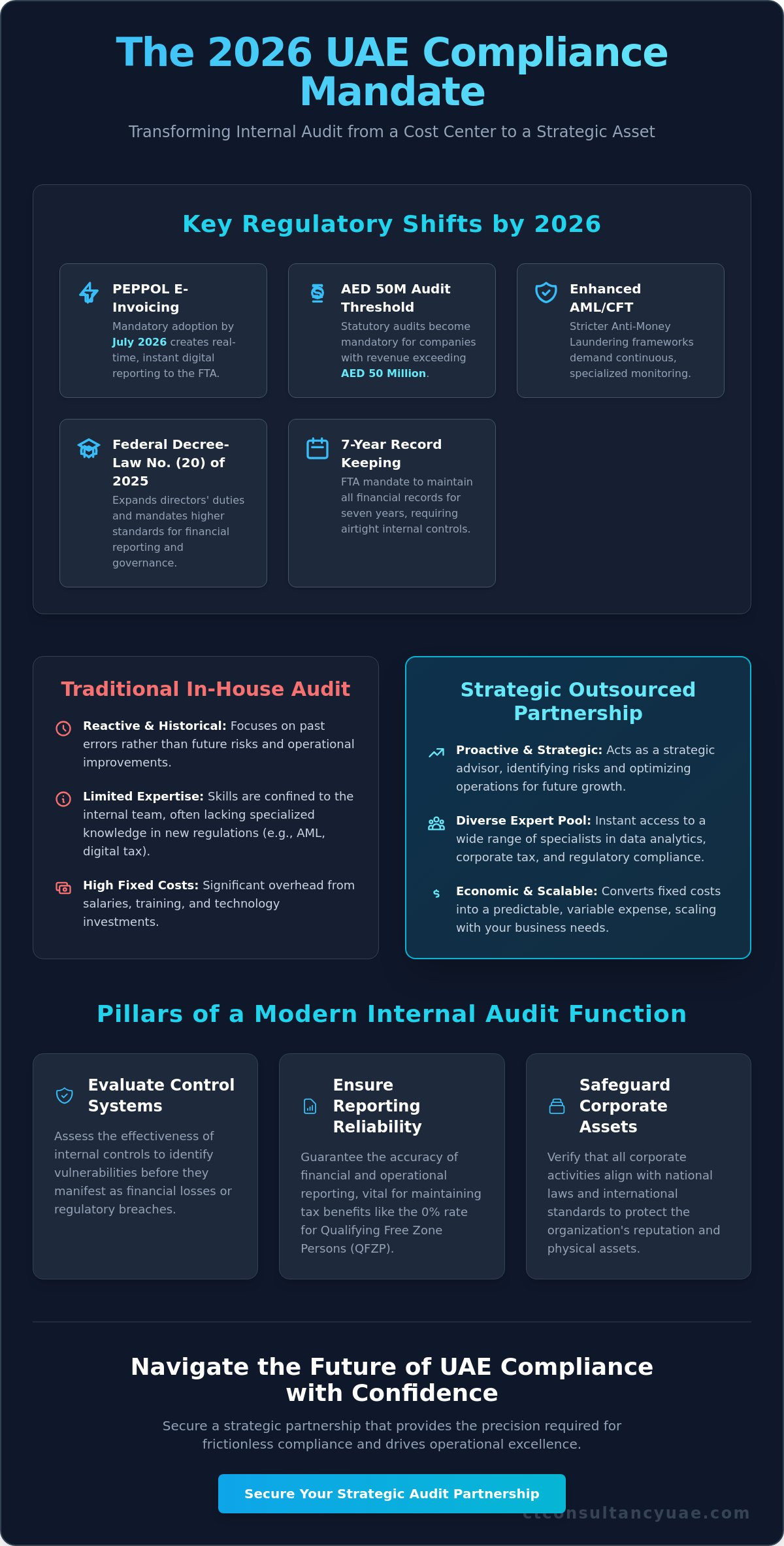
By July 2026, the mandatory adoption of the PEPPOL e-invoicing network will shift the UAE into a regime of instant digital reporting, rendering traditional, reactive oversight obsolete. For many executive teams, the mounting pressure to align with the new Global Internal Audit Standards while managing the high costs of specialized talent makes outsourced internal audit services the most logical path forward. You’ve likely recognized that the sheer complexity of corporate tax documentation and updated AML regulations has made "business as usual" a significant risk to your long-term stability.
This guide reveals how a strategic outsourcing model provides the precision required for frictionless compliance and transforms your audit function into a driver of operational excellence. We will examine the critical 2026 regulatory shifts, including the AED 50 million statutory audit threshold and the latest governance mandates under Federal Decree-Law No. (20) of 2025, to ensure your organization remains both secure and competitive. By the end of this briefing, you’ll understand how to secure strategic peace of mind while identifying the operational inefficiencies that often hide behind complex regulatory requirements.
Key Takeaways
- Transition from traditional compliance monitoring to a strategic partnership that proactively identifies and rectifies operational bottlenecks within your organization.
- Evaluate the economic advantages of utilizing professional service models over permanent internal departments to ensure access to a diverse spectrum of specialized expertise.
- Understand the mechanics of a risk-based audit framework that leverages advanced data analytics to provide high-precision oversight in an increasingly digital economy.
- Establish a robust implementation roadmap for outsourced internal audit services that aligns your corporate objectives with evolving regional regulatory expectations.
- Explore the strategic synergy of integrating internal audit functions with CFO advisory services to create a unified and resilient financial strategy for long-term growth.
Understanding the Strategic Role of Outsourced Internal Audit in the UAE
The corporate environment in the UAE has undergone a fundamental transformation, moving away from a period of relatively light oversight into a sophisticated era of digital transparency and rigorous fiscal accountability. Utilizing outsourced internal audit services is no longer merely a defensive measure against administrative penalties; it has evolved into a high-level professional partnership designed for comprehensive risk oversight. This shift represents a departure from the traditional perception of auditors as internal "police" who focus on historical errors. Instead, the modern internal audit function serves as a strategic advisor, providing the foresight necessary to navigate a landscape where regulatory requirements and operational efficiency are inextricably linked.
For executive decision-makers, the value of this partnership lies in its ability to convert compliance obligations into competitive advantages. By identifying structural weaknesses and suggesting procedural enhancements, an external audit partner provides an objective distance that internal teams often lack. This relationship ensures that your organization doesn’t just meet the minimum legal standards but actively pursues a path of long-term stability and meticulous planning.
The Evolving Regulatory Landscape in 2026
The year 2026 stands as a definitive turning point for UAE business compliance. With the mandatory implementation of the PEPPOL e-invoicing network by July 2026, the Federal Tax Authority (FTA) will gain real-time visibility into transaction data. This digital shift, combined with the AED 50 million revenue threshold for mandatory statutory audits and the FTA mandate to maintain financial records for seven years, means that ad-hoc financial reviews are no longer sufficient to mitigate risk. Organizations must ensure their internal controls are robust enough to withstand constant scrutiny. Furthermore, the enhancement of Anti-Money Laundering (AML) and Counter-Financing of Terrorism (CFT) frameworks requires a level of continuous monitoring that internal departments often struggle to maintain without significant overhead. Federal Decree-Law No. (20) of 2025 has further intensified these requirements by expanding directors’ duties and mandating higher standards for financial reporting, making specialized tax services and audit oversight essential for any serious enterprise.
Core Objectives of a Modern Internal Audit Function
A robust internal audit framework achieves several critical objectives that go beyond basic compliance. To maintain professional excellence, the function must prioritize the following pillars:
- Evaluating Control Systems: Assessing the effectiveness of internal control systems to identify vulnerabilities before they manifest as financial losses or regulatory breaches.
- Reporting Reliability: Ensuring the total accuracy of financial and operational reporting, which is vital for maintaining the 0% corporate tax rate for Qualifying Free Zone Persons (QFZP).
- Asset Safeguarding: Verifying that all corporate activities align with national laws and international standards to protect the organization’s reputation and physical assets.
By leveraging outsourced internal audit services, businesses gain access to a seasoned team that understands the nuances of the UAE market. This approach provides the strategic reassurance that your organization is prepared for the high-stakes nature of the 2026 regulatory environment while maintaining the flexibility to scale as your business grows.
High-performance internal audit is defined by its ability to transform raw financial data into strategic intelligence. By utilizing outsourced internal audit services, UAE enterprises transition from a reactive posture to a proactive one, ensuring that every audit activity aligns with the broader corporate strategy. This methodology prioritizes methodological rigor over simple checklist-based reviews. It allows executive teams to treat the audit process as a catalyst for growth rather than a mere cost center. When the audit function is properly integrated, it identifies structural bottlenecks that hinder scalability, providing a clear roadmap for operational refinement.
Maintaining independence remains the cornerstone of any credible audit process. External partners provide an objective lens that’s shielded from internal corporate politics, ensuring that findings are reported with empirical honesty. This alignment with international regulatory guidance on audit outsourcing reinforces the integrity of the financial reporting chain. It provides stakeholders with the reassurance that risk management is being handled by specialists who possess no conflicting interests within the operational hierarchy. This objective distance is essential for identifying fraud or systemic inefficiencies that might be overlooked by an in-house team.
Risk Assessment and Planning
A customized audit universe is essential for addressing the specific risks inherent to various UAE sectors. Effective planning involves prioritizing high-impact areas such as procurement cycles, payroll integrity, and the accuracy of tax filings. By setting measurable KPIs for the audit function, leadership can track the efficacy of risk mitigation efforts. This structured approach ensures that resources are allocated to the areas of greatest vulnerability, which maximizes the return on the investment in professional oversight. It’s about focusing on what matters most to your specific business model.
Execution and Reporting Frameworks
The lifecycle of a high-performance audit engagement moves seamlessly from fieldwork to the delivery of the final report. Rather than merely listing observations, elite partners provide actionable recommendations that facilitate operational improvement. The Audit Committee plays a pivotal role here, acting as the bridge between the outsourced partner and the board. For businesses seeking to enhance this synergy, integrating these insights with CFO advisory services can provide a holistic view of the company’s financial health, ensuring that audit findings lead to meaningful strategic changes.
Evaluating the Economic Viability: In-House vs. Outsourced Audit Models
Executive leadership must weigh the structural costs of a permanent department against the efficiency of specialized firms. Choosing outsourced internal audit services often hinges on a simple realization; a single hire cannot possess the same breadth of knowledge as an entire firm. While an in-house salary might appear fixed, the actual expenditure includes visas, insurance, and performance bonuses. By contrast, a professional service model offers a transparent fee structure that scales with your actual requirements. This allows for a more precise allocation of capital toward core business growth.
Scalability is a significant factor for UAE enterprises navigating the 2026 landscape. If your business undergoes a merger or enters a new Free Zone, your audit needs will spike. An outsourced partner can deploy additional resources immediately. This model also eliminates "key person risk." In small internal teams, the departure of a single specialist can halt compliance efforts for months. Professional firms ensure continuity through a collective institutional memory that remains unaffected by individual turnover. It’s about building a resilient infrastructure that doesn’t depend on any single individual.
The Total Cost of Ownership (TCO) Analysis
To conduct a rigorous Total Cost of Ownership analysis, you must look beyond the payroll. Hidden costs like continuous professional development for new UAE tax laws, specialized software licenses for real-time monitoring, and dedicated office space quickly accumulate. Integrating these insights with professional accounting services ensures that your financial reporting remains cohesive. This approach provides access to high-level strategic oversight at a fraction of the cost required to maintain an equivalent executive-level internal team. It’s a pragmatic solution for organizations that value financial precision without the overhead of a large department.
Strategic Benefits Beyond the Balance Sheet
Beyond the balance sheet, the external perspective of a consultant is invaluable. They bring "best practices" observed across diverse industries in the UAE, which can streamline long-standing, inefficient internal processes. Adhering to established government guidelines on outsourced internal audit further enhances the credibility of your financial statements. This third-party assurance is often a prerequisite for securing financing from major UAE banks. It also attracts international investors who demand a higher standard of corporate governance. By choosing an external partner, you signal a commitment to transparency that resonates with stakeholders at every level.
Implementing a Risk-Based Internal Audit Framework for Your Organization
Transitioning to outsourced internal audit services requires a structured roadmap to ensure a frictionless integration with your existing operations. This process is not merely a replacement of personnel; it is a fundamental recalibration of your governance framework to meet the sophisticated standards of the 2026 UAE regulatory environment. A successful implementation relies on a phased approach that prioritizes transparency and stakeholder alignment from the outset.
The transition follows a logical progression designed to minimize disruption while maximizing oversight:
- Step 1: Defining Scope: Collaborating with stakeholders to align audit objectives with the board’s risk appetite and long-term strategic goals.
- Step 2: Partner Selection: Identifying a firm with verified UAE regulatory expertise and a deep understanding of the nuances within your specific sector.
- Step 3: Establishing Protocols: Setting clear communication channels and secure data access requirements to ensure a steady, secure flow of information.
- Step 4: Initial Risk Assessment: Mapping the "audit universe" to develop a multi-year plan that addresses high-priority vulnerabilities and operational gaps.
- Step 5: Board Reporting: Implementing a cadence of periodic reporting that provides the board with actionable strategic intelligence rather than just data points.
Selecting the Right Outsourcing Partner
Technical proficiency in UAE Corporate Tax and VAT is a non-negotiable requirement in the current fiscal landscape. When evaluating potential partners, prioritize those who offer industry-specific experience and can provide local references that attest to their reliability. It is also essential to ensure the partner utilizes modern audit software. This technology provides the transparency necessary for real-time monitoring and ensures that all findings are backed by empirical data, which is vital for maintaining "tax readiness" for FTA inspections.
Managing the Transition and Integration
The human element of the transition is often overlooked but remains critical for success. To avoid internal friction, leadership must introduce the external audit team as a supportive partner dedicated to "continuous improvement" rather than a "fault-finding" entity. Setting clear expectations regarding document delivery schedules and interview timelines helps maintain momentum and respects the time of your internal staff. By fostering a culture of collaboration, you ensure that the audit process becomes a tool for professional growth. If you are ready to refine your corporate governance, you can consult our business advisory experts to design a customized framework that fits your unique operational needs.
Navigating UAE Regulatory Complexity with CTC Strategic Audit Solutions
CTC Tax & Accounting approaches outsourced internal audit services as a foundational element of a resilient financial strategy rather than a mere compliance exercise. By integrating audit insights with CFO advisory services, we provide leadership teams with the high-level perspective required to drive sustainable growth. This synergy ensures that the findings from your internal controls directly inform your long-term capital allocation and operational planning, turning regulatory data into a roadmap for efficiency.
Our methodology is particularly critical for ensuring that your Corporate Tax filing is supported by a robust trail of evidence. In an environment where the Federal Tax Authority (FTA) mandates record-keeping for a minimum of seven years, the precision of your internal documentation serves as your primary defense against administrative penalties. We specialize in removing the friction from complex regional requirements, offering customized solutions for SMEs navigating the nuances of Economic Substance Regulations (ESR), Ultimate Beneficial Ownership (UBO), and Anti-Money Laundering (AML) compliance.
The CTC Advantage: Local Expertise, Global Standards
Our firm brings decades of international experience to the UAE national market, ensuring that your organization adheres to global standards while remaining deeply rooted in local regulatory reality. This dual perspective allows us to implement frictionless compliance strategies that reduce the administrative burden on your executive team. You can learn more about us and our commitment to professional excellence, which has positioned us as a trusted partner for businesses seeking to master the complexities of the Middle Eastern fiscal landscape. We prioritize long-term stability over quick fixes, providing a sense of organized momentum for your entire financial operation.
Take the Next Step Toward Strategic Security
Securing your organization’s future begins with a clear understanding of your current vulnerabilities. We invite you to request a diagnostic review of your internal controls to identify specific areas where your governance framework can be strengthened. Beyond immediate compliance, a high-performance audit function significantly enhances your business valuation, providing potential investors or banking partners with the assurance of a well-governed enterprise. This level of transparency is essential for entrepreneurs seeking a frictionless entry into new markets or scaling existing operations. To begin this transition toward strategic security and operational excellence, contact our advisory team for a consultation today. We provide the meticulous planning and expert oversight necessary to ensure your business thrives in the evolving 2026 UAE corporate landscape.
Securing Future Stability in the 2026 UAE Fiscal Landscape
The 2026 regulatory environment in the UAE demands a level of precision that traditional oversight can no longer provide. By transitioning to a risk-based framework, your organization ensures that its internal controls don’t just meet FTA standards but actively drive operational excellence. We’ve explored how the economic viability of this model allows for scalable growth without the administrative burden of a permanent department. This strategic shift is essential for organizations that prioritize long-term stability over temporary fixes.
Secure your business with expert outsourced internal audit services today. Your organization’s resilience depends on the meticulous planning and expert oversight you implement now.
Frequently Asked Questions
What is the difference between an internal audit and an external audit in the UAE?
An internal audit serves as a proactive management tool to improve operations and risk management, while an external audit is a statutory requirement to verify financial statement accuracy for stakeholders. While an external auditor remains independent of the company’s management, an internal auditor acts as a strategic partner focused on identifying inefficiencies and ensuring compliance with internal policies.
Is it mandatory for all UAE companies to have an internal audit function?
An internal audit function is a strict requirement for regulated sectors such as banking, insurance, and Public Joint Stock Companies (PJSCs). While not mandatory for every private company, the introduction of Corporate Tax and the 2025 amendments to the Commercial Companies Law have made these services essential for SMEs to avoid the significant penalties associated with non-compliance.
How often should a business conduct an internal audit in the UAE?
The frequency of an internal audit depends on your organization’s specific risk profile and regulatory obligations. Regulated entities typically require continuous monitoring or quarterly reviews; however, most SMEs find that a semi-annual or annual audit cycle provides sufficient oversight to align with Federal Tax Authority (FTA) reporting deadlines and ensure ongoing tax readiness.
Can an outsourced internal audit firm also handle my VAT and Corporate Tax filings?
Yes, professional firms often provide outsourced internal audit services alongside VAT and Corporate Tax advisory to ensure a cohesive financial strategy. This integration allows for a more comprehensive understanding of your transaction trails. It’s essential that the firm maintains appropriate professional objectivity to ensure the integrity of the audit process remains uncompromised.
What are the main risks that an internal audit typically identifies for SMEs?
For SMEs, internal audits frequently identify risks related to procurement cycles, payroll processing, and the accuracy of related-party transaction documentation. They also highlight gaps in compliance with Economic Substance Regulations (ESR) and Anti-Money Laundering (AML) mandates. These issues are often overlooked until a formal inspection occurs, making early identification vital for long-term stability.
How long does a typical outsourced internal audit engagement take to complete?
A standard internal audit engagement usually spans two to four weeks from initial fieldwork to the delivery of the final report. However, the most effective outsourced internal audit services operate on an ongoing basis. This model utilizes automated monitoring to provide real-time insights rather than a single, historical snapshot of your organization’s financial health.
What is the cost structure for outsourced internal audit services in the UAE?
The cost structure is typically determined by the scope of the engagement, the complexity of your business operations, and the specialized expertise required. Most firms utilize a project-based professional fee model. This provides a more predictable expenditure compared to the salary, benefits, and training costs associated with maintaining a permanent in-house department.
How does internal audit help with Anti-Money Laundering (AML) compliance?
Internal audit verifies that your organization’s Anti-Money Laundering (AML) policies are effectively implemented and consistently followed. It involves reviewing "Know Your Customer" (KYC) documentation, testing the accuracy of suspicious activity monitoring, and ensuring that all reporting aligns with the UAE’s GoAML network requirements. This systematic review significantly mitigates the risk of involvement in financial crime.