With the UAE cloud services market projected to reach a valuation of USD 6.30 billion in 2026, the transition toward digital financial oversight has evolved from a technological trend into a foundational requirement for corporate resilience. You’re likely aware that as the local regulatory environment matures, the margin for error in traditional, manual bookkeeping has effectively vanished. Navigating a 9% Corporate Tax rate on income exceeding AED 375,000 requires a level of precision that spreadsheets simply cannot sustain; it demands the sophisticated integration of cloud bookkeeping services in the UAE to maintain a competitive edge.
We recognize the persistent anxiety that Federal Tax Authority audits and potential penalties for manual data entry errors can create for even the most established enterprises. This guide outlines how adopting cloud-based financial oversight provides the real-time visibility and automated compliance necessary to secure your business’s future. You’ll learn how to establish audit-ready records and streamline your VAT and Corporate Tax filings, transforming your financial department into a strategic engine for expansion and long-term stability.
Key Takeaways
- Understand the transition from localized desktop accounting to centralized, real-time financial ecosystems that prioritize regulatory precision.
- Discover how cloud bookkeeping services in the UAE facilitate seamless adherence to Federal Decree-Law No. 47 on Corporate Tax and long-term VAT documentation requirements.
- Identify the operational advantages of digital ledgers, ranging from enhanced cash flow visibility to the implementation of enterprise-grade data encryption.
- Gain a structured framework for migrating from legacy systems to optimized cloud platforms that align with your specific industry mandates.
- Learn how integrating digital financial oversight with elite CFO advisory services can transform routine compliance into a strategic advantage for business expansion.
The Evolution of Financial Oversight: Understanding Cloud Bookkeeping in the UAE
The digital landscape of the Emirates has undergone a profound transformation, moving away from siloed financial records toward integrated, real-time ecosystems. Understanding Cloud Bookkeeping requires viewing it not merely as a tool for recording transactions, but as a centralized hub that synchronizes every facet of a company’s fiscal health. This evolution is particularly critical as the UAE Cloud Services Market is valued at USD 6.30 billion in 2026, reflecting a nationwide commitment to operational agility and regulatory precision.
Previously, businesses relied on localized desktop software that tethered data to specific hardware, creating bottlenecks and security vulnerabilities. Today, the transition to secure, accessible digital ledgers allows executive decision-makers to oversee financial performance from any location. This shift supports the UAE’s broader economic vision, where digital transformation acts as a catalyst for sustainable growth and international competitiveness. By utilizing professional cloud bookkeeping services in the UAE, organizations ensure they aren’t just keeping pace with technology but are actively leveraging it to mitigate risk.
The Core Components of a Cloud-Based Financial System
A robust cloud ecosystem is defined by its ability to eliminate manual intervention through sophisticated automation. Key elements include:
- Automated Bank Feeds: Direct synchronization with financial institutions ensures that transaction data is captured instantaneously, minimizing the risk of omission.
- Digital Document Management: Cloud-based receipt scanning and optical character recognition (OCR) convert physical invoices into searchable, digital assets.
- Granular Access Controls: Multi-user permissions allow for enhanced internal oversight, ensuring that sensitive data is only accessible to authorized personnel.
Why Traditional Bookkeeping is Becoming Obsolete
In an era where the Federal Tax Authority (FTA) demands meticulous record-keeping, the limitations of traditional methods are increasingly apparent. Localized systems are inherently fragile. A single hardware failure or unbacked-up drive can result in the catastrophic loss of multi-year financial history. Additionally, the inherent delays of manual data entry mean that reports are often outdated by the time they reach a CFO’s desk. Without the digital timestamps and immutable logs provided by cloud systems, maintaining a robust audit trail becomes a logistical burden that many modern enterprises simply cannot afford to carry. The move toward digital ledgers is no longer optional; it’s a strategic necessity for long-term survival.
Strategic Compliance: Aligning Cloud Systems with UAE VAT and Corporate Tax
The introduction of a federal tax framework has fundamentally altered the operational requirements for businesses across the seven emirates. Achieving full alignment with the Federal Decree-Law on Corporate Tax necessitates a transition from retrospective accounting to proactive, real-time oversight. By implementing professional cloud bookkeeping services in the UAE, organizations ensure that every ledger entry is meticulously coded to reflect its specific tax impact. This digital precision isn’t just about efficiency; it’s about building a robust compliance shield that stands up to the most rigorous scrutiny from the Federal Tax Authority (FTA).
Cloud-based ecosystems provide a secure, centralized repository for the mandatory five-year record retention period required for VAT purposes. Instead of managing physical archives that are prone to degradation or loss, executives can access timestamped, immutable digital records that prove the validity of every input tax claim. This level of transparency effectively removes the friction typically associated with tax season, allowing business owners to focus on expansion rather than administrative defense. Leveraging these systems ensures that your firm remains audit-ready at all times, projecting an image of reliability to both regulators and stakeholders.
Corporate Tax Readiness and the 2026 Regulatory Landscape
For the tax periods ending in 2026, maintaining IFRS-compliant books is a non-negotiable prerequisite for Corporate Tax filing. Cloud systems facilitate this by enforcing standardized accounting principles across all entries, ensuring that taxable income is calculated with absolute precision. Accurate expense categorization is vital, as it determines which costs are deductible under the law. If your revenue remains below the AED 3 million threshold, your cloud data provides the necessary evidentiary support to claim Small Business Relief, potentially treating your business as having zero taxable income for the period.
VAT Compliance and the FTA Audit Trail
VAT compliance requires that every transaction is supported by a valid digital tax invoice. Cloud bookkeeping platforms automate this process by linking digital scans directly to the relevant ledger entry, ensuring a 1:1 match that simplifies internal audits. This automation extends to the generation of VAT returns, which eliminates the manual data entry errors that often lead to costly tax penalties. To ensure your business remains fully protected within this complex landscape, you may learn more about our comprehensive tax services and how they integrate with your digital infrastructure.
The ultimate benefit of this digital transition is the creation of a transparent, digital audit trail. When the FTA requests documentation, a cloud-first approach allows for the immediate export of structured data, demonstrating a high level of corporate governance and legal integrity. It’s a shift from reactive anxiety to strategic reassurance, where your financial records serve as a testament to your business’s stability.
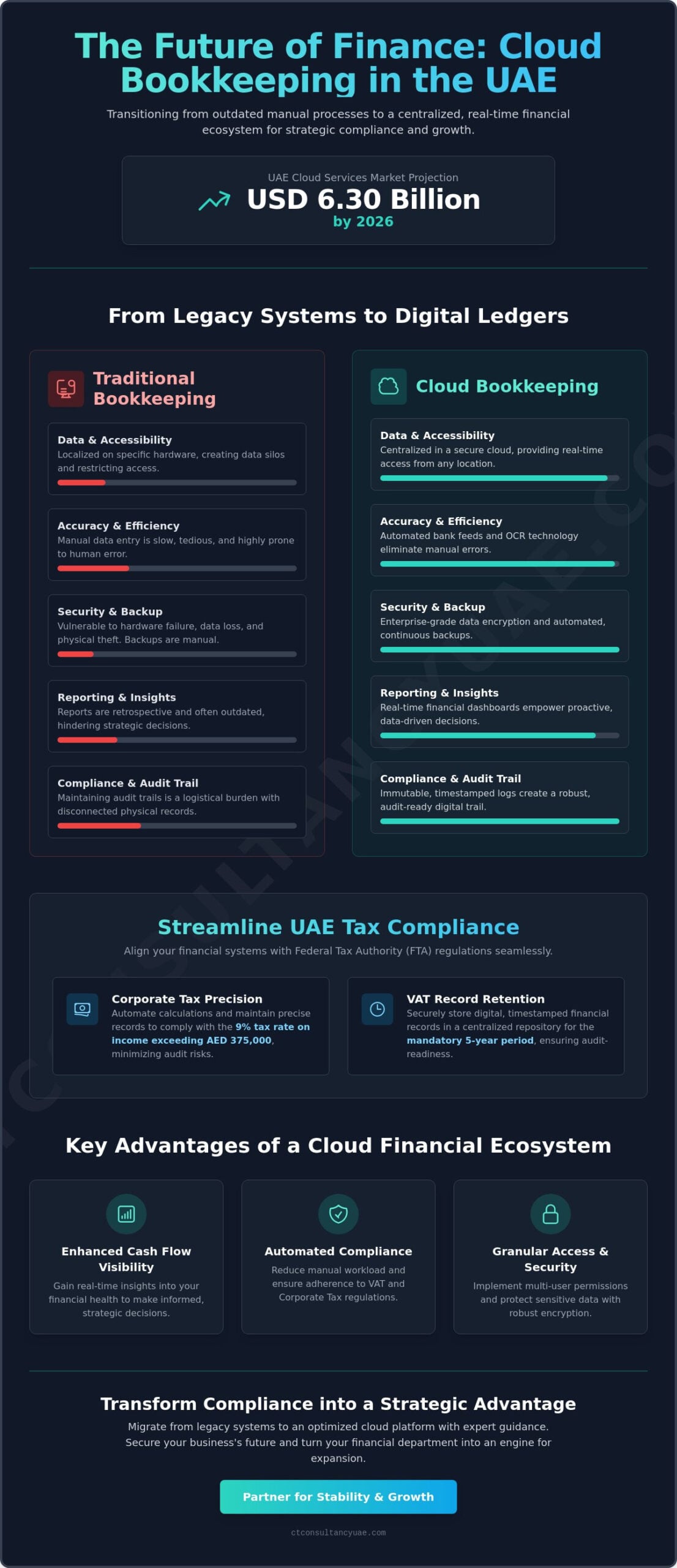
The transition from compliance-centric necessity to operational excellence is where the true value of modern financial systems emerges. While regulatory adherence provides a necessary shield, the agility afforded by digital oversight serves as the engine for corporate growth. By integrating professional cloud bookkeeping services in the UAE, executive leadership gains an immediate, high-definition view of their liquidity and fiscal health. This shift effectively eliminates the "information lag" that often plagues traditional accounting, where decisions are frequently made based on data that is weeks or even months old.
The strategic deployment of digital ledgers allows for a more sophisticated level of fiscal stewardship. One of the primary advantages of cloud-based bookkeeping is the ability to maintain continuous operational momentum regardless of geographic location. This accessibility ensures that your financial infrastructure remains as mobile and dynamic as the UAE market itself, providing a stable foundation for national expansion without the burden of heavy capital expenditure on localized IT hardware.
Real-Time Financial Intelligence for Decision Makers
Modern decision-makers require more than just a balance sheet; they need actionable intelligence. Cloud platforms offer customizable dashboards that track specific Key Performance Indicators (KPIs) in real-time, allowing you to monitor accounts receivable and payable from any device. This level of visibility ensures you’re making data-driven decisions based on today’s numbers. It’s a proactive approach that enables leaders to identify cash flow bottlenecks before they impact operations, transforming the finance department into a strategic partner for CFO advisory services and long-term planning.
Security and Data Integrity in the UAE Cloud
Security remains a paramount concern for firms navigating the high-stakes regulatory environment of the Emirates. Leading platforms such as Xero, QuickBooks, and Zoho utilize enterprise-grade encryption protocols that often surpass the security capabilities of localized private servers. These systems safeguard your records against internal fraud through granular user permission settings, ensuring that sensitive data is only accessible to authorized personnel. With automated backups and robust disaster recovery protocols, your business continuity is guaranteed. Even in the event of local hardware failure, your financial history remains secure and accessible in the cloud, maintaining the integrity of your accounting services and audit trails.
Implementing a Seamless Transition: A Framework for Cloud Migration
Migrating to a digital ecosystem requires a methodical approach to ensure that historical accuracy is preserved while future-proofing the organization. A successful transition begins with a comprehensive audit of existing legacy systems and physical records. This preliminary phase identifies inconsistencies that, if left unaddressed, could propagate errors throughout the new digital ledger. By engaging specialized cloud bookkeeping services in the UAE, firms can execute this shift with the forensic precision required to satisfy both internal stakeholders and external regulators. The goal is to move beyond mere data entry toward a structured financial environment that supports long-term corporate governance.
Executing a structured data migration is the most critical step in maintaining historical data integrity. It involves more than just exporting files; it requires a strategic mapping of data points to ensure that every historical transaction remains searchable and compliant with the Federal Tax Authority’s expectations. This transition serves as an ideal opportunity to refine internal controls and establish a more transparent reporting cadence that benefits executive decision-makers.
Platform Selection and Custom Configuration
Choosing the right software is a strategic decision that depends on industry-specific requirements and the complexity of your supply chain. The ideal platform must offer robust integration capabilities for UAE VAT and Corporate Tax, allowing for automated calculations that align with FTA mandates. Beyond the core ledger, configuration involves creating a bespoke chart of accounts that mirrors your unique operational structure. This often involves integrating third-party applications for payroll management or inventory tracking, creating a unified data environment that eliminates information silos and reduces manual friction.
The Data Migration and Clean-up Phase
The integrity of your new system relies entirely on the quality of the data imported. We focus on verifying opening balances and reconciling historical transactions to ensure a clean break from legacy processes. This stage is critical for maintaining compliance with the UAE’s stringent record-keeping laws, which mandate that digital records remain accessible and verifiable for at least five years. For a deeper understanding of how this fits into a broader financial strategy, you can explore our Outsourced Bookkeeping Services in the UAE: The Strategic Guide.
Once the data is migrated, the focus shifts to human capital. Training internal teams on new digital workflows and reporting structures is essential for maintaining the momentum of the digital transformation. This ensures that the transition is not merely a technical success but an operational one. If you’re ready to modernize your financial infrastructure, our team provides the expert accounting services necessary to manage every stage of your cloud migration.
Partnering for Stability: Customized Cloud Solutions by CTC Tax & Accounting
At CTC Tax & Accounting, we recognize that the true value of cloud bookkeeping services in the UAE lies in the intersection of technological precision and human expertise. In an era where the UAE’s regulatory framework continues to mature, having a partner who acts as a primary friction-remover is essential for maintaining operational momentum. We don’t merely provide a digital repository for your transactions; we establish a robust financial foundation that prioritizes long-term stability and meticulous planning over temporary fixes. Our commitment is to ensure that your business remains agile, compliant, and ready to capitalize on the opportunities presented by the 2026 economic landscape.
The complexity of modern tax laws requires a proactive stance. We provide ongoing regulatory monitoring to ensure your enterprise stays ahead of any updates to Corporate Tax or VAT requirements. This personalized approach rejects one-size-fits-all financial management, opting instead for individualized solutions that align with your specific commercial vision. By synthesizing real-time data from your digital ledger with our deep understanding of the local legal environment, we provide a level of oversight that ensures your business remains resilient against market volatility.
Beyond Bookkeeping: Strategic CFO Advisory
Stability requires more than simple record-keeping. It demands expert interpretation. By utilizing the structured data generated through your cloud platform, our consultants help you explore our high-level CFO advisory services to drive informed decision-making. This integration allows for sophisticated business valuation and feasibility studies, transforming your ledger into a strategic tool for expansion. Whether you’re refining your budget or developing cash flow forecasting models, our elite advisory team ensures your financial infrastructure supports your highest corporate objectives.
The CTC Advantage: Expertise and Reliability
The personality of our firm is rooted in professional authority and strategic reassurance. We leverage decades of international finance and corporate governance experience to ensure your local UAE success. This global perspective, combined with specialized regional expertise, allows us to provide a supportive partnership that drives both growth and profitability. We understand the high-stakes nature of tax and legal compliance, and we’re dedicated to guiding you through every nuance with composed, serious, and meticulous care. If you’re ready to secure your firm’s future, contact us today for a tailored cloud bookkeeping strategy that fits your vision and safeguards your legacy.
Future-Proofing Your Enterprise Through Digital Precision
Adopting digital financial oversight is no longer a matter of technological preference; it’s a strategic imperative for any firm operating within the UAE’s sophisticated tax landscape. By transitioning to cloud bookkeeping services in the UAE, you ensure that your organization remains fully aligned with evolving VAT and Corporate Tax mandates while gaining the real-time intelligence needed for executive decision-making. This shift transforms your accounting department from a back-office function into a proactive engine for national expansion and fiscal stewardship.
Since our founding in 2015, CTC Tax & Accounting has utilized decades of international expertise to provide customized financial solutions for SMEs and freelancers. We specialize in navigating the nuances of UAE Corporate Tax and VAT compliance, acting as a dedicated partner for those who value meticulous planning. It’s our mission to remove the friction of regulatory complexity, allowing you to focus on your core commercial objectives with absolute confidence.
Secure your business’s financial future with our professional cloud bookkeeping services.
Embrace the stability of a digital-first financial ecosystem and position your business for enduring success in the Emirates.
Frequently Asked Questions
Are cloud bookkeeping services legally compliant with UAE tax laws?
Cloud-based systems are fully compliant with UAE tax laws as long as they’re configured to meet the Federal Tax Authority’s (FTA) specific documentation requirements. These platforms facilitate the mandatory five-year record retention period and provide the immutable audit trails necessary for regulatory scrutiny. Utilizing professional cloud bookkeeping services in the UAE ensures your digital ledgers adhere to the precise standards mandated for both VAT and Corporate Tax reporting.
How secure is my financial data when stored in the cloud in the UAE?
Financial data stored within a cloud ecosystem utilizes enterprise-grade security protocols, including sophisticated end-to-end encryption and multi-factor authentication. Leading providers host information on secure servers that undergo rigorous third-party audits to maintain data integrity. This infrastructure typically offers a higher level of resilience against localized hardware failure or unauthorized physical access than traditional, on-premise accounting solutions.
Can I access my financial records from outside the UAE?
You can securely access your financial records from any global location with an active internet connection. Cloud systems leverage browser-based interfaces and dedicated mobile applications to provide real-time visibility into your firm’s fiscal health. This accessibility allows executive decision-makers to monitor UAE operations and approve critical transactions while traveling, ensuring that leadership remains informed regardless of their geographic coordinates.
Do I need to hire a full-time accountant if I use cloud bookkeeping services?
You don’t necessarily require a full-time, on-site accountant when you implement a cloud-based financial ecosystem. Many organizations find it more efficient to partner with specialized firms that manage the digital ledger remotely. This model provides access to high-level expertise and CFO-level advisory services without the significant overhead costs and administrative burdens associated with maintaining a permanent, internal accounting department.
What happens to my historical data during the migration to the cloud?
Historical data undergoes a meticulous migration process where opening balances are verified and reconciled against your legacy records. Every transaction is mapped with precision to ensure a continuous and accurate financial history that remains compliant with local laws. This structured transition serves as a critical clean-up phase, establishing a reliable and transparent foundation for all future tax filings and internal audits.
How does cloud bookkeeping help with UAE Corporate Tax filing?
Cloud bookkeeping facilitates Corporate Tax filing by automating the categorization of deductible expenses and calculating taxable income with absolute precision. The system ensures that your financial records remain IFRS-compliant, which is a fundamental requirement for reporting under Federal Decree-Law No. 47. Real-time data synchronization allows for the immediate generation of the structured financial statements required for your annual tax return submission.
Can cloud bookkeeping platforms handle payroll and WPS compliance?
Most modern cloud platforms integrate seamlessly with specialized payroll modules designed to satisfy UAE Wage Protection System (WPS) requirements. These integrations automate salary processing and generate the specific SIF files required for bank transfers. This level of synchronization ensures that all payroll-related expenses are recorded accurately in your general ledger, eliminating the manual errors typically associated with traditional payroll management.
Is cloud bookkeeping suitable for small businesses and freelancers in the UAE?
Digital financial oversight is exceptionally well-suited for small businesses and freelancers due to its inherent scalability and cost-effectiveness. These systems allow smaller entities to utilize the same sophisticated tools as large corporations without requiring significant capital investment in IT hardware. It’s an ideal solution for those seeking professional cloud bookkeeping services in the UAE to manage their growth while ensuring strict adherence to the UAE’s evolving regulatory landscape.

