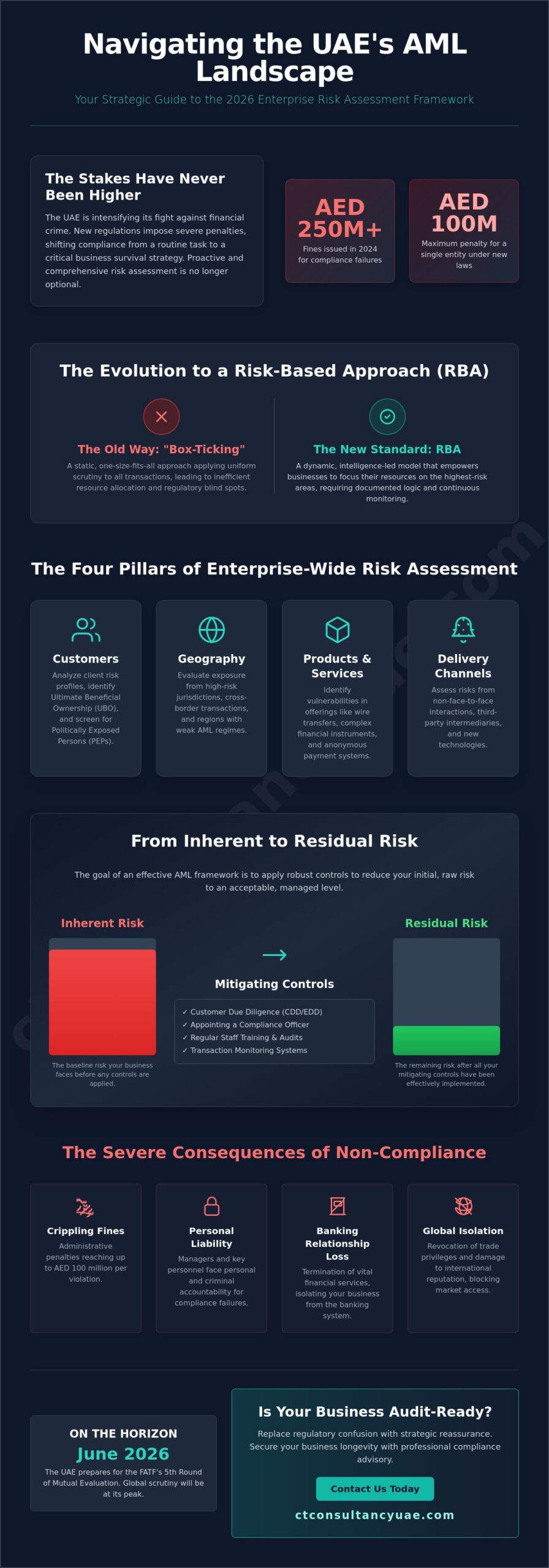
In 2024, the UAE Ministry of Economy issued over AED 250 million in fines against businesses for compliance failures; now, under Federal Decree-Law No. 10 of 2025, a single entity can face penalties reaching AED 100 million. Many executive leaders feel a justified sense of trepidation when reconciling the nuances of Inherent versus Residual risk, particularly as the personal liability of managers is now a statutory reality. Conducting a comprehensive AML risk assessment for business is no longer a mere administrative checkbox but a sophisticated diagnostic tool that secures the structural integrity of your enterprise. This strategic guide provides a clear framework to master the complexities of the UAE regulatory environment, ensuring your operations remain resilient as the nation prepares for the FATF fifth round of mutual evaluation in June 2026.
You’ll gain the clarity needed to transform the requirements of Cabinet Resolution No. 134 of 2025 into a frictionless, audit-ready compliance document. We will examine the precise methodologies for identifying institutional vulnerabilities and implementing the specialized controls required to protect your business from financial crime. By the end of this briefing, you’ll possess a structured roadmap that replaces regulatory confusion with strategic reassurance and long-term stability.
Key Takeaways
- Understand the Risk-Based Approach (RBA) as the mandatory standard for institutional compliance under the latest UAE federal decrees.
- Identify how to deconstruct your business into the four essential pillars of customers, geography, products, and delivery channels to eliminate regulatory blind spots.
- Learn the methodology for conducting a comprehensive AML risk assessment for business that balances inherent risks against the effectiveness of your internal mitigating controls.
- Establish a robust governance framework by appointing a qualified compliance officer and segmenting data for an audit-ready reporting structure.
- Discover how integrating sophisticated accounting and tax advisory services creates a unified defense against financial crime and administrative penalties.
The Strategic Significance of AML Risk Assessment for Business in the UAE
A comprehensive AML risk assessment for business serves as the foundational architecture for any resilient corporate governance framework in the UAE. Rather than viewing compliance as a static obligation, sophisticated enterprises recognize it as a systematic evaluation of their specific vulnerabilities to financial crime. Under the mandate of Federal Decree-Law No. 10 of 2025, which came into effect on October 14, 2025, every regulated entity must now demonstrate a profound understanding of how its operations might be exploited by illicit actors. This transition marks a definitive shift from historical "box-ticking" exercises toward a culture of active risk-understanding, where the depth of an organization’s assessment must mirror the complexity of its commercial activities.
The UAE national regulatory environment is currently anchored by the National Risk Assessment (NRA), a high-level diagnostic that identifies the sectors and activities most susceptible to money laundering and terrorist financing. For individual firms, the NRA acts as the primary baseline. A core component of understanding anti-money laundering entails recognizing that risk is dynamic; therefore, a private enterprise assessment must align with national priorities while addressing the unique nuances of its own client base and service delivery models. This alignment is essential for maintaining the structural integrity of the business within the broader financial ecosystem.
The Evolution of the Risk-Based Approach
The Risk-Based Approach (RBA) has emerged as the definitive national standard for compliance in 2026. Unlike traditional, rigid models that applied uniform scrutiny to every transaction, the RBA empowers businesses to allocate their specialized resources where the threat is demonstrably highest. This model prioritizes efficiency, allowing for simplified due diligence on low-risk profiles while mandating intensive investigation for high-risk counterparts. To satisfy national auditors, firms must provide documented logic that explains why specific risks were categorized as such. This level of precision is often achieved through high-level business advisory that bridges the gap between regulatory theory and operational reality.
Regulatory Consequences of Non-Compliance
The stakes for failing to maintain an audit-ready AML risk assessment for business have never been higher. Under Cabinet Resolution No. 134 of 2025, legal entities now face administrative fines that can reach AED 100 million for severe violations. Beyond these financial penalties, the personal and criminal liability of managers has become a focal point of enforcement; leaders can be held accountable if breaches occur due to a failure in their oversight duties. Non-compliance often leads to the termination of vital banking relationships and the revocation of international trade privileges, effectively isolating a firm from the global market. In the current landscape, meticulous compliance is a prerequisite for attaining elite business status and ensuring long-term institutional stability.
Deconstructing the Enterprise-Wide Risk Assessment Framework
A sophisticated AML risk assessment for business requires a granular deconstruction of the enterprise into four distinct pillars: customers, geography, products or services, and delivery channels. It’s essential to avoid the "one-size-fits-all" trap, as cookie-cutter assessments often fail to capture the unique operational nuances of specialized national entities. A professional assessment synthesizes quantitative metrics, such as transaction volumes and frequency, with qualitative insights regarding market reputation and business intent. This dual-layered data integration ensures that the resulting risk profile is both accurate and defensible under regulatory scrutiny.
Alignment with Ultimate Beneficial Ownership (UBO) filings is a foundational requirement in this process. Identifying the natural persons who ultimately own or control a legal entity is critical for verifying the legitimacy of complex corporate structures. Without this transparency, even the most rigorous assessment remains incomplete, leaving the business exposed to potential shell company exploitation. For organizations aiming to fortify their structural integrity, ensuring that UBO data is consistently updated and reconciled within the broader compliance framework is non-negotiable.
Identifying Inherent Risk Factors
Inherent risk represents the baseline exposure level existing before the application of any mitigating controls. When evaluating customer profiles, specific attention is directed toward Politically Exposed Persons (PEPs) and high-net-worth individuals, who inherently possess higher risk profiles due to their influence and wealth. Geographic risk is equally critical; it requires constant monitoring of international sanctions and national high-risk lists, similar to the frameworks discussed in the National Money Laundering Risk Assessment. Identifying these factors early allows a firm to understand its raw vulnerability before determining which specialized controls are necessary to manage it.
Assessing Product and Channel Vulnerabilities
Specific services and delivery channels often present unique challenges that can be exploited by illicit actors. Non-face-to-face delivery channels, while facilitating market expansion, introduce significant verification hurdles that require advanced digital onboarding protocols. Complex financial structures can also obscure the true nature of transactions, making them susceptible to misuse. This is where strategic oversight through CFO advisory services becomes invaluable. By providing high-level visibility into financial flows and identifying anomalies, such oversight acts as a critical second line of defense. If you’re concerned about hidden vulnerabilities in your current structure, a targeted internal audit can provide the necessary diagnostic clarity to secure your operations.
Navigating Inherent Risks and Mitigating Controls
The core of a sophisticated AML risk assessment for business lies in what we define as the "Compliance Balancing Act." This process involves weighing the inherent risks identified in your initial diagnostic against the actual effectiveness of your internal mitigating controls. It’s a common misconception that identifying a "high risk" customer or jurisdiction necessitates an immediate cessation of operations. On the contrary, the UAE’s risk-based framework allows for high-risk engagements provided they are met with proportionately high-intensity controls, such as Enhanced Due Diligence (EDD). Precision is key here. By balancing these factors, you maintain operational momentum without compromising your regulatory standing.
Professional accounting services serve as a primary internal control within this framework. Accurate financial record-keeping is not merely a matter of fiscal health; it’s a diagnostic tool that allows for the detection of anomalies and suspicious patterns before they escalate into regulatory breaches. The AML Compliance Officer acts as the guardian of this system, monitoring control performance to ensure that safeguards aren’t just theoretical. They ensure that Suspicious Transaction Reports (STRs) are filed via the goAML portal without delay. This typically means within 24 to 48 hours of forming a suspicion, as mandated by the Financial Intelligence Unit (FIU).
Evaluating Internal Control Effectiveness
To be deemed effective by national auditors, controls must be built on three pillars: governance, training, and transaction monitoring. Governance ensures clear accountability at the executive level, while regular training ensures staff can recognize evolving red flags. We’ve seen a decisive shift from manual oversight toward tech-enabled monitoring. These sophisticated systems flag high-risk activities with a level of precision that manual checks cannot match. Independent internal audit services are necessary to validate these controls, providing an objective assessment of whether your defense mechanisms are truly resilient.
Determining Residual Risk and Gaps
Residual risk is the exposure that remains after your controls have been successfully implemented. If your inherent risk is high but your controls are only moderately effective, the residual risk may still exceed your organization’s risk appetite. Identifying these gaps is a critical step that requires immediate remedial action. This process is deeply linked to broader financial management for SMEs. Clarity is vital here. By addressing these gaps, you ensure that your business isn’t just following the law but is actively protected from the financial and reputational fallout of criminal exploitation.
A Methodical Approach to Executing Your National AML Assessment
Executing a methodical AML risk assessment for business requires a structured sequence of actions that translate regulatory theory into operational reality. This process isn’t a one-time event; it’s a continuous cycle of identification and refinement. To ensure your framework meets the rigorous standards of UAE auditors, you must follow a five-step progression that prioritizes data integrity and executive accountability.
- Step 1: Establish the Governance Framework. Appoint a qualified AML Compliance Officer who possesses the authority and resources to oversee the program. This individual serves as the primary liaison with the Financial Intelligence Unit (FIU).
- Step 2: Collect and Segment Data. Gather intelligence across the four risk pillars: customers, geography, products, and delivery channels. This provides the raw material for your vulnerability analysis.
- Step 3: Analyze Likelihood and Impact. Evaluate specific risk scenarios to determine how likely they are to occur and the potential damage they could inflict on your institution.
- Step 4: Map Controls to Risks. Align your existing safeguards with the identified threats and objectively determine their actual effectiveness. This reveals whether your defenses are truly resilient.
- Step 5: Document Findings. Produce a formal Business Risk Assessment (BRA) report. This document acts as your primary evidence of compliance during regulatory inspections.
Data Collection and Segmentation
The accuracy of your assessment depends entirely on the quality of your underlying data. Robust bookkeeping and accounting services provide the necessary financial transparency to identify patterns of behavior that might otherwise remain obscured. By maintaining meticulous records, you can segment your customer base by risk level with high precision. Historical transaction data is essential here; it allows you to establish a baseline of "normal" activity, making it far easier to flag anomalies that require immediate investigation.
The Reporting and Review Cycle
A static assessment is a liability. National regulations require that your AML risk assessment for business undergoes regular updates, typically through annual reviews or whenever significant changes occur in your business model. It’s a mandatory requirement for the Board of Directors to review and approve the assessment, ensuring that compliance is woven into the highest levels of corporate governance. Furthermore, all customer due diligence and transaction records must be retained for a minimum of five years after the relationship ends. If you require a partner to formalize these complex procedures, our specialized AML compliance advisory can help you establish an audit-ready documentation trail.
Securing Business Longevity through Professional Compliance Advisory
Integrating AML with National Tax Compliance
There is a profound synergy between anti-money laundering protocols and national tax requirements that executive decision-makers must leverage. Our tax consultancy services reveal that the data captured for corporate tax reporting provides a foundational layer of financial intelligence for your AML risk profile. Accurate transaction mapping, which is essential for VAT registration services, serves as a dual-purpose diagnostic tool for identifying the anomalies that trigger suspicious activity reports. A holistic approach to regulatory compliance, managed through a single, expert advisory partner, ensures that no data silos exist to obscure potential vulnerabilities. This unified strategy minimizes administrative friction and ensures that your fiscal and compliance obligations are met with equal precision.
The CTC Tax & Accounting Advantage: Precision and Reliability
Navigating the nuances of region-specific regulatory updates requires a partner who possesses both global perspective and local mastery. We reject the one-size-fits-all approach that characterizes generic compliance software, opting instead for customized and individualized solutions that reflect the specific risk appetite of your firm. Our decades of international experience allow CTC Tax & Accounting to act as a primary friction-remover in the business world, guiding you through the complexities of the UAE’s evolving legal landscape with professional calm. We prioritize long-term stability over quick fixes, ensuring that your AML risk assessment for business remains resilient as national standards continue to intensify. To secure your institutional legacy and ensure an audit-ready posture, we invite you to consult with our experts for a comprehensive AML review that fortifies your enterprise against the high stakes of financial crime.
Fortifying Your Enterprise for the 2026 Regulatory Horizon
Navigating the UAE’s evolving compliance landscape requires a decisive shift from reactive measures to a proactive, governance-led strategy. By mastering the AML risk assessment for business, you don’t just avoid administrative penalties; you build a resilient foundation for sustainable international growth. This strategic framework ensures that every customer relationship and delivery channel is scrutinized through the lens of precision, allowing your leadership team to focus on core commercial objectives with absolute confidence and strategic reassurance.
Since our founding in 2015, CTC Tax & Accounting has combined decades of international expertise with deep local regulatory mastery to support SMEs and large enterprises. Our comprehensive approach integrates ESR, UBO, and AML requirements into a single, frictionless compliance solution designed to remove operational barriers. Secure your business with a professional AML Risk Assessment from CTC Tax & Accounting and ensure your organization remains a benchmark of integrity in the global market. We look forward to helping you transform regulatory complexity into a distinct competitive advantage and a legacy of institutional stability.
Frequently Asked Questions
What is the difference between a Business Risk Assessment and a Customer Risk Assessment?
A Business Risk Assessment evaluates the institutional vulnerabilities of the entire enterprise, while a Customer Risk Assessment focuses on the specific threat profile of an individual client. The former sets the threshold for the organization’s overall risk appetite. Conversely, the latter determines the level of due diligence required for a particular onboarding process based on that client’s unique attributes.
How often should my business update its AML risk assessment in the UAE?
Regulated entities in the UAE should update their AML risk assessment for business at least annually or immediately following any significant operational shift. Such shifts include entering a new geographic market, launching a novel product line, or experiencing a change in beneficial ownership. Maintaining a current assessment is a statutory requirement under Cabinet Resolution No. 134 of 2025.
Which businesses are classified as DNFBPs and required to conduct AML assessments?
Can a small business perform its own AML risk assessment without external help?
While small businesses can technically perform their own assessments, the complexity of Federal Decree-Law No. 10 of 2025 often makes external advisory a more secure path. Errors in identifying inherent risks can lead to catastrophic administrative penalties. Utilizing specialized compliance consultants ensures that your documentation remains audit-ready and reflects the latest regulatory nuances in the region.
What are the most common inherent risks faced by businesses in the national market?
Common inherent risks in the UAE market include high-volume cash transactions and the presence of complex, multi-layered corporate structures. Businesses often face exposure through geographic proximity to jurisdictions with higher risk profiles or by engaging with Politically Exposed Persons (PEPs). Identifying these factors is the first step in establishing a resilient aml risk assessment for business.
How does the National Risk Assessment (NRA) affect my company’s individual assessment?
The National Risk Assessment (NRA) serves as the primary benchmark that informs the risk categories within your company’s individual framework. Regulators expect your enterprise assessment to reflect the high-level threats identified at the national level. If the NRA flags a specific sector as high-risk, your individual assessment must demonstrate how you manage that specific exposure with precision.
What happens if a regulator finds gaps in my AML risk assessment during an audit?
If a regulator identifies gaps during an audit, your business may face severe administrative fines reaching up to AED 100 million. Managers can also be held personally and criminally liable if the breach resulted from a failure in their oversight duties. Beyond financial loss, the resulting reputational damage often leads to the termination of essential banking and international trade relationships.
Is there a specific template required for AML risk assessments in the UAE?
There is no single, mandatory template provided by UAE authorities, but the assessment must logically cover the four essential risk pillars. These pillars include customers, geography, products or services, and delivery channels. While the structure is flexible, the documentation must provide a clear audit trail that justifies how your internal controls mitigate your identified inherent risks.