With the UAE attracting a record $30.7 billion in foreign direct investment as of early 2026, the regulatory spotlight on corporate transparency has reached an unprecedented intensity. You understand that maintaining a valid trade license now depends on your capacity to accurately disclose ultimate control, yet the prospect of facing an AED 100,000 fine for a minor oversight often creates unnecessary operational anxiety. Understanding exactly how to file UBO in the UAE is no longer a peripheral task; it’s a core requirement for any entity seeking long-term stability in this high-stakes environment where the distinction between direct and indirect ownership determines your standing with the Ministry of Economy.
Our definitive guide empowers you to master these complexities by providing a sophisticated roadmap through the latest compliance mandates under Cabinet Resolution No. 109 of 2023. You’ll gain a comprehensive understanding of the three-tier identification test and the specific submission protocols for various jurisdictions, ensuring your filing is both accurate and timely. We’ll also detail the essential maintenance requirements and the 15-day window for updates, offering you the peace of mind that comes from a meticulously managed regulatory profile.
Key Takeaways
- Identify the natural persons exercising definitive control through a specialized three-tier test, moving beyond simple corporate ownership to ensure complete transparency.
- Master the technical requirements of how to file UBO in the UAE by navigating the specific digital portals mandated for mainland entities and diverse free zone jurisdictions.
- Establish robust internal registers to track ownership changes, ensuring all modifications are reported within the strictly enforced 15-day regulatory window.
- Protect your commercial standing by aligning your UBO disclosures with broader Anti-Money Laundering (AML) and “Know Your Customer” (KYC) protocols.
- Implement a proactive compliance strategy to mitigate the risk of administrative fines reaching AED 100,000 and safeguard your trade license from potential suspension.
Table of Contents
Understanding Ultimate Beneficial Ownership (UBO) Regulations in the UAE
The concept of beneficial ownership serves as the cornerstone of modern corporate transparency. At its essence, an Ultimate Beneficial Owner is the natural person who ultimately owns or controls a legal entity, even if their name doesn’t appear on the primary trade license. Understanding Ultimate Beneficial Ownership requires looking past corporate layers to identify the individual who exerts at least 25% ownership or significant influence over management decisions. It’s a process of identifying the human element behind the corporate veil.
While the regulatory journey began with Cabinet Decision No. 58 of 2020, the 2026 compliance landscape is governed by the more recent Cabinet Resolution No. 109 of 2023. This updated framework reflects a more rigorous approach to enforcement and data accuracy. Many entrepreneurs still rely on outdated 2021 guidelines, yet the current environment demands a deeper understanding of how to file UBO in UAE to avoid the progressive penalty structures now in place. This mandate isn’t merely an administrative hurdle; it’s a strategic necessity for the UAE’s integration into the global financial system.
The Strategic Importance of Transparency
The UAE’s commitment to corporate clarity has been instrumental in its successful navigation of international standards, particularly following its exit from the FATF ‘grey list’. By mandating UBO reporting, the government strengthens the national Anti-Money Laundering and Counter-Terrorism Financing (AML/CFT) framework. This transparency protects your business from being inadvertently utilized in illicit financial flows, which is critical for maintaining corporate bank accounts. Our business advisory services emphasize that compliance is a shield for your growth, ensuring that your enterprise remains attractive to global investors who prioritize low-risk, transparent jurisdictions.
Entities Subject to UBO Requirements
Most legal persons registered in the UAE must comply with these regulations, whether they operate as mainland establishments or within commercial free zones. However, specific exemptions apply to companies wholly owned by federal or local governments. It’s also vital to recognize that companies in the process of liquidation aren’t exempt; they must maintain their UBO records for a specific period after dissolution. For those operating in specialized financial hubs like the DIFC or ADGM, separate but equivalent regulations apply. Knowing exactly how to file UBO in UAE for your specific jurisdiction is the first step toward securing your corporate standing. Failure to identify the correct natural person, especially when dealing with complex holding structures, remains a primary cause of non-compliance in 2026.
Identifying the Ultimate Beneficial Owner: The Three-Tier Test
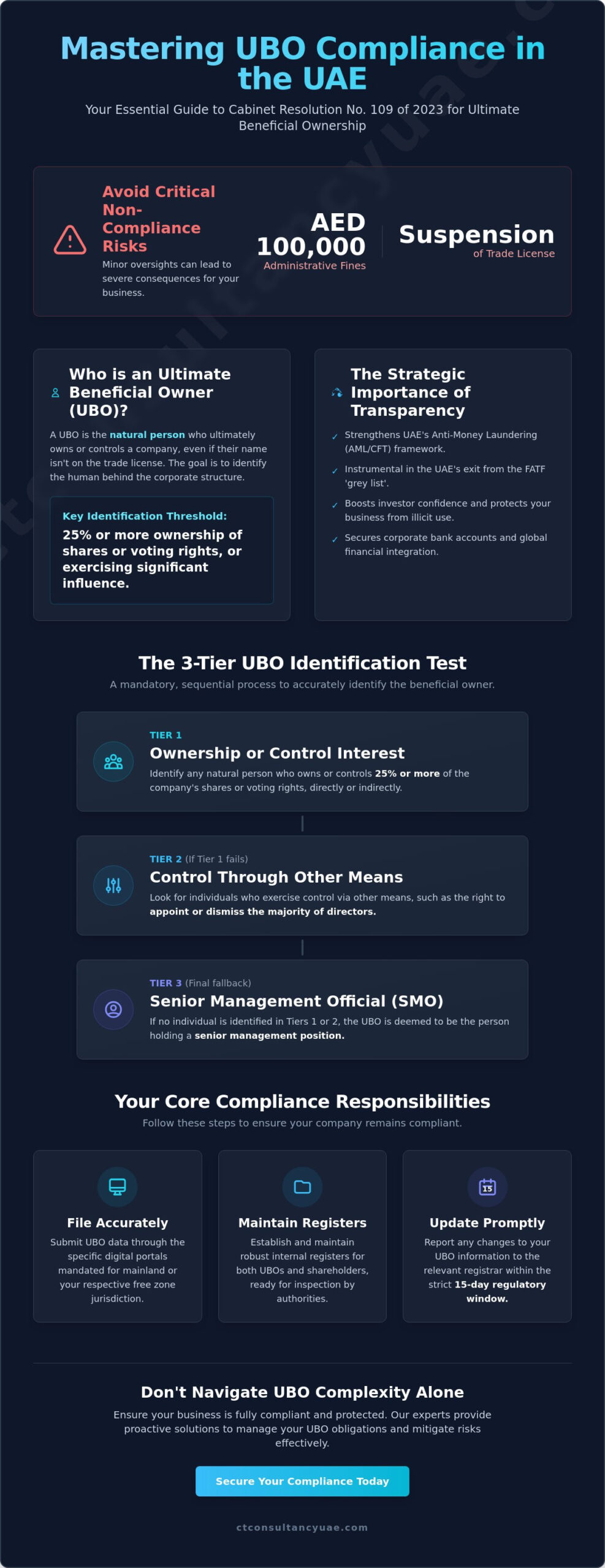
The process of identifying a beneficial owner is a structured, sequential inquiry that moves beyond surface-level entries on a trade license. It requires a rigorous application of the three-tier test mandated by the UAE’s UBO Regulations. This isn’t a matter of convenience; it’s a legal obligation to exhaust each tier in order before moving to the next. Accurate identification is the most critical phase of learning how to file UBO in UAE, as errors here often lead to the significant administrative fines mentioned previously.
- Tier 1: Ownership or Control Interest. The primary filter identifies any natural person who ultimately owns or controls 25% or more of the company’s shares or voting rights.
- Tier 2: Control Through Other Means. If Tier 1 fails to identify a person, you must look for individuals exercising control through alternative mechanisms, such as the right to appoint or dismiss the majority of directors.
- Tier 3: Senior Management Official (SMO). As a final fallback, when no individual meets the first two criteria, the natural person holding the highest executive management position is designated as the UBO.
Direct vs. Indirect Ownership
Determining ownership is rarely straightforward in complex multi-layered corporate structures. You must apply the “look-through” principle, tracing ownership through holding companies, trusts, or intermediaries until a natural person is identified. Simply listing a corporate shareholder as the UBO is a frequent compliance failure. Nominee arrangements also require careful scrutiny; the individual on whose behalf the nominee acts is typically the true beneficial owner. Documenting this chain of control with verified certificates of incumbency or share registers is essential for a successful submission. If your structure involves international entities, our business advisory team can help clarify these sophisticated ownership chains.
The Senior Management Official (SMO) Criteria
The designation of a Senior Management Official is often misunderstood as a shortcut, yet it’s strictly a fallback position. You can only register an SMO if no natural person meets the 25% threshold or exercises control through other means. Once registered, the SMO assumes significant responsibility for the accuracy of the UBO file. In many jurisdictions, this individual must be a resident natural person who is reachable by the authorities. It’s not enough to name a figurehead; the SMO must hold genuine executive authority. Understanding how to file UBO in UAE using this fallback requires a clear paper trail showing that the Tier 1 and Tier 2 searches were exhausted without result.
Filing Channels: Navigating Ministry and Free Zone Portals
While the criteria for identification remain consistent across the Emirates, the actual mechanics of how to file UBO in UAE depend entirely on where your trade license was issued. Mainland establishments and free zone entities operate under different digital infrastructures, each requiring specific authentication protocols and data formats. This jurisdictional fragmentation means that a one-size-fits-all approach is impossible, requiring instead a bespoke alignment with the specific portal managed by your licensing authority. The ultimate objective of these disparate channels is to populate the National Economic Register (NER), providing the federal government with a unified view of corporate control to support national AML/CFT efforts.
Most licensing authorities have now successfully transitioned to fully digital interfaces, eliminating the need for manual submissions. However, the level of detail required can vary significantly between a mainland Department of Economy and Tourism (DET) filing and a specialized free zone declaration. Understanding these nuances is vital for executive decision-makers who must ensure that their corporate data remains synchronized across all active licenses. Failure to navigate these portals correctly often results in rejected applications, which can trigger the progressive penalty system outlined in Cabinet Decision No. 132 of 2023.
Mainland Filing via the Ministry of Economy
For companies registered on the UAE mainland, the Department of Economy and Tourism (DET) in the respective emirate serves as the primary gateway. You’ll typically access the Ministry of Economy e-services platform to complete your declaration, a process that requires verified copies of shareholder registers and valid identification for every natural person identified in your three-tier search. Learn more about our business advisory services to understand how we streamline these technical submissions for diverse corporate structures. It’s essential to remember that initial filings must be finalized within 60 days of receiving your trade license to maintain your entity’s active status.
Free Zone Authorities and Independent Registrars
Free zone entities face a distinct set of requirements, as each authority maintains its own independent registrar and digital interface. For instance, DMCC companies utilize the DMCC Member Portal, while JAFZA entities process their filings through the Dubai Trade portal. It’s particularly important to recognize that financial hubs like the Abu Dhabi Global Market (ADGM) and Dubai International Financial Centre (DIFC) operate under their own independent beneficial ownership regulations. If your enterprise holds multiple licenses across different jurisdictions, you must perform separate filings for each authority. There’s currently no automated cross-authority filing system, so maintaining accuracy across these disparate portals is a manual but critical responsibility for your compliance team. When you’re determining how to file UBO in UAE for a free zone entity, always verify the specific declaration format required by that particular authority’s registrar.
A Step-by-Step Guide to Filing and Maintaining Your UBO Register
Achieving compliance requires a meticulous sequence of actions that begins long before you log into a portal. To master how to file UBO in UAE, you must first secure high-resolution, verified copies of identification documents for every individual identified in your three-tier analysis. This includes current passports, national identity cards, and proof of residential addresses. Once these documents are gathered, the information must be codified into your company’s internal registers, which serve as the primary source of truth for any future regulatory inspections. This documentation phase is where most errors occur, often because businesses fail to look through corporate layers to the natural persons at the end of the chain.
Compiling the Internal UBO Register
Your internal Real Beneficial Owner Register must contain specific, non-negotiable data points for each UBO, including their full legal name, nationality, date and place of birth, and residential address. It’s equally important to record the date on which the individual became a beneficial owner and the nature of their control, whether it’s through share ownership or voting rights. These records must be stored at the company’s registered office and remain readily accessible for inspection by the Ministry of Economy or your specific licensing authority. The internal register is a living document subject to regulatory audit at any time.
Managing Changes and Updates
The most common compliance failure in the 2026 landscape is the neglect of ongoing maintenance. Any modification to your UBO structure, whether it’s a minor change in a director’s residential address or a significant share transfer, triggers a mandatory update requirement. You have a strictly enforced 15-day window to update your internal registers and notify the relevant Registrar through their digital portal. This rapid turnaround requires a proactive monitoring system to ensure that management changes don’t inadvertently lead to administrative violations. Utilizing professional accounting services to maintain your registers provides the necessary oversight to capture these changes in real-time. When you’re considering how to file UBO in UAE, remember that the initial submission is merely the starting point of a continuous transparency cycle. Annual review protocols should be implemented to verify data accuracy, ensuring that your corporate records remain perfectly aligned with your actual ownership structure.
Mitigating Risk: Professional AML and UBO Compliance Solutions
Managing regulatory risk requires a strategic shift from reactive filing to proactive governance. While the procedural steps of how to file UBO in UAE are now digitized, the margin for error has narrowed significantly under the 2026 enforcement regime. For executive teams, the challenge lies not just in the initial submission but in maintaining a flawless record that withstands the scrutiny of the Ministry of Economy and various licensing authorities. We position our expertise as a primary friction-remover, ensuring that your corporate structure remains transparent and fully aligned with national security objectives.
The Cost of Non-Compliance
Cabinet Decision No. 132 of 2023 outlines a progressive penalty structure that penalizes both procedural negligence and reporting delays. An initial violation, such as failing to maintain an accurate internal register or missing the filing deadline, can result in administrative fines of up to AED 50,000. Repeated offenses or a persistent failure to rectify data can see these penalties escalate to AED 100,000. Beyond these immediate financial costs, non-compliant entities face the severe risk of trade license suspension and inclusion on federal blacklists, which effectively halts all commercial operations. This loss of corporate credibility often triggers a domino effect, leading to the immediate termination of corporate banking facilities. Maintaining alignment across all regulatory fronts is essential, much like the precision required for VAT Registration Services in the UAE.
Customized Compliance Frameworks
Complex holding companies and multi-national structures require a more sophisticated approach than a standard administrative checklist. We provide tailored UBO identification strategies that untangle intricate cross-border ownership chains, ensuring that every natural person with definitive control is correctly documented and verified. Our end-to-end management solutions cover the entire lifecycle of compliance, from the initial 60-day filing window to the strictly monitored 15-day update period for any structural changes. By integrating Strategic CFO services for regulatory oversight, your business gains a dedicated partner capable of navigating the specific digital portals of mainland and free zone authorities alike. This meticulous planning removes the operational burden of how to file UBO in UAE, allowing you to focus on strategic growth while we safeguard your long-term stability. CTC Tax & Accounting stands as your elite consultant, offering the precision and regional expertise necessary to thrive in the UAE’s high-stakes regulatory landscape.
Secure Your Corporate Future with Proactive Compliance
The UAE’s regulatory landscape in 2026 demands more than just basic administrative awareness; it requires a persistent commitment to absolute transparency. By mastering the three-tier identification test and maintaining a rigorous 15-day update cycle for all structural changes, you effectively insulate your enterprise from the severe financial and operational risks associated with non-disclosure. Understanding exactly how to file UBO in UAE is the fundamental step toward building a resilient corporate foundation that satisfies both local authorities and global financial standards. It’s no longer enough to simply submit a form; you must maintain a living record of control that reflects the true human element behind your corporate structure.
Since 2015, we’ve served as a strategic advisor to UAE SMEs, leveraging our specialized AML and UBO compliance team to navigate these technical complexities with precision. Ensure your business remains compliant with professional UBO filing services and benefit from our decades of international regulatory experience. Your journey toward frictionless growth in the Emirates is well within reach when backed by meticulous planning and the reassurance of expert oversight. We look forward to supporting your long-term stability in this dynamic market.
Frequently Asked Questions
Is UBO filing mandatory for every business in the UAE?
UBO filing is mandatory for nearly all legal entities registered within the UAE, including mainland establishments and commercial free zone companies. The only exceptions are companies wholly owned by the federal or local government and their subsidiaries. While financial free zones like the DIFC and ADGM have their own independent beneficial ownership regulations, they still require equivalent disclosures to maintain corporate transparency.
What is the deadline for filing UBO in the UAE in 2026?
New companies must complete their initial filing within 60 days of receiving their trade license. For established entities, the focus in 2026 is on the strictly enforced 15-day update window. Any modification to your beneficial ownership data or management structure must be reported to the relevant licensing authority within 15 days of the change to avoid administrative penalties.
What happens if I cannot identify a 25% owner for my company?
If no natural person meets the 25% ownership threshold, you must apply the second and third tiers of the identification test in sequence. This involves identifying individuals who exercise control through other means, such as voting rights or the authority to appoint directors. If no such individual is identified, you must register the natural person holding the senior management official position as the beneficial owner.
How often do I need to update my UBO information with the authorities?
You must update your UBO information every time a change occurs in your ownership or management structure. This isn’t an annual requirement but a real-time obligation triggered by events like share transfers, passport renewals, or changes in residential addresses. Mastering how to file UBO in UAE requires maintaining a proactive monitoring system to ensure these updates reach the registrar within the mandatory 15-day period.
Are Free Zone companies exempt from the Ministry of Economy UBO filing?
Free zone companies aren’t exempt, but they generally submit their declarations to their specific free zone authority rather than the mainland Ministry of Economy portal. Each jurisdiction, such as the DMCC, JAFZA, or RAKEZ, manages its own registrar and digital interface. These authorities eventually synchronize their data with the National Economic Register, ensuring federal oversight of all legal entities operating within the UAE.
What documents are required to prove Ultimate Beneficial Ownership?
Proving ownership requires a verified dossier including valid passport copies, national identity cards, and proof of residential addresses for all identified natural persons. You must also maintain an internal register of partners or shareholders and a register of beneficial owners at your registered office. For complex structures, you’ll need to provide share certificates or articles of association that trace the chain of control back to the ultimate natural persons.
Can a legal entity be an Ultimate Beneficial Owner?
A legal entity can never be registered as an Ultimate Beneficial Owner because the law specifically defines a UBO as a natural person. You’re required to “look through” corporate shareholders, including holding companies and trusts, until you identify the human beings who ultimately exercise control. Listing another company as the UBO is a significant compliance error that often leads to the rejection of your filing and potential fines.
What are the administrative fines for failing to maintain a UBO register?
Administrative fines for failing to maintain or file an accurate UBO register start at AED 50,000 for an initial violation. If the non-compliance is repeated or the entity fails to rectify the error, the fine can escalate to AED 100,000. Understanding how to file UBO in UAE correctly is essential for avoiding these costs and the more severe risks of trade license suspension or being blacklisted by the Ministry of Economy.