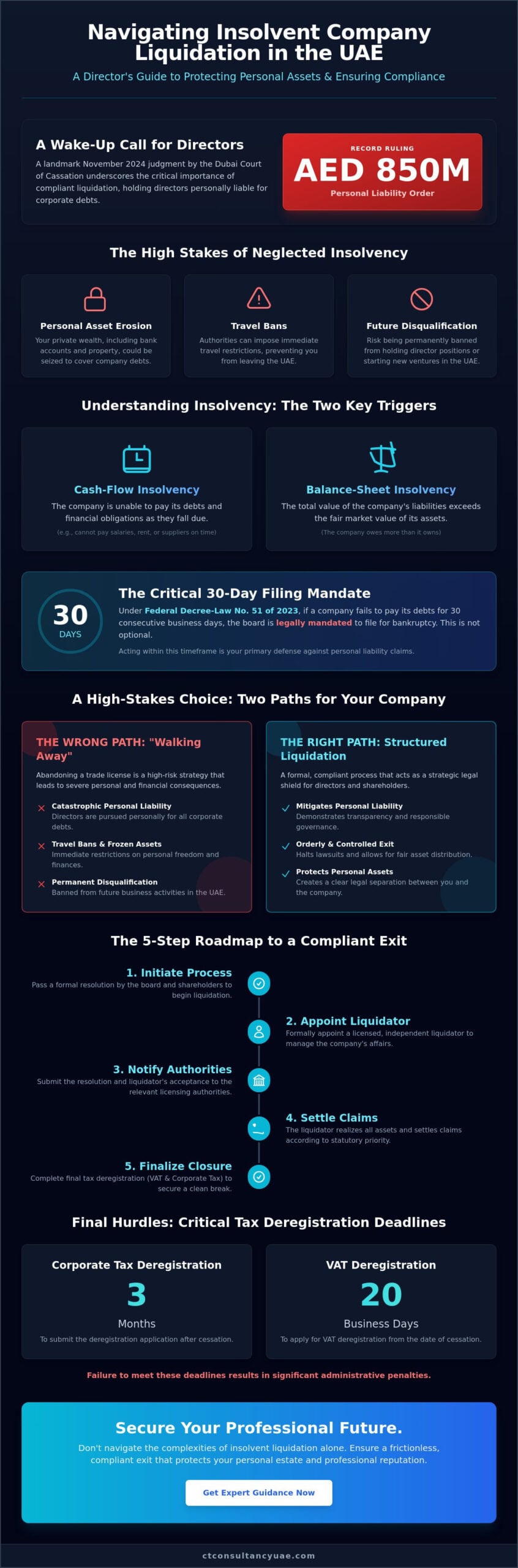
In November 2024, the Dubai Court of Cassation issued a landmark judgment ordering directors and shareholders to pay AED 850 million in personal liability, marking the largest such ruling in UAE history. This unprecedented case underscores the heightened scrutiny that executive leadership faces under the current regulatory landscape. You’re likely concerned that financial distress could lead to personal legal repercussions, travel bans, or the erosion of your private assets. We understand that the intersection of Federal Decree-Law No. 51 of 2023 and the Commercial Companies Law often feels like a labyrinth of conflicting obligations that jeopardize your professional standing.
This article serves as a definitive strategic resource for managing an insolvent company liquidation in the UAE with precision and professional foresight. We’ll provide a clear framework to help you navigate the mandatory three-month corporate tax deregistration window and the twenty-day VAT cessation deadline while mitigating the risk of severe administrative penalties. By following this structured approach, you can ensure a frictionless exit that prioritizes both legal compliance and the long-term protection of your personal estate.
Key Takeaways
- Distinguish between cash-flow and balance-sheet insolvency to accurately assess your firm’s financial position and select the optimal path for a structured wind-down.
- Navigate the critical 30-day filing rule to maintain compliance with UAE Bankruptcy Law and effectively mitigate the risk of personal liability for corporate debts.
- Execute a compliant insolvent company liquidation in the UAE by following a precise roadmap that includes the formal appointment of a licensed liquidator and strategic notification to the licensing authorities.
- Protect your personal assets and reputation by identifying “wrongful trading” triggers and ensuring all executive actions align with current regulatory expectations.
- Finalize your business closure with a clean break through timely VAT and Corporate Tax deregistration, avoiding the accumulation of significant administrative penalties.
Table of Contents
Understanding Insolvent Company Liquidation in the UAE
Insolvent liquidation represents the formal legal procedure for dissolving a corporate entity that possesses insufficient assets or liquidity to satisfy its outstanding debts. Unlike a voluntary winding-up of a solvent business, an insolvent company liquidation in the UAE requires meticulous adherence to statutory priorities to ensure all stakeholders are treated equitably under the law. A fundamental component of this process is Understanding Insolvency in its two primary forms: cash-flow insolvency, where a company can’t pay debts as they fall due, and balance-sheet insolvency, where total liabilities outweigh the fair market value of all corporate assets. Recognizing these triggers early is essential for directors who wish to avoid the severe repercussions of wrongful trading.
Simply “walking away” or abandoning a trade license is a high-risk strategy that often leads to catastrophic personal consequences. In the UAE, regulatory bodies and creditors can pursue directors personally if a company is left in a state of neglected insolvency. This can result in travel bans, the freezing of personal bank accounts, and a permanent disqualification from future entrepreneurial ventures. Engaging in a formal, structured liquidation serves as a strategic legal shield; it provides an orderly exit that demonstrates transparency and protects the personal assets of shareholders and executives from future litigation.
The Legal Basis for Insolvent Closure
The regulatory environment is primarily governed by the UAE Commercial Companies Law (Federal Decree-Law No. 32 of 2021), which outlines the standard requirements for winding up operations. However, for entities facing terminal financial distress, the Federal Decree-Law No. 51 of 2023 on Financial Restructuring and Bankruptcy provides the critical framework. This law mandates that a company must initiate insolvency proceedings if it remains unable to pay its debts for 30 consecutive business days. Failing to act within this window can expose leadership to claims of mismanagement, making it vital to seek professional business advisory support early in the process.
Key Stakeholders in the Liquidation Process
The board of directors and shareholders hold the primary responsibility for initiating the liquidation by passing a formal resolution. Once the process begins, a licensed liquidator takes control of the company’s affairs, acting as an independent party to realize assets and settle claims. Creditors are classified into specific tiers; secured creditors and government obligations, such as VAT or Corporate Tax, typically receive priority. A liquidator’s role is to ensure these hierarchies are respected, providing a clear and documented path toward the final cancellation of the trade license and all associated regulatory obligations.
Navigating the Legal Framework: Companies Law vs. Bankruptcy Law
Determining the precise moment when a standard winding-up transitions into a formal insolvency proceeding is a critical fiduciary responsibility for UAE directors. While the Commercial Companies Law (Federal Decree-Law No. 32 of 2021) provides the baseline for closing a business, an insolvent company liquidation in the UAE is increasingly governed by the rigorous standards of the Bankruptcy Law (Federal Decree-Law No. 51 of 2023). The primary distinction lies in the company’s ability to satisfy its creditors. Once a business enters the territory of terminal debt, the legal focus shifts from a simple administrative de-registration to a court-sanctioned process designed to protect the integrity of the market.
The “30-day rule” stands as a pivotal regulatory threshold. According to the current legal framework, if a company ceases to honor its financial obligations as they fall due for 30 consecutive business days, the board is legally mandated to file for bankruptcy. This isn’t a suggestion but a statutory requirement. Proactive engagement with CFO Advisory Services can help leadership identify these liquidity triggers before they manifest as legal breaches. Adhering to this timeline is the most effective way to secure a moratorium on creditor actions. This stay of proceedings halts lawsuits and prevents the uncoordinated seizure of assets, allowing for a structured distribution overseen by a court-appointed trustee.
Control of the entity naturally shifts during this transition. Once the insolvency process is triggered, the authority of the board is superseded by the liquidator or trustee. This individual assumes the role of an objective arbiter, ensuring that the liquidation proceeds in accordance with the law rather than the preferences of individual shareholders. This transfer of power is a safeguard; it removes the burden of debt management from the directors and places it in the hands of a licensed professional specialized in asset realization.
Voluntary Liquidation for Distressed Entities
Insolvent companies may still pursue a voluntary path if they maintain a level of creditor consensus. This requires a Special Resolution from the shareholders and the formal appointment of an independent liquidator. The success of this route depends heavily on the liquidator’s ability to demonstrate that the process will be transparent and that no creditor will be unfairly prejudiced. If a majority of creditors object, the process often pivots toward a more rigid court-supervised environment.
Compulsory Liquidation and Court-Ordered Winding Up
Compulsory liquidation occurs when a court intervenes, often following a petition by a creditor who hasn’t been paid. In these high-stakes scenarios, the UAE courts take an active role in overseeing the winding up of heavily indebted firms. While the loss of control is total, court supervision provides directors with a layer of legal protection. If the court determines that the failure was due to genuine market conditions rather than fraud or gross mismanagement, it can help shield individuals from the most severe personal liabilities.
The Procedural Roadmap for Liquidating an Insolvent Entity
Executing an insolvent company liquidation in the UAE requires a disciplined adherence to a multi-stage statutory sequence. The process initiates with a formal board resolution and a subsequent general assembly meeting where shareholders pass a Special Resolution to dissolve the entity. During this session, a licensed liquidator must be officially appointed to take custody of the company’s assets and records. This resolution is then submitted to the relevant Licensing Authority, such as the Department of Economy and Tourism (DET) for mainland firms or the specific Free Zone authority, to obtain a preliminary liquidation certificate.
Once the preliminary certificate is issued, the company enters a mandatory public notice period. For mainland entities, this involves publishing a liquidation notice in two local Arabic newspapers, triggering a 45-day statutory window for creditors to submit their claims. Simultaneously, the Federal Tax Authority (FTA) must be notified to begin the tax deregistration process. This stage is critical; failing to manage these notifications can lead to significant delays and administrative penalties. Systematic asset realization follows, where the liquidator converts corporate holdings into liquidity to settle preferential debts, such as employee wages and government dues, in the order prescribed by UAE law.
The Critical Role of the Liquidator
In the UAE, the liquidator acts as an independent fiduciary and must be registered on the official list of licensed liquidators. Their primary duty involves a forensic review of the company’s financial history to identify instances of “wrongful trading” or “fraudulent preference,” where certain creditors may have been prioritized over others. They are responsible for preparing a comprehensive statement of affairs, often requiring precise accounting services to ensure all entries are beyond reproach. The process culminates in a final liquidation report and a distribution account, which provides a transparent record of how all terminal liabilities were addressed.
Managing Regulatory Clearances
Achieving a “clean break” necessitates obtaining clearances from various government bodies to ensure no residual obligations remain. This includes cancelling all employee visas through the Ministry of Human Resources and Emiratisation (MOHRE) and securing “no-objection” certificates from utility providers and telecommunications companies. Corporate bank accounts must be systematically closed, a task that often proves complex for insolvent firms due to outstanding facilities. While mainland entities follow the DET’s specific roadmap, Free Zone entities must adhere to the unique deregistration protocols of their respective jurisdictions, such as the DIFC or ADGM, which may have distinct insolvency regimes.
The concept of “piercing the corporate veil” remains one of the most significant legal risks for leadership during an insolvent company liquidation in the UAE. While a Limited Liability Company (LLC) is designed to separate corporate debts from personal assets, this protection is contingent upon the board’s strict adherence to fiduciary duties. If a court determines that directors acted with gross negligence, engaged in fraudulent activity, or deliberately ignored the 30-day insolvency notification window, the legal shield may be set aside. This exposure makes the transition from active operations to a formal wind-down a high-stakes period that requires absolute transparency.
Avoiding “wrongful trading” is the most effective way to maintain executive protection. This occurs when management continues to incur new liabilities despite knowing, or being in a position where they should have known, that the company had no reasonable prospect of avoiding insolvent liquidation. Continuing to operate under these conditions is often viewed as a breach of duty to creditors. Maintaining a comprehensive paper trail that documents the board’s decision-making process is essential. Meticulous financial records serve as a primary defense, proving that the business failure resulted from genuine market volatility rather than personal misconduct.
Potential Legal Pitfalls for Management
UAE law distinguishes clearly between a legitimate business failure and criminal negligence. Directors must be particularly cautious regarding “preference payments,” where specific creditors are settled shortly before the insolvency date at the expense of others. A liquidator has the statutory authority to “claw back” these funds to ensure an equitable distribution among all claimants. Utilizing professional CFO advisory services during the pre-liquidation phase ensures that all payments are prioritized according to the legal hierarchy, effectively neutralizing the risk of future litigation or claims of mismanagement.
Safeguarding Personal Assets
The LLC structure remains a robust vehicle for risk management when supported by proactive governance. Engaging in high-level business advisory allows leadership to identify terminal risks before they manifest as irrevocable legal liabilities. Internal audits play a vital role here, validating the company’s insolvency position and providing an objective basis for the decision to liquidate. By demonstrating that the board acted in the best interests of the creditor body as a whole, executives can successfully insulate their private estates and reputations from corporate fallout. If you are concerned about your current liability profile, our team provides expert business advisory services to help you navigate these complexities with confidence.
Finalizing the Exit: Tax Deregistration and Compliance
The formal dissolution of a corporate entity remains incomplete until the Federal Tax Authority (FTA) issues its definitive clearance. For those managing an insolvent company liquidation in the UAE, the tax deregistration phase is frequently the most arduous administrative hurdle. It’s not enough to simply stop trading; you must apply for VAT deregistration within 20 business days of the cessation of business activities. Delaying this step triggers immediate administrative penalties that can further drain the company’s remaining assets. Simultaneously, Corporate Tax obligations under Federal Decree-Law No. 47 of 2022 require a final tax return and a formal deregistration application within three months of the entity’s dissolution. Failure to adhere to this timeline results in a penalty of AED 1,000 per month, which can escalate to a maximum of AED 10,000.
Obtaining the Tax Clearance Certificate is the ultimate prerequisite for the final cancellation of the trade license by the Department of Economy and Tourism or the relevant Free Zone authority. This document proves that the company has no outstanding tax liabilities or unfiled returns. CTC Tax & Accounting provides the technical expertise required to navigate the EmaraTax portal and manage the submission of final accounts. We ensure that the liquidator’s final report aligns perfectly with tax filings, creating a frictionless path to the final deregistration certificate. This level of precision is essential for directors who wish to avoid personal liability for unpaid corporate taxes.
VAT and Corporate Tax Finality
The liquidator’s appointment must be formally communicated to the FTA to ensure that all communication channels are redirected and that the authority recognizes the liquidator as the legal representative. This phase frequently triggers a tax audit, as the authority seeks to verify that all historical filings are accurate before the entity ceases to exist. During an insolvent company liquidation in the UAE, the liquidator must account for any unpaid tax as a preferential debt. Leveraging specialized tax services during this window is vital for identifying potential discrepancies that could lead to significant fines, ensuring that the winding-up period isn’t delayed by unresolved compliance issues.
Post-Liquidation Obligations
Closing the corporate chapter doesn’t immediately end all responsibilities for the board or the shareholders. UAE law mandates that dissolved companies maintain their financial and tax records for a statutory period of five to seven years, even after the trade license is cancelled. Additionally, the Ultimate Beneficial Ownership (UBO) register must be updated to reflect the company’s final status and the conclusion of the liquidator’s mandate. For international shareholders and corporate groups, these steps are essential for preventing residual legal issues in other jurisdictions. By prioritizing these final compliance markers, you can achieve a truly frictionless exit that preserves the integrity of your global professional standing.
Securing Your Professional Future through Strategic Compliance
Managing the terminal phase of a business requires more than just administrative closure; it demands a rigorous commitment to the UAE’s evolving legal standards. Success hinges on recognizing the 30-day insolvency threshold and executing a meticulous tax deregistration process that satisfies the Federal Tax Authority’s stringent requirements. It’s essential to recognize that a transparent insolvent company liquidation in the UAE is your most robust defense against personal liability and long-term reputational damage. By prioritizing these statutory markers, you ensure that the corporate wind-down remains a professional transition rather than a legal crisis.
Our firm brings decades of international financial expertise to every engagement, offering specialized knowledge of UAE Bankruptcy and Tax laws to facilitate a seamless transition. We provide end-to-end management of regulatory clearances, ensuring that every statutory obligation is met with precision and professional integrity. Consult our experts for a confidential insolvency and liquidation strategy to ensure your exit is handled with the highest level of corporate governance. While closing a business is a complex undertaking, a well-executed strategy provides the foundation for your next successful venture.
Frequently Asked Questions
Can a company be liquidated if it has outstanding debts in the UAE?
Yes, a company with outstanding debts can and must be liquidated through a formal insolvent winding-up process. This procedure ensures that remaining assets are distributed to creditors in the legal order of priority prescribed by the UAE Bankruptcy Law. Simply abandoning an indebted entity is prohibited and leads to severe personal legal risks, including travel bans and asset freezes, for the management team.
What is the difference between voluntary and compulsory liquidation for an insolvent firm?
Voluntary liquidation is initiated by a shareholder resolution when the owners recognize the entity can’t meet its obligations. In contrast, compulsory liquidation is a court-ordered process often triggered by a petition from an unpaid creditor. Both paths require a licensed liquidator, but the court-ordered route involves higher levels of judicial oversight and significantly less control for the original directors.
Are directors personally liable for the debts of an insolvent LLC in the UAE?
Directors of a Limited Liability Company are typically protected from corporate debts, but this shield isn’t absolute. Under the UAE Bankruptcy Law, personal liability can be imposed if the court finds evidence of gross mismanagement, fraud, or a failure to file for insolvency within the 30-day statutory window. Maintaining precise financial records is the primary way to demonstrate that the business failure resulted from genuine market conditions.
How long does the insolvent company liquidation process typically take?
The timeline for an insolvent company liquidation in the UAE generally spans between six and twelve months. This duration accounts for the mandatory 45-day creditor notice period required for mainland firms and the time needed to obtain clearances from various government departments. Complex cases involving significant asset realization or multiple creditor disputes can extend this timeframe beyond the standard window.
What happens to employee visas during the liquidation of an insolvent company?
All employee visas must be cancelled as part of the formal winding-up sequence to obtain clearance from the Ministry of Human Resources and Emiratisation. Under UAE law, outstanding employee wages and end-of-service benefits are classified as preferential debts. These are prioritized during the distribution of realized assets, ensuring that staff claims are addressed before funds are allocated to unsecured creditors.
Is a final audit mandatory for company liquidation in the UAE?
A final audit report prepared by a UAE-registered auditor is a mandatory requirement for nearly all licensing authorities. This report provides a verified account of the company’s final financial position and ensures that all assets have been correctly realized and distributed. It’s a critical document for obtaining the final liquidation certificate and ensuring a clean regulatory exit from the market.
Can a company stop paying VAT once it enters the liquidation process?
Tax obligations don’t cease simply because a company enters liquidation. You must continue to file VAT returns and fulfill corporate tax requirements until the Federal Tax Authority approves your formal deregistration. Failing to apply for VAT deregistration within 20 business days of stopping operations can lead to substantial administrative fines that further diminish the remaining liquidation estate.
What is the role of the UAE courts in an insolvent liquidation?
The UAE courts serve as the ultimate supervisor in cases of terminal insolvency to ensure the process remains equitable. They have the authority to appoint insolvency trustees, stay creditor lawsuits, and ratify the final distribution of assets. Their involvement provides a structured environment that prevents uncoordinated asset seizures and ensures that the insolvent company liquidation in the UAE follows the priority rankings established by law.